Charlott-Maria Schürmann and Dante's Pearl OLD – Their Shared Story, an Interview
Interview with Charlott-Maria Schürmann about Dante’s Pearl: “I wish every rider could experience that feeling at least once”
 from Jan Tönjes
 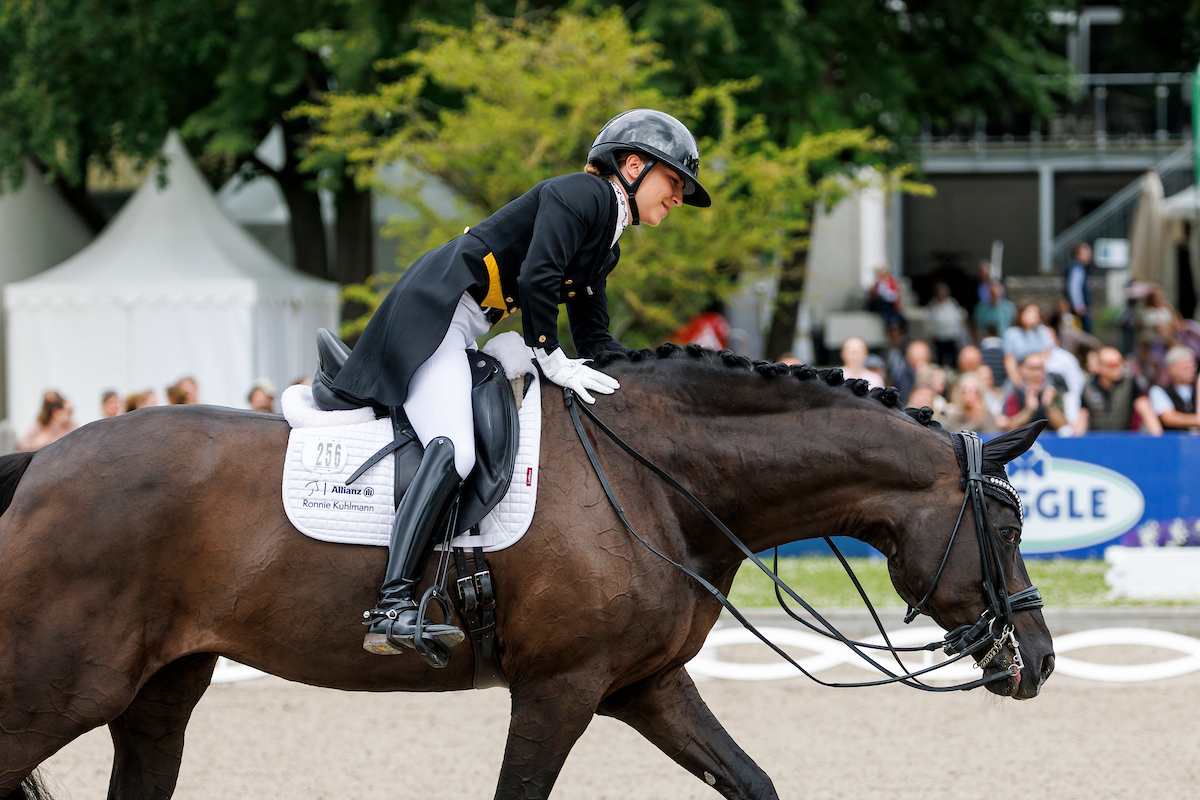 Dante's Pearl OLD and Charlott-Maria Schürmann at the German Championships in Balve in 2026. Photo: sportfotos-lafrentz.de
 Charlott-Maria Schürmann and Dante’s Pearl arrived at the German Championships as “the ones to watch” and went home with a medal. A few days later, they were named to the national team. We wanted to know more. About “Pearlie,” her personal life, and whether everything has always gone as smoothly as one might assume with such a dream career. That’s why we sat down for an in-depth conversation with Charlott-Maria Schürmann at the German Championships:
EQUI PAGES: You find yourself in a somewhat different situation at these German Championships—how does that feel?
Charlott-Maria Schürmann: It feels a little surreal; I don’t think it’s really sunk in yet. If someone had told me six months ago that I’d finish third in the first round of the senior competition, I would have said: “Yeah, OK, I’ll take that—let’s go for it.” But yeah, it’s cool, absolutely—it really is a dream. This horse is just extraordinary.
Please tell us your story.
I got her when she was seven from a friend of mine, who had bought her at the P.S.I. when she was five. Then she had her for a year in Switzerland, but then she had to cut back a bit on riding for professional reasons and said, “I have a horse here, but I think she needs to go to you—will you take her?” I hadn’t even looked into what kind of horse she had bought at the P.S.I. Then she came off the trailer and I thought to myself: Wow, I’ve never seen such a beautiful horse.
On top of that, Dante’s Pearl OLD isn’t just good—it’s also beautiful. Does she realize that, even just a little?
Yes, she does like to be the center of attention. She really is a wonderful horse—in every way, from her temperament to how she interacts with other horses. She’s just very smart in every respect.
At age seven—what was her level of education at that point?
We started with flying changes, and then we worked on the rest. We had to get used to each other first; she’s got a lot of spirit, is alert and full of energy, and really didn’t have much competition experience. Once we’d gotten a little more comfortable with each other after a few months, we rode a small M-level dressage test. It always went pretty well, but she was still easily distracted by her surroundings and nervous. Basically, at seven years old, we just built up a bit of routine, but didn’t ride her that much. We grew closer little by little, and then she competed in a Young Horse S-level competition. Then I gave up for a while because she was always one step ahead of me.
But that’s kind of what you want, isn’t it? When they’re so perceptive and say, “I’ll show you—I already know what you want.”
She’s just so smart, and nothing comes hard to her. But really, the hardest part was the waiting and the stillness. I can take my time with this: that was what she had to learn. She never had to learn how to trot or how to gallop, but she simply had to learn to wait.
On the other hand, that’s obviously a drive that doesn’t exactly get in the way of success in international sports…
That’s working in my favor now.
When did you start training for the 3* level—meaning passage, piaffe, flying changes, and so on?
She competed in the Nürnberger Burg-Pokal at age nine; in the final at the Festhalle, she was a bit on the fast side but still did well. Then she immediately moved on to the Louisdor Prize qualifiers at age ten and qualified in Hagen back in April. We had actually been practicing all summer (the previous year) because she had also qualified early for the final of the Nürnberger Burg-Pokal. That’s why I didn’t put so much pressure on her as a nine-year-old all summer, and I just incorporated piaffe and passages a bit in a playful way. And then things moved quickly, from December to April, and she managed it quite well.
When you say “we,” who are you training with?
I train with Santiago Damil and Monica Theodorescu.
Has there ever been a moment when you thought, “Here’s a point she doesn’t understand”?
No, not really. I mean, it certainly took her a while to learn the classic piaffe: in the Young Horse Grand Prix and Louisdor competitions, it was still a bit of a struggle, a bit of a fumbling process. I just went with whatever came naturally to her at the time. This jump we’re doing now took a little while, but she picked it up really well.
So now you have a beautiful horse—one that competed in the final of the Nuremberg Burg-Pokal and performed well in the Louisdor qualifiers—which means you’re already among the top in Germany in the young horse category. Then came the next step into “adult competition”—how did that go?
In the Louisdor Final, she had to compete in the Grand Prix right at the end. The goal was always for her to do that at age ten. And she did it. We went to Guxhagen, competed in a national competition there, and she won that one too.
I knew from day one that this was a special horse. I’m so happy for her because she belongs where she is now. That everything has worked out so well, that we found each other, that she has the strength and has gained that confidence. She loves this sport; she loves trotting out there, and it gets dead quiet. When she starts trotting and you hear that “wow,” she picks up on that too. She seems to grow even bigger then; she’s proud of herself.
What does it feel like during the test? Go over the short side one more time. You know, turn away, diagonal, extended trot…
Basically, it’s a pure delight from start to finish. This horse is simply a gift. Whether she’s standing still, picking up speed, or executing those incredible half-passes—there’s nothing more beautiful.
I wish every rider could experience that feeling at least once.
What is a typical day like for Dante’s Pearl at home?
I always stick to short training sessions, so she’s ridden four days a week, and then she gets plenty of time outside, lots of physical therapy, and grazing. There’s a lot involved.
So, she’s a princess and is treated accordingly?
Yes, absolutely, and she deserves it.
An international tournament, and suddenly the scores are no longer in the lower 70 percent range—which, internationally speaking, is quite an achievement in itself; in many other countries, that would be enough to earn a spot on the national team. How did that feel?
Well, our first international tournament was in Lier back in March, and it didn’t go so well.
… environmentally conscious
Yeah, we were really on edge. It kind of took me back two years, to my first Young Horse S class, where I also gave up. I thought to myself, “Oh my God, here we go again.” That’s how we started. But in the end, it turned out to be a good thing, because it took all the pressure off. Maybe I put that pressure on myself because I want to present the horse in the best possible light—she’s just so special.
Learning from mistakes
But anyway, it went so badly that afterward we said, “OK, it can’t get any worse than this.” And we realized where we stood and that she needed to get back into the swing of things. And so did I, because I hadn’t ridden a Grand Prix in a long time either. (Charlott-Maria Schürmann hadn’t ridden a Grand Prix in over two years).
Monica (Theodorescu) always says that Grand Prix riding is hard. Well, Grand Prix riding is even harder, and she’s absolutely right about that.
Then came the tournament in Tolbert.
Exactly, we drove to Tolbert because my goal was to ride at Hagen. The mare loves Hagen—she’s from Hagen, and it’s right around the corner; it’s always a dream tournament. Then we thought: It’s our first time away from home, so I think we should go out and compete. That turned out to be a good decision. The Grand Prix went much, much better. The warm-up already felt sensational. In the competition itself, there were a lot of careless mistakes. But in the Special, not much went wrong, and we were able to win.
Then, ten days later, straight to Hagen. That short interval did her good—it kept her in tournament mode a bit, and me too.
OK, but then, what happened after those two wins in Hagen?
Monica and I made a plan to head to Balve. I needed to get back into a routine, and I needed another stop between Hagen and Balve. That left only Munich or Hamburg. And since I really love the Munich tournament—even though it’s super far away—I said I’d love to go to Munich.
You were initially entered in the CDI3*.
Yeah, because I called it that too, quite naively. I didn’t expect it all to escalate like that. And then Moni said, “Yeah, well, I think we’ll change that. I’ll just ride 5*.” It was really cool—amazing. My best Grand Prix so far. Except for the last line—that was totally my fault. Then I said, “OK, thank God—better that it happened here than in Balve.”
What did we learn from Munich?
So we really learn from our mistakes. We get to know each other better during the exam. Where does she need more help? Where can I really give her some space and celebrate her a little? The Special in Munich was truly sensational—to come out of it with 77 percent! Tears were streaming down my face; my nerves were shot: I thought, my God, that I’d ever achieve this is just crazy.
When a beautiful black horse scores 77 percent in an international Grand Prix Special, it’s usually the usual suspects with fat checkbooks or millions to throw around… The mare is owned by a Swiss family—originally from Germany but now based in Switzerland.
The horse is not for sale. The horse will continue to call Artland home until 2028 (laughs)—Artland in Germany, that is.
And how does the owner feel about that?
She’s a good friend. She’s absolutely thrilled, and we’re in close contact—the whole family is celebrating with her. I gave her her first pony. My mom drove him to Switzerland in a trailer back then. So we’ve really known each other since we were little kids, which is why this is such a great friendship. Pearl has brought us even closer together, and now we’re all living the dream together.
Does she have any quirks? Is there anything she likes or really doesn’t like?
What she doesn’t really like—because she’s so beautiful, everyone always goes to her. When we have a lot of visitors or a lot of students come over: “Where’s Dantes Pearl?” She only likes that a couple of times, and then she’s like, “Nah, not again, don’t pet my face,” so she’s a bit of a diva. She loves the attention, but at some point, enough is enough. And she always needs her window; she looks out day and night. I have cameras everywhere, so I always see it.
In the paddock—should you roll around right away or soak up some sun first?
She’s not wild at all—she’s calm and easygoing. She’s not the kind of horse that would suddenly freak out. She’s very thoughtful in what she does. She’s not clumsy. You know, there are horses that bump into everything or trip over things. She would never do that.
Were there any reactions from international riders? From international dealers, obviously—that’s how I understood it. But what about riders?
Everyone has known us as a couple for a long time, and everyone also knows that it wasn’t always easy—that we really had to work our way up to this. And my riding friends are so sweet; they’re all genuinely happy for us that we’ve made it this far. Take Fabi (Fabienne Müller-Lütkemeier), for example. I rode with Fabi at the European Championships in Ermelo in 2009, and she was the first one to hug me with tears in her eyes. She said she’s so happy for me because everyone knows how hard we work and how much heart and soul we put into it.
Thank you!
The interview was conducted by Jan Tönjes
We’ve summarized more information about the Shooting Stars in the article “10 Things About Dante’s Pearl OLD and Charlott-Maria Schürmann.”
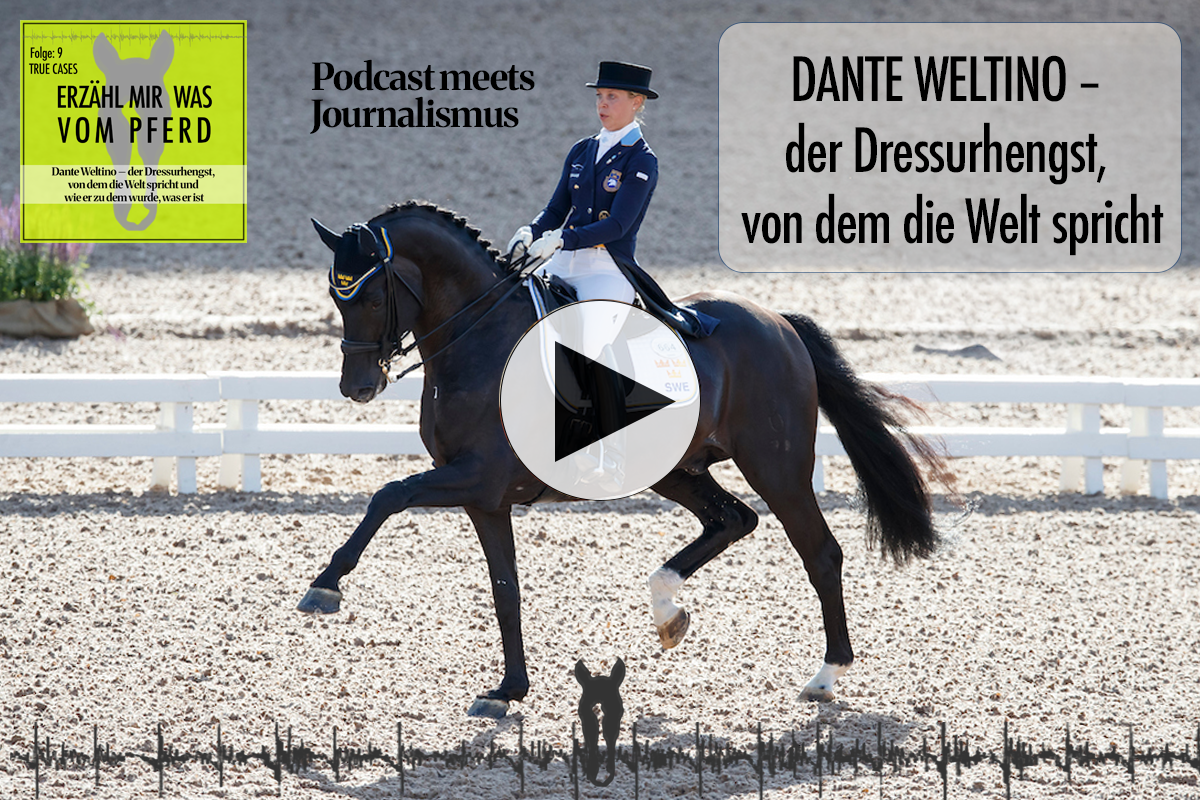
We’ve also written a feature on Dante’s Pearl’s father, Dante Weltino.
Ähnliche Beiträge