Olympic Team – Equestrian Teams and the Commitments Athletes Make, from Tournament Planning to Doping Tests Conducted by NADA
“On the team”—what does that mean in equestrian sports for the horse and the rider?
 from Jan Tönjes
 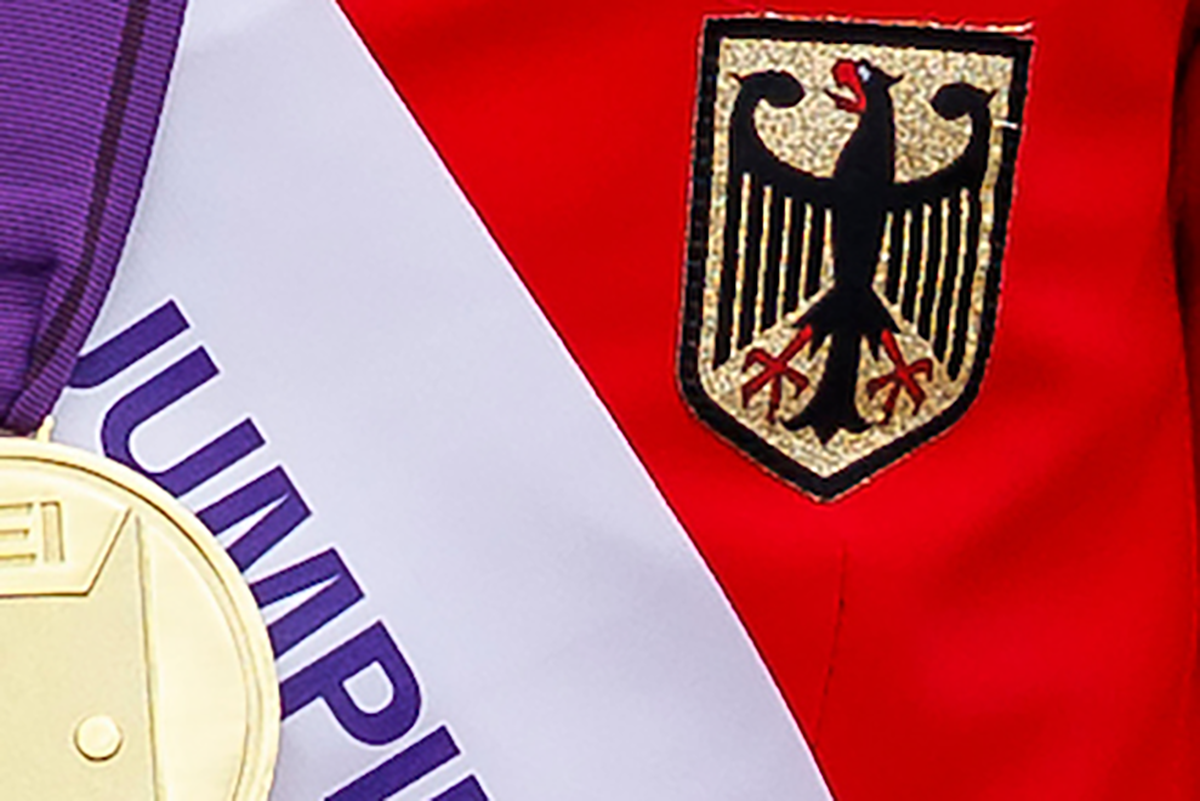 The federal eagle on the left chest—the emblem of the German national equestrian teams. sportfotos-lafrentz.de
 “Olympic squad”—this term is used in the three Olympic equestrian disciplines. The show jumping squad includes (as of September 2, 2026, in alphabetical order) the following riders:
- Christian Ahlmann/Untouched LB
- Daniel Deußer/Otello de Guldenboom
- MarcusEhning/Coolio
- SophieHinners/Iron Dames Singclair
- André Thieme/DSP Chakaria
- RichardVogel/United Touch S
In the elite roster, riders and horses are listed as pairs.
“On the team”—and now what?
What does being selected for a team actually mean, specifically? What responsibilities does this entail for riders? What about the horses? What are the benefits of being selected for a squad? First things first: It’s a long road to the “Olymp”—that is, the Olympic squad.
From Pony Riders in the State Squad to the Olympic Squad
Since the competitive sports reform by the German Olympic Sports Confederation (DOSB), the German squad system has followed a uniform, nationwide structure. It is the same for all three Olympic disciplines—dressage, show jumping, and eventing. At the top is the Olympic squad (OK), followed by the prospective squad (PK), and below that are the junior squads NK1 and NK2 at the national level. A clear and permeable national team structure—one that makes it possible to identify and support talented riders early on, regardless of their origin or background (including financial circumstances)—is a key factor in qualifying for federal government funding.
A Mixed Picture for State Teams
The Westphalian Equestrian Federation, one of the state federations with the largest membership under the umbrella of the German Equestrian Federation (FN)/Pferdesport Deutschland, serves as a good example of how this is organized in practice: Below the national level, there are state squads LK1 through LK4, categorized by age groups from U16 to U21. In Westphalia, for example, selection for the LK1 squad is based on winning a medal at a Westphalian Junior Championship or successfully competing in a national junior championship—provided that the rider-horse pair remains in the same age group during the year of selection. Those who distinguish themselves there can eventually make their way through NK2 and NK1 to the Prospect Squad or, theoretically, even the Olympic Squad. Talent identification begins early at the state level. The path to the top is a long one.
Who Will Be on the Show Jumping Team in 2026
The respective discipline-specific committee of the German Olympic Equestrian Committee (DOKR) decides on the composition of the teams. In mid-December 2025, the DOKR Show Jumping Committee announced a new Olympic squad with an eye toward the World Championships in Aachen. At that time, eight months before the World Championships in Aachen, the squad was composed as follows:
Olympic Team for Ski Jumping, December 2025
- Richard Vogel and United Touch S (2025 European Champion)
- Christian Kukuk with Checker 47, Just Be Gentle, and Cepano Baloubet
- Marcus Ehning and Coolio
- Gerrit Nieberg with Pingpong van de Lentamel
- Sophie Hinners with several “Iron Dames” horses
- Christian Ahlmann with Dourkhan Hero Z
- Daniel Deußer with Otello de Guldenboom
Based on sales of Cepano Baloubet and Ping Pong As is customary, the roster was Updated throughout the season. For example, André Thieme and DSP Chakaria, who, after a long injury layoff, returned to competition with victories in the U.S. and in Hamburg had returned, back to the top squad.
The Framework Agreement: Signing in Exchange for Compliance with Instructions
Being selected for a national team does not automatically qualify a rider to compete in Nations Cups or championships. To that end, the DOKR requires all squad riders to sign a framework agreement—also known in the sports world as an “athlete agreement”—anew each year. In addition, an arbitration agreement must be signed. These documents govern the relationship between the rider, the national coach, and the DOKR Show Jumping Committee. As the German Equestrian Federation emphasizes, these are not a creation of the federation itself, but rather a requirement of the federal government and the DOSB: Without such an agreement, no federal funding is provided to the national governing body.
Planning Certainty for National Team Coach
Among other things, this pertains to the obligation to follow instructions from the national team coach and the DOKR Show Jumping Committee regarding annual planning: Anyone listed on the Olympic squad must—depending on their individual agreement with the national coach—make themselves available for Nations Cup competitions and coordinate the tournament schedule for the horse registered on the squad with the federation. In other words: A squad horse is no longer a purely private sports partner whose annual schedule is decided solely by the owner and the rider, but rather part of national team planning geared toward championships. World Championships and the Olympic Games in even-numbered years, and European Championships in odd-numbered years.
The Long-Running Dispute Over the Signature: Ahlmann and Deußer
The case of Christian Ahlmann and Daniel Deußer shows that this commitment is not merely a formality. In 2017, both decided not to sign the athlete and arbitration agreements, thereby opting out of the national team—even though they met the athletic criteria for the (then) A-team. One of the points of contention was a clause regarding unannounced training visits by the federation. As a result, in 2018, both had to watch both the CHIO Aachen and the World Championships in Tryon as spectators, even though they were both bronze medalists at the 2016 Rio Olympics. It wasn’t until 2019, after a two-year hiatus, that they once again met the formal criteria and signed the agreement. Those who do not sign the agreement forfeit not only the opportunity to compete for Germany in the Nations Cup and championships but also all associated funding benefits.
Anti-Doping Regulations: Signing the NADA Rules and Regulations
In addition to the framework agreement , national team athletes also agree by
signing to abide by
the FN’s Anti-Doping Regulations (ADO), which are based on the rules and
regulations
of the National Anti-Doping Agency (NADA) and the World Anti-Doping Code.
In practice, this means: reporting requirements regarding whereabouts and availability for the Registered Testing Pool—that is, being available at all times for training and competition testing. All athletes on the Olympic team are automatically part of the Registered Testing Pool.
Always Under Surveillance
This sounds plausible, but it significantly restricts quality of life. For example, elite athletes must constantly report their whereabouts. Anyone who fails to do so and is not found where they said they would be during an unannounced doping test—even if it’s just at a neighbor’s barbecue—runs the risk of being listed as having tested positive for doping. Even turning off one’s cell phone—for example, during a session with a physical therapist or a doctor’s visit—must be reported in advance.
Doping tests
Doping tests—whether scheduled or unannounced—aren’t everyone’s cup of tea. Not so much because they have something to hide, but simply because privacy is virtually nonexistent during the testing process. To ensure that the urine actually comes from the athlete, officials from the National Anti-Doping Agency (NADA) monitor the sample collection with their own eyes. This is called a “visual check” and is intended to ensure that no doubt can arise. Discretion? Not a chance (more info on the The Urine Sample Procedure Here)! It’s more than just “peeing into a cup.” During a doping test, pants must be pulled down below the knees and clothing on the upper body must be rolled up to the chest. This ensures that no foreign urine—which an athlete might try to smuggle into the cup—can be hidden.
Urinating with a Trusted Person
Anyone who wishes to do so may have a trusted person present during the procedure. For minors, this is actually mandatory. This means you have two pairs of eyes focused on your midsection—the center of the action. Yes, sports demand sacrifices—more than just sweat and time.
By the way: The sample must be 90 milliliters of urine. Athletes can choose which heat-sealed cup to use for the sample. NADA testing personnel provide several options to choose from. The same applies to the sample collection kit. Even the process of transferring the urine into the vials that are sent to the lab—the A and B samples—must also be carried out by the athlete. This ensures that the sample is not contaminated by substances on the hands of the NADA testing personnel, for example.
Sports Jurisdiction
Anyone considered a national team athlete remains in the testing pool for a specified period and must regularly report to NADA where they will be and when. This is because everyone listed on the national team is subject to sports jurisdiction. It was precisely this strict jurisdiction of sports tribunals—rather than proceeding before a regular court—that led Ahlmann and Deußer to reject the arbitration agreement for years: Both had already been embroiled in years-long legal disputes with the FN in the past following positive doping tests on their horses that occurred long ago.
“Strict Liability” Principle
What else is in the agreement: The strict reversal of the burden of proof under the “strict liability” principle applies. This means that proof of intent is not required at all for a sanction to be imposed. The detection of a prohibited substance in the sample is sufficient. The athlete must then be able to explain how the substance entered his or her body.
And what about the horses?
Animal welfare has become a key concept in equestrian sports. It’s not just elite riders who are committed to the ““Ethical Principles of the Horse Lover” which the FN adopted in 1995. In doing so, they commit to the principle that the welfare of the horse takes precedence over the needs of humans. This is supplemented at the international level by the ““FEI Code of Conduct for the Welfare of the Horse”, to which all competitors—not just squad riders—are subject upon submitting their entry for an FEI tournament. The Code of Conduct explicitly states that the horse’s welfare takes precedence over everything else at all times. Violations of this code—ranging from inappropriate handling to incidents in the stable that violate animal welfare regulations—can be sanctioned in Germany under the Competition Rules (LPO), for example, by revoking the annual competition license.
NADA Also Conducts Doping Tests on Horses
Since 2011,
NADA has been conducting doping tests on horses
on behalf of the German Olympic Equestrian Committee (DOKR) and the German Equestrian Federation e.V. (FN)—now known as Pferdesport Deutschland—on behalf ofthe German Olympic EquestrianCommittee (DOKR) and the German Equestrian Federation (FN). These tests involve screening squad horses during training. In 2016, the FN’s Sports Advisory Board clearly defined the procedures for conducting doping tests, from sample collection to handling the analysis results.
Ambassadors of Sport: Is There a Code of Conduct?
Following discussions about alcohol abuse and assaults within the equestrian community, the FN Presidential Commission proposed a nationwide code of ethics for tournament officials—judges, etc.—that would, among other things, govern their conduct and public image.
In Westphalia—where, as with so many things in Germany, many aspects of equestrian sports are regulated at the federal state level, that is, by the state equestrian associations—there is such a code of conduct. It describes the role of setting a good example and the responsibilities at equestrian events, even outside of official working hours. In addition to appropriate attire, it even defines “substance use” and how to handle it: “I will generally refrain from consuming alcohol until my duties as a judge or examiner at the equestrian event are complete, and I will not use tobacco products while judging. While judging, my full concentration is focused on the athletic performances. I will not use my phone while judging.”
And what about the riders? Especially those on the national team? The ones with the federal eagle on their left chest? Their public image—including their social media presence, how they conduct interviews, and how they represent the sport at championships—is an area that has become increasingly important.
The umbrella organization does not disclose the exact wording, as the national team agreement is an internal document between Pferdesport Deutschland and the national team athlete. At the same time, the federation emphasizes that the agreement clearly stipulates that riders must view themselves as representatives of equestrian sports: “In principle, however, the national team agreement includes not only athletic requirements but also provisions regarding the rights and obligations of national team members. These include expectations regarding responsible conduct in public as well as fulfilling the role model responsibilities associated with membership in a national squad. National team athletes commit to observing the applicable rules and regulations of organized sports, as well as the federation’s values and principles, and to ensuring that their behavior does not harm the interests of equestrian sports. Assessments are always made on a case-by-case basis.”
Financial Benefits: Sports Aid as the Second Pillar
Athlete support is the responsibility of the federal government, specifically the State Ministry of Sports and Volunteer Work.Anyone listed on the national team roster has access to funding from the German Sports Aid Foundation—though there is no legal entitlement to it. Since the 2020 reform of athlete funding by the Federal Ministry of the Interior, athletes on the “Top Team” (Olympic and prospective squads) have received a monthly base grant of 800 euros, while those holding a sports funding position receive 400 euros. In addition, there are contributions toward retirement savings, which are intended to help bridge the gap caused by the dual demands of elite sports and starting a career. Athletes on the “Top Team Future”—that is, the prospective squad—receive funding at graduated, lower rates.
Critics—such as those from the AfD parliamentary group in the Bundestag—point out, however, that many elite athletes who are not part of the Olympic squad still rely on part-time jobs with the police, customs, or the Bundeswehr to afford to compete at the highest level.
The Bundeswehr—An Employer in the Saddle
This is where a third pillar of the German support system comes into play: the Bundeswehr’s sports support groups. A prerequisite for applying to become a sports soldier is membership in a national or state squad; The Bundeswehr itself emphasizes that it is not a sponsor but an employer—the young riders are regular soldiers with a clear mission: to achieve sporting success and represent Germany.
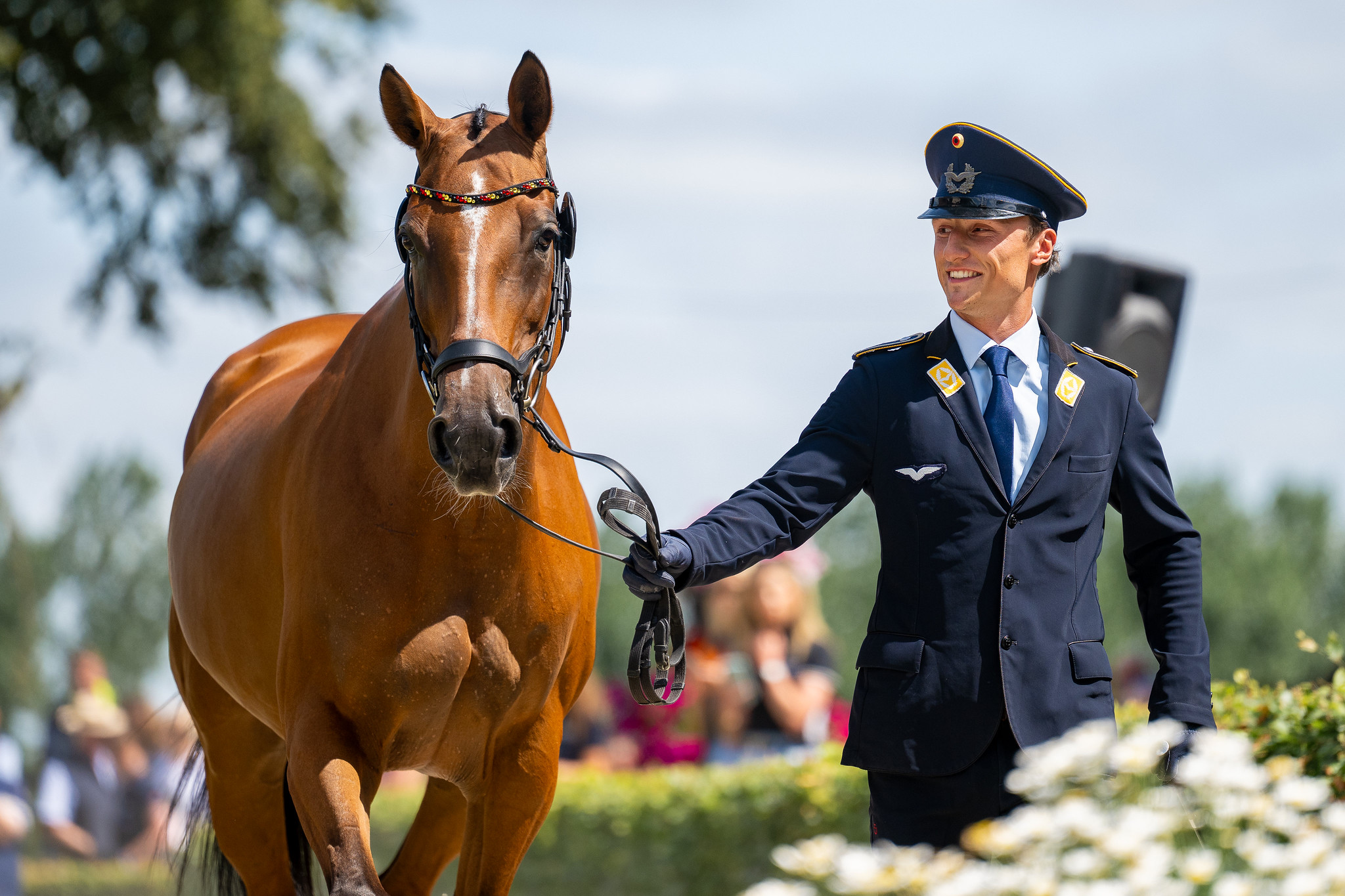
Warendorf, home to the DOKR’s Federal Equestrian Training Center, has traditionally been where the largest contingent of equestrian sports soldiers trains. One example was longtime Olympic champion Julia Krajewski, who competed in the blue uniform of the sports company. Those who are accepted first undergo basic military training before the focus shifts to sports—contracts are initially signed for eleven months and extended depending on athletic progress. Currently, for example, Calvin Böckmann is competing in the blue uniform and with a crisp salute.
Preventive Health Care: Mandatory Appointments for Elite Athlete Status
When it comes to health, too, the daily routine of a national team rider differs significantly from that of an amateur. National team athletes are required to undergo regular sports medicine examinations at DOSB-licensed examination centers—the so-called annual general examinations or fitness examinations. These include, among other things, a basic internal medicine and orthopedic examination. During the first sports medicine health examination, an ultrasound examination of the heart (echocardiography) is also performed, which is then typically repeated every two years. The goal is to detect undiagnosed cardiovascular diseases at an early stage. Depending on the squad level, the range of care provided becomes more comprehensive: While athletes in lower-level youth squads are often treated only for acute symptoms, elite athletes at the Olympic training centers receive comprehensive physical therapy and sports medicine care, including performance physiology diagnostics to guide training. For riders, this means their own closely monitored preventive health care—while, of course, the squad horse also undergoes its own veterinary check-up program at the same time.
What elite athletes have to do with promoting a sport in general
The Federal Ministry of the Interior provides more than 54 million euros annually to support the regional training center system for all sports in Germany. For all sports, the achievements attained serve as an important basis for determining financial support. That is why, among other things, the successes of German riders are so significant, including for grassroots sports. In 2025, nearly three million euros (2,997,148.00 euros) flowed from the Federal Chancellery, where the Ministry of Sports is located, to Warendorf. For 2026, the figure is even just under 3.6 million euros (3,597,861.80 euros). There are several reasons for this increase: First, the federal government has made more funds available overall. In addition, however, the funding also takes into account the successes achieved so far and the prospects for success in 2028. The Olympic Games will take place in Los Angeles in 2028. The federal government clearly has high hopes for the riders.
The Olympic Games are always a key event for the national teams. Not only because the global public turns its attention to sports with a smaller reach—and equestrian sports fall into this category when compared internationally—but also because contracts with national coaches and similar positions are renegotiated after the Olympics.