Dressage: Grand Prix to Include “Chewing with Reins Out of the Hand” Starting in 2027 – Reactions from International Riders, Trainers, and Judges.
Allowing the Horse to Chew the Reins in the Grand Prix – Reactions from the Dressage World
 from Jan Tönjes
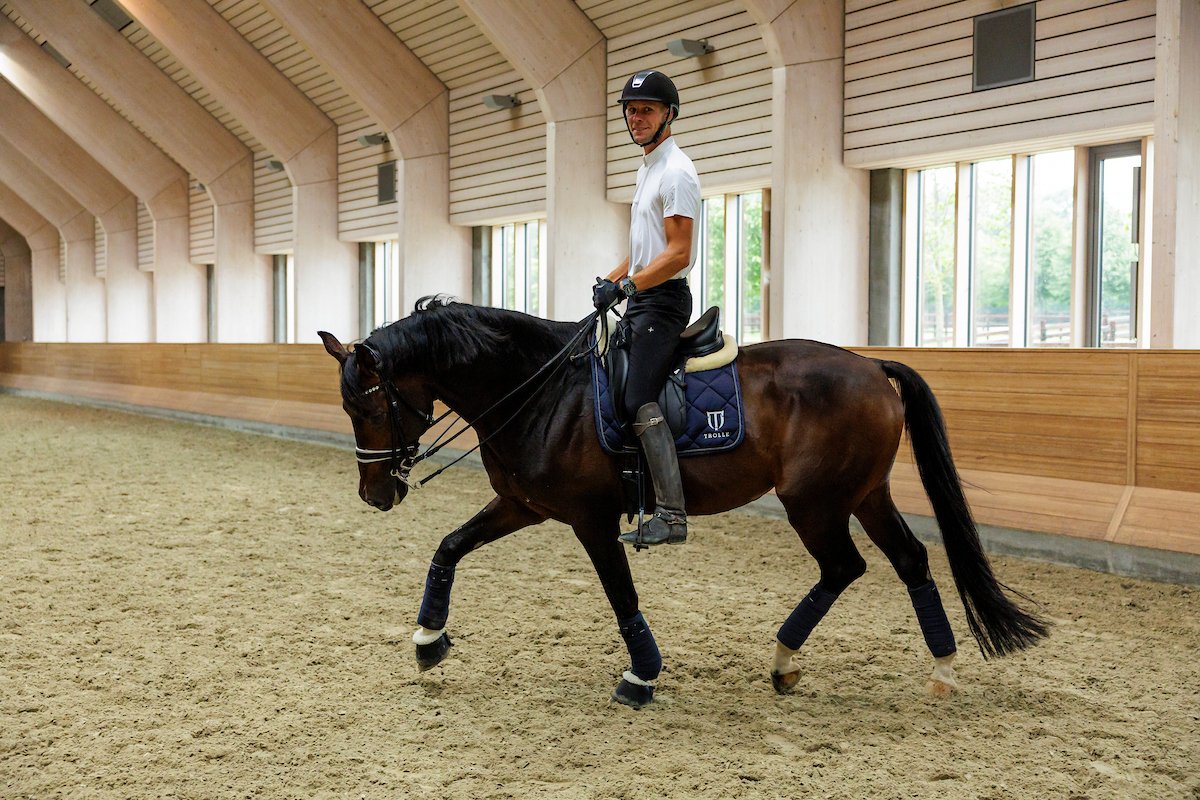
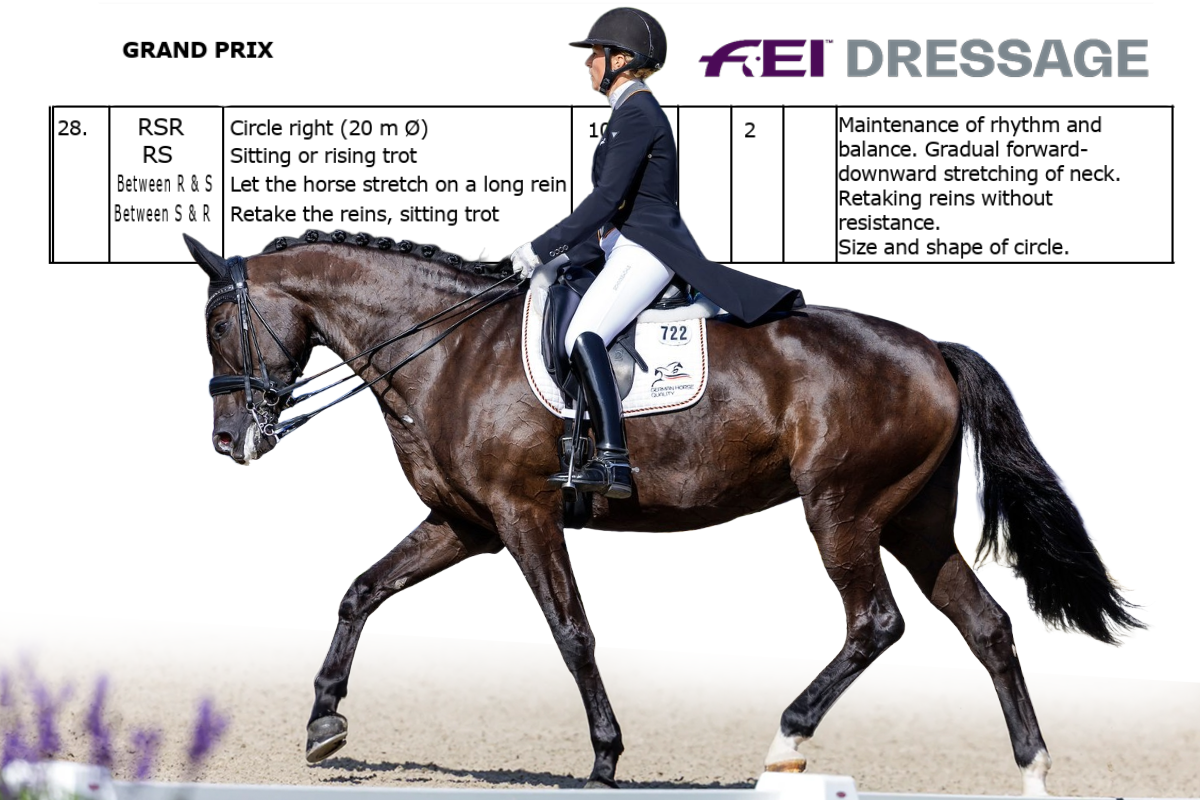 "Chewing while the reins are held out of the rider's hand" will be a required element of international Grand Prix competitions starting in 2027, but this test of responsiveness will also be included in dressage exercises in lower-level classes in the future. Photo: sportfotos-lafrentz.de
Letting a horse chew on the reins while they’re out of your hands? Actually, this is a “tool”—an essential part of riding for anyone who rides a horse. Something that has essentially become second nature to everyone in the saddle. A component of daily training as essential as the saddle and bit. Whether a horse is young or old, competing on the show jumping course or in the dressage arena. Everyone should be able to let the horse chew on the reins while they’re out of hand. Starting in 2027, letting the horse chew on the reins while they’re out of hand on a circle will be part of the Grand Prix test. It follows the canter sequence in collected trot and can be performed in a sitting or light trot. This decision is a hot topic in the international dressage scene. And like everything that happens in elite sports, it will have repercussions even in competitions that are not international but rather of local significance. Sooner or later.
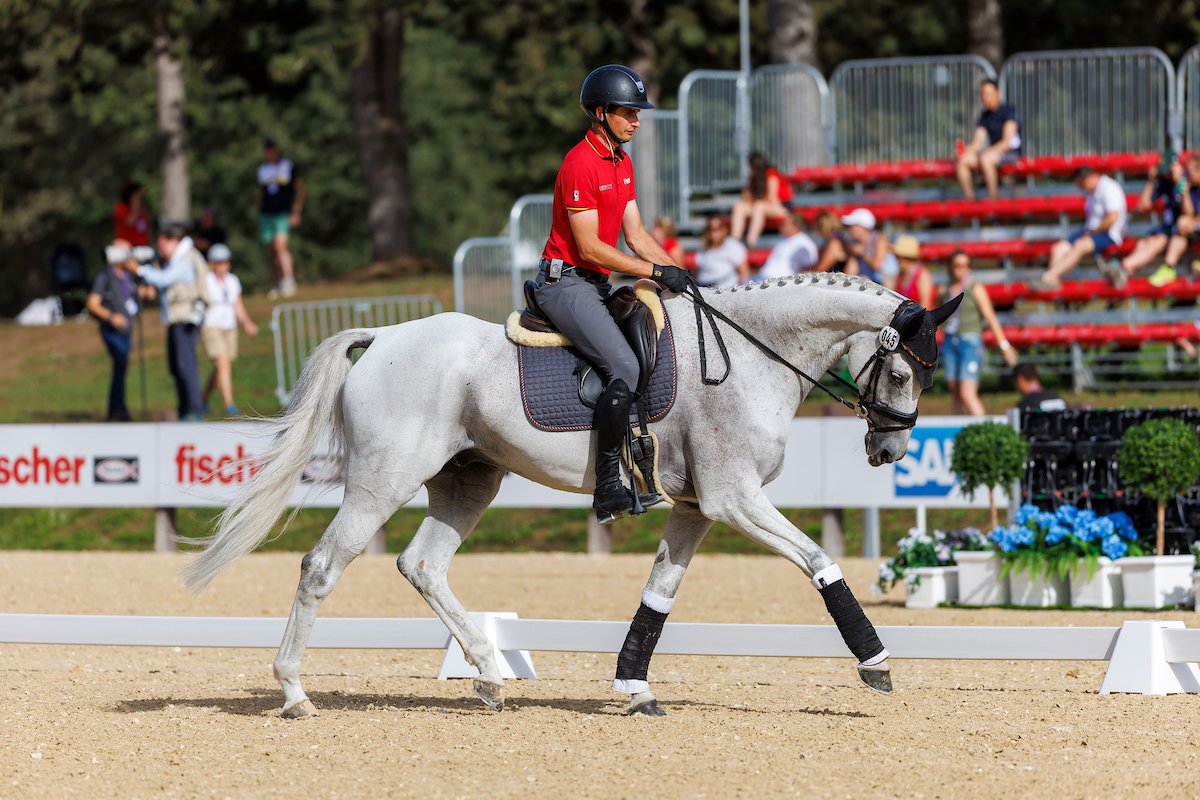
(Almost) everyone advocates letting the horse chew with the reins out of hand
No matter who you ask, everyone emphasizes the importance of the lesson. Although, listening to some of them, it seems that the term “lesson” feels somehow wrong. Allowing the horse to chew while the reins are out of your hand is more of a natural part of the training process. It’s not a lesson that’s performed over a specific distance between two letters and “trained”—that is, “practiced”—accordingly.
One rider who doesn’t need to practice for this is Dorothee Schneider. The Olympic team champion and master rider says, “I think letting the horse chew with the reins out of your hands in the new Grand Prix makes a lot of sense, and I’m really looking forward to it.” Uta Gräf, who has trained many Grand Prix horses, echoes this sentiment: “I believe it’s another step toward refined, relaxed riding—even in the Grand Prix—which is, after all, the goal of training.” Furthermore, according to the Palatinate native, it would then “become more commonplace at home to let horses have a bit more freedom for a while—allowing them to chew with the reins out of hand—before taking them back and continuing directly with the exercises.”
For Benjamin Werndl, who placed fourth at the 2022 World Championships, the exercise is “a fundamental part of training. That’s how we start our training, we do it in between, and that’s how we end our training, too.”
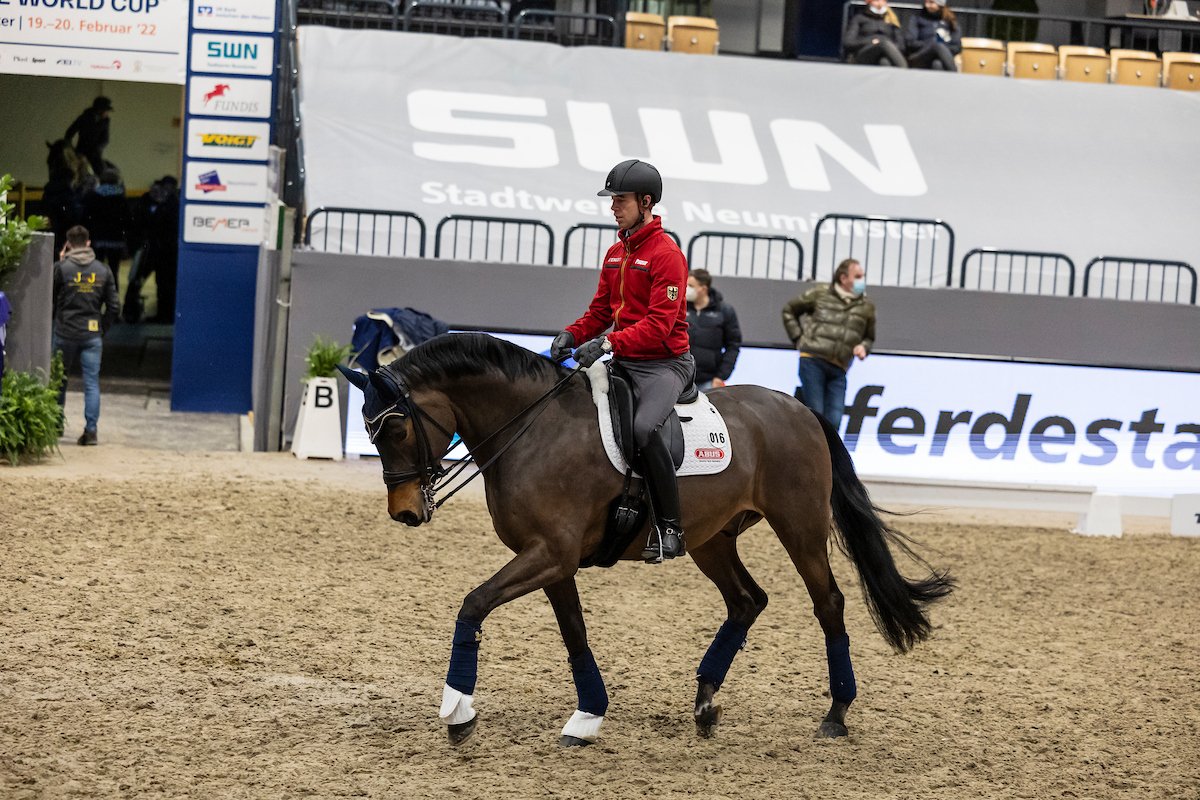
Photo: sportfotos-lafrentz.de
“An Objective Measure of Training Quality”
At the Balkenhol family’s farm, too, no training session goes by without letting the horse chew with the reins out of the rider’s hands. For Olympic rider Anabel Balkenhol, one thing is certain: “This exercise immediately reveals whether a horse is truly supple, relaxed, and trained to trust.” Allowing the horse to chew with the reins out of the hand is a clear and objective measure of the quality of training—because true responsiveness is demonstrated not only in the highest collection but also in the horse’s ability to trustingly extend to the hand and work over its back.”
“You practice what you’ll be tested on”
The vast majority of responses are positive, including those from judges and coaches (see below). There is a consensus that at home, “what is practiced is what is tested.” And so, with the change taking effect on January 1, 2027, many are hopeful that this increased practice will have an overall positive impact on the sport. Olympic judge Henning Lehrmann, who is responsible for dressage at the German Judges’ Association (DRV), calls it a very sensible exercise. “And what is tested is also practiced; in that sense, it will hopefully benefit the training of the horses.” Hans-Heinrich Meyer zu Strohen, newly appointed riding master and national coach for Germany’s young dressage talent, shares this view.
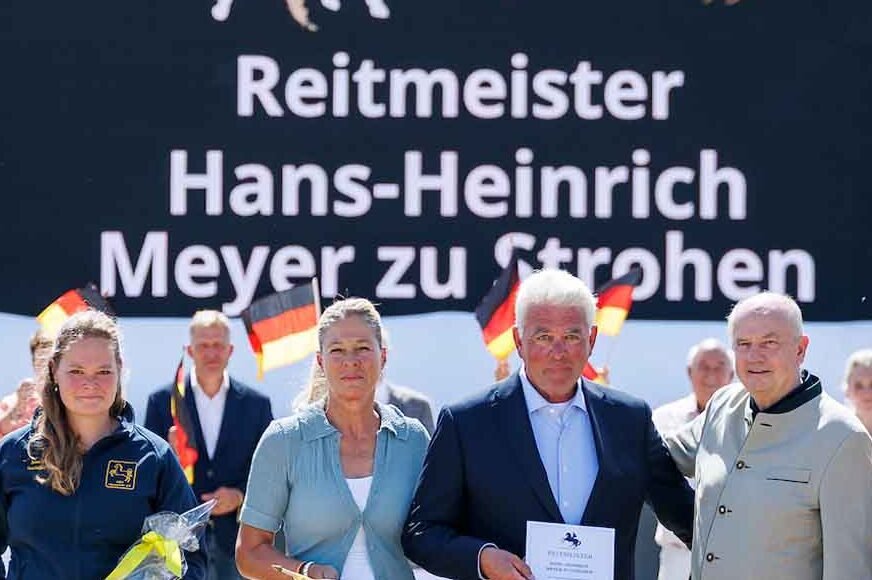
This helps the riders, the trainers, and, above all, the horses.
Hans-Heinrich Meyer zu Strohen, National Dressage Coach for Juniors and Young Riders
Positive Experiences from Lower Classes
Elisabeth Max-Theurer, Olympic champion and Level 4 judge, points to experiences from competitions for five- and six-year-olds: “Allowing the horse to chew with the reins out of hand has proven effective in introductory competitions for young riders and young horses. Above all, because letting the horse chew on the reins out of hand must then be practiced, and this helps the horses relax and let go.” The Austrian considers the idea “very positive for the development of our sport.”
But there are other voices as well, albeit few. And they don’t necessarily want their names mentioned here. They say there is a danger that “letting the horse chew the reins out of your hand” could degenerate into a kind of trick.
Can you “train” a horse to chew with the reins out of your hand?
Some people even refer to this as “dressage.” In international competition, you see many horses that, while their noses are now at the vertical and no longer behind it, still do not carry themselves and are not obedient, let alone truly meet the criteria of the training scale. Rather, they assume a trained posture without approaching the bit from the hindquarters to the fore. But that is fundamental if one is to speak of genuine, true contact. In this respect, the idea that even this training component could be “drilled in” cannot be entirely dismissed.
What should “letting the horse chew with the reins out of your hands” look like?
Martin Plewa, master rider, longtime national coach of the German eventing team, and longtime co-author of the guidelines for riding and driving, thinks the idea is “great.” “For me, letting the horse chew the reins out of your hand is a key exercise for assessing the horse’s suppleness and the quality of its contact.” But what does it look like when performed correctly? The expert explains:
The only difference between letting the horse chew the reins while they’re in your hand and a normal bridle is that the withers are no longer the highest point.
Martin Plewa, Riding Instructor
The challenge here is that the line from the nose to the forehead—which in Grand Prix competitions is often judged quite leniently as “still on the vertical”—must remain on the vertical despite the lower neck position. Anything else would be a fault. Plewa emphasizes that the whole package must be right: “This approach to the bit with the nose-forehead line at the vertical. In the extended position. That everything is actually maintained: rhythm, suppleness, naturalness, and contact.” And, the riding master adds, “Tempo, longitudinal flexion”—of course.
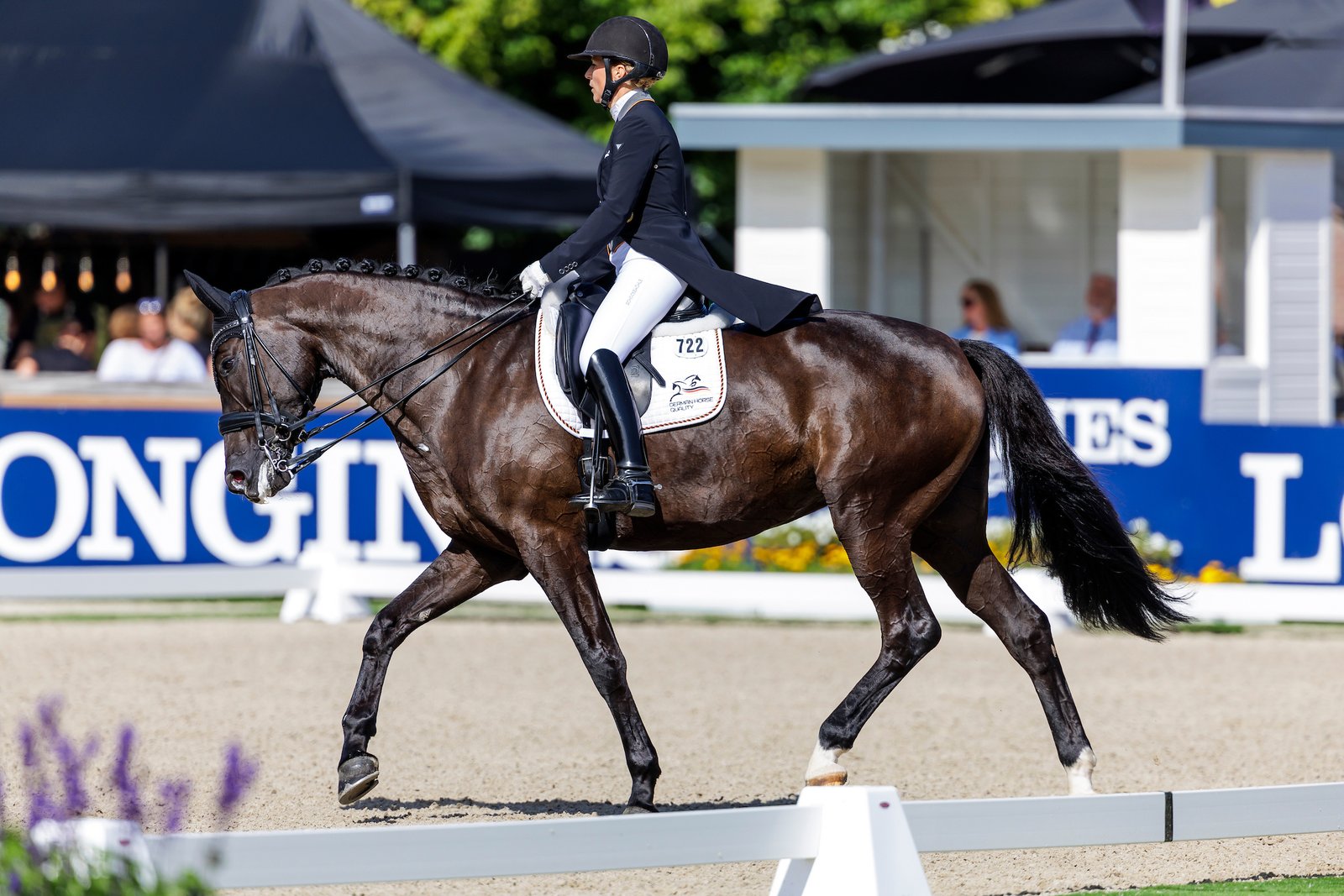
It sounds simple, but you don’t have to be a Grand Prix rider to know from your own experience how difficult it is to keep the horse in this position so securely in response to the driving aids that you can actually let the reins hang loosely from your hands, as if—as is often said—you were pushing forward with broomsticks.
Two reins, double the difficulty—the Kandare challenge
Plewa emphasizes another important aspect, partly because, in his opinion, it is a decisive criterion in the judges’ evaluation: “What’s important with the curb bit is that when you let the horse chew with the reins out of your hands, the curb reins must no longer be taut. Because if they’re still taut during the deeper extension position, they essentially act as a ‘deep-setting’ device.”
According to Plewa, experience from lower classes shows that this poses a challenge from a riding perspective: “Contact only on the snaffle rein! I’m curious to see how this will be judged. We already see in riding horse classes that this exercise is usually judged incorrectly or overlooked.”
How did the decision come about to establish “chewing with the reins out of the hand” in Grand Prix competition?
The International Equestrian Federation (FEI) has long been aware that the “social license to operate”—that is, public acceptance of equestrian sports—is waning. Equestrian sports do not receive the same level of attention in every country as they do in parts of Western Europe. But in many of the major equestrian nations, including Germany, reports of blue tongue disease or images of dressage horses bending well beyond the vertical do little to make the sport more popular. Even though the “summer fairy tale” of the 2026 World Championships in Aachen showed that equestrian sports still spark enthusiasm even beyond the equestrian bubble.
Equine Ethics and Wellbeing Commission
The “Equine Ethics and Wellbeing Commission,” a FEI commission composed of international experts from the academic community, has identified issues in equestrian sports and developed a comprehensive plan. One result was the establishment of the “Dressage Strategic Action Plan Working Group.” It consists of
- George Williams (USA), Chair, former Olympic equestrian
- Monica Theodorescu, Olympic champion, German national team coach
- Klaus Roeser, athlete representative of the European Equestrian Federation (EEF) and Secretary General of the International Dressage Riders’ Club (IDRC),
- Raphael Saleh (FRA), Level 4 judge, Chairman of the Jury at the Paris Olympic Games
- Gareth Hughes, British championship rider
- Kyra Kyrklund (FIN), six-time Olympian and internationally sought-after trainer
- Lise Berg, Danish professor of veterinary medicine at the University of Copenhagen
She discussed various issues, consulted additional experts on the redesign of not only the Grand Prix dressage test, developed proposals, and then put them through a “field test” in Warendorf. Among the riders present was team world champion Katharina Hemmer, accompanied by her trainer, master rider Hubertus Schmidt.
“Katha” Hemmer – involved as a guinea pig
Katharina Hemmer: “I rode the exercise exactly as it has now been modified, and I don’t think that should really be a problem. My horse took to it very well. After all, it’s just a brief test of suppleness and relaxation, and it really shouldn’t be a problem for any Grand Prix horse.”
“There were other proposals on the table as well,” adds Hubertus Schmidt. “Those were tried out, too.” The Olympic champion, World and European champion with the German team, multiple World Cup finalist, riding instructor, and trainer of Katharina Hemmer and Anna Schölermann reports on the FEI Insider event: “The first idea was, of course, to let the horse chew the reins out of your hand during the passage. I’d consider that extremely difficult—especially for riders who aren’t quite as experienced. I think letting the horse chew on the reins while riding a slightly curved line (the circle) is a perfect exercise and very doable. Above all, it’s important to me to test this not only as a lesson in the Grand Prix, but also in the classes below it.”
Is the horse maintaining its posture? Go ahead and score it!
Monica Theodorescu, national team coach, Olympic champion, world and European champion with German teams, and multiple World Cup winner, is a member of the “Dressage Strategic Working Group,” which discussed and proposed the changes to the exercises. She not only advocates for letting the horse chew with the reins out of the rider’s hands, but also points to the second change—the “überstreichen.”
Incorporating “chewing the reins while they are held in the hand” and “brushing past” in all categories up to the Grand Prix and Grand Prix Special helps assess the horse’s suppleness and self-carriage.
Where are these exercises required?
The “Überstreichen” has become a standard part of the exercises at all competition levels. In the Grand Prix (here is the test valid as of January 1, 2027) and the Prix St. Georges, the horse is required to chew with the reins out of the rider’s hands; in the Grand Prix Special (here is the test) and the Intermédiaire I, the horse is required to cross over. In the Grand Prix Special, the over-the-hand movement takes place after the start of the canter at X on the short side, continuing at A for three to four canter strides. The horses then proceed into a right-hand canter half-pass.
Who came up with this idea?
The draft for the additions to the course design was written by a working group that included Level 4 judges Katrina Wüst and Christof Umbach, as well as British World Cup champion Becky Moody.
For Christof Umbach, it’s important that this “might be a step in the right direction, so that we don’t fall into the same kind of misguided path in the future as we have in past decades. That we simply place too much value on “spectacular riding,” which then came at the expense of the horses’ gymnastic training. Suppleness is the most important thing first, before we even think about expression. But that doesn’t mean a horse’s quality should be penalized; even a high-quality horse with “powerful gaits” should be able to achieve an extended posture. And that’s what suppleness is all about—being able to bring a horse into a state of positive tension and then immediately allow it to relax again.”

The fact that a horse can chew on the reins, no matter which exercise it’s in—that’s what dressage is all about, and it’s a sign of a well-trained horse.
Christof Umbach, an international Level 4 dressage judge who helped design the new exercises
Aligning? “It shouldn’t be rocket science.”
Judge Katrina Wüst also believes it is important to consider at what point in the exercise the “chewing the reins out of the hand” occurs: After the canter sequence, the horse is brought down to a collected trot at point M in the Grand Prix. The horse then proceeds to the circle, where the exercise is performed. It can be executed in a light trot or a sitting trot. The horse then moves to the long side into a strong trot (R-K) and then to the center line. “It is particularly telling when—as in the Grand Prix—the demonstration of maximum suppleness is assessed in combination with maximum impulsion in the strong trot and, finally, maximum cadence in the final passage. As a judge, one certainly delights in a successful demonstration of suppleness by an excellently trained horse. It is important, however, that everyone agrees on how it should be ridden and judged. But that shouldn’t be rocket science,” says Wüst.
Kyra Kyrklund: “A wonderful lesson”
This assessment is echoed by trainer and six-time Olympian Kyra Kyrklund: “I think it’s great that the exercise is placed at the end of the test program. We’ve noticed that most horses actually performed the passage better on the final center line as a result. They showed a better passage there because they had been allowed to move freely and had relaxed beforehand.”
Impact on Daily Training
Top riders would have no problem with this—“they can already do it. They practice it at home, too.” Everyone else will just have to work on it now. “Everyone really needs to get good at this: relaxing the horse and allowing it to loosen up in the neck without running off, without raising its head too high, and without pushing its back away or bolting.”
If it doesn’t work, it’s essentially an admission of failure on the rider’s part—and the judges will see right through it. “Allowing the horse to chew with the reins out of the rider’s hands is an excellent way to check whether the horse can truly maintain the rhythm on its own, without the rider holding it too tightly or providing excessive support to keep the cadence steady.”
The Judges Will Decide
Nicole Nockemann believes, from both a judge’s and a rider’s perspective, that letting the reins hang looselyis “one of the most important lessons we have in the entire training of the horse—starting with the young horse—and it simply must not be lost along the way to the Grand Prix level.”
Jessica von Bredow-Werndl: “Continuously Developing the Sport”
Jessica
von
Bredow-Werndl, a four-time Olympic champion, generally takes a positive view of innovation. “I think it’s important that we continuously develop the sport and constantly ask ourselves how we can best assess our horses’ training and suppleness. If the new exercise helps to make the suppleness, contact, and connection between horse and rider even more apparent, I see that as an opportunity.”
And then she adds a crucial sentence: “Of course, what will be decisive is how it is implemented in practice and evaluated by the judges.” In this regard, she agrees with riding instructor Martin Plewa, who notes that the “letting the horse chew the reins out of the hand” maneuver is rarely executed correctly—and judged accordingly—even in riding horse classes (see above). The author of the guidelines emphasizes: “It is crucial that it is judged correctly—and I find this very important—that it is taken into account and only then evaluated positively if rhythm, tempo, and balance are maintained.” It may only be a few meters along the circle, but there are plenty of criteria that must be met. “Tact, tempo, rhythm, position, flexion, and CONTACT must be maintained; only the neck is no longer the highest point! ”
Ride Correctly and … Judge Correctly
Dr. Evi Eisenhardt, an international Level 4 judge with extensive experience judging at championships, points out quite pragmatically that it is not just the lengthening of the reins that should be evaluated. “Furthermore, the horse’s responsiveness becomes evident when the reins are taken up again.”
The grade for the lesson is multiplied by a factor of two and included in the final score. This puts it on equal footing with piaffes, pirouettes, zigzag half-passes, strong and collected walk, and the half-passes, which—at least according to the test sheet—are to be ridden in collected trot.
Why not bring back the final scores?
International Grand Prix judge Dr. Dietrich Plewa introduces a new perspective to the discussion. He believes it should actually go without saying that one can expect a Grand Prix horse “that the quality of the basic gait—the trot—remains unchanged and that the horse demonstrates a willingness to extend. And at the same time, back action.” However, the attorney looks beyond the mere change in the test requirements:
On the other hand, the introduction of this “lesson” reveals a lack of confidence on the part of top management, stemming from the belief that the guidance often provided by the curb bit does not reflect a solid foundation of training—particularly with regard to the horse’s suppleness in the neck and back.
Dr. Dietrich Plewa, Grand Prix Judge
Dr. Plewa does not reject the change, but wonders whether there might have been other ways to incorporate a horse’s suppleness into the judge’s decision. The attempt “should not be rejected on principle, but it does not make up for the shortfall that arose when, years ago, the basic scores—which I consider very important—for purity of the gaits—of all things—and for suppleness and obedience that is, for meeting the criteria of the training scale—were eliminated years ago. This was done in favor of a single score: that of the rider—seat and aid (now called “harmony”).”
Did external pressure influence the decision to allow horses to chew with the reins out of the rider’s hands?
Even though the change to the Grand Prix task has generally been met with broad approval, there are critics who are questioning the reason behind it. Their argument: The sport is fine just the way it is. There are many other ways—some drawn from much older versions of the Grand Prix test—to assess responsiveness, which would allow the judges to incorporate this criterion even more clearly into their evaluations. The responsiveness tests are said to be a reaction to the animal welfare debate. They are allowing themselves to be driven by “out-of-control” outsiders.
“Standing still is a step backward”
Benjamin Werndl has also heard these views. He says: “Standing still is a step backward, and I think our sport, too, should continue to evolve. That doesn’t mean we shouldn’t have the backbone to say what our sport stands for. But suppleness is, after all, a fundamental part of a horse’s training; it can be assessed very effectively this way, and it brings it even more into focus and allows for further training. In that respect, I welcome it.”
ADVERTISEMENT
Master Class with Benjamin Werndl
Benjamin Werndl will be giving a master class on October 31 starting at 3 p.m. at the Klosterhof Medingen. It’s quite possible that he’ll also discuss the importance of letting the horse chew with the reins out of your hands. Tickets here.
The Wrong Signal to the Horse?
Others, however, argue from the horse’s perspective. They say that letting the horse chew with the reins out of the rider’s hands is a recurring part of training. But it also marks the end of the training session. Horses trained in this way know that, after strenuous work, the moment of relaxation has now arrived and they can slowly “wind down.” But that is exactly what does not happen in this exercise. After all, the horses still have 50 meters of strong trot ahead of them, as well as a centerline with passages and a piaffe.
Letting horses chew the reins while they’re in your hand—already common practice in Denmark, for everyone!
Denmark is already one step ahead, as Princess Nathalie zu Sayn-Wittgenstein—a member of the bronze medal-winning team at the 2008 Hong Kong Olympics, a World Cup runner-up, and coach to riders including Daniel Bachmann Andersen—reports. “We’ve already introduced this in Denmark since last year. It’s been well received by the judges. Of course, it has to be practiced at home; the riders need to work on it. In Denmark, from Class E up to Grand Prix, letting the horse chew with the reins out of the hand is required. I think it’s a good thing. And the judges also need to familiarize themselves with how it’s ridden correctly and how to score it correctly.”
“Coefficient Two”
Daniel Bachmann Andersen agrees. He points to the backward movement, which also reveals a great deal about how a horse has been trained. “You can see what’s emphasized in the training.” The Dane hopes that the focus on suppleness won’t be limited to just the new exercise. “The normal transitions, the lightness—that all of that will come into play. More so than, let’s say, five years ago.” Without knowing that the movement is actually scored with a double weighting in the score sheet, he spontaneously suggests during the conversation, “The coefficient should be two.”
“It’s certainly a challenge for us judges”
Hans Christian Matthiesen is not only
a judge
but also a veterinarian. As a Level 4 judge, he has already judged at the Olympic Games. He is known for giving a lot of thought to the sport (in the podcast “ERZÄHL MIR WAS VOM PFERD,” he made a case for freedom of choice between a snaffle bit and a curb bit).) and to drive that forward as well. His role as chairman of the International Dressage Officials Club (IDOC) also helps in this regard. He, too, points to the positive experiences in Denmark. “I find this a refreshing step. Some say that letting the horse chew with the reins out of the hand doesn’t belong at the Grand Prix level, and yet I find it exciting to see how horses perform this exercise at the highest level. Part of the challenge is precisely to demonstrate that you can present your horse in a completely relaxed, yielding, or supple manner. For us judges, it will certainly be a challenge, but with time and experience, we must learn to judge the exercise consistently and provide riders and trainers with clear guidance. And I think it sends an important message to the outside world. In our sport, we’re ready to break new ground and find new ways to present our horses.”
Starting January 1, 2027, the new international events will be held at tournaments.