All New in the Riding Horse Division at the National Championship—A Status Report
The New National Riding Horse Championship—Hit or Miss?
 from Dominique Wehrmann
 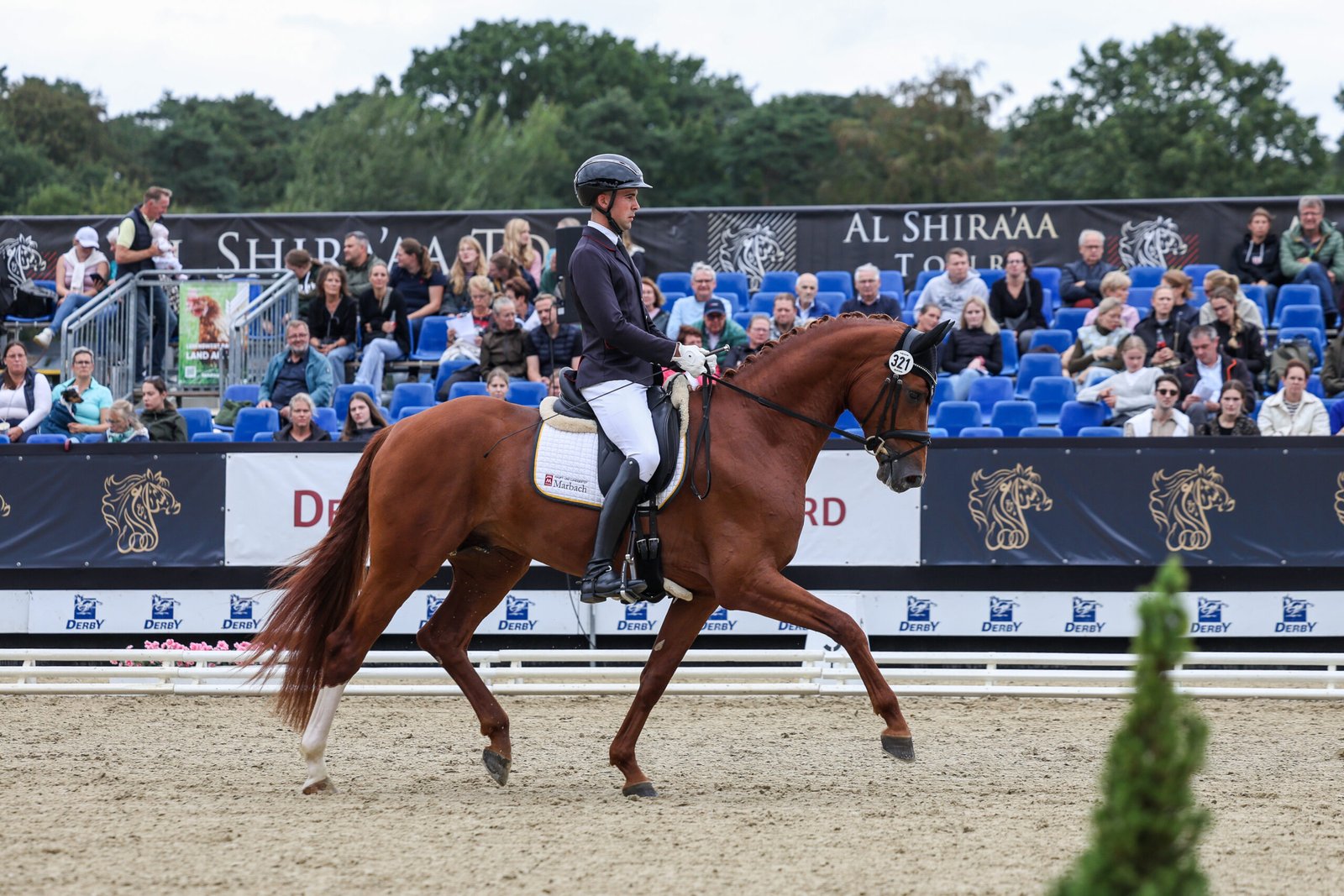 Under Linus Keller, Danubio was among the winners of the new final format. He took bronze in the four-year-old stallion class.
Photo: Rebecca Thamm
Under Linus Keller, Danubio was among the winners of the new final format. He took bronze in the four-year-old stallion class.
Photo: Rebecca Thamm The date of the National Championship, however, was different. It was moved up by one week because it would otherwise have conflicted with the Tournament of Champions in Münster, which begins on September 3. The “Tournament of Champions,” which would otherwise have been scheduled for the same time as the National Championship, was in turn postponed because Münster was the venue for the celebrations marking the 80th anniversary of the state of North Rhine-Westphalia on the last weekend of August. So the saying went: After the World Championships in Aachen comes the Bundeschampionat.
The mandatory training
began on Tuesday with the qualifying round for the seven-year-old show jumpers. Things got serious for the riding horses on Wednesday. At 10:30 a.m., the mandatory acclimatization session for the three-year-old mares and geldings began in the competition arena. It was an overcast day with calm weather—not too cold, but not warm enough that the horses would have been calmer than usual simply because of the weather. Most of the horses were not being ridden 90 percent of the time the way one would hope for with three-year-olds. Most were set too high and too tight.
To the riders’ credit, it must be acknowledged that the new environment, unfamiliar colleagues, and the many new experiences can be quite stressful for the horses—depending on their temperament and sensitivity. Understandably, this makes it difficult to find an appropriate way to handle the young horses. Some managed this quite well over time, however. Other horses, however, did not calm down at all. On the contrary, they curled up more and more, sweated profusely, and appeared very stressed.
It’s completely baffling: when a horse is clearly afraid of something, and the rider keeps trying to force it past that spot. Why? You’d think a professional would have at least a basic understanding of how horses learn and know that this approach only makes things worse. After several futile attempts, he finally let the horse stand still and gave it a moment to look around on its own. Lo and behold, the horse calmed down.
More calm, better visibility
The steward in charge, Hermann Erver, said later that he very much welcomed the opportunity for mandatory training. “Having three horses on the competition arena for 15 minutes each clearly has advantages. We as stewards have significantly more opportunities to step in and help, and the riders have far more opportunities to prepare their horses specifically.”
By “intervening to help,” Erver means, for example, asking a rider with a calmer, more confident horse to ride ahead and have the others follow behind so they can build their confidence. We’ve seen this happen occasionally when the riders have coordinated among themselves.
Riders and instructors wholeheartedly agreed that the horses get to know the competition arena better in groups of three than with eight to ten other horses. It’s important to note that the riding horses were allowed into the arena even before the actual competition days in the past. However, on those occasions, they were sometimes in groups of ten. Naturally, the young horses were then more preoccupied with their companions than with anything else.
On the other hand, riders complained that they don’t think it makes sense to make it mandatory for horses to become accustomed to the arena while under saddle. For some horses, it would be better if they were first introduced to the arena while being led by hand—an option that would also have the advantage of making the logistical juggling act between mandatory training and arena assessment less of a burden for riders with multiple horses.
The Building Assessment
According to the concept originally proposed bytheFN’s“Young Horse Summit,”the building assessment was to be eliminated entirely. Following numerous protests, including from the German Judges’ Association, it was included in the program as a compromise—as a separate event held before the in-riding presentations.
Additional Stress
The three-year-olds had to be presented to the judges following the public training session in the jumping arena —a challenge when you had several horses, all of which had to be accustomed to being ridden in the competition arena and then presented to the judges in hand at the very other end of the sprawling grounds. The pre-inspection turned into an extra item on an already packed schedule, for which the horses had to be braided and prepared as if for a competition start—even though that wasn’t scheduled to begin for hours. “It was pure stress—especially for us, but ultimately for the horses as well,” said a rider who worked with both horses and ponies.
Anyone who wanted to watch the conformation evaluation of the four-year-old stallions had to be ready in Warendorf at 7:30 a.m. The scoring therefore took place largely behind closed doors.
Significant Discrepancies in Scores
What the spectators did notice, however, was how a gelding that had received a 9.5 for conformation was given a 7.0 for the functionality of his body under the saddle. There were other examples as well, some with truly staggering discrepancies between the evaluation of conformation in hand and functionality under saddle. Wolfgang Egbers defended the change: “Individuality can be better assessed with separate conformation scores.” He also pointed out that a stunning conformation does not necessarily allow for conclusions about the functionality of the horse’s physique.
Egbers, along with his colleagues, appreciated the quiet atmosphere in the riding arena, which allowed them to thoroughly assess the horses and then justify their scores. One colleague, however, questioned the ultimate purpose of this approach. After all, she noted, such a procedure couldn’t be applied at regional tournaments where horses aren’t stabled on-site. In her opinion, the old procedure should be retained, or the judging should instead focus on the rider’s performance in the arena. At the DSP Championship in Darmstadt, they deliberately tried this out, having the riders ride away from and toward the judges at a walk specifically for this purpose.
Suggestion for an adjustment
: The riders we spoke with would like to see the old system reinstated. What they would welcome, however, is for the spectators to wait to applaud until the respective group of horses has left the arena. After all, they say, standing still and being inspected isn’t the problem at all. For most horses, the stress only begins when the clapping starts.
The reason the building assessment was omitted after the test was the assumption that this would result in the horses spending less time in the arena. As it turned out in practice, this didn’t work out as planned. The horses remained in the arena until, in the qualifying rounds, the five scores for all participants in a group had been announced, and in the finals, until all scores had been explained. The horses were therefore in the competition situation for roughly the same amount of time, with the only difference being that they still had the rider on their backs.
To quote a horse owner: “The building inspection was the least of our problems. Now they’ve turned it into one.”
Pioneers
Another new feature was the inclusion of pioneers, whose role was to demonstrate how to complete the task. For this purpose, the Westphalian Horse Stud Book had kindly provided horses for sale that were of a quality suitable for the occasion, but—perhaps also intimidated by the setting—were not really presented in a manner appropriate for young horses. The judge addressed this issue, but it could not really be remedied.
Disqualifications
During the competition itself, the judges disqualified horses—for example, one because its gait wasn’t smooth enough (though this likely had more to do with tension than with a physical problem), and another because it was overwhelmed by the demands of the day. This was consistent.
Equally decisive was a steward’s decision not to allow one of the three-year-old stallions to enter the competition at all because he exhibited an unclear gait.
Class A Dressage Horse Tests – Pros and Cons
One significant change, which affects only the four-year-olds, is the elimination of the test with an outside rider. Instead, all finalists competed in a Class A dressage horse test. The majority of the larger horses handled this reasonably well. However, with the mares and geldings, one got the impression that the extended sitting position—which is increasingly required in the test—was too much for some of them. The stallions, who had already undergone more training through licensing, performance tests, etc., fared better.
Some riders benefited from this format, such as the bronze medalist from Marbach, Danubio, who tends to get a bit lost in a class with two “standout horses,” but really shone in the test thanks to his excellent rideability. Some riders also see this as a plus. “Yes, the test is more demanding. But it also provides a clearer assessment of a horse’s suitability for riding.”
But it seems questionable whether the Class A dressage horse competition is a sensible path for the future. The judges have already warned that no one was prepared for the new format this year, but that this will change if the procedure remains the same. Because then the riders will be “practicing” Dressage Horse Class A. “We had actually said we wanted to make it easier for the horses. In reality, it became more difficult.”
Friends, where are you?
Especially since the horses had to cope not only with the demands of the task but also with being alone in the arena. Why not let them into the arena in pairs? Among the large horses, it was only one stallion, Be my Guest—the winner of the qualifier—who suddenly decided to bolt toward the exit. Whether he was startled or simply wanted to join his friends couldn’t be determined with certainty.
There were some truly unsightly scenes involving the pony stallions—moments when the ponies suddenly turned around, took off, and sprinted toward the warm-up area, and could only be stopped with great difficulty. That said, the challenging conditions—caused by strong winds, fluttering advertising banners along the fence, and crackling and hissing microphones—may also have played a role here.
The judges apologized over the microphone for the conditions. It would certainly be easier for the horses if they were allowed to enter the arena in pairs.
How do the others actually do it?
Incidentally, the Pavo Cup took place in the Netherlands at the same time as the Bundeschampionat. Here, the four-year-olds competed in pairs in the arena. And the top three from each age group were ridden by an outside rider to “get a feel for them.” That was interesting and revealing, and the horses showed hardly any difference in stress levels.
We had asked Dr. Miesner, head of the Breeding Department at the FN, to provide a summary, which is now available. You can read it here.
Ähnliche Beiträge