Why Riders Should Invest Their Money in Good Riding Technique Training Rather Than New Saddle Pads
Padding on the Saddle—A Curse or a Blessing?
 from Editorial office
Just as every living creature has its own unique way of moving and holding its body, every rider also has a seat all their own within the framework of the position prescribed by riding theory. To follow the horse’s movements smoothly, the rider moves in the saddle in all directions—forward and backward, up and down, and sideways in all directions. These are minimal shifts in position in the saddle, but the horse senses them immediately, and the saddle must allow for them.
This is all the more important given that the rider not only follows the horse’s movements but also actively influences them through weight and leg aids in conjunction with rein aids. To communicate with the horse in a nuanced way, a relaxed, balanced, and hand-independent seat is an indispensable prerequisite.
However, the rider can only achieve a relaxed balance if they can use their own natural balance and are not hindered by an ill-fitting saddle or, for that matter, the saddle pommel.
Support—okay, obstruction—a no-go
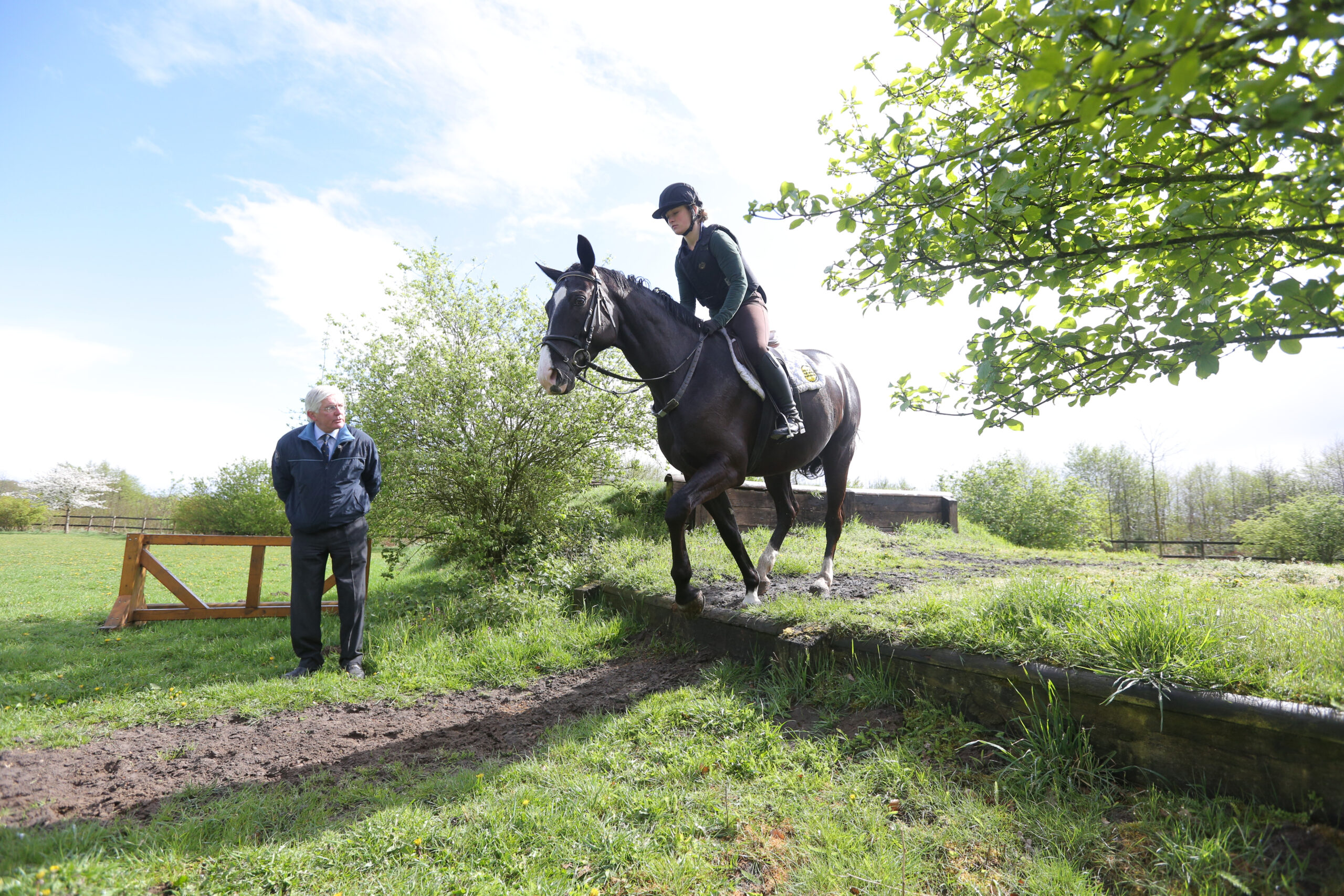
It’s no coincidence that stirrup pads are called “blocks” in English, because they often tend to restrict the rider’s movement in the saddle rather than support them. Stirrup leathers are meant to provide the rider with support and help them keep their leg in the correct position and find their balance. What they are not meant to do is replace or even interfere with a balanced, rein-independent seat. Yet that is exactly what you see time and again all over the country—riders who practically “clamp” themselves to their stirrup pads instead of finding their balance from a deep seat in the saddle with their leg “hanging” freely at their center of gravity. This affects the rider’s entire seat, and consequently their influence on the horse.
Improper fit “thanks to” the pads
Another problem is pommel pads that are incorrectly positioned and/or shaped from the outset, which place the rider in an unfavorable position. In dressage saddles, for example, you often see knee rolls that follow the vertical contour of the saddle flaps, even though the rider’s thigh rests at an angle on the saddle flaps. The result: The rider must move their thigh further back than intended, or their knee will bump against the pommel, or they will pull their knee over the pommel to avoid the pressure. The entire seat sensation is disrupted or cannot even develop correctly. Furthermore, such stirrup pads do not allow for different stirrup lengths. However, stirrup length is not just a matter of leg length, but also of individual seating comfort.
Conclusion: Better to focus on seat training than on general rules
Anyone who has trouble finding their balance in the saddle should not fall for what seems like the most obvious solution—using pommel pads and/or a particularly low saddle to clamp themselves onto the horse. For one thing, this only addresses the symptom and not the cause; for another, it’s not exactly horse-friendly, because the more wedged in the rider is, the less able they are to adapt to the horse’s movements. Any rider who wants to seriously improve their skills has no choice but to take the hard road and learn balance in the saddle through seat training. The reward for this effort is a whole new riding experience, because, almost as a side effect, communication with the horse through the use of aids becomes more precise—and thus more refined—almost effortlessly.