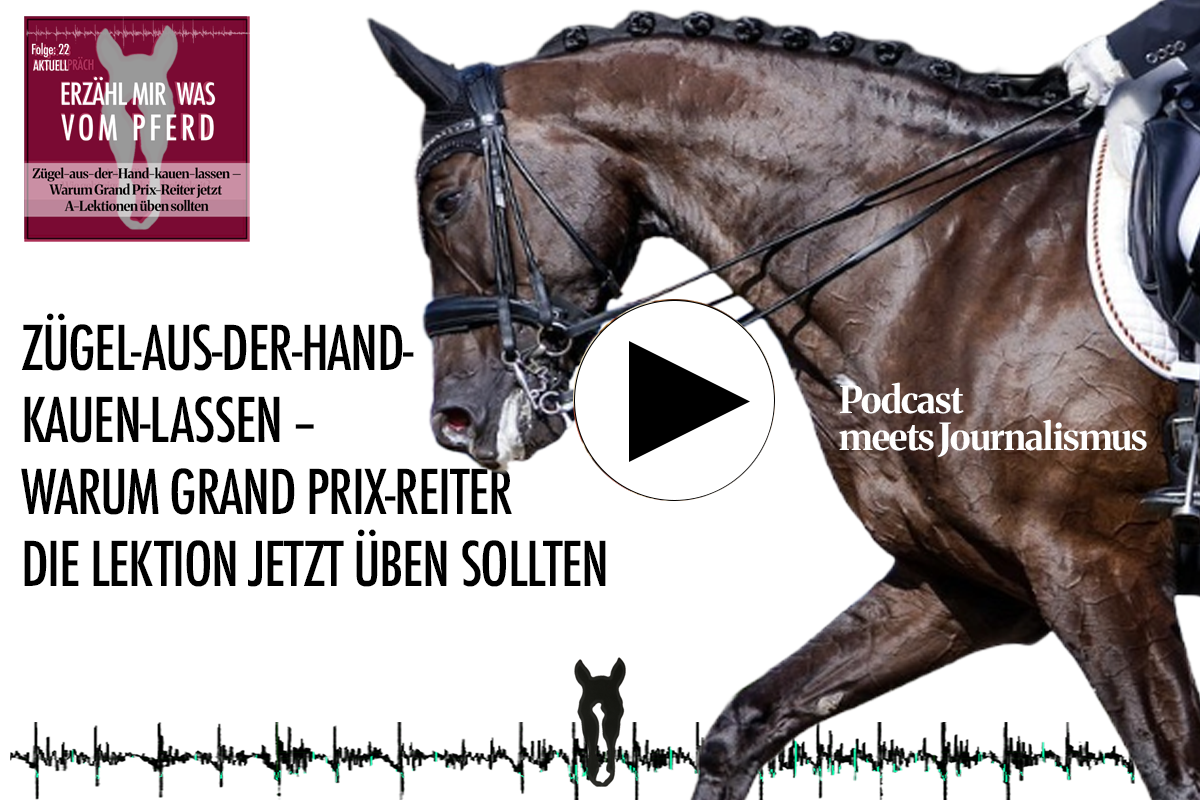
Dr. Carsten Munk, German Judges Association, Guest Commentary: Allowing the horse to chew the reins out of the rider’s hand in the Grand Prix is “open to debate when in doubt”
Dr. Carsten Munk, German Judges Association: Allowing the reins to slip “is open to debate when in doubt”
 from Editorial office
 Dr. Carsten Munk, Chairman of the German Judges Association (DRV). Photo: FN/M. Kaup
The exercise known as “letting the horse chew with the reins out of the rider’s hands,” which is firmly established in the system of classical riding instruction, serves to assess and improve the horse’s willingness to extend and achieve a secure, relaxed state. In this exercise, the regular contraction and relaxation of the muscles in time with the movement should also be evident.
The FEI’s decision to include this exercise in the Grand Prix (and other international competitions) starting in 2027—primarily to assess the horse’s suppleness—requires consideration from various perspectives (here are some reactions from the international equestrian community). Let’s stick to the Grand Prix.
Relaxation Before Fluidity
First, there is the perspective of the judge, who must evaluate the Grand Prix performance:
The following still holds true: A relaxed horse is not necessarily completely responsive. But if it is responsive—even up to the highest collection!—then it is also relaxed! Relaxation is, of course, an essential prerequisite for achieving the necessary responsiveness—the highest collection(!)—as expected in the Grand Prix.
The higher the level of training, the more
the horse’s suppleness is assessed
in conjunction with its responsiveness. In this respect, willingness to stretch and suppleness—along with a multitude of other factors—are an integral part of responsiveness. It is this—and not suppleness alone—that is at the heart of the evaluation of the entire test!
“Numerous Opportunities” to Assess Willingness to
Extend
There are
numerous opportunities
throughout the Grand Prix test
to assess
the horse’s
willingness to
extend. In general, the horse should extend from hind to front, over the back, and toward the hand in all phases. This fundamental quality must be clearly evident throughout the entire test and is an essential litmus test for proper training! Without this absolutely essential prerequisite, halts and transitions (not just those between passages and piaffes) as well as the horse’s entire gait will remain imperfect.
However, recognizing this basic requirement for a Grand Prix horse does not necessarily require the exercise of letting the horse chew with the reins out of your hands!
Specific examples
To make it even clearer: The required transition—for example, from the highest collection in the passage to the strong stride—can only be achieved if the horse demonstrates a clear willingness to extend over the back toward the hand, based on confident suppleness. When in doubt, the execution of this transition—due to the responsiveness it also requires—is more meaningful than simply letting the horse chew on the reins with a loose hand!
Frame Extension
It is also clearly evident from the required frame extensions in the reinforcements, as well as from the required frame adjustments during the returns, whether the horse, with the appropriate willingness to lengthen over the back, extends toward the rider’s hand or is ready to return to an upright position with secure contact while taking on increased weight.
Problematic Course Layout
In the 2027 edition of the Grand Prix, the test requires the horse to be allowed to chew with the reins out of the rider’s hands in a collected trot along the RSR circle toward the end of the exercise. On the section from R to S, a light trot may be used (note: in collected trot!); on the section from S to R, the reins must be shortened again. Immediately afterward, a strong trot must be demonstrated on the diagonal from R to K.
For this circle exercise—in which the horse is allowed to chew on the reins while they are held out of the rider’s hand and then brought back in—the FEI has now introduced a coefficient of 2!
Problem: Strong trot after taking up the reins again
This raises the question of what degree of collection the collected trot should exhibit throughout this entire exercise. The fact is that this collected trot must be developed in the extended position and thus without the horse sitting up. Does this approach correspond to the horse’s anatomy? Immediately after shortening the reins, a strong trot must then be developed. What degree of collection should serve as the basis for the transition to a strong trot? Can the required degree of collection be achieved when shortening the reins—a process that should be completed by the time the horse reaches “R”—in order to actually develop a strong trot from “R”? The intensification should still be the result of and a means to control the collection, which may not be fully achieved in preparation for the strong trot due to the preceding shortening of the reins!
Taking into account the aforementioned—admittedly incomplete—arguments, it appears, from the judge’s perspective, that adding the “letting the horse chew with the reins out of hand” exercise to the Grand Prix is indeed unnecessary.
The quality of a well-trained horse is also evident in the fact that the muscles involved in the movement rhythmically contract and relax in alternation. The ability of the muscles to relax is, of course, not only tested but also promoted by the “chewing with reins out of hand” exercise.
However, whether or not it makes sense to immediately restore the required high collection after letting the horse chew on the reins out of hand is, in case of doubt, open to debate. We’ll have to wait and see what the riders and trainers decide.
The horses themselves will certainly find “chewing with the reins out of hand” pleasant.
It will be interesting to see how this sequence of exercises—highest collection, extended posture with optimal relaxation, highest collection—plays out and proves itself in practice.
Dr. Carsten Munk, Chairman of the German Judges’ Association (DRV)