"Horse Whisperer" Monty Roberts has died at the age of 91
On the Death of Monty Roberts: The Man Who Listened to Horses
 from Dominique Wehrmann
 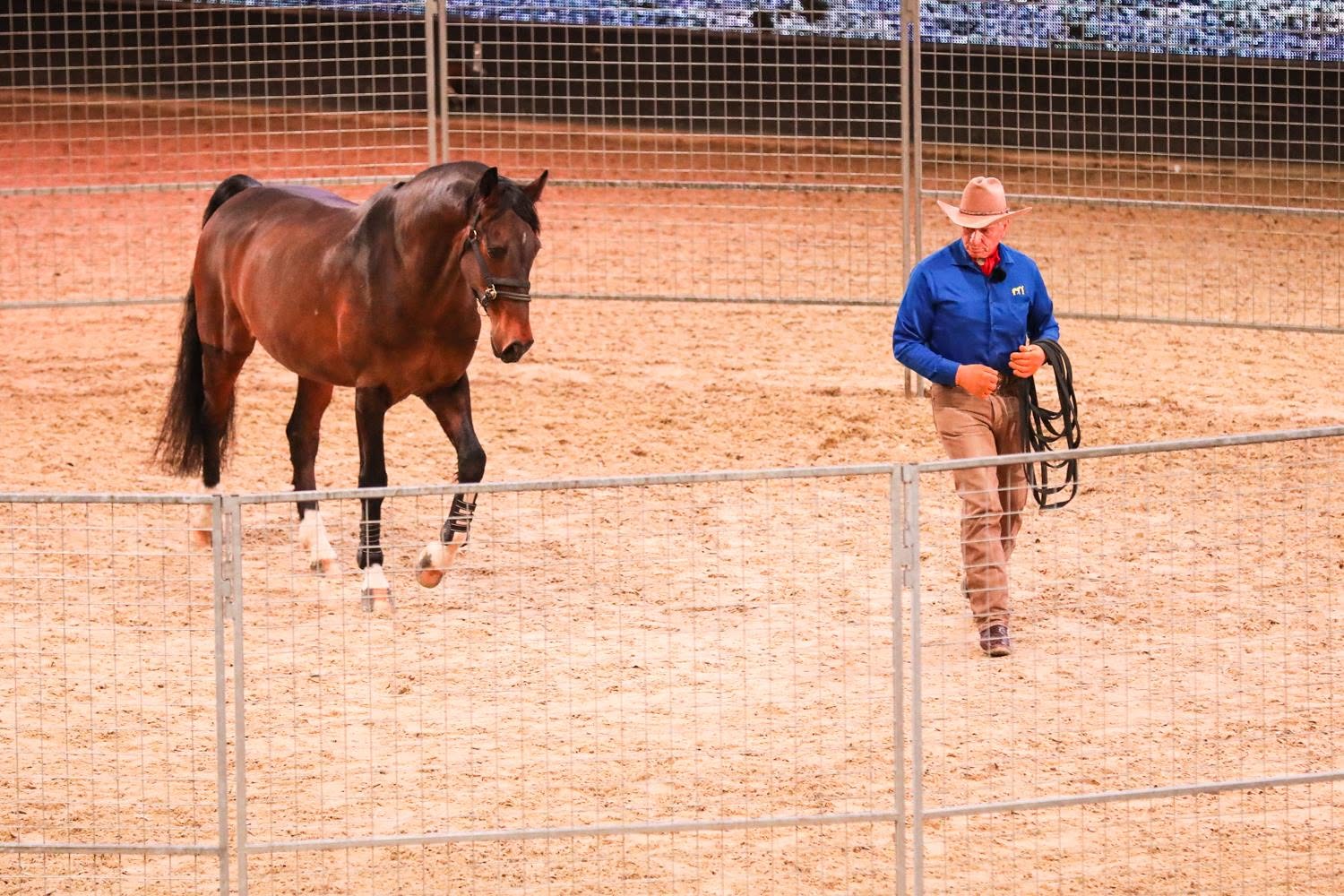 Monty Roberts at EQUITANA in Essen in 2019.
Photo: EQUITANA/Hans Kuczka
Monty Roberts at EQUITANA in Essen in 2019.
Photo: EQUITANA/Hans Kuczka How Roberts Used His Childhood Traumas to Make the Equestrian World a Little Better
Monty Roberts was born Marvin Earl Roberts on May 14, 1935, in Salinas, California. His father ran a horse farm there, so the boy practically grew up in the saddle. He was already in the saddle by the age of three. At four, he competed in his first tournaments. But this early closeness to horses was also overshadowed by harshness. Roberts’ father trained horses using the “breaking” methods common at the time—often brutal—which involved breaking a horse’s will through coercion and pain. He also relied on harshness in raising his son. Roberts has repeatedly recounted that he was beaten as a child.
The origins of his life’s work lie in his experience of violence against horses and against himself. From an early age, the young Roberts developed a deep aversion to these methods and an equally deep longing for a different approach. The decisive impetus is said to have come from several weeks of observing wild mustang herds in the Nevada desert, where he traveled as a teenager to round up wild horses for a rodeo.
He claims to have spent hours observing how the animals communicated with one another: through body posture, the direction of their gaze, ear movements, and distance, they created a subtle yet clearly discernible communication system that Roberts later called “Equus.” It became clear to him that this same silent language could be used to offer horses trust, rather than forcing it upon them. He later called this moment of mutual choice between human and horse “Join-Up,” the foundation of all his subsequent work.
It is this background that lent his method its particular credibility: Roberts did not speak about nonviolence as an uninvolved observer, but as someone who had to experience its alternative firsthand before he developed it for horses.
Join-Up Is Taking the World by Storm
Over the following decades, observing the mustangs evolved into a well-developed methodology. Instead of using force, ropes, and pressure to accustom horses to the saddle and rider, Roberts relied on the round pen: In a circular enclosure, he allowed the horse to choose to join the human once it recognized the person as a trustworthy “herd leader.” Young horses, which were often broken in for days using traditional methods, could frequently be accustomed to the saddle, bridle, and rider within about 30 minutes using the Join-Up method—without spurs or a whip.
In 1986, Roberts demonstrated his concept publicly for the first time. In 1989, Queen Elizabeth II invited him to Windsor Castle, where he trained her horses and, over the following decades, became her informal advisor on equine matters—a connection that significantly boosted his international fame. With his book *The Man Who Listens to Horses*, published in 1996, Roberts became known to an audience of millions. The book also inspired the novel and film *The Horse Whisperer*.
Roberts and Lomitas from the Fährhof Stud Farm
Robert’s work in Germany holds a special place in his career—all sparked by a stallion whose career had actually seemed to be over.
The thoroughbred Lomitas, born in 1988 at Northmoore Stud in England and raised at the Jacobs family’s Gestüt Fährhof in Lower Saxony, had won several races by a wide margin as a two- and three-year-old under trainer Andreas Wöhler and was considered the favorite for the German Derby. But before the 1991 2,000 Guineas, he refused to enter the starting gate. The stallion panicked so badly that even several grooms could barely hold him. His racing career—and with it, his later, financially significant role as a breeding stallion—seemed to have come to an end.
Walther J. Jacobs, owner of the Fährhof stud farm, subsequently hired Roberts, who was still largely unknown in Europe at the time. With great patience, Roberts worked with Lomitas until the horse once again entered the starting gate of his own accord. The stallion went on to win, among other races, the Berlin Grand Prix, as well as the Baden Grand Prix and the Prix de l’Europe—both by margins of seven and eight lengths, respectively—and became one of the most significant German racehorses in recent history.
Lomitas also made a lasting impact as a breeding stallion: Among his offspring was the exceptional mare Danedream, who in 2011 became only the second German horse ever to win the Prix de l’Arc de Triomphe. Lomitas himself died in 2010 at the age of 22 at the Fährhof following surgery for colic.
For Roberts, working with Lomitas opened the door to Germany and Europe: it established his reputation in the local breeding scene and led to decades-long connections with German stud farms—including a friendship with the Jacobs family and the Fährhof Stud that lasted until the very end. In the years that followed, Roberts returned to Germany repeatedly, including several visits to the EQUITANA horse show, most recently in 2019 before a sold-out crowd in Essen.
In addition to his work with horses, Roberts later applied the principles of trust and communication to a business coaching program that was used by companies such as Volkswagen, General Motors, and Merrill Lynch, among others. In 2002, the University of Zurich awarded him an honorary doctorate.
The Last Few Years
In recent years, Monty Roberts had become less visible; he was increasingly plagued by health problems. His faithful companion, the mustang gelding Shy Boy—with whom Roberts had spectacularly demonstrated his Join-Up principle in 1997—died just a few months before him at the age of about 33. Roberts himself remained an ambassador for his method until the very end and continued to serve as an instructor at the Monty Roberts International Learning Center at Flag Is Up Farms, where he continued to certify new instructors. On August 1, 2026, he passed away at the very place where his life’s work had begun.
Monty Roberts has left the equestrian world with more than just a training method. He has demonstrated to an entire industry that trust can be built more quickly and last longer than submission—and that performance and nonviolence are not mutually exclusive, but can in fact be interdependent. That said, the method also has critics who accuse Roberts of using psychological coercion. Nevertheless, riders and trainers worldwide—from Olympic disciplines to recreational riding—continue to follow the principles of Join-Up and Follow-Up to this day.
In Germany, Roberts’ story remains inextricably linked to Lomitas and the Fährhof Stud—a chapter that demonstrates how his approach was able to save not only frightened recreational horses but also top-class racehorses and their economic future.
Above all, however, Monty Roberts has brought to the forefront of equestrian sports a question that was rarely asked before him: What does a horse need in order to trust us—and what are humans willing to change to make that happen? This question will keep his method, his books, and the generations of riders he has influenced alive long after his death.
His books
Monty Roberts has documented his knowledge in numerous books, some of which have been translated into many languages, including:
- The Man Who Listens to Horses (Original Title: The Man Who Listens to Horses, 1996)
- Shy Boy: Conversations with a Mustang (Original title: Shy Boy: The Horse That Came in from the Wild, 1998)
- The Language of Horses (Original Title: A Hands-On Guide to the Monty Roberts Methods of Join-Up Horsemanship, 2002)
- The Wisdom of Horses and What We Humans Can Learn from Them (Original Title: Join-Up: Horse Sense for People, 2003)
- Horses of My Life