Hofgut am Mühltal: The town of Niddatal wants to close a riding school with 200 children due to an alleged missing signature from six years ago
Hofgut am Mühltal: How a City Is Trying to Shut Down a Horse Ranch
 from Jan Tönjes
 Hofgut am Mühltal. Photos: private collection
Six years in operation, 14 school horses, about 200 riding students, ten employees. On top of that, Elisa Herrges, the director, is not only a Master of Equine Management in Horse Care and Services and a Level A Riding Instructor, but also holds numerous additional qualifications. It’s actually a business you’d be proud to showcase.
But suddenly, the question has arisen as to whether the contract Elisa Herrges signed six years ago is no longer valid. The city council members of Niddatal in Hesse have decided that the 2020 purchase of the hereditary building right and the lease of the pastures are no longer valid. The argument: an alleged procedural error—a second signature—is said to be missing. The podcast “Erzähl mir was vom Pferd” spoke with Elisa Herrges—and took a look at the equestrian facility via FaceTime.
At half past eight in the morning… “
”…
for a long time, everything was still fine. At first glance, you wouldn’t realize that this is no longer the case. It’s just before nine—all is quiet at the Hofgut am Mühlbach, a good half hour northeast of Frankfurt. It’s a typical morning; there’s not much going on yet. During school breaks, the first kids start showing up here at nine o’clock.
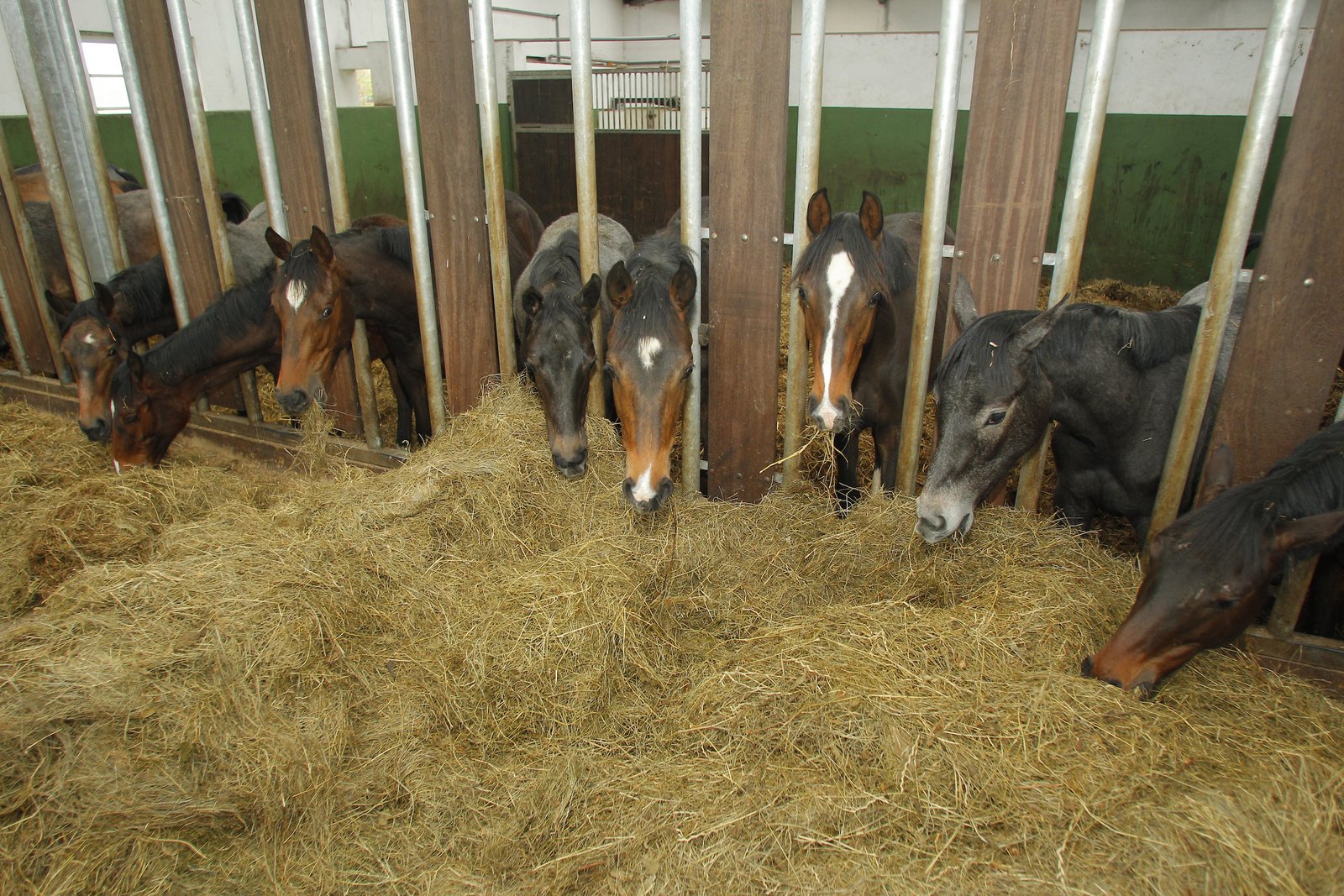
In front of the stable: paddock stalls overlooking the riding arena.
Hobby riders, like school horses, follow a program tailored to their needs. “They should get to go out a lot, spend plenty of time outdoors, and take in what’s happening here,” explains farm manager Elisa Herrges. And if the weather isn’t so nice, a tall, airy stable aisle awaits them inside. The indoor arena, two outdoor riding arenas, and a lunging circle offer plenty of options. The tack room shows that order is a top priority here—even if the concept of “law and order” has taken a bit of a hit in the operators’ eyes. But when you look out at the pastures, which lie just a few steps away from the actual riding facility, you forget all about that. Peace, quiet, horses. The Mühlbach estate spans about six hectares. Most of it was acquired through a hereditary lease, while the paddocks are leased.
Paddock stalls, Pilates, ponies, and horses
There are currently 22 horses on the farm; there is room for a maximum of 34. The old indoor stalls are mainly used to store hay and straw; the outdoor stalls are the ones that are primarily occupied. “We currently have 14 school horses; 18 horses belong to me, and then there are a few young horses who are just starting their training and are still on their way to the riding school,” explains Elisa Herrges. There are also ponies among them, so the size is just right for the little ones. There’s something for everyone. And “everyone”—that’s a lot of people who come into contact with horses here.
“We have about 200 riding students, ranging from the very youngest in the ‘Mini and Maxi Club Kids’ all the way up to advanced adult riders—so it’s a really diverse group,” says the master equine manager. She employs ten staff members to run the riding school, horse boarding facility, training courses, summer camps, and more.
Owner of Hofgut am Mühlbach: Elisa Herrges

To call her a “jack-of-all-trades” would be inappropriate. But it’s accurate. Because Elisa Herrges is thirsty—thirsty for knowledge. There are probably few people in Germany who run an equestrian center and can boast as many qualifications as she does. Elisa Herrges is
- Level A Riding Instructor (FN)
- Equine Physical Therapist (DIPO)
- Degree in “Equestrian Sports Management”
- Additional coaching certifications in “Seat and Balance Training” & “Saddle Evaluation”
- Pilates Instructor Levels C & B, Fitness Instructor Level C
- Training with Uta Gräf, among others
A Dream Found, a Dream Realized
It has been six years since Herrges came across a “For Sale” ad for the farmstead. However, she did not purchase the property at that time. Instead, she bought only the buildings and barns; the land itself is still owned by the town of Niddatal. Herrges holds what is known as a hereditary building right—that is, the right to operate her own farm on someone else’s land, as well as the right to pass it on to heirs or sell it.
She also leases the pastures from the city. The seller was the previous owner, who, according to attorney Hans-Jürgen Wartenberg, transferred the hereditary building right with the municipality’s consent. The deal was finalized while the current mayor, Hahn, was still in office. The mayor signed on behalf of the city—that is undisputed. The land registry office recorded the transfer of title. So everything was done by the book.
Took a Financial Risk
“Of course, it’s not like you’re just buying a pair of shoes,” says Herrges, looking back. The project couldn’t have been pulled off without a bank’s help: “We also have financing arranged with a bank for this, so there are a lot of people—experts—involved who review it and examine it before you actually get to the point of signing anything.”
For clarification: What does “hereditary building right” mean?
Anyone who builds under a
hereditary building right
does not become the owner of the land. Ownership remains (in this case) with the city. However, the holder of the right may erect a building—including an indoor riding arena and stables—and pays a so-called “ground rent” for this privilege. The transaction is notarized and recorded in the land registry. According to Elisa Herrges’ attorney, Hans-Jürgen Wartenberg, this right is inheritable and transferable and is governed by its own law.
Thorsten Masuch, a public law attorney, describes it as “use for a limited period of time: At some point, the property, including the structures on it, reverts to the owner.” When that happens is precisely stipulated in the contract (you can read the full interview with Thorsten Masuch on the topic of hereditary building leases here).
Specifically—can the city terminate the contract years later because of a signature?
In October 2025, the idyll comes to an end. That’s when Herrges first hears about problems. She isn’t contacted directly; instead, the previous owner reaches out to her. He had received a letter from the city’s attorney. “And I still remember exactly the moment when I saw a message from him on my phone, asking me to call him back urgently.” She calls him back during a short break between classes. “At first, I honestly couldn’t believe it.”
City Council Members Do Not Consider Themselves Bound by the Contract
At the end of August 2026, the city council members decide that both the purchase of the hereditary building right and the pasture lease should no longer be valid. Their argument: an alleged procedural error in the original transaction. A representative of the municipality states that a second signature was missing.
Attorney Wartenberg suspects that this may refer to the first deputy mayor. However, according to the attorney, it is not at all known whether such an internal directive even existed. The city intends to take decisive action and has already sent an eviction notice. Herrges is taking legal action against it.
The town remains silent—due to a poisoning murder
The mayor is not commenting. In response to an inquiry from the podcast *ERZÄHL MIR WAS VOM PFERD*, he stated that while they understand the public interest, they ask “for your understanding that we cannot and will not comment on this matter at this time.” Among other things, this is attributed to a poisoning murder case: A suspect reportedly worked at City Hall, the criminal investigation department conducted a search, and the employees are traumatized. This case has nothing to do with Herrges or the Hofgut.
A Visit from Customs
The tone is getting harsher. Herrges recounts a hearing in which terms like “a girl’s dream,” “pony farm,” and “naive” were used. “That’s just really hurtful, and it’s also really disrespectful,” Herrges says bravely. But you can tell by looking at her that the accusations are still gnawing at her.
And then there was the issue with customs. Suddenly, customs officers in full combat gear were standing in the yard. Herrges wasn’t at the farm that day, but her employees informed her immediately. An anonymous tip to customs alleging illegal employment was what triggered it. Yet her employees had been properly registered and deregistered; “given the circumstances, the accusation was completely baseless.”
But the operation had been dangerous. “Horses are flight animals; they react to unexpected situations and sudden movements.” Is there a connection between Customs and the city? You can’t prove something like that. Shortly before, a letter from a lawyer representing the city had arrived. It stated that she should abide by the law and “not spread any social media backlashes.”
“You Can Write Anything”
For attorney Hans-Jürgen Wartenberg, whom Herrges has retained, it is clear that the transaction is valid. Commenting on the city’s actions, he says: “You can write anything. The question is whether it has a reasonable legal basis.” Externally, the mayor is the official “who represents the municipality”; his signature at the time was sufficient. What’s surprising is that Wartenberg’s letter to the city asking what exactly is supposed to be null and void remains unanswered.
Even if there were indeed an internal error, the lawyer said, that would not be the buyer’s responsibility: “In that case, the municipality might have to deal with a claim for recourse.” He says that the city administration had also given the impression that the city was liable for the property. Wartenberg considers this unacceptable as well: The property is not encumbered, “the citizens aren’t liable for anything.” He checked with the district attorney’s office: “They haven’t received any complaint.”
Sell the horses, keep the loan
And what if the city sticks to its position? Herrges tries to stay calm: “Well, if it came down to it, I’d have to sell my horses, cancel lessons for my students, lay off my employees, and shut down my business here—basically, my livelihood. And then I’d be stuck with a loan that I could no longer make payments on.”
Claims for recourse: “I don’t know if 800,000 euros will be enough.”
Wartenberg points to the legal process: It is not possible “for the mayor to show up at the site tomorrow morning like a sheriff and shut it down personally. “That’s what the courts are there for—to decide such matters.” Even if the city were formally proven right, a decision wouldn’t be reached for years. By then, however, it would have caused damage for which the municipality would be liable: “And I don’t know if 800,000 euros would be enough.”
The Lawyer’s Sense of Unease
Wartenberg’s position is clear. He takes his client’s perspective. She hired him. That’s just how it is. But what does a neutral expert say?
Thorsten Masuch, a fully qualified lawyer and, until August 2025, an adjunct professor of public law at Harz University of Applied Sciences in Halberstadt, considers the city’s actions to be “legally rather questionable.” Due to the principle of protection of legitimate expectations, a reversal of the transaction could only be an exception: A right that was notarized, entered in the leasehold land register, and has been in effect for six years does not automatically lapse simply because the municipality made an internal error, such as a missing second signature. Has the city provided a justification? So far, “nothing.” While errors could possibly be rectified, the city is not seeking dialogue with the operators.
Open to
Discussion
Legally speaking, the immediate issue is the eviction notice. Attorney Wartenberg leaves no doubt that moving out without compensation is out of the question. However, he says money is negotiable—for example, if the city had leased the pastures on favorable terms: “We can talk about anything.” According to him, however, the municipality has not yet issued an official statement on the legal situation. The lawyer emphasizes: “We’re open to discussion.”
You can listen to the full podcast here.