Daniel Deußer on his World Championship horse in Aachen 2026, Otello de Guldenboom, and his sire, Tobago Z
Daniel Deußer: Otello de Guldenboom and his sire, Tobago Z – “They have something in common”
 from Jan Tönjes
 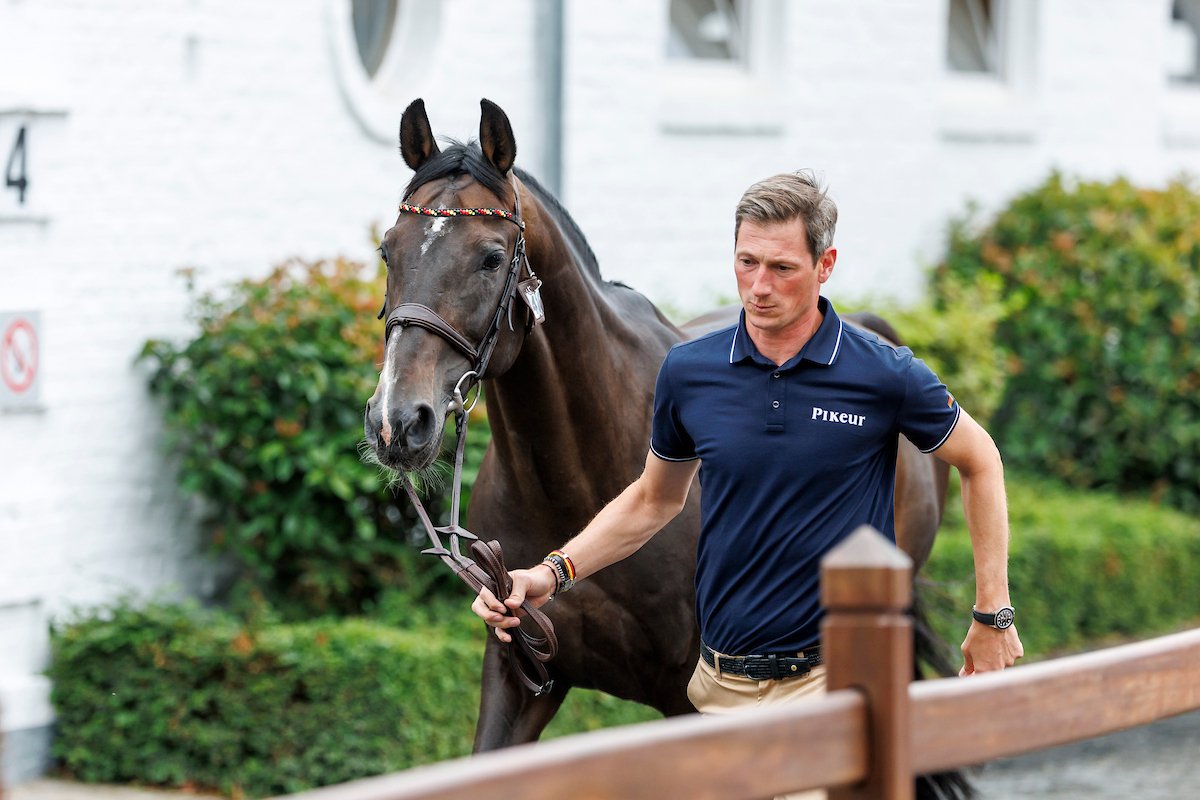 Daniel Deußer and Otello de Guldenboom, who is a descendant of Deußer's champion horse Tobago Z. Photo: sportfotos-lafrentz.de
 At first glance, Daniel Deußer’s 2026 World Championship horse, Otello de Guldenboom, and Tobago Z don’t have much in common. Otello, a bay with a distinctly rectangular build, is a son of Tobago Z. Tobago Z was a chestnut, rather small in stature (though Daniel Deußer’s height alone would certainly be an asset to any basketball team), and a chestnut with a mark or two.
They have more in common when it comes to their athletic achievements: Both have placed high in the World Cup finals. Tobago Z finished fourth in 2019, and his son finished second seven years later.
A Belgian with Holsteiner roots
The stallion was bred by Hugo Versnick in Reesegem, Belgium. Otello’s dam is named Caretina. She is a Holsteiner mare and descends fromCaretino-Cor de la Bryère. She has siblings and offspring that have been successful at the S-level. Her family is line 628B; a three-digit number—always an indication of a long breeding tradition.
The career of the Belgian horse sired by a Holsteiner dam began under Italian ownership. He was ridden by Gianluca Genussa and later, starting with 1.30-meter jumps, by Andrea Calabro. Calabro also owned the stallion. In 2023, the Tobago Z son advanced to the 1.50-meter level. “And then Andrea Calabro offered us the horse,” says Daniel Deußer. When he says “us,” he means his Belgian employer, Stephex Stables. Calabro said the horse was good. Stephan Conter, head of Stephex Enterprises, is always open to hearing about interesting horses. During the trial rides, it quickly became clear: “The horse could jump very, very high. The horse wanted to be cautious, but it was also a bit slower and its body wasn’t quite fully developed yet.”
“That horse could jump very, very high”
It was Kendra Claricia Brinkop who was riding the nine-year-old stallion during the trial ride back then. “Stephan and I were standing on the ground, just watching for a bit.” The deal was sealed, and Otello remained at Stephex Stables for further training. The son of Tobago Z then competed in his first shows under Stephan’s daughter, Emily. “However, Otello was simply too much of a horse for Emily,” said Daniel Deußer. “You can’t say he’s clumsy, but he’s a large-framed horse, a bit longer than what girls are used to.”
Systematically structured
Otello’s talents had been recognized. It was now up to Daniel Deußer to bring them together into a complete work of art. Jumping ability, canter, rideability—fine-tuning was on the training agenda: building momentum without the forward impulse being misinterpreted as an invitation to charge ahead. “You have to find a balance here. Of course, they need that frequency, that momentum, to clear a high jump, but you certainly don’t want that momentum to carry over into the race.” Keeping a horse in balance—or teaching it to be in balance—was the main focus. “Some horses have more of it, some have less, and we simply have to teach it to them.”
Viva Mexico!
The stallion—who, at competitions, shows absolutely no signs of being uncastrated—“though things might be different at home…”—grew into the sport. At the two- and three-star level, he was a horse who traveled along to gain experience. Things got serious overseas: “When he was just over ten years old, I took him on a tour of Mexico. And there he ended up winning one or two show jumping competitions. But more as a second horse. And since my first horse had been sidelined the previous week, he also jumped his first Grand Prix there. With one fault, but he still placed, and that was good.”
From then on, things took off—the World Cup season, culminating in the 2026 finals. “He jumped well every round. Just right. They were all tough rounds. When something really does go wrong—like here in Aachen during the second round of the Grand Prix, where he had two faults—I have to be completely honest: With the first fault, I might have ridden better; with the second, I should have ridden better because I was pushing a bit for time.”
An “unemotional horse”
Interesting: Daniel Deußer describes Otello as “unemotional,” unflappable. At first glance, one might almost think he’s detached. Deußer’s experience training Tobago in previous years helped him understand Otello. “Well, they have something in common in that neither of them is particularly striking during training or in the warm-up ring.”
I remember it very clearly with Tobago—he was also very sluggish in the warm-up arena and jumped the obstacles quite normally. You had the feeling that I’d never make it over a 1.55 oxer in the course.
That made him a little nervous at first, too. “I probably also wasted a lot of time trying to incorporate that into my training, which in the end never came up. But still, at some point in the course, it worked.”
Father and Son—Alike and Equally Successful
This realization—that less is more—has helped Deußer tremendously with Tobago’s son, Otello. You don’t have to repeat history; no 1.60-meter jumps in training at home: “The fact is, it’s not really necessary. Why do you have to jump high? You have to warm up your horse the way the horse needs it. And you can gauge what he gives you on the course. And you also have to learn a little bit to take each horse as he is. I think with Otello I never worried about it as much as I did with Tobago. That’s why I think everything went a little faster with Otello.”
The stallion has long since come into his own. The fact that he can sometimes dart just barely clear of the bars doesn’t bother his rider:“He does that every now and then. And to be completely honest, I don’t see it as a warning that he might make a mistake. His technique is such that his toes are sometimes a little lower than his leg.”
As the saying goes—”They win in all shapes”—and it’s also true that “They jump in all shapes.”