Amateurs in Equestrian Sports: Over 90 percent of all competitive riders are amateurs—but what exactly does that mean?
Amateurs in German Equestrian Sports – Competitive Riding, Yes; Competing Against Professionals, No
 from Jan Tönjes
 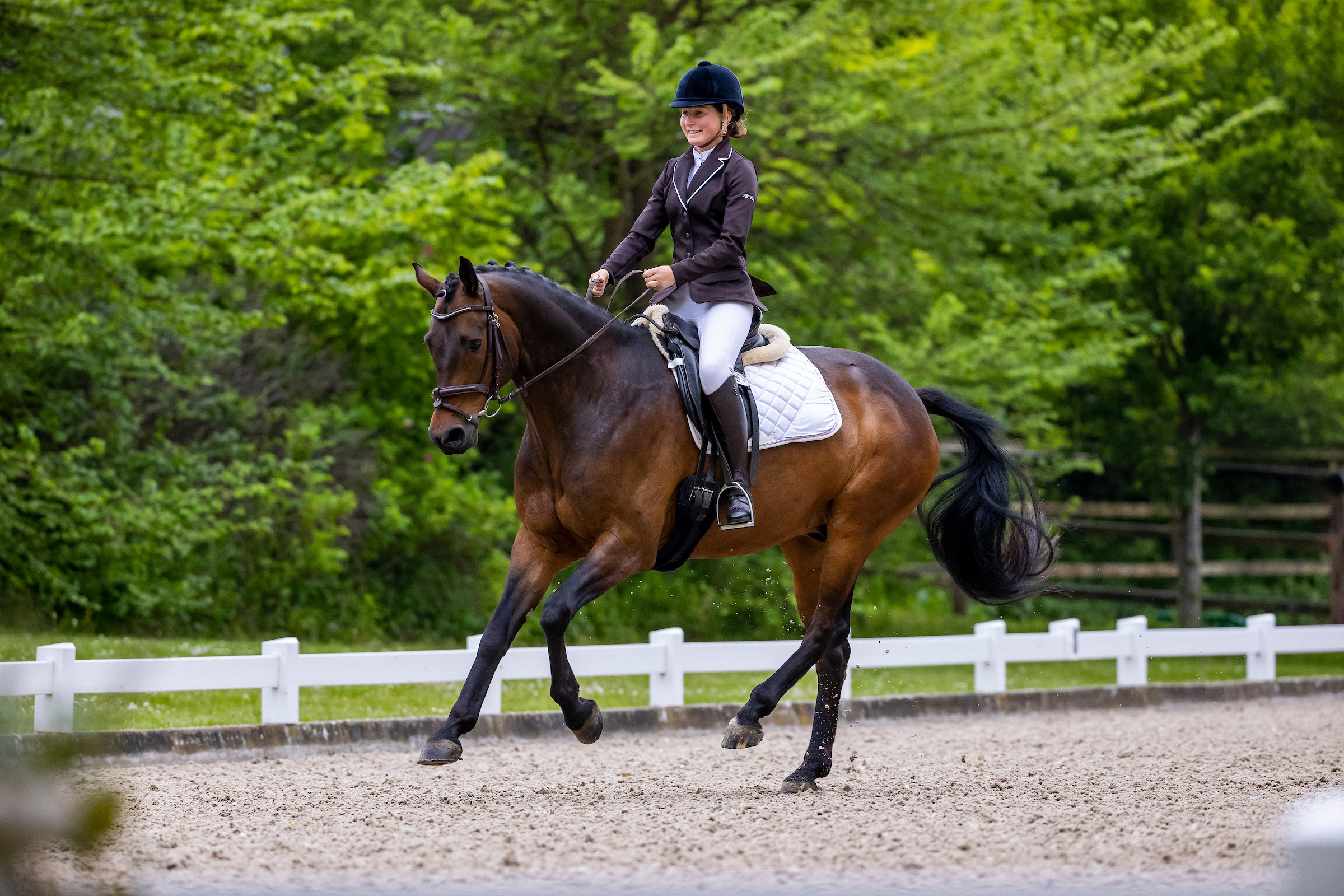 The criteria for who is eligible to hold "amateur" status in German tournaments are clearly defined. Photo: sportfotos-lafrentz.de
 Amateurs—what might sound like after-work sports, a hobby, or even “second-tier in terms of skill” is a world of its own.
LPO Regulates Amateur Status
The “amateur” status is clearly defined in German equestrian sports. Because the German Equestrian Federation (FN, now known as Pferdesport Deutschland) is responsible for everything related to competitive equestrian sports, it also plays a role here. More specifically: a single sentence in the implementing regulations of the Performance Test Regulations (LPO). Section 20.6.6 states:
An amateur is someone who does not earn an income from this activity on a commercial basis
- not by riding other people’s horses
- not through riding lessons,
- not through regular horse trading.
The threshold applies to compensation for part-time workers, known as “minijobs.” Training stipends for aspiring equine managers do not count as business income; they are expressly exempt.
How the “amateur” status came about in competitive sports
Until 2013, there was no separate competition category for amateurs. Hobby riders who competed against professional riders and highly successful amateurs with four or more competition horses usually came away empty-handed. Tough luck. “Closed competitions” were intended to remedy this. It’s a clunky name, but the idea behind it is simple: to determine the best among equals.
This has been the case since 2013. And the terms “amateur classes” are already explicitly mentioned in the competition announcement. These aren’t a courtesy on the part of the organizer, but a requirement: Since 2013, organizers have been required to schedule at least 20 percent of their classes for amateurs. If you’d like to read more about it, Section 23.3 of the LPO sets out the details.
What can amateur riders do to support the sport of horseback riding?
EQUI PAGES is dedicating an in-depth series with background information to amateur sports in the three Olympic disciplines. In this series, we aim to shed light on developments in Germany, take a look at other countries and how they approach amateur equestrian sports, and ultimately, at a live event, address the question of how amateur riders can proactively shape the future of equestrian sports. Especially in light of current public discussions, our guiding principle is: “Equestrian Sports in Crisis—and What We Can Do AboutIt”
Performance class is a deciding factor
However, amateur status does not depend solely on income. Anyone in performance class 7, 6, or 5 is automatically classified as an amateur.
Starting with performance class 4, the number of placed horses becomes a factor
Things get more complicated starting with performance classes 4, 3, or 2: What matters here is whether, during the previous season—from October 1 of the year before last through September 30 of last year—successes in the respective discipline were achieved with no more than three different horses. Successes in dressage and show jumping classes count toward this requirement, but successes with ponies do not. So even if you consider yourself a true amateur rider, you can no longer maintain that status if you achieve success with four horses. Caution: Anyone who, as a one-time exception and out of courtesy, rides a difficult horse for a neighbor in the stable aisle in a show jumping class and places in the competition will lose their status if they have placed “in the money” with three other horses during the same season.
Too good, three-star level, LK 1 – “Unfortunately, we have to stay outside”
Anyone who is in Performance Class 1 or has more than one victory in Class S*** or higher is no longer considered an amateur—at least in the discipline in which those victories were achieved. Horse Management Masters and Horse Management Specialists with “Classical Riding Training” are generally not permitted to compete in amateur classes, unless it has been four years since they changed careers.
Learned to ride, changed jobs—all just for fun, or what?
Upon request, amateur status may be granted in such cases. All you need is a form and a check mark next to “It has been more than 4 years since I completed my training as a horse manager in classical riding.” In addition, an affidavit is required attesting that the signatory does not earn any commercial income in the equestrian sector. This classification is reviewed each time the annual competition license is renewed. Those eligible to hold this classification are listed in the Nennung Online portal with the corresponding suffix “(Amateur)” following their performance class.
Anyone who jumps over 1.50 meters will lose their passport
Internationally, the rules are getting even stricter—and this applies specifically to show jumping. Anyone wishing to compete as a “CSI amateur rider” at international tournaments needs a separate license issued by the FN (click here for the form). This costs 100 euros plus VAT, including FEI registration. The minimum age is 14. Twelve- and thirteen-year-olds may participate in CSI-Am classes, but only at heights up to 1.30 meters. Horses must be at least six years old; for amateur championships, they must be at least seven.
So consider carefully who can clear such high jumps…
And then there’s the clause that really packs a punch: Anyone who competes in a national or international tournament during the current calendar year in which the first round of a show jumping competition measures 1.50 meters or more loses their amateur status—immediately, for the remainder of the year.
This upgrade can only be reversed after a waiting period, in consultation with the FN. However, this cannot under any circumstances occur within the same calendar year. Furthermore, anyone holding an amateur license is generally excluded from participating in other CSI competitions at mixed CSI/CSIAm tournaments in Germany.
International Amateur Show Jumping Competitions
There are two types of internationally organized amateur tournaments: CSIAm-A with prize money and CSIAm-B without. The maximum entry fee per horse is 1,500 euros, excluding VAT—the rest, including boarding fees, transportation, hotel, and customs duties, is the responsibility of the participants anyway.
Organizations for Amateurs in German Competitive Sports
There are various initiatives dedicated specifically to amateur riders. Many of them are organized on a regional basis. The two largest associations involved in amateur competitions are the Amateur Show Jumping Club (ASC) and the Association for the Promotion of Amateur and Professional Riders (FAB).