The First Equestrian Club Exclusively for Amateurs: Here's How the Association for Amateur and Professional Equestrian Sports (FAB) Works.
FAB Association for Amateur and Professional Equestrian Sports: Operating its own (tournament) system for 30 years
 from Jan Tönjes
 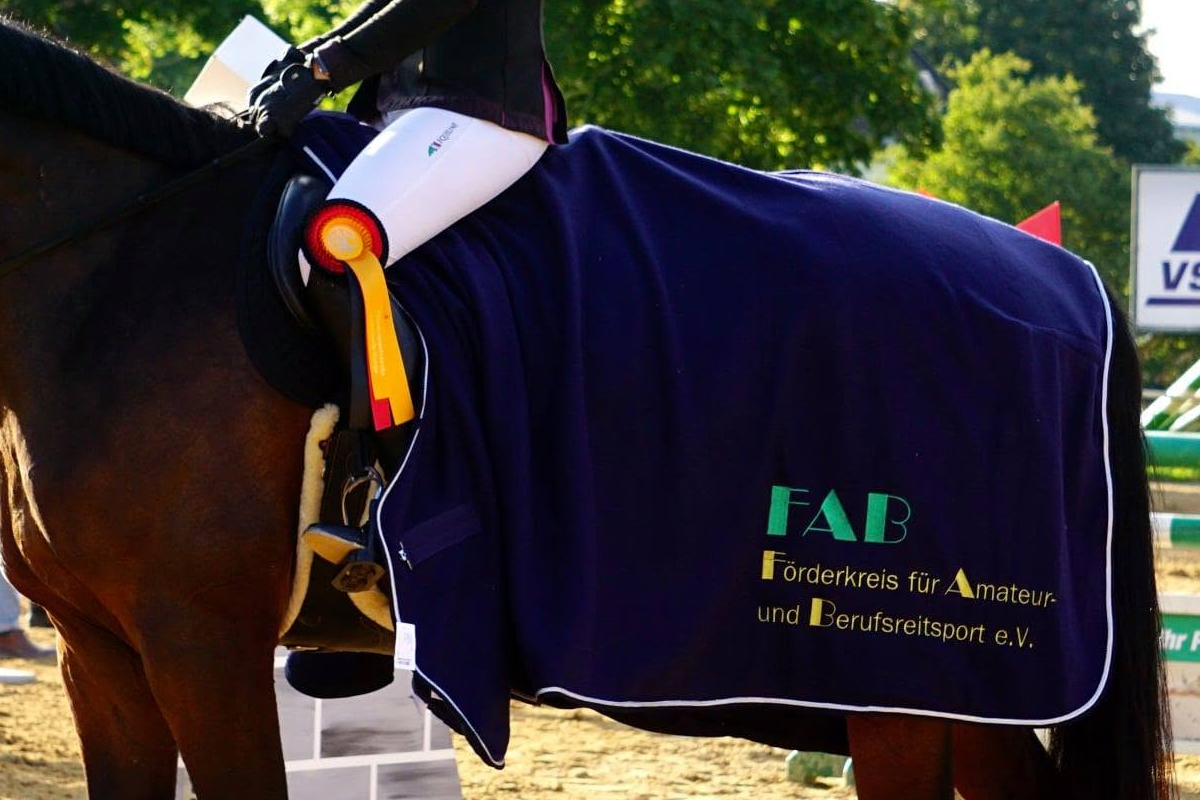 FAB Association for Amateur and Professional Equestrian Sports (FAB) Photo: acebook.com/FAB.Foerderkreis/
 The FAB has been around since the 1990s. Back then, a unique tournament system was developed—with a focus on amateur riders, based on the FAB’s own definition of “amateur” and featuring its own dressage and show jumping competitions. In addition—and this is what truly sets it apart—the scoring system allows the amateurs’ own trainers to become winners as well. In addition to the winner’s glory, their coach can also look forward to financial recognition. This was a novel concept and remains to this day a unique selling point of the Förderkreis für Amateur- und Berufsreitsport.
An amateur differs from a professional neither in terms of time, money, nor talent
That is essentially what the FAB guidelines state. This sentence sums it all up. Anyone classified by the FAB as a “non-professional tournament participant”—to use the official term—may not earn income on a commercial basis: not by riding other people’s horses, not by giving riding lessons, and not by trading horses.
Strict Rules
In this respect, the FAB definition largely coincides with the FN’s LPO definition of an amateur. According to the FAB’s amateur statutes, a “non-professional competition participant” may have achieved success in the respective discipline with no more than three different horses during the previous season—from October 1 of the year before last through September 30 of last year. If this number is exceeded, the participant is no longer eligible for FAB competitions. He or she must then comply with the requirement again over two consecutive competition years before a return is possible. There is one exception: Anyone who submits an application to their own regional association and is granted FN amateur status there will also be recognized by the FAB.
Trainees may start at FAB for the time being
There are also clear rules for apprentices: During their first and second years of training, provided they are in performance class 3 or lower, they are also considered “non-professional competition participants.” Their apprenticeship wages, which are governed by collective bargaining agreements, are expressly not counted as “harmful income.” There is one more exception: Anyone who earns expense reimbursements from volunteer work within their own club—that is, who contributes to the (equestrian) community—can receive up to 556 euros per month for this without jeopardizing their amateur status. This ensures that riders who hold club offices still retain access to FAB tournament events.
What Counts as Income—and What Doesn’t
The FAB Amateur Bylaws define income very broadly: Any compensation for riding or instruction counts, including payments in kind—even if the money goes to a third party. If a rider is ridden free of charge by a professional colleague on the latter’s horse, the rider is expressly considered a “non-professional rider.” Tips and occasional gifts not linked to any service rendered do not count as income. Anyone who no longer meets the conditions during the course of the season is obligated to notify the event organizer and the FAB office directly and to withdraw from the competition—event organizers may disqualify riders in the event of known violations, but must first give the affected rider an opportunity to respond.
L, M, S – the right test for every skill level
Competition takes place at the “First Grand FAB Amateur Cup”—the FAB tournament series featuring various stops—in the two disciplines of dressage and show jumping, in the L, M, and S classes respectively. The principle: Amateurs who compete against other amateurs in their performance class—rather than against professional riders or highly successful frequent competitors with four or more tournament horses—have a realistic chance of winning a prize and placing.
The qualification results are used to calculate a running FAB series standings: The winner of a competition receives 35 points, the runner-up 32, and third place 30—from there, points are awarded in increments of two. Each participant is credited only with the points earned by their highest-placed horse; any other placed horses ridden by the same rider are removed from the standings, and the next participants in line move up. In general, only FAB members or trial members can earn points—placed riders without FAB membership are simply treated for ranking purposes as if they had not placed.
At the end of the qualifying series, there are state finals and a national final, for which the top amateurs qualify based on their rankings. Participants do not need to submit their own results from a qualifying event—the organizers automatically forward them to the FAB results service.
When the Coach Shares in the Victory
However, what truly sets the FAB system apart is not the riders, but their trainers. “Riders let their trainers win” is the FAB’s motto. For every competition won, the trainer of the winning rider receives a reward of 50 euros, the trainer of the runner-up receives 30 euros, and the trainer of the third-place finisher receives 20 euros.
The more “prestigious” the tournament, the more recognition for those responsible for training
At the FAB State Championships in dressage and show jumping for classes L, M, and S, the prize money increases: 300 euros for the trainer of the state champion, 200 euros for the trainer of the state runner-up, and 100 euros for the trainer of the third-place finisher. The National Finals of the “First Grand FAB Amateur Cup” take it to the highest level: the prize money reaches four figures! The coach of the FAB champion receives 1,000 euros. If the rider finishes as runner-up, the coach gets 500 euros. And for third place in the national standings, the coach still receives 250 euros. If a rider has not designated an FAB coach, the prize money is forfeited without replacement.
Coaches must be members of the FAB
In order for a trainer to be eligible to participate in this ranking at all, he or she must be a FAB member. Within the FAB system, he or she is then automatically considered a “professional” and, in turn, is not permitted to earn Cup points while riding. A prerequisite for payment is also a signed coach’s declaration as well as proof of minimum professional qualifications: a Coach C license or completed vocational training in equestrian sports.
If a rider changes coaches during the season, this is also clearly regulated: The change of coach must be reported in writing to the FAB office, including the names of the old and new coaches as well as the horse in question; the date of receipt by the office will be used for evaluation purposes.
How Much Does the FAB Cost?
- Annual membership fee for full members (effective January 1, 2026): 95 euros
- Reduced annual membership fee (automatically for youth up to age 18; for those 18 and older, proof of student, apprentice, or trainee status is required): 70 euros
- L-Series Member Fee: 25 euros*
- M-Series Member Fee: 50 euros*
- S Series Participant Fee: 75 euros* *Due upon submission of the first entry for the respective series; one-time fee per calendar year
- Trial membership: 40 euros, one-time fee per calendar year (will be credited toward the full membership fee if you upgrade to full membership within the same year)
- Full Coach Membership: 85 euros per calendar year
Trial members may participate in three FAB qualifying events regardless of their own state association and earn “shadow points” in the process, which will be converted to regular series points upon conversion to full membership. Trial membership is open exclusively to riders who have never previously been trial or full FAB members.
The FAB Coach Award at a Glance
| Level | 1st Place Coach | 2nd Place Coach | 3rd Place Coach |
| Individual FAB Certification | 50 € | 30 € | 20 € |
| FAB State Championship (L, M, S) | 300 € | 200 € | 100 € |
| FAB National Finals | €1,000 | 500 € | 250 € |
Requirement: The coach must be a FAB member and must have submitted a valid coach declaration, including proof of qualification (Coach C certificate or completed vocational training), to the office.
Organized nationwide, with strong regional roots
Unlike the state associations within the FN structure, the FAB is not organized through its own regional units with designated local contacts, but rather centrally through its office in Bergisch Gladbach. In doing so, it cooperates closely with the existing state association structures of the German Equestrian Federation.
The heart lies in the Rhineland
Formally, the FAB is an affiliate of the Rhineland Regional Equestrian Association and a member of the German Equestrian and Driving Federation (DRFV). At the partner level, it also cooperates with the Bavarian Equestrian and Driving Federation and the Rhineland Equestrian Federation, through which some of the qualifying tournaments are also held.
I’d like to host a FAB certification course—what do I need to do?
Organizers who wish to host a FAB-qualified event themselves may apply directly to the FAB office, independent of their state association—the FAB supports these tournaments with honorary prizes and, in the case of FAB-only competitions without external amateur competitors, additionally with subsidies toward the prize money: 100 euros per division in Class L, 150 euros in Class M, a flat rate of 300 euros in Dressage Class S, and 500 euros in Jumping Class S.
From a Niche Project to a Nationwide Association
The FAB’s roots go back a good 30 years. The support group was founded by Wolfgang Maus and Martin Meister—both of whom remain associated with the association to this day as honorary members—along with Sylvia Geuss-Kierdorf, Ingrid Baruch, and Erhard Pott.
Convincing the state associations and the FN of the importance of the idea of an independent amateur development program required a great deal of patience: it didn’t happen without some friction. At times, the very survival of the club was even in question.
FAB’s Influence on “Traditional” Equestrian Sports
At an extraordinary general meeting in November 2017, the possibility of liquidating the club was raised. However, the members wanted to continue, and a fresh start was made with new leadership. New ideas were also implemented, such as the precision time trial in show jumping—now LPO-compliant as a show jumping test with an ideal time in accordance with § 535 of the Performance Testing Regulations (LPO). A pilot project was also tested in which para-sport and able-bodied amateur athletes competed together in a single competition. Last but not least, the club also claims the inclusion of the term “amateur” in the LPO as a success resulting from years of advocacy on the part of the FAB.
FAB Office
FAB e.V. P.O. Box 10 01 01 51401 Bergisch Gladbach
Phone: 02204 424794 or 0176 34655494 Fax: 02204 424793 Email: office@fabev.de Website: www.fabev.de Instagram: @fabev_
Phone hours: Monday and Wednesday, 9–11 a.m.; Tuesday and Thursday, 2–4 p.m.
Important Forms to Download
- FAB Amateur Status Declaration 2026 (PDF)
- FAB Amateur Bylaws 2026 (PDF)
- Coach Change Form (PDF)
- FAB Trainer Statement (PDF)
What can amateur riders do to support the sport of horseback riding?
EQUI PAGES is dedicating an in-depth series with background information to amateur sports in the three Olympic disciplines. In this series, we aim to shed light on developments in Germany, take a look at other countries and how they approach amateur equestrian sports, and ultimately, at a live event, address the question of how amateur riders can proactively shape the future of equestrian sports. Especially in light of current public discussions, our guiding principle is: “Equestrian Sports in Crisis—and What We Can Do AboutIt”