A Profile of Katharina Rhomberg, Austria's Most Successful Show Jumper Today
Katharina Rhomberg – Austria’s World Championship Hope
 from Dominique Wehrmann
 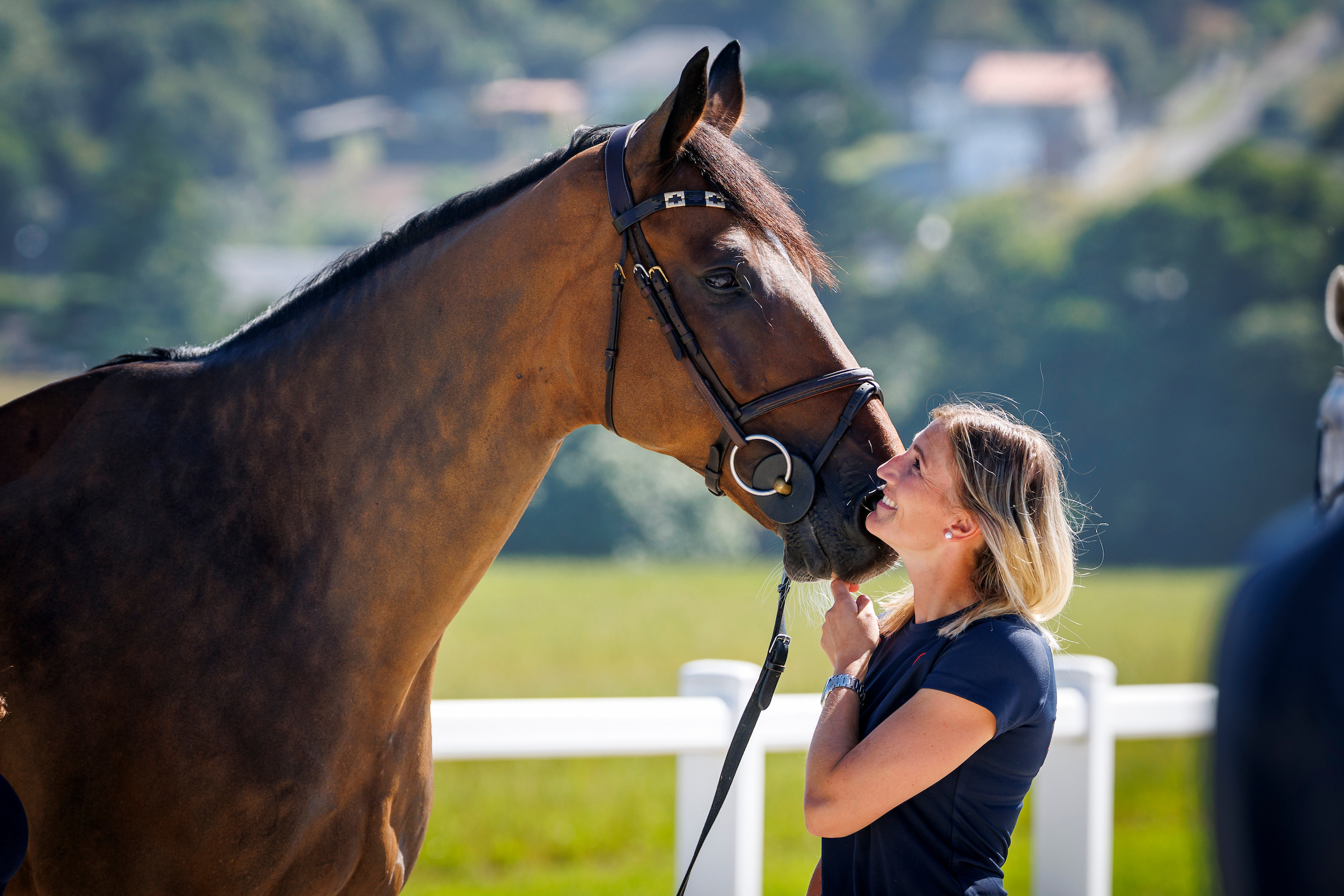 The Best of Friends: Katharina Rhomberg and the "kindest-hearted" Cuma.
Photo: sportfotos-lafrentz.de
The Best of Friends: Katharina Rhomberg and the "kindest-hearted" Cuma.
Photo: sportfotos-lafrentz.de Katharina Rhomberg is currently Austria’s top show jumper. Not only because she became national champion for the first time in mid-June with one of her young horses, but also because she has been competing at the very top for years, both nationally and internationally. At the 2023 European Championships, she and her teammates made history: They won Austria’s first team medal in show jumping and thereby also qualified for the Olympics, where they competed as a team in 2024. In 2025, Rhomberg made her third appearance at the European Championships.
So she has already achieved, experienced, and seen quite a lot in show jumping. But she has never been more successful than she is right now. She recently celebrated her first victory in a five-star Grand Prix. We spoke with the 33-year-old and got to know a down-to-earth person who works hard for her success.
Local History Society
Katharina Rhomberg’s horses are stabled at the riding club in Dornbirn, where she first began riding as a child many years ago. Her parents had already leased a stable bay there, and she and her brother Christian—who, like her, is an internationally successful show jumper—grew up around horses. Their parents taught them how to ride, but otherwise they were responsible for ensuring their horses were well cared for. Feeding, grooming, and mucking out came before riding.
However, it wasn’t a foregone conclusion that Katharina Rhomberg would one day occupy two stalls at her home club. Although the 33-year-old dreamed of a career as a professional, she also knew that it would be a difficult path. “I first earned my high school diploma and then studied business administration to have a safety net. After finishing my studies, I reached a point where I had to decide: Should I take a regular job, or should I try to work part-time and ride part-time?”
However, she quickly realized that this wasn’t feasible in the long run if she wanted to pursue the sport seriously. “A regular job is just too inflexible. I can’t schedule tournaments the way I need to.”
So, at the age of 22, she took the plunge and devoted herself entirely to horseback riding. Looking back now, it was the right move—even though she had her doubts from time to time.
The Right People Along the Way
“There were times when I kept asking myself: Am I really good enough? Can I make it to the top? Doubts like that are part of the process.” The people closest to her helped her through those situations. Rhomberg: “I’d say about half the people in my extended circle didn’t really believe in me. They said, ‘You won’t make it; you’re better off staying in Ländle.’ And the other half believed in me more than I believed in myself.”
She considers the latter—along with the mental coach who has been working with her for five years—to be the decisive factor that has helped her progress. This includes, above all, her family, but especially her horse’s owner, Gerhard Rauch. He, however, is also part of the family in a sense, since he is, so to speak, her father-in-law, even though she and her boyfriend aren’t married.
Rauch didn’t really have anything to do with horses, but he was interested in what his (step)son’s partner was doing and attended the competition at the local stable in Dornbirn. Rhomberg rode and had one knockdown. Another rider had two horses in the competition and won the class with the second one. “He thought it was unfair that she had two chances,” says Katharina Rhomberg. “I explained that I only have one horse that I can ride in competitions like that. He replied that he’d buy me another horse right away.”
No sooner said than done. That was eight years ago. Eight of her ten horses now belong to Gerhard Rauch.
Influential Trainers and Horses
In terms of equestrian training, three coaches had a particularly strong influence on Katharina Rhomberg’s career: Susanne Behring from the time she was 16 until she was 22, followed by Kurt Gravemeier, and for the past three years or so, Thomas Balsiger, the father of Swiss show jumper Bryan Balsiger.
“Kurt Gravemeier helped me move up to the higher classes,” recalls Katharina Rhomberg. “It was under his guidance that I competed in the Austrian National Championships for the first time. He always believed in me and matched me with the right horses.” Above all, her two top horses, Cuma and Colestus Cambridge. Although the former German national team coach had to push her a little to get her to ride both of them.
“Both came from Markus Merschformann,” Rhomberg reports. “When I test-rode Cuma, he was seven years old. It was clear that he had a lot of quality. But he was a huge horse with a massive canter. I’d never ridden anything like that before, and I said, ‘I can’t ride him!’ But Kurt convinced me.” For which she is extremely grateful today.
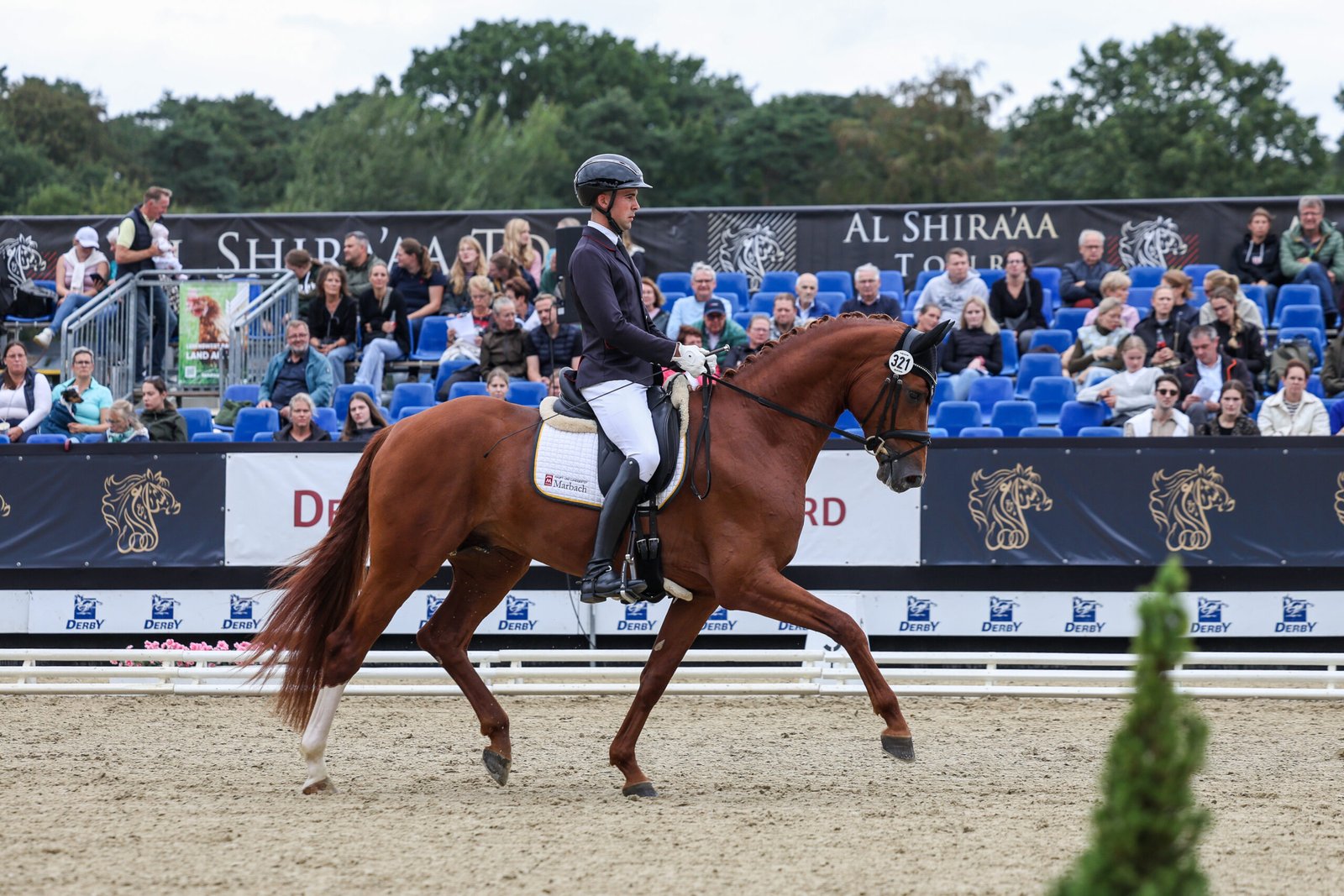
Riding the Comme il faut son—now 14 years old—she was part of the bronze-medal-winning team at the 2023 European Championships. She also competed with him in the other two European Championships, as well as the 2022 World Championships in Herning. Most recently, the pair scored a double-zero in the Nations Cup in St. Gallen, helping their team—as the top pair—to a sensational second-place finish.
“He’s the kindest horse,” says Katharina Cuma. “He gave me an incredible sense of security during my first really tough competitions. Back then, I wasn’t as far along as a rider as I am today. With him, I’ve experienced everything from 1.45 to 1.50 meters all the way up to the very, very most difficult show jumping events. He simply clears everything—he has incredible ability. That helped me a lot.”
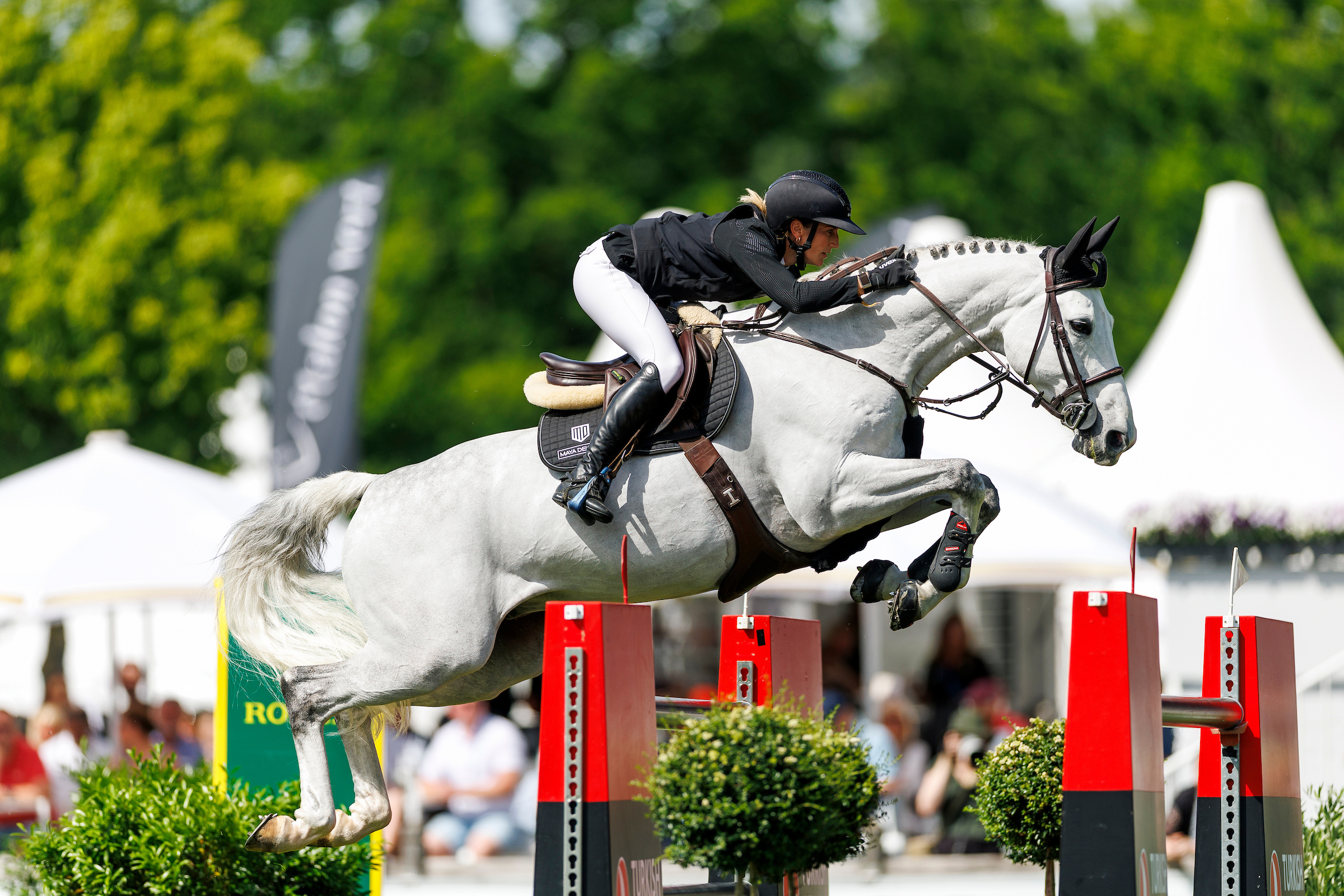
Colestus Cambridge, the Video Purchase
What she learned at Cuma proved invaluable in training her second top horse, the 11-year-old Colestus Cambridge, who capped off Rhomberg’s St. Gallen weekend with a second-place finish in the Grand Prix. He, too, came to her through the Merschformann-Gravemeier connection.
“He’s the only horse we’ve ever bought based on a video without trying him out,” Rhomberg reports. “Kurt Gravemeier was absolutely thrilled with him. He said he was a world-class horse. To be honest, you couldn’t really tell that from the video because he was casually hopping over small jumps. I wasn’t sure if he was really a top-class horse. But Kurt was so convinced that he called my horse’s owner. Then we had to act fast because there were other interested buyers as well. We decided that if he was healthy, we’d take him.”
That’s how Colestus Cambridge came to Katharina Rhomberg at the age of six. She realized just how right Gravemeier had been in his assessment as soon as she entered him in his first competition. “His greatest strength is his attitude. When he’s at a competition and gets to jump, he really comes alive. It makes him happy—you can feel it right away. You can sense a whole different zest for life in him.” In addition, the Colestus son, bred by Udo Grochowski, is “incredibly smart.” “You can really tell how he thinks for himself on the course,” says Katharina Rhomberg.
Start with Hänschen
It’s not just these two—all of her horses came to her when they were quite young. Katharina Rhomberg sees this as a major advantage. “Aside from the fact that you can train them to your own riding style early on, the truth is: the more time you spend together, the stronger the bond becomes. Sure, it can be easier to buy a horse that’s already fully trained. But I’m convinced that rider and horse must trust each other 100 percent to be successful. In a jump-off, milliseconds make all the difference. The better the communication between them, the greater the chances of success.”
And there’s something else that matters to Rhomberg here: she can precisely control how much work the horses do. “Basic training is the most important thing. And no matter how eager the horses may be, you have to build up young horses gradually and only ever ask of them what they’re physically and mentally capable of. They also need plenty of rest breaks.”
Gut feeling and team spirit
When that’s the case is usually determined by her own gut feeling. “I know my horses—for some, less is more, while others need more starts. A plan is good and important, but you have to stay flexible.”
In addition to her gut feeling, Katharina Rhomberg trusts her team. “A good veterinarian, farrier, physical therapist, and so on are essential. Once you’ve found them, you should definitely stick with them—even if things don’t go so well sometimes. Then you have to work together to find solutions.”
And working on yourself, as Rhomberg knows. “For a while, I had a problem with both horses (Cuma and Colestus)—they weren’t responsive enough for the really difficult, technical courses. That’s why I worked on my dressage with Thomas Balsiger, Franke Sloothaak, and the Swede Pether Markne. That helped me incredibly on the course.”
So much so that this year, in Versilia, Italy, she won her first five-star Grand Prix with Colestus Cambridge. A major moment that, in Rhomberg’s view, can be attributed not only to her dressage training. “Over the past two or three years, I’ve really focused intensively on my mental and physical fitness and improved my riding. At the same time, my horses have developed. It was actually a continuous process, and now we’re on the same page and everything fits together.”
Being able to let go
The victory in Versilia was a dream come true, says Rhomberg. But her favorite moments in the sport aren’t necessarily the ones where a ribbon is at stake. “Aside from the sheer feeling of success, it’s also just wonderful for me to see how far we’ve come with the horses. When you’ve known a horse from a young age and walk this path together—all the way to the top—that’s something very special.”
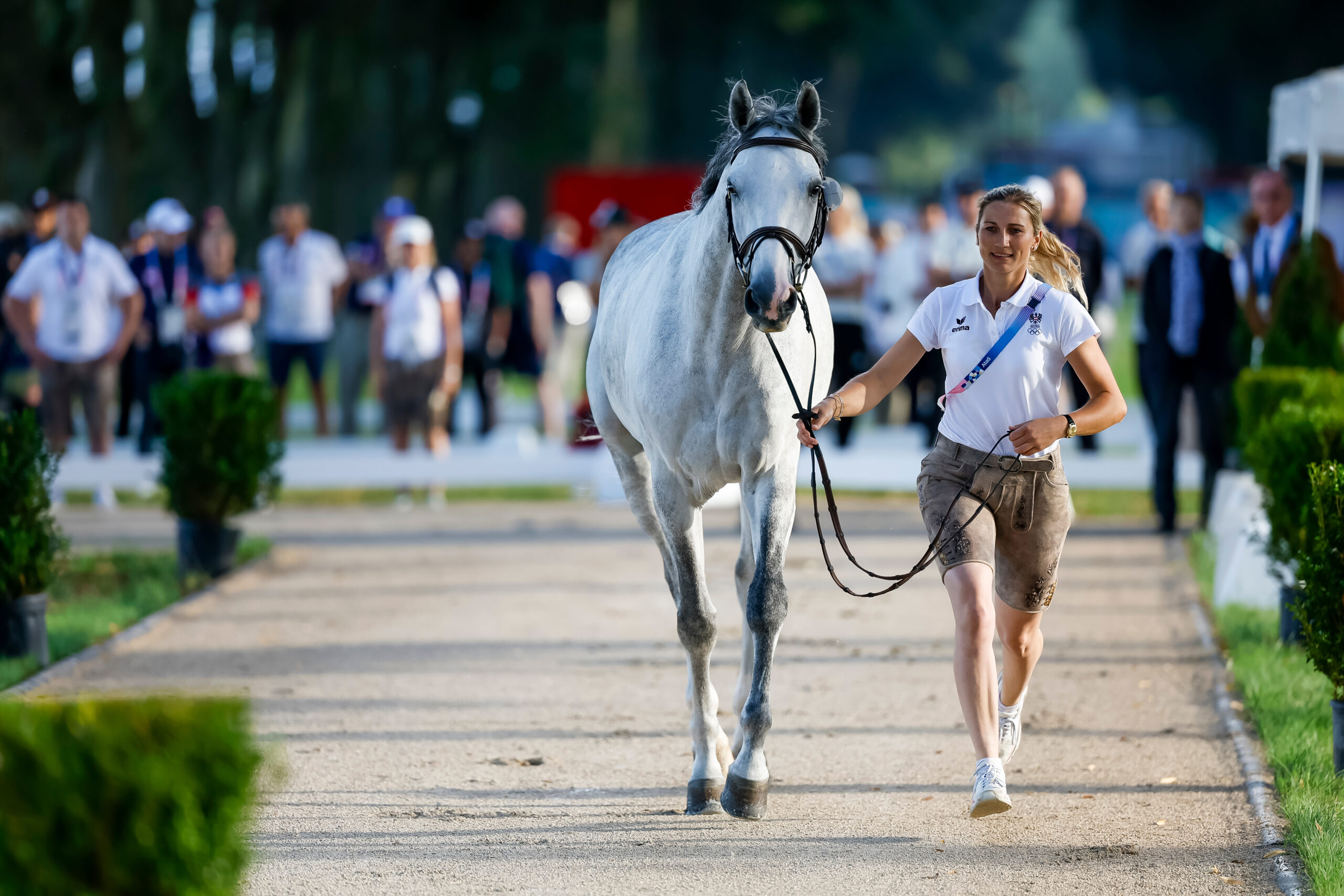
One horse with whom she has traveled this path is Cody, a son of Cardento out of the Holsteiner line. She rode the 15-year-old gray for seven years, competing with him from the Youngster Tour all the way up to the CSI5*. But now she has passed him on to a young rider, even though he’s still in top shape. “It was really hard for me, but I noticed that he no longer takes as much joy in jumping over 1.45 meters as he used to. He used to charge at every obstacle and tackle them with fiery enthusiasm. That was still the case with the lower jumps. But the higher the jumps got, the more I felt that he was losing his joy. And it’s important to me that the horses enjoy what they’re doing. Only then do they truly deliver top performances.”
Of course, she could have kept Cody and ridden him in smaller competitions. But that seemed unfair to the horse. “Now, with Livia Schranz, he has a 12-year-old rider who is completely devoted to him. It already worked out really well at their first competition.”
You could say that. The first tournament was the Children’s State Championship. After the first class with Cody went like clockwork and Livia’s usual horse got injured, she decided on the spot to saddle Cody for the remaining events as well—and became champion. “That was really wonderful for me to watch, too. When you can hand a horse over with a clear conscience because you know he’s doing well, that’s exactly the right thing to do,” said Rhomberg.
Nearby and distant destinations
It’s safe to say that Katharina Rhomberg and her horses are in the best shape of their lives—just right for the World Championships in Aachen. “The official nomination hasn’t been announced yet, but I know that I’m on the list with Cuma and Colestus. Both have already shown this year that they’re in top form.”
The goal now is to maintain this form—and she’s planning to compete with Colestus at the World Championships. Rhomberg has a well-thought-out plan for this: “Two tournaments on beautiful grass courses in Samorin and Valkenswaard. Then a two-week break and preparation, and then it’s off to the World Championships,” she outlines the plan. “The goal is for the horses to be in top mental and physical shape and for all of us to arrive in the best possible condition.” So that they can then deliver the best possible performance.
Many of her dreams have already come true in recent years. But Katharina Rhomberg still has one big dream: “My own stable, my own facility—that would be it. And then, to stay at the top consistently with several horses. And if, someday, I look back on this time and can say that I built and earned all of this myself, that would be the best thing ever!”