The story of show jumper René Dittmer
René Dittmer – a story of talent, courage and perseverance
 from Dominique Wehrmann
 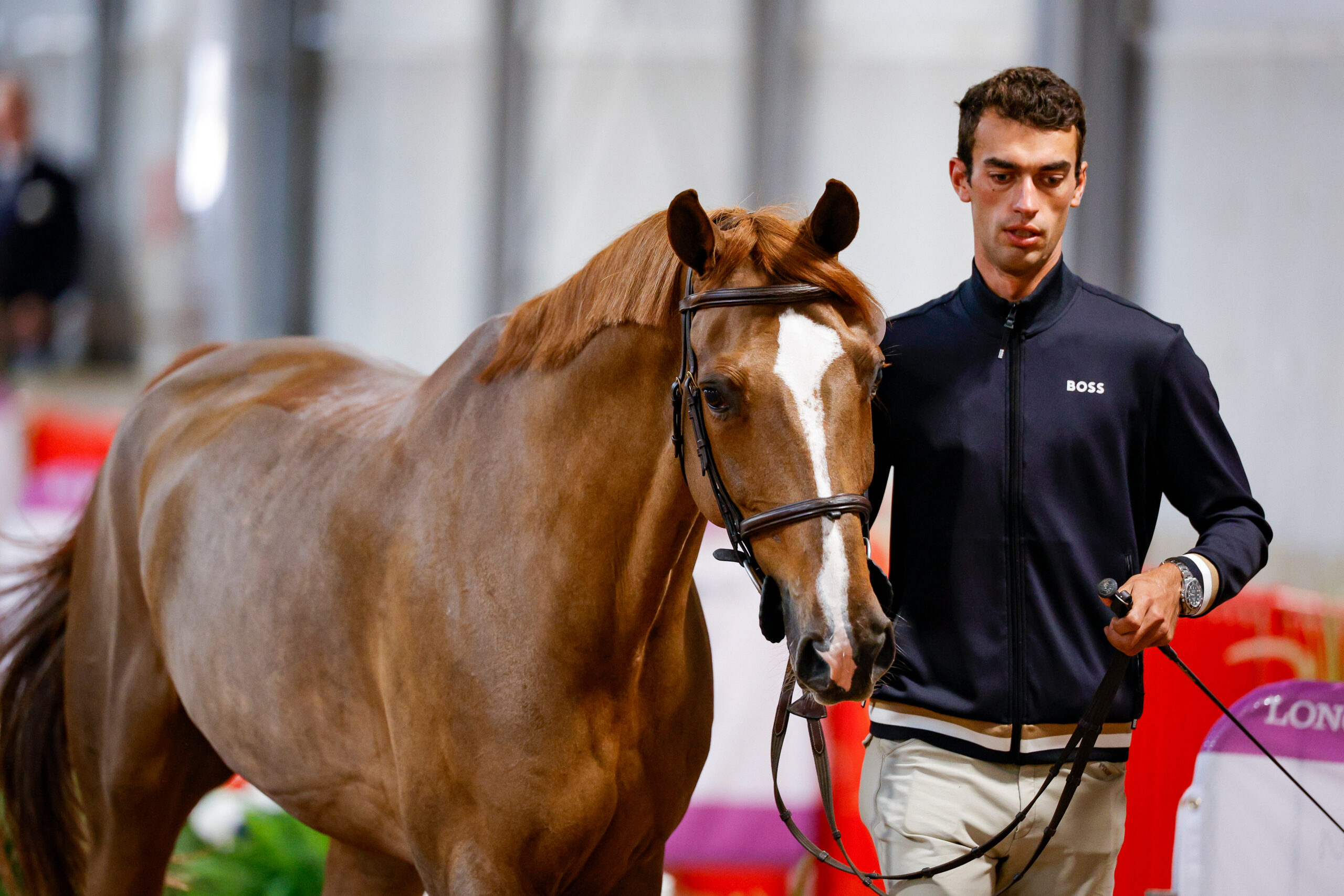 A well-rehearsed duo: René Dittmer and the Holsteiner Casall son Cody. Photo: sportfotos-lafrentz.de/Tiffany van Halle
 René Dittmer would be a hot contender for a medal at the 2026 German Championships, but national coach Otto Becker needs him for the CSIO5* Nations’ Cup in St. Gallen. The national title competitions in Balve will therefore take place without last year’s third-placed rider. It’s a shame, because René Dittmer has been a household name to anyone interested in show jumping since his victory with the German team at the League Of Nations stage in Ocala and his sensational fourth place at the World Cup Final in Fort Worth, Texas.
The USA is Dittmer’s second home. Just like at the beginning of the 19th century, when the first great wave of migration from Europe swept into the USA, René Dittmer’s hunger drove him to seek his fortune overseas – the hunger for success, the desire to prove himself. Despite all doubters – first and foremost his parents.
He has been on assignment in the United States for several weeks every spring for a number of years now. What was a great adventure the first time around has proved to be a courageous but well-considered and absolutely right move. The success has proved Dittmer right in his decision. Not only in this respect.
A love of horses runs in the family
René Dittmer comes from Stade, not far from Hamburg. His father was a truck driver, his mother a bank employee. Not an exorbitantly wealthy family, but one in which horses have always played a role. Dittmer’s parents kept them at the house, had their own small stable and a riding arena. René sat in the saddle for the first time at the age of six. He got his own pony. But you can well imagine that the two-metre tall lout quickly outgrew his pony size. So he switched to horses when he was eleven.
His parents had an eye for getting their son the best possible mount. “I had a pretty good horse back then, with which I was able to compete in the German Championships as a junior and young rider,” reports Dittmer. However, just like Richard Vogel, Sophie Hinners and Christian Kukuk, he was never part of a junior European Championship team at a young age.
If it had been up to his parents, riding would have remained a hobby for René Dittmer. He took his A-levels and began to study International Management. But the horses wouldn’t let him go. “I always rode on the side. Then at some point the riding took over.”
He had to and wanted to make a decision – in favor of riding. “In the end, I dropped out of university and joined Markus and Meredith Michaels-Beerbaum.” The MMB show stable in Thedinghausen is in the immediate vicinity of Dittmer’s parents’ house in Stade. He says: “It also brought me to international competitions, which had a huge impact on me.”
He rode for Markus and Meredith Michaels-Beerbaum for three and a half years, after which he ventured into self-employment. That was in the early 2020s.
Who dares, wins
That in itself requires a certain amount of courage to take risks. After a year or two of working in Germany at his parents’ facility, he decided to travel to the USA with his horses over the winter to ride in competitions. The Winter Equestrian Festival in Wellington had long been a fixture on the show calendar, and Ocala was becoming increasingly popular. “About four years ago, I dared to fly horses to the USA for the first time. That was a risk, of course. I hadn’t been self-employed that long and it all costs a lot of money: the flights for the horses, the maintenance over there and keeping the stable running at home at the same time.”
Why did he take the plunge anyway? “At the time, there were simply really good opportunities to get into good tournaments there. The winter season in Europe mainly consists of World Cup tournaments. And if you want to ride at five-star level, I wasn’t high enough up in the world rankings back then. I might have made it to a World Cup tournament once, but probably no more. In the USA, on the other hand, there were incredibly good opportunities. I thought: I just have to take a chance now. It could have gone wrong – if a horse gets injured, that’s real. But somehow it went really well. And you make a lot of good contacts there, which is extremely important in our business.”
However, his parents were anything but enthusiastic about his son’s decisions, neither about dropping out of university (“Sometimes I think I might have done better myself”). “When I flew horses to the USA for the first time, my father thought: now it’s all over with the boy.” But now they are proud. And rightly so, because their courage paid off in every respect. René Dittmer’s career took off. “I had good success in sport and it was a clear advantage for my business – I was able to train in the USA, teach people and one or two students from the USA came over with me, who I now train here over the summer. It has now become a permanent fixture.” A life in two worlds. But Dittmer says quite clearly: “Stade will always be my home.”
Your own show stable
He has turned his parents’ small farm with a handful of boxes into a show stable – largely with his own hands. He has twelve horses in training here. His business is a mixture of sport, trade and training. To this day, he benefits from what he learned from the Michaels-Beerbaum family in Thedinghausen.
“I learned a lot about the entire management of horses there – about tournament preparation, which tournaments to plan, how best to use the horses. And in terms of riding too, of course – simply because I got the chance to attend international competitions and ride good horses. I didn’t have access to horses like that before. My fine-tuning has improved a lot during this time. I have to say, I’ve learned an incredible amount – from the two horses themselves and from the experience of the many competitions.”
For every twelve horses, he has a team of six people, four grooms, himself as rider and another rider. He says: “This is essential if you want the horses to receive the best possible care. Someone can drop out or fall ill from time to time. And when he is on the road, he wants to have the feeling that the horses at home want for nothing. In fact, even he likes to be at home. “Especially now, after such a long time on the road, I’m really glad to be home again. I’ve added quite a lot to my parents’ yard. It’s turned out really nicely. When you have a nice layout at home, it’s also more fun. It’s nice to see your colleagues again. There are also friends in the USA, of course. But home is home.”
Corsica X and Cody – the four-legged protagonists
René also obtained his two current top horses through personal contacts, the 13-year-old Holstein mare Corsica X by Connor, his 2025 DM bronze medal winner, and the eleven-year-old Cody by Casall, also a Holsteiner, whose granddam is a sister to the licensed and internationally successful Cartani out of the former world champion Taggi by Sören von Rönne. The latter is also Cody’s breeder and a very good friend of René Dittmer. “Sören von Rönne sold Cody to Cerrin (Döhle, editor’s note), who rode him for a long time. Cerrin handed over the riding to Linn Hahmann. I went there, tried him out and bought him.” But not with the ulterior motive that this chestnut would one day not only carry him to the World Cup Final, but also to fourth place here. “I thought he could be successful at 1.45 to 1.50 meters – I couldn’t have predicted that he would become a real five-star horse. But he grew into it incredibly quickly. His first World Ranking show jumping competition in February or March last year, and now the World Cup Final – that’s an amazing development.”
In which he has played a big part as a rider. He can explain exactly how this development came about: “He has certainly built up his ability through strength, and his confidence has grown. He is always very careful. If he doesn’t want to go somewhere, he can be a bit stubborn. But as soon as he is relaxed and has confidence, he doesn’t actually touch a pole. The World Cup Final is a great example of this.”
The mare Corsica X is a very different kind of horse, who has already had several riders in her life, including Marten Witt, another friend of Dittmer. It was with him in the saddle that René saw the Connor daughter for the first time. But shortly after their first meeting, the mare was sold to the USA. Dittmer did not hear from her again at first. But the two seem to have some kind of fateful connection. “Things didn’t go so well with the new rider. I was in the USA at the time and Marten suggested to the buyer that I could help. It dragged on for another year, but at some point he gave me the horse. Then we worked our way up bit by bit – starting in 1.25 to 1.30 meter courses, then it went steeply upwards.” What is special about the mare, apart from her caution, is her own head. “She has her own character that you have to be able to deal with,” says Dittmer.
He can obviously do it. 2026 was the year of firsts for him. Corsica X carried him over his first League of Nations course in March. The team won. Cody was the partner for his first World Cup final – fourth place, tied on points with the third-placed rider. His biggest dream? “To win the Grand Prix of Aachen and to ride for Germany in championships.”
One thing is certain: This story of courage, talent and perseverance has not yet been told.