Bitless Riding with a Hackamore: How Much Pressure Is Applied with This Type of Bridle?
Hackamore: How Much Pressure Is There in a “Bitless” Bridle?
 from Jan Tönjes
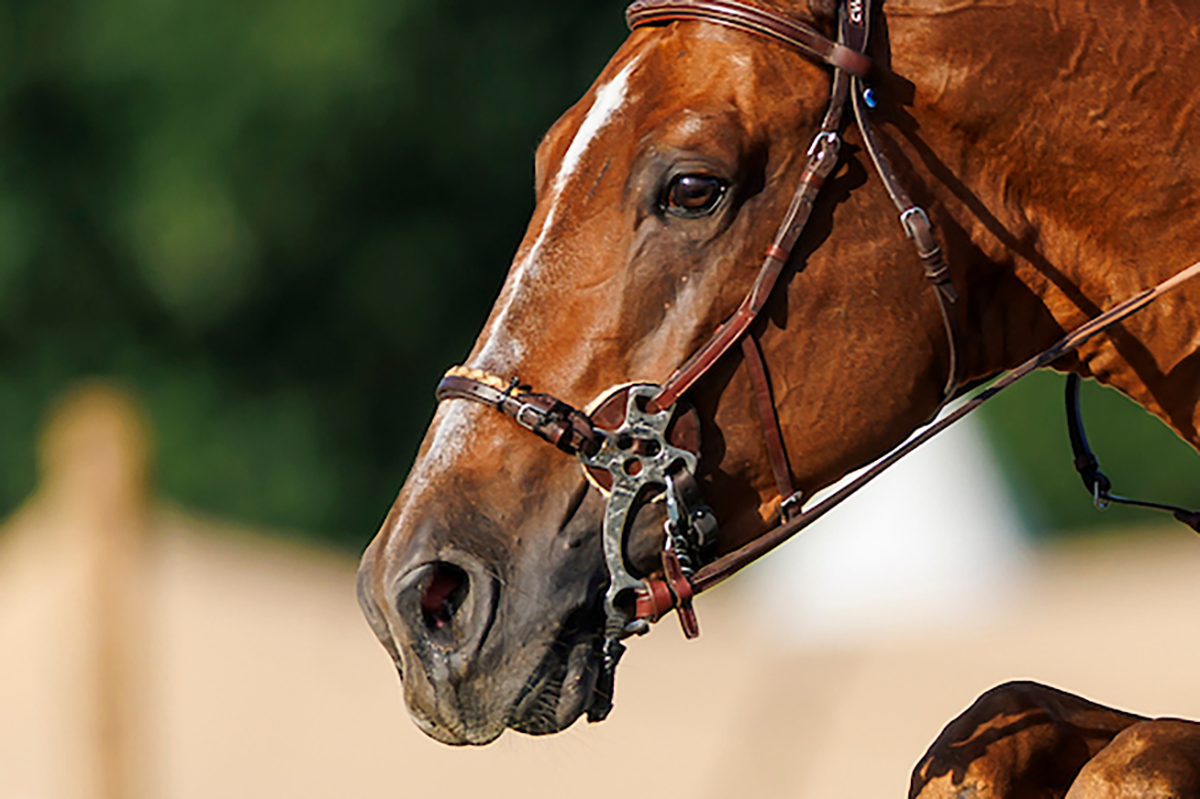 The hackamore is a bitless bridle commonly seen in show jumping. Photo: sportfotos-lafrentz.de
The concept of the hackamore—a bitless bridle that exerts leverage and pressure on, among other things, the horse’s nose—is said to have originated in North Africa and to have found its way to Europe via the Moors. In Persia, too, there are records of bridles from pre-Christian times that used nosebands without a bit.
Whether people back then were primarily concerned with protecting the horse’s sensitive mouth and tongue—one of the horse’s most sensitive areas—remains to be seen. Over the centuries, the hackamore, or bosal—which does not rely on leverage—became increasingly widespread. Hackamores were used particularly in working equitation, where herders relied on their horses to respond quickly to their signals.
The Lever: What 17 Centimeters Can Do
Anyone who studies how the hackamore works cannot ignore the physics involved. Currently, hackamores with shanks up to 17 centimeters long are permitted both nationally and internationally.
In a hackamore with shanks, the law of leverage comes into play. The shank has an upper ring (connected to the cheek piece and thus ultimately to the headstall), a pivot point at the noseband, and a rein ring at the bottom. When the rider pulls on the reins, their force acts on two areas. This influences the resulting pressure. The decisive factor here is where the hackamore’s pivot point is located. Simply put, the longer the lower section, the greater the pressure exerted on the poll, nose, and chin.

“Bitless” does not mean “pressure-free”
In recent years, pressure measurements have been conducted repeatedly, including with bitless bridles. In 2021, Nina Robinson and Tracy L. Bye (2021) studied five horses that were being ridden. Pressure sensors were attached under the noseband and the headpiece. However, hackamores were not examined in this study.
A little physics is a must
Pressure is calculated by dividing force by area. The unit of measurement is the pascal (Pa). It results from the force acting perpendicular to a surface. It is expressed in newtons. The force exerted by one kilogram is (due to Earth’s gravitational acceleration g = 9.81 m/s2) is approximately 10 newtons. When considering pressure, it is important to consider the type of surface over which this weight is distributed. If you imagine that one liter of milk (approx. 1 kg = 10 newtons) is distributed over a sheet of A4 paper (623.7 square centimeters), the resulting pressure is 0.016 N/cm². If I place this liter of milk on an area about the size of a thumbnail—approximately one square centimeter—the resulting pressure is 10 N/cm². You can definitely feel it, but it’s bearable—at least on your thumbnail.
In a study conducted by Victoria Lewis conducted in 2024 at Hartpury University in the United Kingdom, the effects of varying levels of rein pressure were examined. The study analyzed data sets from previous studies (Kuhnke et al., 2010, Egenvall et al., 2015) that had measured the pressure exerted by the reins. The results for the basic gaits were as follows:
Force application in the basic gaits in a ridden horse
- Step 7 – 43 N
- Trot 11 – 51 N
- Gallop 16 – 104 N
These forces acted primarily on the corners of the mouth. It’s easy to imagine the effect of 104 newtons on a relatively small contact area. 10.4 liters of milk weighing down on a single square centimeter—that’s certainly what you’d call pressure.
The results from Robinson/Bye were obtained without a bit (side-pull bridle, 4.42 N/cm², and cross-under variant, 2.96 N/cm²). In the test series, the pressure values were higher than those of a water snaffle bit with a noseband (2.67 N/cm²). With the side-pull variant, in which the reins attach directly to the nose piece, the value was significantly higher. The authors note that such strong pressure, if applied for a long period, could already cause tissue damage.
What area does the pressure from the hackamore affect?
In addition to the force applied to the reins, the contact area is always an important factor. That is why the FEI mandates flat, flexible nose pieces for hackamores: a wider contact area distributes the same force over a larger surface.
However, the pressure is not applied solely to the nasal bone. Various studies have identified the following areas of the horse’s head where the influence of a bit or bitless bridle plays a role; naturally, how tightly the noseband is fastened also has an impact.
Areas of the horse’s head that are subjected to pressure
- Nasal bone, on both sides. The nasal bone lies beneath thin skin and has very little soft tissue padding. The nose plate of the hackamore or the noseband presses the tissue directly against the bone.
- Upper jaw, laterally in front of the facial ridge. The cheekbone is the bony ridge on the cheek. There is little soft tissue between the skin and the bone in this area.
- Lower jaw. The lateral mandible, as anyone can feel for themselves, is also only lightly padded. With a hackamore, the chin chain exerts tension on the mandible.
- Mental fossa
- Base of the ear, temporomandibular joint. Beneath the neck piece, the highest pressure intensities are measured at the base of the ear near the temporomandibular joint.
Can you really break someone’s nose with a hackamore?
Answer: Yes. Theoretically, this is possible, since the lever forces can amplify the pull of the rein many times over. It is important to fasten the noseband correctly—about two finger-widths below the cheekbone—just as with other nosebands. The lower part of a horse’s nose has weaker bones. There is more cartilage in this area, which can be damaged more easily.
A Different Kind of Riding
The strong forces are one challenge when riding with a hackamore. The other challenge is the riding itself. Because it’s a sharp bridle—as even the leading manufacturers of this bridle note in their descriptions—it requires a particularly steady rider’s hand. Furthermore, you tend to give impulses rather than aiming for constant contact.
To make matters worse, the “steering” is different. It’s harder to position the horse with this type of bridle. Anyone who pulls hard on one side of a hackamore—which doesn’t necessarily have to be intentional, but can happen, for example, during a course of show jumping if the horse isn’t responding to the aids—actually risks causing injuries. It doesn’t necessarily have to be a broken nose. But pressure sores on specific, overloaded areas are painful for the horse and can lead to deformities in the affected structures.
All experts agree: The hackamore is a type of bridle that belongs only in the hands of experienced riders.

Studies on pressure during bridling
- MacKechnie-Guire R et al. (2025): Comparison of rein forces and pressure beneath the noseband and headpiece of a snaffle bridle and a double bridle. Animals 15(7):1058. doi:10.3390/ani15071058