


What Para-Dressage Does for the Horses—and What the Horses Do for the Para-Dressage Riders
Para-dressage riders—the best ambassadors
 from Dominique Wehrmann
In August, tens of thousands of people witnessed equestrian history being made at the World Championships in Aachen. The Grand Prix ride by Katharina Hemmer and Denoix, the cross-country rounds by Michael Jung on Chipmunk and Julia Krajewski on Nickel, the show jumping team final, Steve Guerdat and Dynamix de Belheme’s final jump to the title, and more.
It was all incredibly exciting, and above all, the performances showcased riding that was close to perfection. A true art form. The perfect symbiosis of rider and horse. Not all pairs achieved this, but that’s just the nature of the sport. Because riding is incredibly difficult, and there are no shortcuts. Every rider works day in and day out to become one with their horse—whether at the world-class level or in A-level dressage and show jumping, in the saddle and in daily handling.
In Aachen, we saw many couples whose relationships are so strong and secure that they can draw on that unity almost anytime and under any circumstances. Those are the images that were shown over and over again. People talked about a “summer fairy tale,” and for the most part, that’s exactly what it was.
The Quiet Elite Athletes
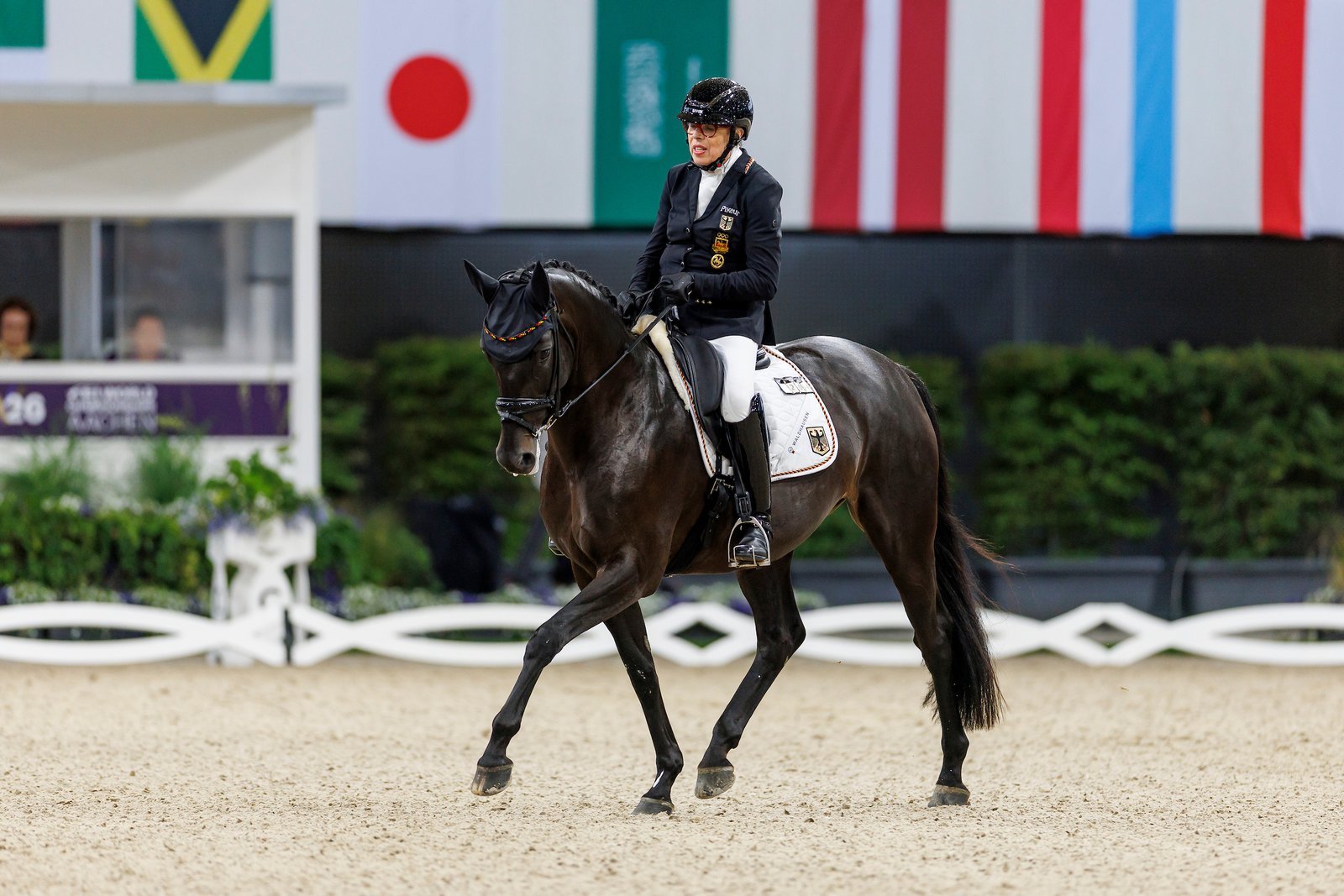
But over the past two weeks, wonderful sports action wasn’t limited to the venues where there’s always a lot going on. No less spectacular—but unfortunately with significantly smaller crowds—were the performances by the para-dressage riders. Admittedly, anyone interested exclusively in piaffes and passages or spectacular deep jumps is in the wrong place here. You really have to look a little more closely to recognize the spectacle here. Take, for example, the performance by Heidemarie Dresing and her mare Poesie in the Grade II Grand Prix A.
Vote of Confidence
Just as the two of them turned toward the center line at a walk to stop, greet the crowd, and open the German Para-Dressage World Championships on behalf of Germany, a wheel loader or something similar rumbled past the stadium. Poesie was startled, scrambled backward in panic, and turned on a dime—just get out of here! She nearly lost her rider in the process: 71-year-old Heidemarie Dresing, who suffers from multiple sclerosis. However, her rider’s moment of panic seemed to be exactly the moment when Poesie pulled herself together and shifted back into forward motion. Dresing settled herself as best she could, patted the mare on the neck, and the two set about their task. In Grade II, only walk and trot are ridden. The pair had started with scores between 1 and 2 for the opening salute. But they caught up from one exercise to the next, ultimately winning their first world championship title. The mare was completely content throughout—calm, attentive, and with a contact that one would wish for in vain from many pairs in the Grand Prix arena. Despite the moment of fright.
“Poesie was really scared,” said Heidemarie Dresing after her ride. “Luckily, I was able to quickly regain her trust because I know her so well by now. I do everything with my horse: I don’t just ride her, I also take care of her. I go for walks with her, as far as I’m able.”
The Benefits of a Traditional Education
Heidemarie Dresing cannot “push” her horse forward in a moment like this. She lacks the strength in her legs to do so. The fact that a horse overcomes its flight instinct in such a situation and reconnects with its rider is the result of years of building trust. The fact that this ultimately led to a gold medal is the reward for systematic training. Behavior that is actually un-equestrian—yet all too human—such as “pushing through” when something isn’t working because one loses patience and has the means to do so, is simply not an option for riders like Heidemarie Dresing. They must wait patiently until their horse is ready to engage with them. A para-equestrian partnership is a partnership between equals.
Horses: A Reason for Living
None of the World Championship riders we spoke with in Aachen were born with a disability. All of them had to cope with setbacks of varying severity. And all of them said that without the horses, they wouldn’t have made it through it all. It was the horses, they said, that gave them a sense of purpose, goals, hope, and joy once again. Being able to go back to the stable, wanting to ride again—that’s what gave them hope and strength during their darkest hours, and that’s what drove them through the arduous rehabilitation process.
Horses for Heroes Award for Britta Wassermann
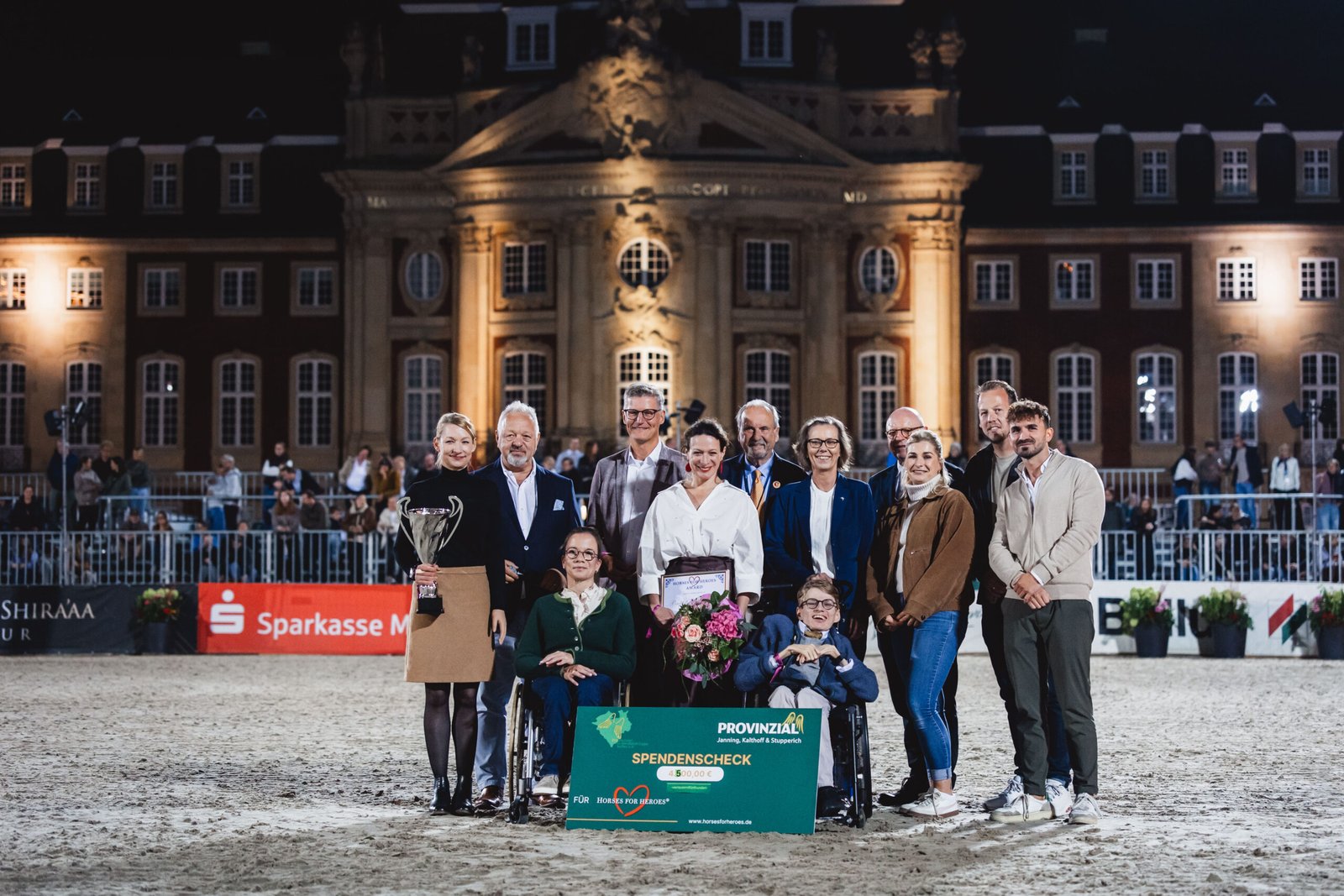
The situation was similar yet different for Britta Wassermann, a dressage rider who competed successfully up to Class M, whose experiences at the Para-World Championships date back several years, and who was honored with the Horses for Heroes Award in Münster. She received the award because her story exemplifies what many people experience with horses—they are much less sports partners than life partners. And as is fitting in a good partnership, they are there when you need them most—in their very own equine way.
Britta Wassermann’s Horse Story
Britta Wassermann was eight years old when she was diagnosed with an aggressive form of bone cancer. It turned out that amputating her left arm was her only chance of survival. The surgery, combined with subsequent chemotherapy, saved her life.
Up until that point, Britta had had nothing to do with horses. Or rather, almost nothing. Her best friend had her own pony. However, that aroused not so much Britta’s envy as her jealousy, because it meant she had to compete with the pony for her friend’s attention. But Britta’s illness changed everything. Not only did she have to come to terms emotionally with having only one arm from then on, but her body also had to adjust. Britta had to learn to cope with a whole new balance.
Then her friend’s mother, who owned a pony, had an idea: Why not try therapeutic riding? Maybe they could kill two birds with one stone—restore Britta’s zest for life and retrain her sense of balance.
Britta wasn’t very enthusiastic. “Try sitting on a pony and catching a ball with one hand…” But Britta must have been quite skilled at riding. In any case, she was soon allowed to ride in regular school lessons—the start of a great career that took her, even at a young age, to the Para-Dressage World Championships, which at the time were not yet held under the auspices of the FEI. In 1994, she qualified for the event with her mare Accenta, winning bronze in the team competition and silver in the freestyle.
She’s the Rider Herself
Throughout this time, Britta always had the ambition to train her horses entirely on her own—both at Accenta, which was considered extremely challenging, and at the events that followed. She succeeded remarkably well. After Accenta, she also managed to train her second horse, the Oldenburg gelding Don Geronimo (aka “Mo”), up to the M** level and successfully compete with him in regular show jumping. The two were on their way to the advanced class. Pirouettes (!), zigzag half-passes (!), flying changes—Britta taught him all of this with just one hand. But then Mo had a terrible accident in the paddock. For weeks, the veterinarians fought to save his life—knowing what this horse meant to his rider. To no avail. Mo could not be saved.
A New Horse, New Challenges
What helped Britta get over Mos’s death back then also has four legs and is a chestnut: Balduin. She discovered the gelding—who had just started training—at his breeders’ place, where she had actually picked out a different horse. But with Balduin, it was something like love at first sight. Her joy over the new addition didn’t last long, however. Soon after his arrival, Balduin also had an accident in the pasture and seriously injured his shoulder. The nerve was damaged, and it took two and a half years before riding was even a possibility.
Balduin is now nine years old, and Britta still gets surprised looks from time to time when she mentions that he hasn’t progressed beyond Class A in competition. Britta Wassermann hasn’t let other people’s opinions get her down for a long time now. “He lost two years due to his injury, and with only one arm, a lot of things just take longer. I can’t just rein him in when he gets ahead of himself or slow him down when he bolts again because he’s scared of something.”
A Daily Ray
of Hope
Even though it was her illness that brought Britta to horses in the first place, and even though it can be difficult at times—today, it’s the horses that brighten her day. She says, “On horseback is the only place where I don’t feel any pain.” And she’s not just dealing with the long-term effects of her amputation, such as phantom pain and muscle tension. In 2011, part of her lung had to be removed—a consequence of her chemotherapy.
Horses for Heroes Award
As mentioned, Britta Wassermann was presented with the Horses for
Heroes
Award at the Tournament of Champions. The award aims to highlight stories like hers and thereby underscore the crucial role that horses play in society.
There’s a story behind this award, too. Anuschka Bayer founded Horses for Heroes based on her experiences with her severely disabled son, Clemens. Horses became important companions for him and his family. This experience sparked a desire to give other people with disabilities access to horses as well. Today, the organization works toward this goal in collaboration with a nationwide network of qualified therapists, facilities, coaches, and families, including the German Board of Trustees for Therapeutic Riding (DKThR).
As Münster’s mayor, Tilman Fuchs, said in his laudatory speech for the new award recipient, Britta Wassermann: “Sometimes you need a second chance—and sometimes you need a horse to give you the courage to live again.”
By the way, Britta Wassermann’s Instagram account—@wassermannbritta—offers a pretty good look at what a typical day of training is like for horses with only one arm.


