New FN seminar series "Making horse welfare visible"
Review of the seminar “What does the horse want to tell us? Focus on horse welfare”
 from Dominique Wehrmann
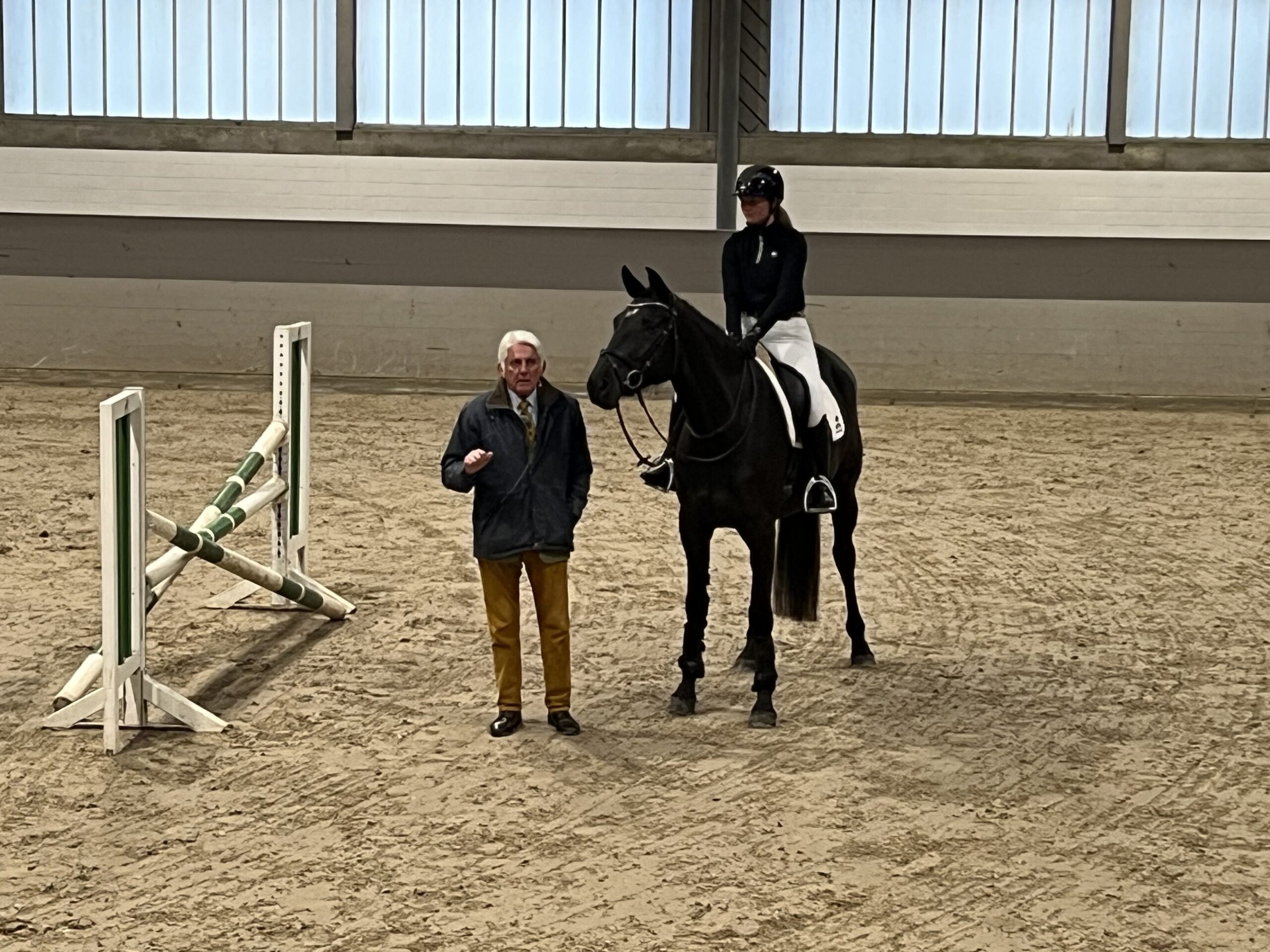
Around 70 seminar participants gathered in the large riding hall at the Luhmühlen Training Center on 22 April at 5 p.m. to find answers to the question “What does the horse want to tell us?” over the next few hours. First, biologist and equine scientist Dr. Kathrin Kienapfel gave a lecture on the species-typical expressive behavior of the horse, illustrated with numerous practical pictures. Dr. Kienapfel spoke for 90 minutes. Sounds long-winded, but it wasn’t. The examples were thought-provoking and opened our eyes to many things.
Dr. Kienapfel then handed over the lectern and projector to riding master Martin Plewa. The former national coach of the German eventing riders and member of the Xenophon supervisory board explained the extent to which horse-friendly training contributes to horse welfare and, on the contrary, the damage that can be caused by taking the wrong path.
Illustrative examples from practice
After the theory, the explanations were demonstrated using practical examples. Several female riders came to the AZL with their horses for this. Their names were not mentioned and that was a good thing. Because this was about honesty and we can only thank the participants for having the courage to expose themselves to critical observations. There were a lot of them and many of them had to be pointed out by the trained eye of biologist Kienapfel. The solution to any kind of defensive reaction on the part of the horse was usually the same: Hands off! However, there were also other reactions in which the horses felt visibly “left alone” without the familiar contact to the bit and only relaxed when the contact was re-established.
Whoever draws, loses
There was an aha moment when an eventing rider presented her horse with a three-ring snaffle. When it came to jumping, Martin Plewa asked her to let the reins out of her hand before the obstacle. This has proven successful in eventing to encourage riders to let their horses work more independently, explained the former head of the Westphalian Riding and Driving School in Münster-Handorf.
At first, the seminar participant’s horse seemed a little confused by the lack of contact, “swam” in front of the jump and then choked more badly than well over it. However, it only took two attempts before the two horses got used to the new situation and produced a beautiful round jump in which the horse naturally maintained speed and rhythm in front of and behind the obstacle.
The warm-up was followed by loose jumping sequences. Here the horse became violent and when the rider tried to bring it under control with half halts, it lifted up and resisted the hand. Dr. Kienapfel asked the rider why she was actually riding her horse with a three-ring bit. “Because otherwise he gets too strong,” was the answer. Martin Plewa responded: “He was least strong when you let him chew the reins out of your hand before the jump.” That said it all.
Tongue defect? Riding error rather
Similarly impressive was the change that took place in an 18-year-old “Professor”, a successful advanced (S) level dressage horse that is supposed to teach its young rider the basics of the world between A and C levels. Even during the warm-up, you could see how the rider tried to bring the horse down with wide reins. When it was her turn for her “lesson”, the gelding showed himself to be high and tightly reared up in an absolute upright position and with his tongue always visible on the right side of his mouth. He moved as if split in two.
Dr. Kienapfel drew attention to the signs of the horse’s discomfort, Martin Plewa gave the rider tips on how to make it easier for her horse. The most important: make the curb reins longer and let the snaffle reins prevail. The rider should – like everyone else – ride with one hand and occasionally let the reins out of her hand. The aim was to make the horse’s neck longer. And it worked. The gelding began to chew and stretch. The whole movement changed and became more flowing and harmonious.
Martin Plewa repeatedly pointed out that it is the horse that seeks contact with the bit and that the rider should only allow it, but not force it. It sounds so logical. And yet an estimated 85 percent of people see it differently. Deputy Xenophon Chairwoman Karin Lührs has thought about this. She herself is a rider and trainer up to Grand Prix level and judges up to advanced (S) level.
Neck down instead of leaning in?
You know it: horse and rider with the typical side view in our German riding stables. The horse’s neck is pulled down with the hand, the horse is positioned narrowly and far too low. If you ask the riders, it is supposedly about riding the horse over its back. There is a big misunderstanding here.
“The horse should seek the contact, the rider should allow it.” That’s what our guidelines say. The contact is created by a sensitive connection between the rider’s hand and the horse’s mouth, and very importantly, it is dynamic! Sometimes stronger, sometimes lighter, depending on what is needed. And it should be “soft, constant, springy” and develop a willingness to stretch.
If the neck is mechanically pulled tight over the reins and possibly with force, the horse can neither search nor find. The balancing pole is taken away from him. It is prevented from leaning in.
A major habituation process has developed here. As a result, you mainly see narrow necks, open mouths and unhappy horses in German arenas. As soon as the rider sits in the saddle, the reins are taken short and the horse’s mouth is pulled onto the chest. Short in front, long behind. Unfortunately wrong!
But how canöCan we change that? This can only be achieved through specialist knowledge, i.e. through the correct application / training / assessment of our riding theory in practice. This is where we riders, trainers and judges are equally challenged! For the good of our horses and the sport, because this would make an important contribution to putting riding back in the right light. As normality currently stands, much of the criticism – not all of it – is unfortunately justified.
Karin Lührs