The finalists for the 2026 Nuremberg Burg Cup at the Festhalle in Frankfurt
Past winners, 2026 finalists—the Nuremberg Burg Cup is already making waves
 from Dominique Wehrmann
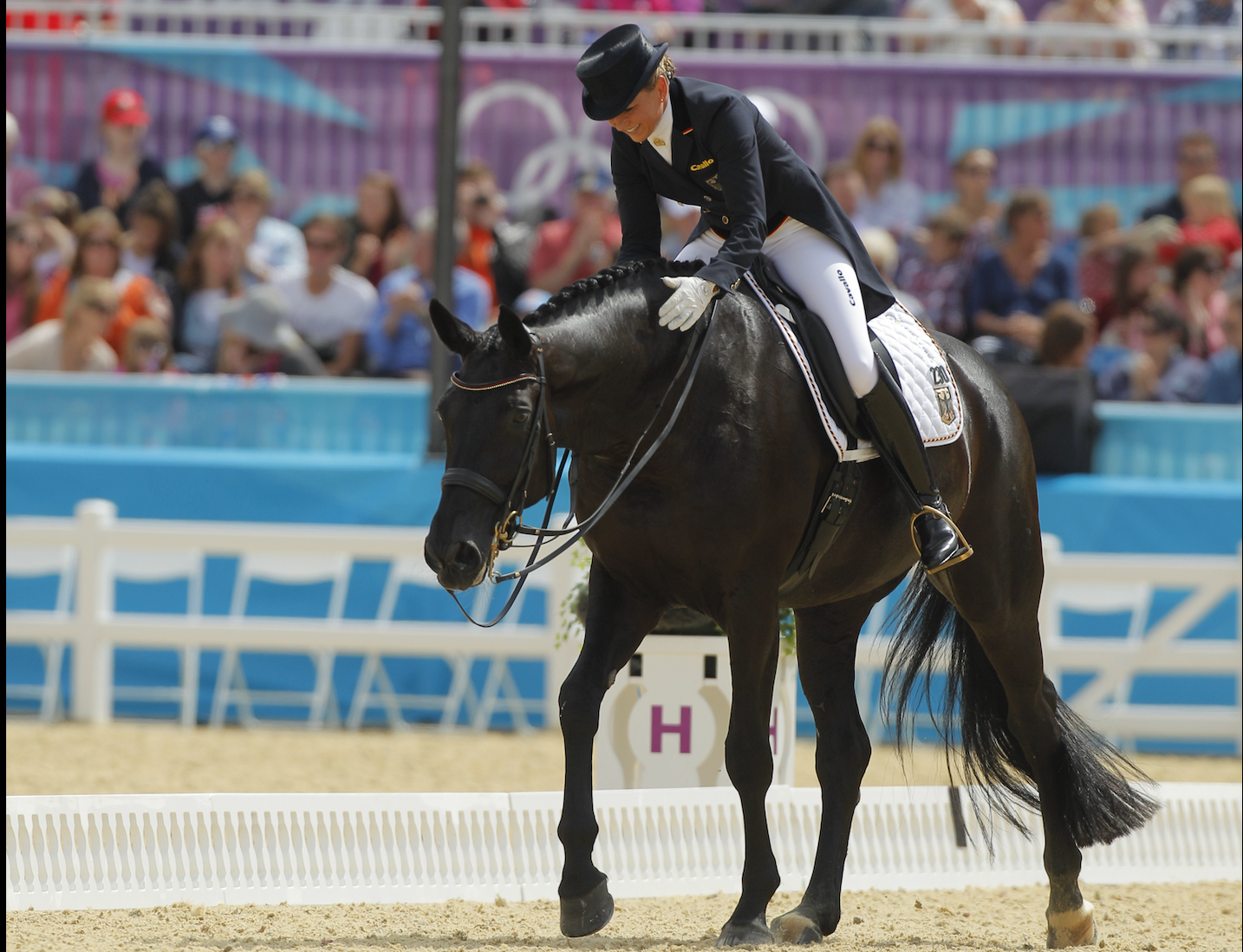
 Who will succeed Charlott Maria Schürmann and Life Time, who rocked the Frankfurt Festhalle in 2025?
Photo: sportfotos-lafrentz.de
Nuremberg Burg Cup
The first Nuremberg
Burg
Cup was held in 1992, featuring Germany’s best seven- to nine-year-old dressage horses competing at the Prix St. Georges level in a special test originally designed by Dr. Reiner Klimke. The track record of this series—or rather, of the horses that have competed in it—is impressive. Nearly all went on to become Grand Prix horses; many competed in championships; and some won medals. Here is an overview:
Past Winners and What Became of Them
1992: Nicole Uphoff with Sir Lennox —the Hanoverian son of Shogun xx was expected to succeed the four-time Olympic champion Rembrandt. He didn’t quite make it, but he enjoyed numerous successes up to the Grand Prix level.
1993: Klaus Balkenhol wins the Gold Medal of Honor— the Rhineland-born son of Ehrensold claimed victory in the Grand Prix Special the year after his Burg Cup win.
1994: Rubinstein with Martina Hannöver— Hannöver herself rode the Westphalian son of Rosenkavalier, who was closely related to Rembrandt, in Grand Prix competitions before he was transferred first to Heike Kemmer and then to Nicole Uphoff. Rubinstein made his mark in the arena at a time when stallions were not yet common in the sport, and in the process established his own stallion line, which has since practically died out.
1995: Aurelius FRH with Isabell Werth— Werth’s first Burg-Pokal winner also competed in the Grand Prix, but not in the Championship. Werth had more talented horses in her stable for that. Madeleine Winter-Schulze rode Aurelius herself in the Small Tour; he was also ridden by Karin Rehbein for a short time before finding a home with Ina Saalbach-Müller, who presented him for several years with a string of victories in the Prix St. Georges and Intermédiaire I.
1996: Giorgio with Isabell Werth – Isabell Werth later placed in World Cup competitions with the Hanoverian Graf Lehndorff-Sohn.
1997: Chacomo with Alexandra Simons-de Ridder— the impressive Holsteiner son of Calypso I was the first horse to qualify for a German championship team via the Burg Cup. Among other achievements, the pair was part of the German gold-medal-winning team at the 2000 Olympic Games in Sydney.
1998: *Relevant* with Nicole Uphoff – Rubinstein sends his son, who did not achieve worldwide fame with Nicole Uphoff but rather with the American Lisa Wilcox, and who, among other accomplishments, won an Olympic bronze medal with the team at the 2004 Games in Athens.
1999: Cockney with Nadine Capellmann – Nadine Capellmann trained the Holsteiner son of Caretino—with whom she also won the National Championship for six-year-old dressage horses—up to Grand Prix level and successfully competed him. He was later sold to the Bolz family and went on to achieve further success with Sonja Bolz.
2000: Miss Holstein with Karin Rehbein— yet another Holsteiner mare with dressage talent, this time sired by Romino. Karin Rehbein later competed her up to the Grand Prix level before Miss Holstein moved on to Dieter Laugks, with whom she also competed in several Grand Prix events.
2001: Bonaparte with Heike Kemmer— they were a mainstay of the German national team for years and one of the most elegant pairs of that era. They won Olympic team gold twice, in 2004 and 2008, and also took bronze in the freestyle in 2008. In 2003 and 2005, they won European Championship gold with the team, and in 2006, they claimed World Championship gold in Aachen.
2002: Wahajama with Ann-Kathrin Linsenhoff— this beautiful daughter of Warkant also went on to achieve success up to the Grand Prix level with Ann-Kathrin Linsenhoff in the saddle.
2003: Karin Rehbein with Cherie— Cherie, too, enjoyed success up to the Grand Prix level. She later moved to Madeleine Winter-Schulze’s stable and became her personal riding horse. In addition, she gave birth to a foal by Danciano in 2014, though that foal did not achieve any notable success.
2004: Elvis and Nadine Capellmann— the pair who set a record score of 81.17 percent in the finals, a mark that remains unmatched to this day. They, too, went on to win Olympic gold for Germany, also in 2008 in Hong Kong. Prior to that, they were team world champions in 2006 and European silver medalists with the team in 2007.
2005: Whisper with Monica Theodorescu— the last major success story for the current national team coach, with numerous international Grand Prix victories. The pair were alternates for the 2012 Olympic Games in London. Afterward, Theodorescu became head coach of the German dressage team and rode her horse Whisper only for herself.
2006: Comic Hilltop with Carola Koppelmann— this beautiful gray horse also competed in Grand Prix events, though only a few times. He was also used as a stud and sired Chardonnay, a licensed stallion who went on to achieve success in Grand Prix competitions.
2007: Augustin with Victoria Max-Theurer— the home-bred Oldenburg was the most successful horse of the Austrian rider’s career. She competed with him in three European Championships, as well as the 2014 World Championships and the 2012 Olympic Games.
2008: El Santo with Isabell Werth – Ernie competed in Grand Prix events and, together with Werth, was part of the German team at the 2011 European Championships in Rotterdam, where the team won silver. The pair also competed in three World Cup Finals.
2009: Blind Date with Brigitte Wittig – Blind Date, better known as “Beate,” later competed internationally with Victoria Max-Theurer. Among other events, they participated in the 2015 and 2017 European Championships.
2010: Rassolini, ridden by Kathrin Meyer zu Strohen— yet another Rubinstein descendant (via Rubioso N)—at the top of the standings. Rassolini was later sold to the U.S., where he won a Grand Prix with Jan Ebeling before becoming a training horse for Christian Simonson, the current World Cup runner-up.
2011: Desperado OLD with Carola Koppelmann – Desperado OLD also became a Grand Prix horse, accompanying Koppelmann to the 2013 German Championships in Balve, among other events, where they finished in 15th place, however, well outside the medal ranks.
2012: Burlington with Charlott-Maria Schürmann— at 19 years old, Charlott-Maria Schürmann was the youngest winner in the series at the time, riding a horse she had trained herself, on which she later achieved her first Grand Prix victories. Prior to the Burg-Pokal Final, the pair had won team gold and individual silver at the European Young Riders Championships in Bern that same season.
2013: Weihegold with Beatrice Buchwald— the horse that enjoyed the most successful career of all, both under saddle and in breeding. You can read here about the incomparable lifetime achievements of this Oldenburg mare, who emerged victorious from her mare show thanks to her outstanding riding qualities.
2014: Samba King with Matthias Alexander Rath —the Danish son of Sandro King was ridden by Matthias Alexander Rath in competitions up to the Intermédiaire II level following his victory. Later, he joined the Thai royal family to teach Princess Sirivannavari Nariratana Rajakanya Mahidol the basics of dressage. She competed with the gelding in the Small Tour in 2023.
2015: Santiago with Dorothee Schneider— the first of three winners in the 20 finals that Dorothee Schneider rode. Dorothee Schneider herself trained him up to S*** level. In 2018, while she was still working for Helgstrand, Simone Pearce presented the Stedinger son at two tournaments in Denmark. After that, nothing was heard of the gelding for a long time, until he reappeared in Germany in 2024 and competed in Class M with an amateur rider.
2016: Vitalis with Isabel Freese— the KWPN stallion is likely the only winner who did not compete in at least one S***-level class after the Nuremberg Burg-Pokal. He had more important things to do, namely becoming one of the most sought-after dressage sires in the world. With a score of 79.220 percent, he came close to breaking Elvis’s record at the time.
2017: Flamboyant with Isabell Werth— no, yet another winner who never competed in a Grand Prix. The Oldenburg stallion, a son of Fidertanz, was sold to the Pistner family after his victory in the Burg-Pokal and, under their daughter Valentina, became a reliable contender in all Junior European Championships. They competed five times, winning gold three times in the team event and silver twice. In addition, they earned one gold, five silver, and two bronze medals in the individual freestyle competition.
2018: First Romance and Dorothee Schneider – Dorothee Schneider’s Württemberg gelding by First Romancier has not become a championship horse, but he has proven to be a very successful Grand Pfix horse, ridden as always by the owner herself.
2019: Total Hope and Isabel Freese – It’s not particularly unusual for a stallion’s offspring to succeed in the same discipline as their sire. But for a mare to pass on her traits as spectacularly as Weihegold does is very, very rare. Total Hope was her first major success, a son of Totilas—a name even non-riders recognize—and the horse that made Isabel Freese’s dream of competing at the 2024 Olympics in Paris a reality. There, the pair reached the final, just as they did at the 2026 World Championships and the 2023 and 2025 European Championships. They also competed at the 2022 World Championships and placed third at the 2025 World Cup Final.
2020: Destacado with Matthias Alexander Rath— Destacado, who was trained by Rath himself, competed in Grand Prix events with Matthias Alexander Rath, was selected for the national squad, and, among other achievements, won silver in the freestyle at the 2025 German Championships. At the turn of the year, however, Rath sold the Desperados son to young rider Ava Osing. The pair were nominated for the 2026 Junior European Championships but were unable to compete, according to the FN, due to health issues on the rider’s part.
2021: Straight Horse Ascenzione and Helen Langehanenberg – Riding Sezuan’s full sister, Helen Langehanenberg competed multiple times this year at the Grand Prix level, both nationally and internationally.
2022: Briatore with Andrina Suter— among other achievements, the pair became Swiss champions at the Intermédiaire II level in 2024.
2023: Skovens Tzarina with Isabell Werth – Isabell Werth presented the Danish Zack daughter on behalf of her owner, her student Victoria Max-Theurer. In 2025, Werth rode her to victory several more times in the Small Tour; as of 2026, Tzarina has not yet competed in any tournaments.
2024: Barcelo and Dorothee – Schneider’s third Burg Cup victory; this year, he easily qualified for the Louisdor Prize final and is among the favorites there.
2025: Life Time with Charlott-Maria Schürmann – Schürmann’s second self-trained chestnut stallion, who impressed across the board in Frankfurt. This year, the pair competed in their first S***-level events.
And in 2026? These couples have a chance
Horses & Dreams Hagen a.T.W., April 22–26, 2026
Patrik Kittel J’Adore Dior H (75.512%)
Frederic Wandres, “Fänomen de Malleret” (74.463%)
Pferd International Munich-Riem, May 14–17, 2026
Sabina Schrödter Feine Bella NRW (74.732%)
Nicole Grosch Visser’s Hit “Valeria VEC OLD” (74.049%)
Longines Balve Optimum / German Championships, June 4–7, 2026
Bianca Nowag-Aulenbrock Sky (74.463%)
Görlitz Summer Weeks at Rosenhof Görlitz, July 16–19, 2026
Dorothee Schneider Valerie (74.293%)
Elmloher Equestrian Festival, July 30 – August 2, 2026
Bernadette Brune San to Alati FRH (74.415%)
Schäftlarn / Fichtenhof Classic, September 4–6, 2026
Sina Aringer Dalma Sia Bellante (76.000%)
Raphael Netz, “Glamourdoc” (74.683%)
Darmstadt-Kranichstein, September 17–20, 2026
Charlotta Rogerson Nice Touch W (76.537%)
Guxhagen-Dörnhagen, Oct. 8–11, 2026
Rose Oatley Ferdades (74.707%)
Rose Oatley Debutant PS (74.463%)
Based on the preliminary results, Charlotta Rogerson and her KWPN mare Nice Touch W would seem to have the best chances in the 2026 final. But experience has shown that the cards are reshuffled in Frankfurt—if only because of the atmosphere in the Festhalle.
Also noteworthy was the success of Rose Oatley, who—in addition to her two finalists in Darmstadt—rode a third horse, the highly talented Opoque, into the ribbon ranks, though without a placing. But what a season for the 19-year-old, who also became the U25 European Champion and, just a few weeks ago, won her first Grand Prix Special at her debut CDI in Herning—all thanks to her experienced horse Alive and Kicking, whom she took over from Charlotte Dujardin.