Isabell Werth Wins with Back for Good in the Warm-Up Competition for the Final Louisdor Prize Qualifier in Guxhagen
Isabell Werth Wins with Back for Good in the Warm-Up Competition for the Final Louisdor Prize Qualifier in Guxhagen
 from Jan Tönjes
 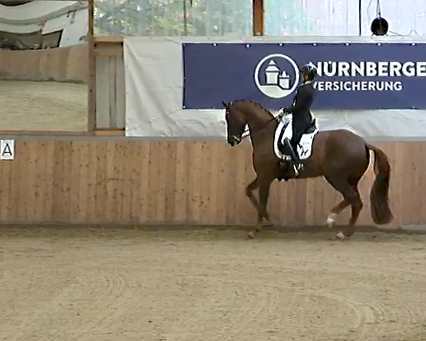 Isabell Werth and Back for Good in Guxhagen-Dörnhagen. Photo: Screenshot from Clipmyhorse
 New game, new luck … After the Recognized qualification at the Anakenenhof Isabell Werth seized the opportunity in Guxhagen to secure her spot in the finals with Back for Good, the long-legged dark chestnut. During the greeting, the son of Ben Benicio initially looked up at the arena ceiling. Then the ride began. It was a ride in which, technically, almost everything went right, though one could sense some inner tension in the DSP gelding, whose career had begun as a licensed stallion. Two weeks ago, Werth’s “stable jockey,” Niklaas Feilzer, had the Gelding Successfully Debuted in S-Level Dressage. This cleared the way for another attempt to qualify the dark chestnut for the Louisdor Prize.
Technically, everything is there; he just needs more practice
After a dynamic trot extension and well-executed cross-over traverses, the rider from Brandenburg demonstrated even piaffes, though not quite without tension. In the second round, Werth allowed him to use his neck a bit longer to find balance, which had a positive effect on the transition into the passage.
Technically brilliant: the first, very centered left pirouette. In general, however, it was also evident in the canter that the gelding lacks competition experience. He has competed in six S-level classes over the past two years.
The flying changes in the ones
At a canter, one wished that the large dark chestnut would work even more and with greater relaxation along his entire backline. With “full steam ahead,” she moved into the two-tempi changes. In the flying changes from jump to jump, things went awry after a promising start. It wasn’t until the end of the diagonal that the three essential components—horse, rider, and aids—came together again. Werth patted the DSP gelding approvingly. With a score of 73.026 percent, she emerges as the winner and thus the favorite heading into Sunday’s actual qualification round for the series final.
A “Hallowach” makes Vitali feel more energetic
After an already very impressive performance—finishing third—at the Anakenenhof, Anna Schölermann has a real chance of qualifying for the final with Vitally PCH, the eight-year-old son of Vitalis. Vitally has everything a Grand Prix horse needs. However, during the second piaffe, Schölermann had to remind the dark chestnut quite clearly that this is not a movement performed in slow motion on the hind legs. After this encouragement, the son of the Olympic silver medalist Consecration Gold …then more lively. The first piaffe started too late and was very clearly moving forward. The little nudge seemed to have had a big effect. As the test progressed, Vitali appeared more active and responded better to the driving aids.
The pirouettes were consistent in their execution, but could have been performed on a slightly smaller scale—especially the second one. The flying changes to two jumps and from jump to jump were a highlight of the test. Vitally PCH also demonstrated his full potential during the final passage on the center line. It was a world of difference from the start of the test, when the passage had been performed with somewhat less energy. 72.316 percent, second place.
Dr. Annabel Frenzen and Vabali secured third place. The supple son of Veneno demonstrated consistent passages and confident flying changes; his piaffes still lacked energy and drive, and his canter pirouettes could have been more balanced (71.526).
Lucie Anouk Baumgürtel, riding First Vienna, finished just behind her. The U25 European team champion fully showcased the strengths of her Vitalis mare in the first third of the test: the first piaffe was executed confidently on the spot, though perhaps with slightly too few steps, which cost her some points. Overall, the trot and piaffe passage sequence at the start was elastic, supple, and expressive. In the left pirouette, however, the mare braced her hind leg and jumped almost simultaneously, rather than maintaining the canter rhythm. The judges considered this less problematic than the right-hand pirouette. The rider executed that one with a wider turn, thereby minimizing the rhythm issue. The pair received one point less than Annabel Frenzen (71.474).