Saxony-Anhalt Wins World Championship Gold in the Young Breeders' Category in Celle
Saxony-Thuringia’s young breeders are world champions!
 from Dominique Wehrmann
 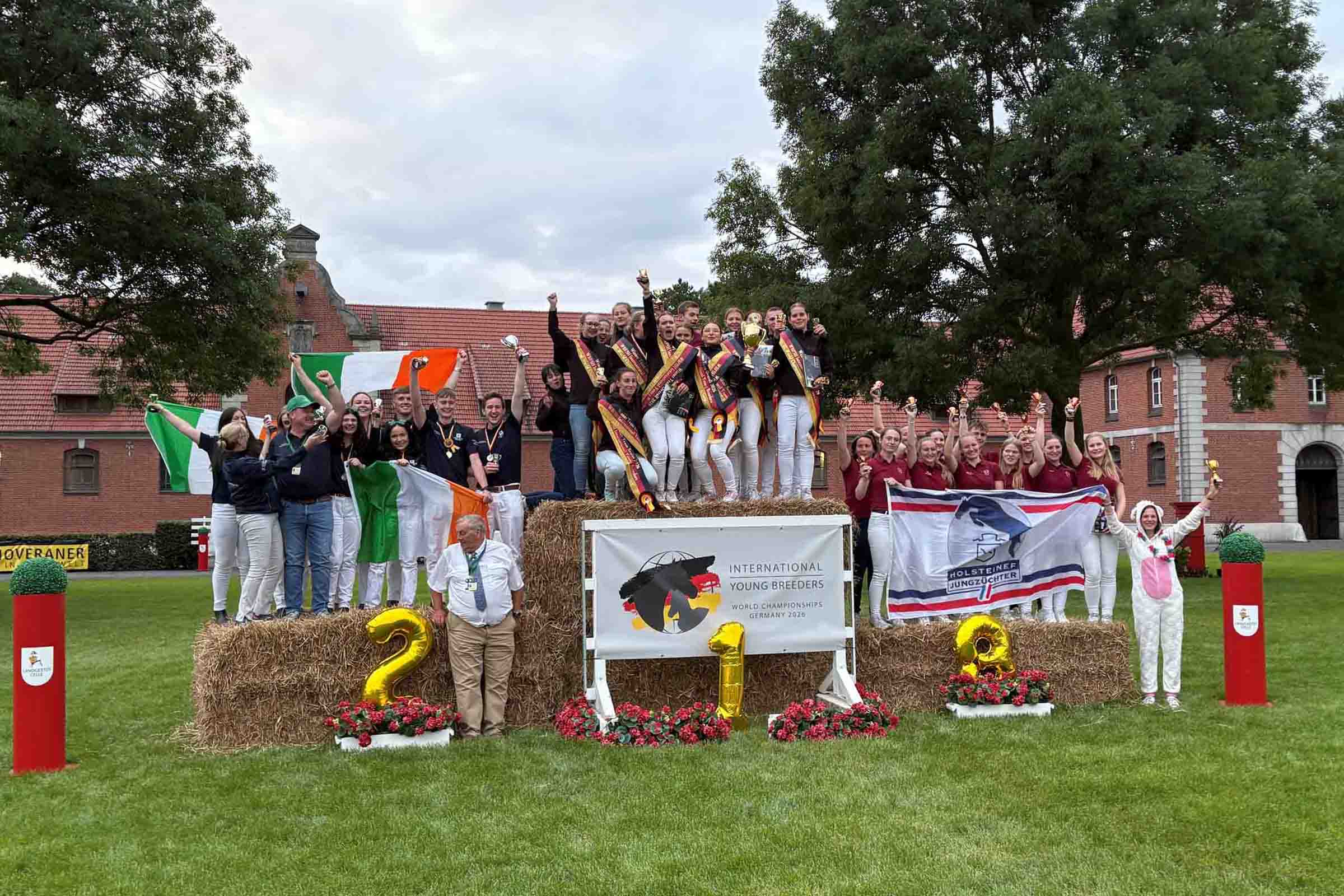 The most successful horse breeders of tomorrow were recognized at the 2026 Young Breeders' World Championship hosted by the Saxony-Thuringia Horse Breeders' Association, followed by the Irish Sport Horse Association and the Holsteiner Association.
Photo: German Young Breeders
The most successful horse breeders of tomorrow were recognized at the 2026 Young Breeders' World Championship hosted by the Saxony-Thuringia Horse Breeders' Association, followed by the Irish Sport Horse Association and the Holsteiner Association.
Photo: German Young Breeders In the end, the team from the Saxony-Thuringia Horse Breeders’ Association secured the most points in the overall multi-age standings—ahead of the Irish Sport Horse Association and the Holsteiner Association. In addition, the Saxony-Thuringia Horse Breeders’ Association won gold in the 21-to-26-year-old age group.
Five Events for the Title
In young breeders’ competitions, horse connoisseurs must master five sub-disciplines. The first discipline at the World Championships was the theory test—one hour to answer 50 multiple-choice questions. Next up was grooming—for the horses. Including braiding, the young breeders had to groom and present the horses assigned to them to the best of their ability. The key here: their own personal style.
This was followed by the conformation evaluation, the assessment of a horse during free jumping, and the crowning event of every young breeders’ competition: the presentation on the triangular course, which involved correctly lining up and presenting the horses at a walk and a trot.
Judge Walter Wadenspanner explained what the jury looks for: “Basically, it’s like a dressage test—the entire presentation should flow smoothly. We want to see the horse moving in perfectly straight lines, turning the corner still at a walk, and only then breaking into a straight trot. And we observe how the participant communicates with their whip handler, because both must work well together as a team.” He continued: “It’s important to present a horse in the best possible way—not just cautiously and obediently. You should feel free to take a few risks without disrupting the harmonious flow.” In other words—the horses should trot properly, but keep the rhythm.
The young breeders from the Saxony-Thuringia Horse Breeders’ Association performed best on the assigned tasks. The senior team consisted of Julienne Freund, Lena Opitz, Mirjam Münch, and Adrian Kromer. In the junior division, Laura-Sophie Popp, Rebekka Tschirpig, Anna Rabe, and Lilly Springer each played their part in winning the world championship title.
A family of young breeders with a knack for organization
The idea to hold the World Championships in Celle, of all places, came about during the National Championships, as State Stable Master Dr. Axel Brockmann reported:
“The point was that the association’s facilities are all somewhat similar, no matter where in the world they are. So I said, if you want to bring together young breeders from all over the world, then a historic place like Celle would be a nice choice.”
The young breeders have clearly gone all out to do justice to the atmosphere of the Lower Saxony State Stud. Dr. Axel Brockmann was deeply impressed by the young breeders’ organizational skills: “I’m thrilled by how wonderfully the young breeders have organized this. The joy and dedication with which they’re participating on-site, but also how superbly they’ve planned everything in advance over the past year and a half. This event isn’t just a world championship—the way our young breeders work is also world-class.”
Horses provided by the organizer
The organizers from Celle had to take care of the horses. This is because one of the challenges of young breeders’ competitions is that participants do not compete with their own horses; instead, horses are provided to them. Brockmann explained: “The free-jumping horses all come from the stud farm. We can easily create standardized conditions because we know our horses. The team, led by Heiko Tietze and Wolfhard Witte from Adelheidsdorf, handled all of this.”
Since stallions were not allowed at the preliminary show, 35 horses from the surrounding area of Celle were brought in instead. They enjoyed a few days of fun during the young breeders’ competition. “They were stabled here and looked after, groomed, and cared for by the young breeders. That’s going great, too,” said Brockmann.
A Real World Championship
“We’re a large community of young breeders,” says Ines Rathke, president of the German Young Breeders’ Association, highlighting the charm that defines these competitions. Of course, success is also a factor. But above all, the World Championship in Celle was once again a great opportunity to exchange ideas with like-minded people and make new connections.
On the German side, in addition to the Hanoverian Association and the Saxony-Thuringia Horse Breeders’ Association, the Bavarian State Association of Horse Breeders, the Mecklenburg-Western Pomerania Horse Breeders’ Association, the Rhineland-Palatinate-Saarland Horse Breeders’ Association, the Oldenburg Horse Breeders’ Association, the Holsteiner Horse Breeders’ Association, and the Trakehner Association each sent one or two teams to the competition.
Participants traveled from Belgium, Denmark, Sweden, France, Latvia, the Netherlands, and Austria—the Canadian team had the longest journey.
“In 2017, we also flew over to the World Championships at Spruce Meadows on a chartered plane with representatives from all the German breeding associations,” recalls Ines Rathke. “Now they’re coming to Europe and combining it with a little tour of the continent.”
Accordingly, sightseeing was also on the agenda in Celle: In addition to a guided tour of the state stud farm, the guests visited the Famos stud farm and the Schulze Brüning farm.
An Overview of the Medalists
Overall Team Standings
Gold: Saxony-Thuringia (1,813.5 points)
Silver: Irish Sport Horse (1,811.5 points)
Bronze: Holstein (1,796.5 points)
Junior Teams (U21)
Gold: Selle Français (927.5 points)
Silver: Holstein (921.5 points)
Bronze: Brandenburg-Anhalt (914.5 points)
Senior Teams (ages 21 to 26)
Gold: Saxony-Thuringia (910.5 points)
Silver: Irish Sport Horse (902 points)
Bronze: Swedish Warmblood (897 points)
Junior Individual Standings:
Gold: Hilma Alden, Swedish Warmblood (319 points)
Silver: Henni Edler, Brandenburg-Anhalt (315 points)
Bronze: Ambre Bouvier, Selle Français (312 points)
Senior Individual Standings:
Gold: Julienne Freund, Saxony-Thuringia (307 points)
Silver: Ellen McWey, Irish Sport Horse (305.5 points)
Bronze: Thea Karlsson, Swedish Wamblood (305 points)