"Hot irons" - "Young horses in competitive sport: support or excessive demands?"
FN discussion forum “Hot irons” – Young horse training in focus
 from Dominique Wehrmann
 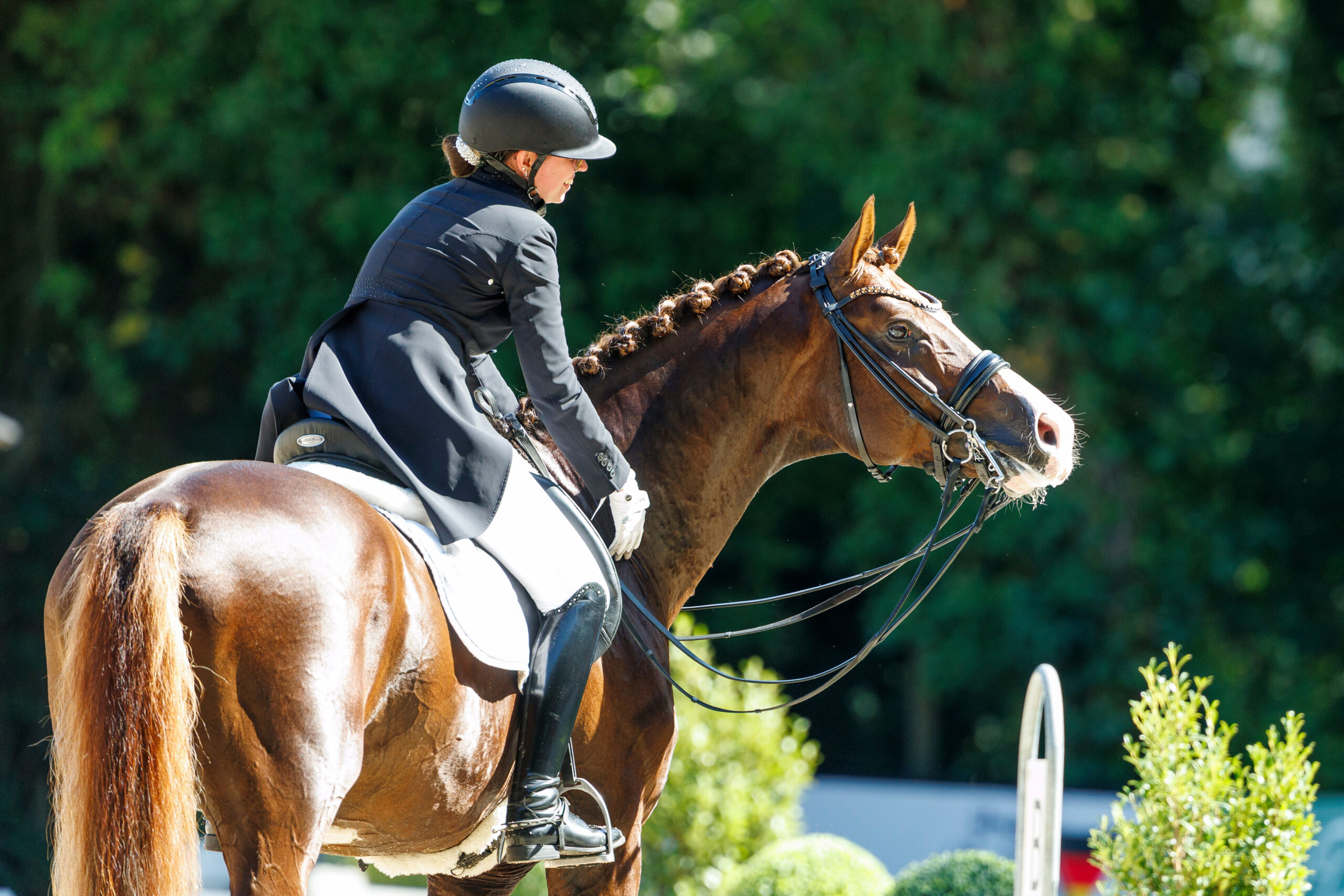 Seven-year-olds and advanced dressage - too early or okay with the right approach? These were the questions addressed at the second FN discussion "Hot Irons". Photo: Archive sportfotos-lafrentz.de
 The “hot potato” evening at the association’s headquarters in Warendorf began for the 50 or so visitors with the news that, contrary to what had been announced, there would be no PETA representative on the panel. An hour before the start of the event, the FN sent an email to this effect, informing the audience that a sudden death had occurred in the immediate family of the planned panelist. Without PETA then.
Association President Martin Richenhagen hosted the evening and brought along his Parson Russell Terrier dog Lotti, who is just three months old. She contributed little to the discussion, but she was cute. Richenhagen placed her on the table in front of him and Lotti slept there for most of the evening. But that was only in passing.
Whale rescuer meets young horse discussion
The role of “bad cop” on the podium therefore fell solely to Dr. Kirsten Tönnies, as FN Managing Director Dr. Dennis Peiler said as moderator: “well-known from radio and television”. The vet with her own small animal practice is always available for interviews of all kinds – be it in the field of animal testing, animals in agriculture, equestrian sport or, as recently, whale rescue. This was the first question that FN President Richenhagen asked her: “How’s Timmy?” However, he did not wait for the answer.
Also sitting on the podium with Tönnies were:
- veterinarian Prof. Dr. Christine Aurich, head of the Institute of Veterinary Medicine at the University of Vienna and the equine clinic there as well as the Graf Lehndorff Institute for Equine Science in Neustadt/Dosse, who has worked intensively on research into species-appropriate training for young horses, among other things,
- Riding master Martin Plewa, former national coach of the German eventing riders and director of the Westphalian Riding and Driving School, co-author of the guidelines for riding and driving,
- Wilken Treu as Managing Director of the Hannoveraner Verband as representative of the breeding associations and
- Ingo Pape as a breeder, stallion owner and operator of a highly successful training and show stable.
Pithy sentences to get you in the mood
The FN had prepared video recordings to set the mood for the evening’s topic. The equine veterinarian Dr. Hermann Josef Genn spoke on the subject of training young horses and warned that three and four-year-old horses should only be ridden out as late as possible and as little as possible, as this puts a lot of strain on the horse’s sacroiliac joint. He advised breeders to give their foals as much exercise as possible – and to maintain this when training their horses. His request to the trainers: do not practice trot reinforcement at home. His appeal to the judges from the vet’s point of view: respect the naturalness of the basic gaits.
National trainer Hans-Heinrich Meyer zu Strohen has worked with both two-legged and four-legged youngsters in his many years as a trainer and pointed out, among other things, that the rider’s experience plays a major role in giving the horses confidence, especially with young horses.
Keep your enemies closer than your friends
After the video clips, Martin Richenhagen took the floor as host and, in view of the complaints in the run-up to the event, once again justified the decision to bring representatives of PETA and Dr. Kirsten Tönnies, an avowed critic of sport, to the podium. “PETA is constantly beating us up. They are calling for a complete ban on horse riding. I don’t think we should put up with that. But you can only have a conversation with people you can actually see. You have to argue sensibly.”
He then went on to talk about PETA as an institution: “PETA has seven members in Germany, because that’s how many you need to found an association. They collect money here, which is transferred to England, where PETA is a company that distributes the money to its shareholders. However, PETA does not make a practical contribution to animal welfare in Germany. Dr. Kirsten Tönnies contradicted this when she had the floor later and reminded the audience that PETA takes legal action for animals in Germany, particularly in the area of agriculture, for example in turkey farming.
Whether and if so what practical contribution PETA makes to horse welfare will perhaps be revealed elsewhere. In any case, Richenhagen announced: “I will continue to want to talk to PETA in the future. You can’t deal with critics by not talking to them. Then you always remain a victim.”
Early exposure is not bad across the board
Prof. Dr. Christine Aurich and her colleagues have done a lot of research into the training of young horses, both thoroughbreds in racing and warmbloods. The results are astounding. The scientist explained that it is a wrong approach to believe that horses should only be put under stress once the epiphyseal joints (growth plates) have closed at the age of six. “In humans, they close at just under 20 years of age. But children and young people do sport,” she illustrated. And as studies on racehorses and warmbloods have shown, it is even beneficial for the physical development of horses and keeping them healthy to get them used to physical exertion at a young age – it’s all about moderation.
Aurich’s topic is not only the physical maturation process of young horses, she and her team have also looked in detail at the emotional resilience of young horses and found: “You can do a lot with horses as young as 18 months if you do it carefully.”
Moderator Peiler asked what indicators of mental maturity are. Prof. Aurich replied: “It varies from individual to individual. Horses enter puberty at 12 to 15 months. After that, their resilience is somewhat higher. And stress can be measured – through the cortisol level, heart rate, facial expressions, etc.” Among other things, the researchers discovered that young horses show much clearer signs of stress during transportation than during physical exertion, for example.
When is the right time to present horses in public? “It’s better to get horses used to new things early on. Slow familiarization is valuable. But the horses don’t necessarily have to go to a show at the age of three. It’s a question of the overall situation, who does what, when and how with the horse,” says Aurich.
Horses in the shop window
This was the cue for Wilken Treu, representing the breeding associations, who had vehemently argued in favor of retaining the tests for three-year-olds at the Bundeschampionat. He made no secret of the fact that the reasons for public appearances by very young horses are marketing and selection. “It’s all about putting the horses in the shop window at an early stage and making this possible for the breeders,” said Treu.
At the same time, he was self-critical: “This is the crux of ‘overdoing it’ in preparation. We’ve done that too and are questioning it.” At the same time, as an association, they are also “customer-driven”. But the aim is to create a framework that ensures that there are no excessive demands during preparation. By “overexertion”, he meant physical and mental overload, Treu explained. It is also a question of how much you can tolerate as a commission.
Just no template thinking
Horses from the Pape stables in Hemmoor are always remarkably well-trained. Be it on the riding horse arena at the Bundeschampionat, at the World Championships for Young Dressage Horses or in international Grand Prix sport – the horses presented by Susan Pape and rider Greta Heemsoth are generally characterized by harmonious performances. When asked what the ideal path for the young horse is, Ingo Pape had a clear statement ready.
“I’m reminded of Paul Stecken, who said ‘ten horses are ten different horses’. For each horse, I ask myself what the ideal way is, and the individual horse gives me the answer.” For example, they may start lunging some horses at the age of two, while others are still out in the pasture at the age of four.
Building trust in humans is an issue for every horse. “The horses grow up with us in groups in both summer and winter. Later, we become their new companions. That’s why the big headline above everything is: trust.” In order to build this, you need the right response for every behavior. “I’m very much against trying to force horses into templates. That’s almost the stupidest thing you can do.”
Lunging frowned upon
Martin Plewa, who is also a member of the Xenophon Supervisory Board, agreed with Ingo Pape on most points. He recalled how things used to be done when horses were still used in agriculture and the military. “The horses were broken in at the age of two and a half next to a buddy and broken in at the age of three. But carefully. We were only allowed to trot lightly and canter in a light seat, without spurs and only with a short crop.”
Even if there was no biomechanically and anatomically correct explanation for this at the time, experience taught the horsemen of the time that horses became accustomed to exertion and also became more durable. Because that was the big issue “A cavalryman never wanted to become an infantryman”, Plewa illustrated the credo of the time, when horses still made an important contribution to the livelihood of families and their health was vital.
For this reason, a training method that is common today was “frowned upon” back then, according to Plewa: lunging. “If my father saw how young stallions are lunged at licensing today and, above all, how they are lunged, he would turn over in his grave,” said the riding master. He underlined the fact that this is not an outdated view by referring to a study from 2021, which classifies lunging as a risk to the health of horses.
Plewa recommends ground work with the horses instead – which is also extremely effective as a confidence-building measure. “When I get horses used to cross-country obstacles, I always do it in hand – I first go down the deep jump, through the water and over the ditch. Then the horse follows quite naturally,” is his experience.
Yesterday’s animal training?
Dr. Kirsten Tönnies was now given the opportunity to present her point of view. She began by commenting on her colleague Hermann Josef Genn’s remarks from the initial video recordings, where Genn said that it was more likely “to go to a show with a well-prepared three-year-old than with a poorly prepared four-year-old”. Tönnies saw this as further proof of her thesis that the veterinary profession is generally in favor of using the animals and therefore does not want any real changes.
She believes that no area of animal training is treated “as yesterday” as that of the horse. “I want to talk more about positive and negative reinforcement,” she said, introducing the topic of operant conditioning into the discussion. In her opinion, far too little use is made of rewards through food in horse training.
Fewer rules, more trust
Martin Richenhagen drew a somewhat provocative interim conclusion in the direction of his colleague Dr. Dennis Peiler from the contributions made so far: It would then probably be necessary to move away from regulation towards orientation towards guidelines with appropriate training for judges. “We need a new culture away from mistrust. Riders actually want the best for their horses,” he is convinced. The orientation in training must then be the knowledge of when the horse is ready for which step.
Young rider – old horse, old rider – young horse
Martin Plewa noted that the trainer’s competence and experience are the most important factors in training young horses. “I don’t understand that bad habits such as lunging the horse tired have found their way into young horse training, possibly even with a short lunge and waving stirrups. This is completely nonsensical and has nothing to do with training. I’m building up stress here rather than reducing it. The calmer I am with my horse, the calmer my horse stays.”
At this point, Plewa approached the FN with a clear demand: “I would have liked there to be a training department. That is more important than sport and everything else.”
He is aware that such a department already exists, which is headed by eventing team Olympic champion Thies Kaspareit, one of Plewa’s former protégés. Nevertheless, more needs to be done in the area of training, especially among the judges.
Eliminate black sheep
But what is it that goes wrong in young horse training from her point of view, moderator Dr. Dennis Peiler asked system critic Kirsten Tönnies. “For me, there is a lack of positive reinforcement at the right moment,” came the answer, at which puppy Lotti briefly began to yelp. Tönnies continued: “The mentality of older gentlemen is not suitable for young horses.” Her example: said older gentlemen would hold foals with their noses against the electric fence.
Then she demands that horses should not compete until they are four years old. Working with them, touching them, brushing them, “wrapping them in blankets” and giving them hooves is okay. “But not competitions.”
Her third point is one that everyone could probably agree with: “I want black sheep to be eliminated earlier.”
Reaction Ingo Pape
The comment about the black sheep was somewhat lost in the face of the criticism of the older gentlemen. Ingo Pape was given the floor and took up the cudgels for his breeders. “Always this miserable generalization! I know a lot of older gentlemen who I consider to be great horse people.” Approving knocks with the knuckles on the table tops from the rows of spectators.
For him, training young horses also has a lot to do with familiarization. His example: training away from home, simply seeing how the horse reacts? “That is very important. Once the horses have had a certain amount of stress, they mature as a result. It’s always a question of how you do it, not when you do it.”
Dr. Kirsten Tönnies countered the fact that the horses at the Pape stables were not used to the trailer with the statement that all of their horses were well-behaved when being loaded.
Comments from the audience
One of the speakers from the audience was Heinrich Plaas-Beisemann, who runs a renowned boarding stable in Fröndenberg, sits at the table as a judge up to Grand Prix level, is a member of the licensing commission of the Westphalian Studbook and is generally regarded as a true horseman. His appeal echoed that of his seatmate Dr. Hermann-Josef Genn: “We must not exhaust the movement possibilities of young horses.”
Holger Suel, who not only has a knack for horses, but also for donkeys and mules, also addressed the topic of horses’ learning behavior, albeit in a different way to Dr. Kirsten Tönnies. Suel: “People are always surprised when I stop after 10 minutes. But why should I go on any longer if I’ve achieved what I wanted? It would be expensive if you paid for 45 minutes of riding lessons and only used 10 minutes of it? It’s even more expensive in the long run if you keep going even though the horse has already done everything right.” It may be that giving treats as a form of positive reinforcement is not particularly widespread in horse training. But learning theory also considers the removal of something negative (effort during training) to be reinforcement. In other words: When something works, stop.
Conclusions of the panelists
At the end of the event, the participants were asked to sum up the evening. Ingo Pape kicked things off and explained: “Our biggest problem is generalizing. I don’t like to make generalizations from a distance and without knowledge, like the internet hyenas.”
Wilken Treu intends to increase efforts to identify black sheep.
Dr. Kirsten Tönnies said it was difficult to “talk about things that have been entrenched for decades”. Her appeal: get the reins off the showgrounds.
In his conclusion, Plewa emphasized the transfer of knowledge. “We need to train the eye for the good, the positive. We need a broader framework and natural movement sequences and must place value on letting the reins out of the hand. We judges also need to take a good look at ourselves. I don’t understand why a horse still gets a 7.5 for rideability if it doesn’t lean into the hand.” His suggestion: Commented trailblazers at the Bundeschampionat to show how it should be done.
Prof. Dr. Christine Aurich’s comment also went in the direction of training. “Young people have a hard time learning, how do I do it? We have to help them find good trainers.”
Note: The innovations at the Bundeschampionat were also briefly touched on this evening. A more detailed article will follow soon.