Portrait Sadie Smith
Sadie Smith – from someone who dropped out of school to live her dream
 from Dominique Wehrmann
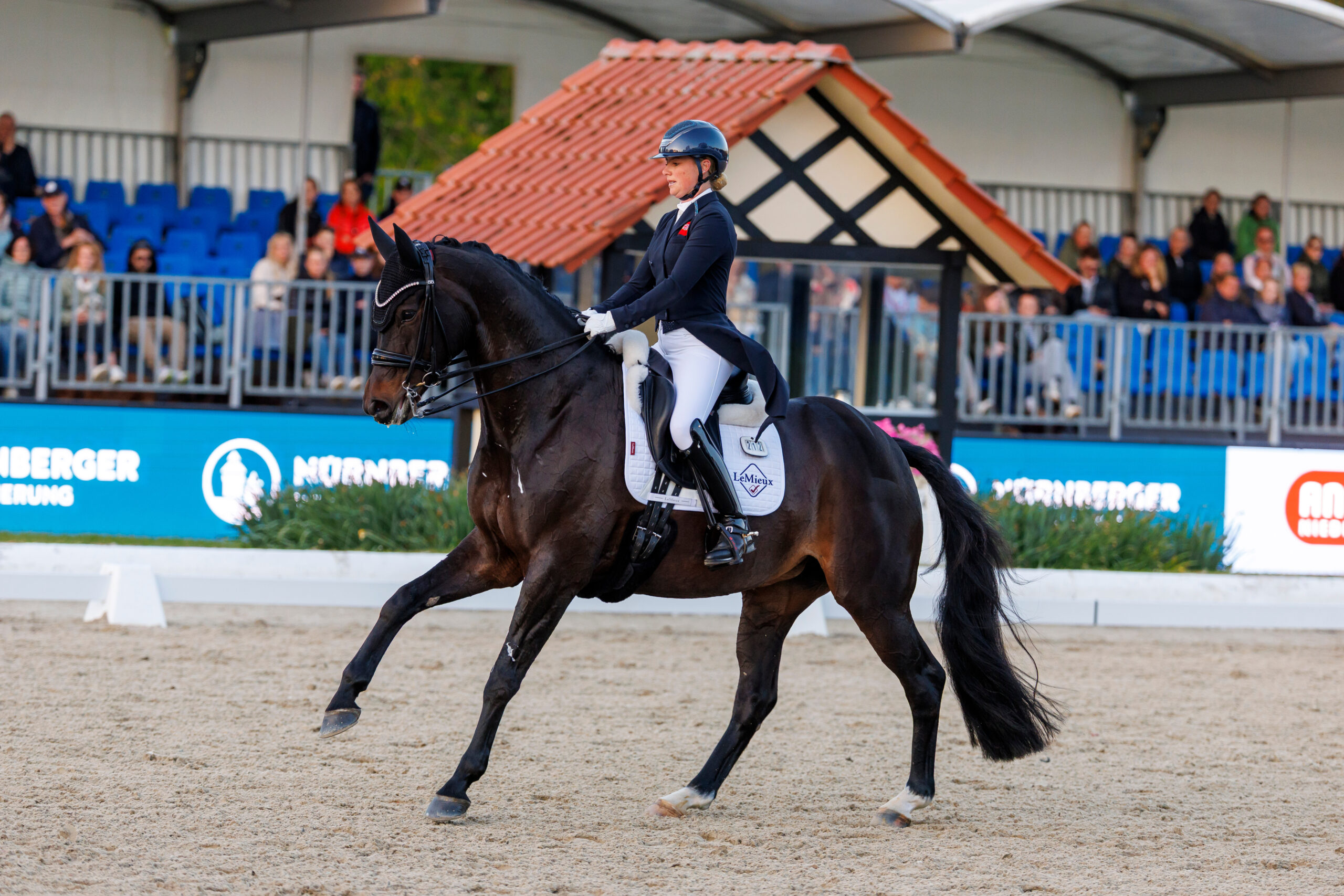
 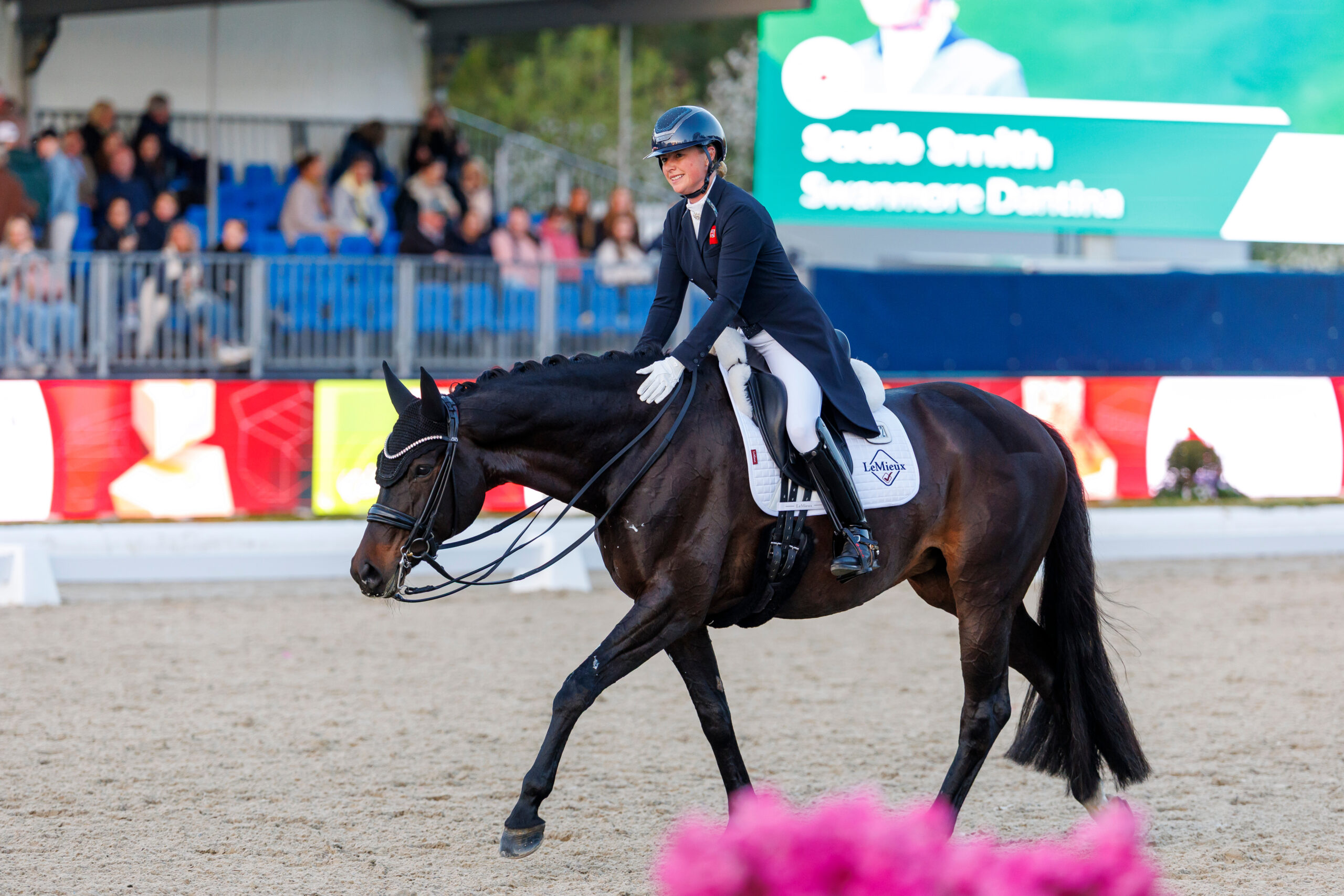 Sadie Smith and Swanmore Dantina - a pair who have ridden their way into the limelight at Horses & Dreams. Photo: Sportfotos-lafrentz.de
 Sadie Smith grew up in Southampton. Her parents had nothing to do with horses and neither did she until she was invited to a friend’s birthday party at the age of eight, where pony riding was on the agenda. A game changer in Sadie’s life. From that day on, everything in her life revolved around horses. Her parents allowed her to take lessons at the local riding school. To earn more riding lessons, she helped out in the stables. However, having her own horse remained an unattainable dream. The solution: a riding partnership with a mare, with whom Sadie initially mainly jumped. However, as the mare’s ability was limited, she tried to improve her dressage skills, looked for a trainer and found Kay Waterman.
Kay Waterman worked with Norbert van Laak. When she once again traveled to Germany to take lessons, Sadie was allowed to accompany her. It was the 2005 European Championships year for the dressage riders at Hof Kasselmann in Hagen. Having been to Germany before, Waterman and her pupil were keen to see the spectacle. This was the second turning point in the life of Sadie Smith, who was 15 years old at the time. “This is where I saw Carl (Hester, then with Escapado, editor’s note) ride for the first time and I thought: ‘Oh my God, this is exactly what I want to do!”
Horses as a profession
Sadie made a plan, and she put it into action immediately. “I actually had pretty good grades, but I hated college! I wanted nothing more than to be with horses.” So she dropped out of school.
She initially worked for her trainer Kay Waterman. She then moved to the Irish Grand Prix rider Roland Tong and his partner Ben St. John-James at their stud called Swanmore Stud. She worked for them for five important years, breaking in young horses, showing them at competitions and quickly making a name for herself. She was national champion (in the sense of winner of the Bundeschampionat) several times at the age of less than 20.
One of the horses she rode at the time was a mare called Charatana by Charatan W-Donnerhall, bred by Christian Heinrich in Germany and then sold to Great Britain. This Charatana was later to have a foal, a filly by Dante Weltino called Swanmore Dantina. But more on that later.
Apprenticeship years at Hester
After five years at Swanmore Stud, it was time for something new. Sadie began to work freelance and rode for, among others, the breeder Sarah Tyler-Evans, who in turn had horses under Carl Hester’s saddle. This brought her into contact with Sadie’s great idol, who was basically “to blame” for her decision to leave school to become a dressage rider. Sadie took lessons with Hester and both the British champion and his best pupil at the time, Charlotte Dujardin, were impressed by Sadie’s talent. When a position became available at Hester’s business, Sadie jumped at the chance.
“It was fantastic to work for Carl. I got so many opportunities,” says Sadie. She rode Imhotep as a youngster as well as Gio and Alive and Kicking, today all international Grand Prix horses that Charlotte Dujardin sold to other riders for millions. But she also got the chance to learn on the Olympic champions Valegro and Uthopia. In short, she may not have reaped the laurels for her work with Imhotep & Co, but she gained experience from which she still benefits today.
During this time, Sadie Smith also trained her own young horse, a Dimaggio son called Keystone Dynamite. She rode her first Grand Prix competitions with him. The dark chestnut was her masterpiece, so to speak. Just when the pair were ready to take off internationally, COVID put the world on hold. “I couldn’t travel to any competitions. I ended up selling him. Because I had this other mare at the time, Dia, who came after him.”
Dantina – Dream horse found! Right?
While Sadie Smith was earning her spurs with Hester, her former riding horse Charatana gave birth to a filly with her former employers Roland Tong and Ben St. John-James, who was christened Swanmore Dantina. The Dante Weltino daughter, nicknamed Dia, was to be sold. Sadie, remembering the mare’s mother, asked if she could have a look at her. The viewing ended with the purchase of the young mare “for not much money”.
But when Dia finally arrived, Sadie started to wonder. “She didn’t have much angle in her hind leg and looked more like a show horse. She was also quite fat.” Dia was well-behaved, but because of her belly, Sadie’s legs, which were not exactly high, only reached halfway up the horse’s rump. This irritated the mare so much that Sadie left the riding to a friend for the time being.
Not only because of this, but also because Sadie suspected that Dia was probably not good enough for the sport, she wanted to sell her again. Problem: Dia contracted a leg injury that prevented her from passing the vet check. So instead of a change of stall, she had to rest for the time being.
When Fortuna helps out
When the mare was allowed back into work, Sadie realized that she had another horse under saddle. “She showed really great and when I went to a young horse show with Carl’s horses, I took her along. She did really well!” The first interested parties promptly came forward and offered her a lot of money for the mare. Sadie was faced with a dilemma. “I didn’t really want to give her away, but I thought it was more sensible.” In the end, her head won out over her gut feeling. Sadie sold the then five-year-old mare to a lady who seemed to be very fond of her. But the liaison didn’t last long. After just a few days, the buyer returned Dantina to Sadie Smith. “I don’t even remember why,” she tries to recall the situation. “I think she just didn’t get on with her. But Dia is incredibly sweet in everything. It was a very strange situation. But anyway, she came back and since then she has developed incredibly.” She has never considered selling her again, “because I just love her”.
From zero to Grand Prix
One year after not being sold, Dia won the British Championships for six-year-olds with Sadie in the saddle. As seven-year-olds, they were fifth at the World Championships for Young Dressage Horses. “And then she won practically everything in the UK,” says Sadie. In 2024, the mare became National Intermédiaire II Champion. In 2025, she competed in her first Grand Prix season, helped her rider win her first Nations Cup in Rotterdam, made her British Champion at Grand Prix level and was allowed to compete in the World Cup Tour for the first time in London. They finished sixth in the Grand Prix and the freestyle. “She has far exceeded all my expectations,” says Sadie. “But it’s been a long road.”
European intermezzo
A long journey that also took them to mainland Europe in the meantime. In 2021, Sadie worked in the stables of Anne and Gertjan van Olst through Carl Hester, where the world champion Lottie Fry had already found a home through Hester after the early death of her mother. But in 2021, the world was still feeling the aftermath of the coronavirus pandemic. Sadie too. Although she was given top horses to ride, she was homesick. It got so bad that she packed her bags and returned to England.
Here she had to start from scratch, so to speak, but she managed that too. She is now self-employed at Sarah Tyler-Evans’ stables and rides horses for various owners, including Peter Belshaw, the former owner of Jessica von Bredow-Werndl’s Kismet. The constant who has always been at Sadie’s side is Swanmore Dantina, with whom Sadie was now able to accept an audience award for the most harmonious performance after the freestyle in Hagen.
World Championship Aachen?
Hagen was another milestone for the pair, not so much because of the result (third place in the Grand Prix with 71.630 percent and fifth place in the freestyle with 76.380 percent), but because of the potential they revealed. What comes next? Is the WEG in Aachen on the cards? The pair were at least already on the shortlist for the 2025 European Championships. But Sadie Smith doesn’t want to go out on a limb when it comes to the WEG.
“There’s still so much I can do better because I’m still inexperienced, of course. Of course, it would be absolutely incredible to get a chance like this. But we have a lot of good British riders and I’m not pushing anything. I’m just going to enjoy the shows and hopefully get a little bit better each time. If I got the chance, it would be mega. But I don’t want to put any pressure on myself.”
Dressage and social media
In Hagen, Sadie Smith received an audience award for her beautiful riding and her partnership with her horse. She took the decisive step towards the Grand Prix in Carl Hester’s stables and thus alongside Charlotte Dujardin, who has repeatedly been criticized in recent years. How does she feel about that?
“For someone like me who is just starting out in international sport, it can be quite intimidating to be under constant scrutiny. It’s not that I think what we’re doing is wrong. I think people forget that this is a very demanding sport. I think all riders really love their horses. But it is a high performance sport. It’s not as if the riders want their horses to open their mouths, for example. But they are not robots, they are animals, and they react and sometimes open their mouths. Everyone tries to do it perfectly. But nobody achieves 100 percent, so of course it will never be perfect. There are so many ways to express your opinion – not that that’s a bad thing, but I honestly don’t know if there shouldn’t be some kind of limit to what people are allowed to post.”
At the same time, the pursuit of perfection is exactly what Sadie believes makes dressage so addictive. When asked whether she has ever thought about hanging up her dressage boots in the face of all the criticism, she said: “Sometimes. At least a little bit. But I really love it. I think there’s something seductive about dressage because you can always improve. I think that’s exactly what drives me: the fact that you’re always striving to get better.”
And improving in equestrian sport means achieving more harmony between rider and horse, as the Ethical Principles of the Horse Lover stipulate in point 7. Especially in dressage, where this harmony is assessed in marks.