A horse in Dreieich died of a herpes infection
Herpes in Hesse
 from Dominique Wehrmann
 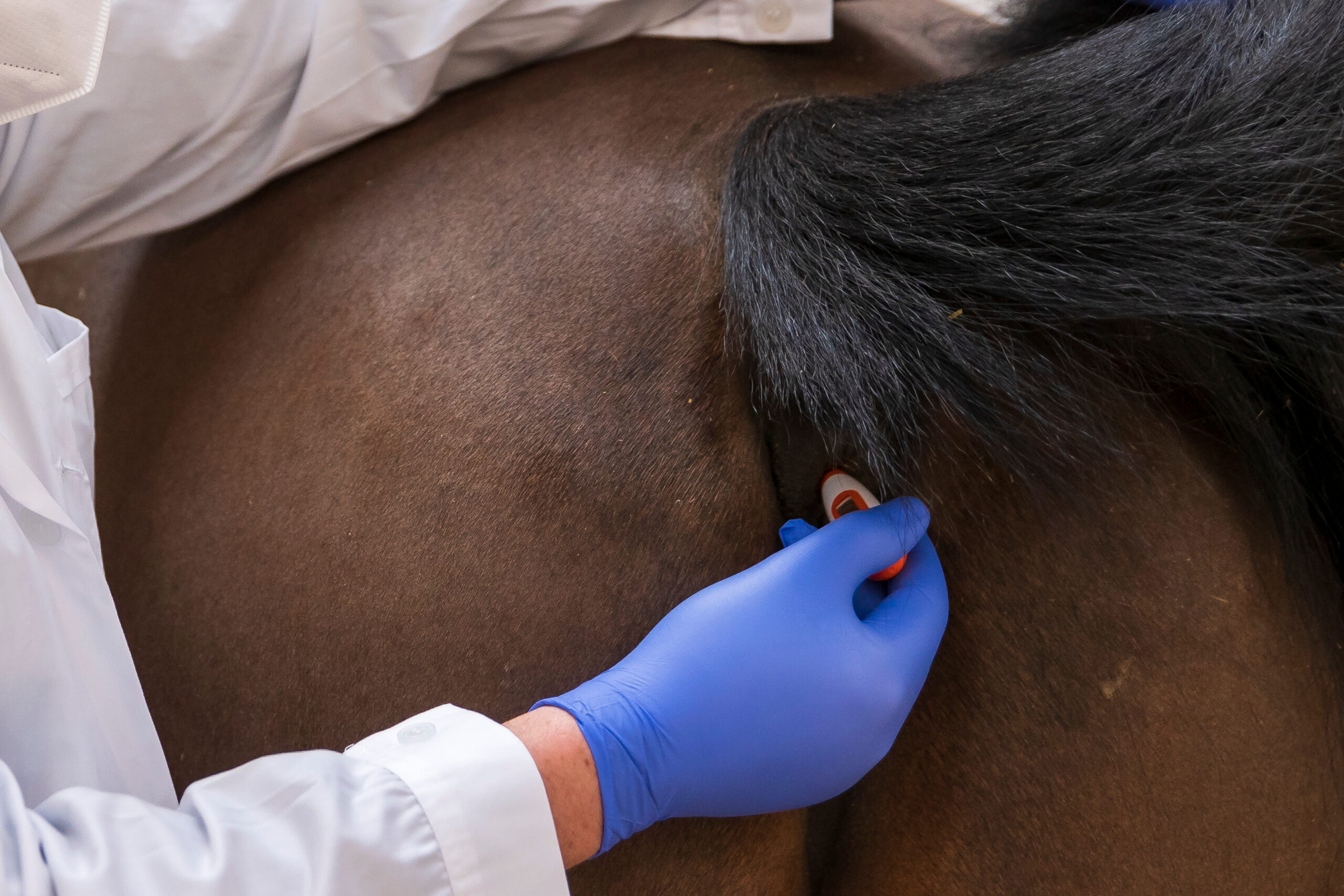 Taking a temperature twice a day in the affected stables helps to detect the herpes outbreak at an early stage and to be able to take measures. Photo: Sportfotos-lafrentz.de
 Today, the Equestrian Sports Association of Hesse announced that a horse with a herpes infection died in Dreieich. In addition, three other horses were diagnosed with fever. It is not yet certain whether this is the result of an infection. The results of the laboratory tests are still pending.
The affected club immediately initiated the necessary hygiene measures to prevent the virus from spreading, according to the association.
Herpes now notifiable
We reported yesterday that the equine herpes virus type 1 is now one of the notifiable animal diseases together with influenza. The regulation applies to the whole of Germany, as confirmed to us by a spokesperson from the Federal Ministry of Agriculture:
“EHV and equine influenza are two WOAH-listed diseases. There is therefore an obligation to monitor and report in the sense of a comprehensive fulfillment of the reporting obligation to the WOAH and transparent international trade. In addition, knowledge of the occurrence and spread of these diseases is of national interest for the purposes of early warning or early detection of a changed epidemiological situation and, if necessary, for the implementation of an effective risk assessment and action planning.
To date, there has been a lack of data on the occurrence of this disease in Germany due to a lack of regulations on monitoring and reporting. In order to optimize monitoring and compliance with international reporting obligations, mandatory reporting of these diseases in accordance with Section 4 of this Ordinance is expedient. The provisions of the Animal Disease Notification Ordinance apply to the whole of Germany.”
With the introduction of the mandatory reporting of EHV-1, the affected stables can now also be quarantined by the authorities.
Irrespective of this, however, it is in the interests of the outbreak farms and contact stables to take precautions to prevent the spread of the highly contagious disease at all costs.
What to do in the event of a herpes outbreak?
Ideally, the stable should be divided into three areas for sick horses, suspect horses and healthy horses, each with its own equipment such as buckets, pitchforks, brooms etc.. As herpes is primarily transmitted through direct contact, the horses should have as little contact with each other as possible.
Horses should have their temperature taken twice a day and their behavior should be observed. Typical symptoms of a herpes infection are diseases of the upper respiratory tract, loss of appetite and, in severe cases, neurological deficits or, depending on the type of virus, miscarriages or premature births. Treatment is only possible symptomatically.
People can also transmit the virus from horse to horse. It is therefore necessary to change clothes after contact with sick animals, use disposable gloves, wash and disinfect hands and use shoe covers. Disinfection trays at the stable doors are also strongly recommended.
Dogs and cats should be kept out of the stables. The yard should be cordoned off so that no horses can leave the stables and no other horses can come in from outside. Participation in competitions, attending courses etc. must be postponed during this time.
A return to normality is possible four weeks after the symptoms have subsided in the horses, provided that no horse has developed another fever or shown other symptoms within these four weeks.
Even though immunization against herpes is no longer a compulsory vaccination, vets, the FN and StIKo Vet (Standing Vaccination Commission for Veterinary Medicine) recommend vaccinating against it across the entire herd because vaccinated horses shed fewer viruses. This reduces the overall infection pressure.