Genomic breeding value estimation: Breeding with a view to DNA
“Wahl-O-Mat” horse breeding: genomic-based breeding values launch nationwide
 from Jan Tönjes
Breeding value estimates are a topic that has always preoccupied animal breeders. Until now, horse breeding has lagged somewhat behind other areas of animal breeding. But recording the milk yield of a cow and mapping it genomically is also something different from targeting the potential of a future dressage horse.
Genomic breeding values as important additional information
Until now, the selection of breeding horses has been based primarily on observable characteristics and the results of performance tests. The so-called phenotype was decisive for what decisions were made as a breeder or as a member of an evaluation committee: conformation traits, movements, jumping ability … All factors that can be influenced by environmental factors – training, personal taste, the question of what ideals the person judging the foal or stallion … grew up with. Factors that override the actual genetic predisposition, at least in part. Genomic analysis now focuses directly on the genetic material: Hereditary predispositions for numerous traits can be read much more reliably from the horse’s genotype. This significantly increases the reliability of selection and mating decisions.
How does genomic breeding value estimation work?
The process is complex, very roughly simplified it can be summarized as follows: Certain characteristics are observed in a horse. We then look at how similar or dissimilar other horses have shown these traits. If this data is then linked for a sufficiently large number of individuals, patterns and similarities can be identified in the genome. In this way, significant “gene loci” are defined for a trait. This in turn makes it possible to look for matches for every horse genomically examined in the future – usually at several gene loci, as there is no such thing as the “Totilas front leg mechanics gene”. Are they predominantly favorable expressions of the gene loci? Or is it more of a colorful mix that does not encourage the hope of a “dressage horse maker”?
For the first time, traits from conformation, movement and jumping ability are now systematically combined with genomic information in such a way that breeding decisions can be better substantiated. The summarized presentation makes it easier to use.
Genomic breeding value estimation based on gigantic amounts of data
Research and, above all, typing, i.e. creating a genome database, has been going on for a long time. It is based on data from 14 years of systematic recording using linear description. A total of 28 conformation, 19 movement and 12 jumping traits could be genomically processed in this way. Profiles of around 84,000 horses were used for the evaluation, which were described linearly.
First linear description
In the linear description, the direction in which certain criteria, “characteristics”, deviate in one direction or the other from a starting point of 0 is noted. The scale ranges from -3 to +3, i.e. a flat, straight croup (-3) or a steeply sloping croup (+3). Important: It is described, not evaluated!
In addition to the detailed data of the 84,000 linearly described horses, the database benefits from a pool of over 130,000 genotyped horses. All of this is compiled and evaluated in the vit data center using state-of-the-art methods.
What do the breeders get out of it?
The system was developed by the International Association of Future Horse Breeding GmbH & Co KG(IAFH): The association of leading German warmblood breeding associations pursues the goal of making genomically supported applications specifically usable for sport horse breeding. The new IAFH breeding values for stallions are now available online free of charge to breeders from the member associations.
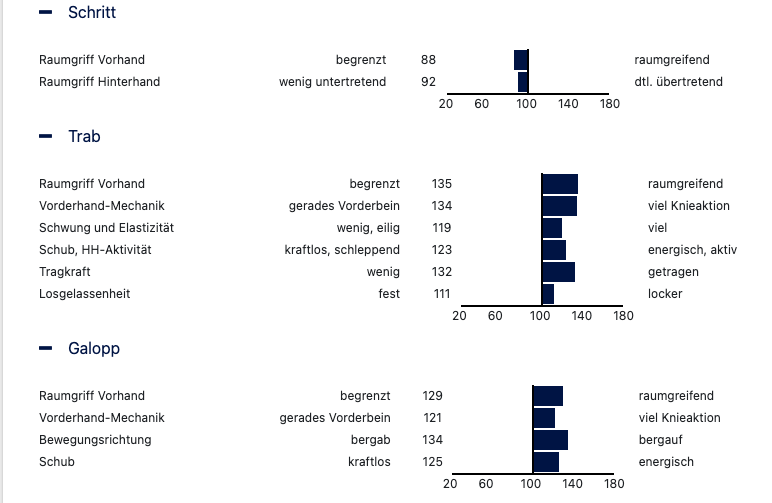
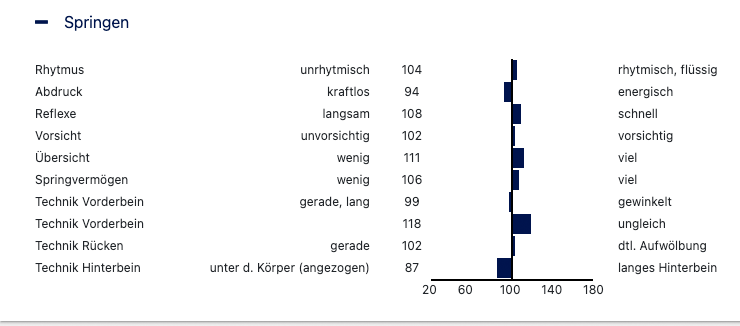
The highlight is the combination of phenotype data (tournament results, linear descriptions, …) with the high-resolution genotypic information in analyses, so that reliable results are available in a “consumer-friendly” way. Thus, a diagram illustration appears, as known from the representation of the linear description, but with a different scale. Here, the zero stands for an average characteristic, which varies from 0 with a bandwidth of -3 to +3. In the genomic breeding values, however, the 100 in the center indicates that the genetics do not point in the direction of one extreme or the other.
“Wahl-O-Mat” of modern horse breeding
Another core element is a digital mating program: breeders can define individual breeding goals and receive suitable stallion suggestions for their mares – a kind of “Wahl-O-Mat” of modern horse breeding. However, the final decision remains with the breeder. “It is additional information,” emphasizes PD Dr. Kathrin Stock, the driving force behind the efforts surrounding genomic breeding value estimation in horses. “Typing gives me a high-resolution genomic pedigree, so to speak. This means, for example, that my foal has 59.3 percent of the genes from the dam and 40.7 percent from the sire.” The data can then be broken down much further “and this allows us to work out much more precisely which genetics are advantageous,” says the vet involved in the analyses at vit.
Health information soon to be mappable?
In the long term, the focus will be on health in addition to performance and conformation. The aim of genomic breeding values is to improve the resilience and robustness of the population. An SNP chip with relevant gene loci is already available. A SNP chip (Single Nucleotide Polymorphism Microarray) is a DNA chip that analyzes tens of thousands of known genetic variants (SNPs) in a sample in parallel. It enables rapid, high-resolution genotyping for disease diagnostics, parentage testing and breeding value estimation in various animal species.
What is not yet sufficiently available, however, is health data. If certain diseases are to be clearly genetically assigned, a lot of data from veterinary practices and clinics is needed. Intensive work is also being done on this data basis in cooperation with veterinary associations. A breakthrough in this area could have a lasting impact on horse breeding and make breeding values even more health-oriented in the future. “In the end,” says Dr. André Hahn, Managing Director of the IAFH, “it’s all about health.”