Review of the "Fliegerschmiede" breeders' evening with Franke Sloothaak and Tim Rieskamp-Gödeking
“Fliegerschmiede” – Insights into the training work of experts
 from Dominique Wehrmann
 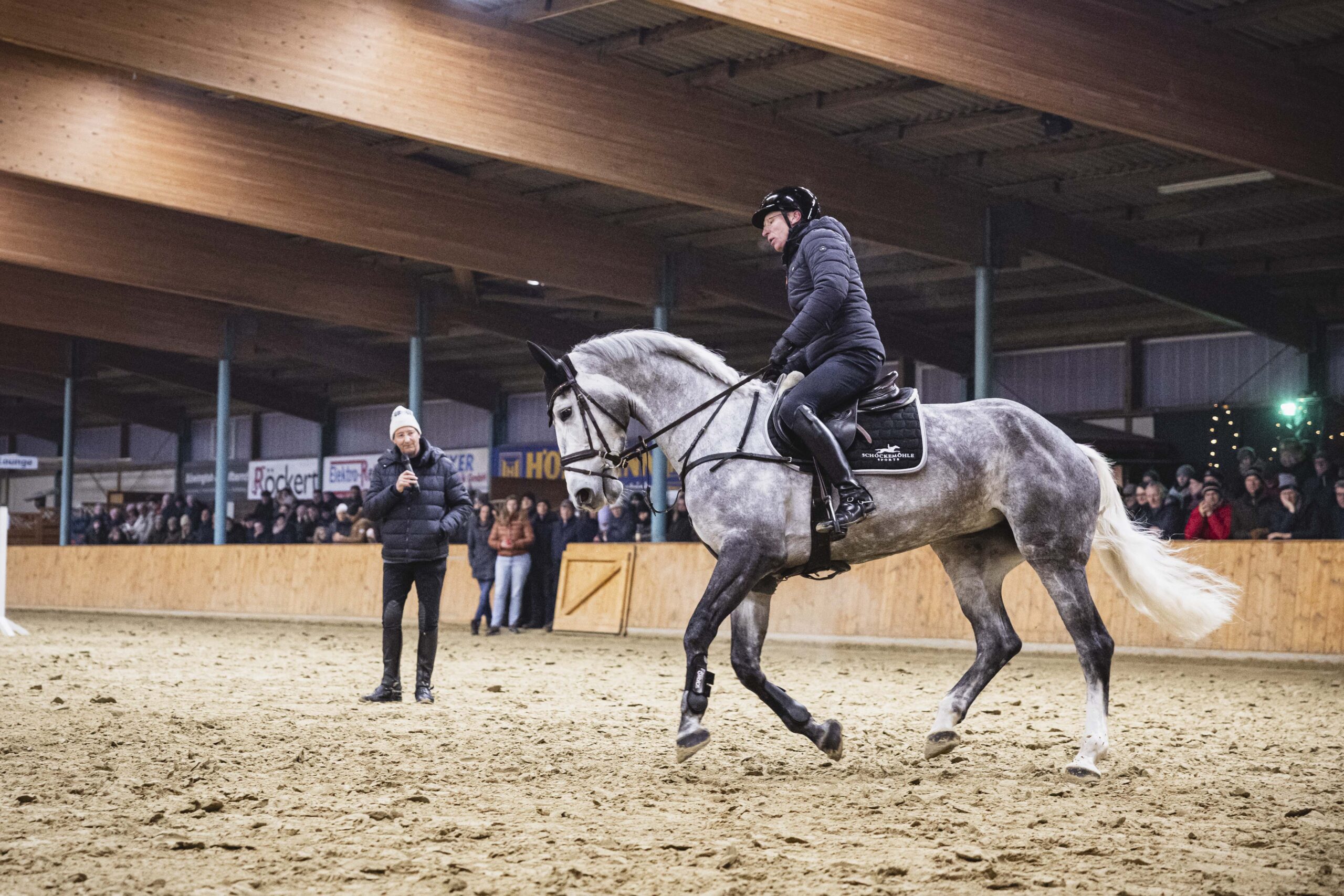 Tim Rieskamp Goedeking in the saddle on the KWPN mare Noa-Cara. Photo: Johanna Milse/johannamilsephotography
 The small town of Steinhagen, located between Bielefeld and Gütersloh, is a center of show jumping horse breeding and training. Tim Rieskamp-Goedeking took over the stables and breeding from Lutz Gössing, Olympic rider in the 1970s and later known in show jumping as the sponsor of Mylene Diedrichsmeyer and others after his active career ended. Franke Sloothaak (68) is based right next door. The 1994 show jumping world champion and two-time Olympic team champion has lived in East Westphalia for a long time.
However, you can only imagine how idyllic it is here on February 3 at 6.30 pm. A small motorcade pushes its way through the snow flurries along the snow-covered country lanes to its destination, the indoor riding arena, where the breeders’ evening is to take place from 7 p.m. under the motto “Fliegerschmiede”. The anteroom of the long side is well filled. Two radiant heaters should make it a little more comfortable. Mulled wine, punch and schnitzel or meat loaf rolls should be more effective. The general topic of conversation is horses. And that’s what the next two hours will be all about, more specifically show jumpers, their breeding and training. Olympic champion Sloothaak will explain some of the principles of training, while Tim Rieskamp-Goedeking will take over the practical part in the saddle with his horses.
Chao Lee’s brother on the double lunge
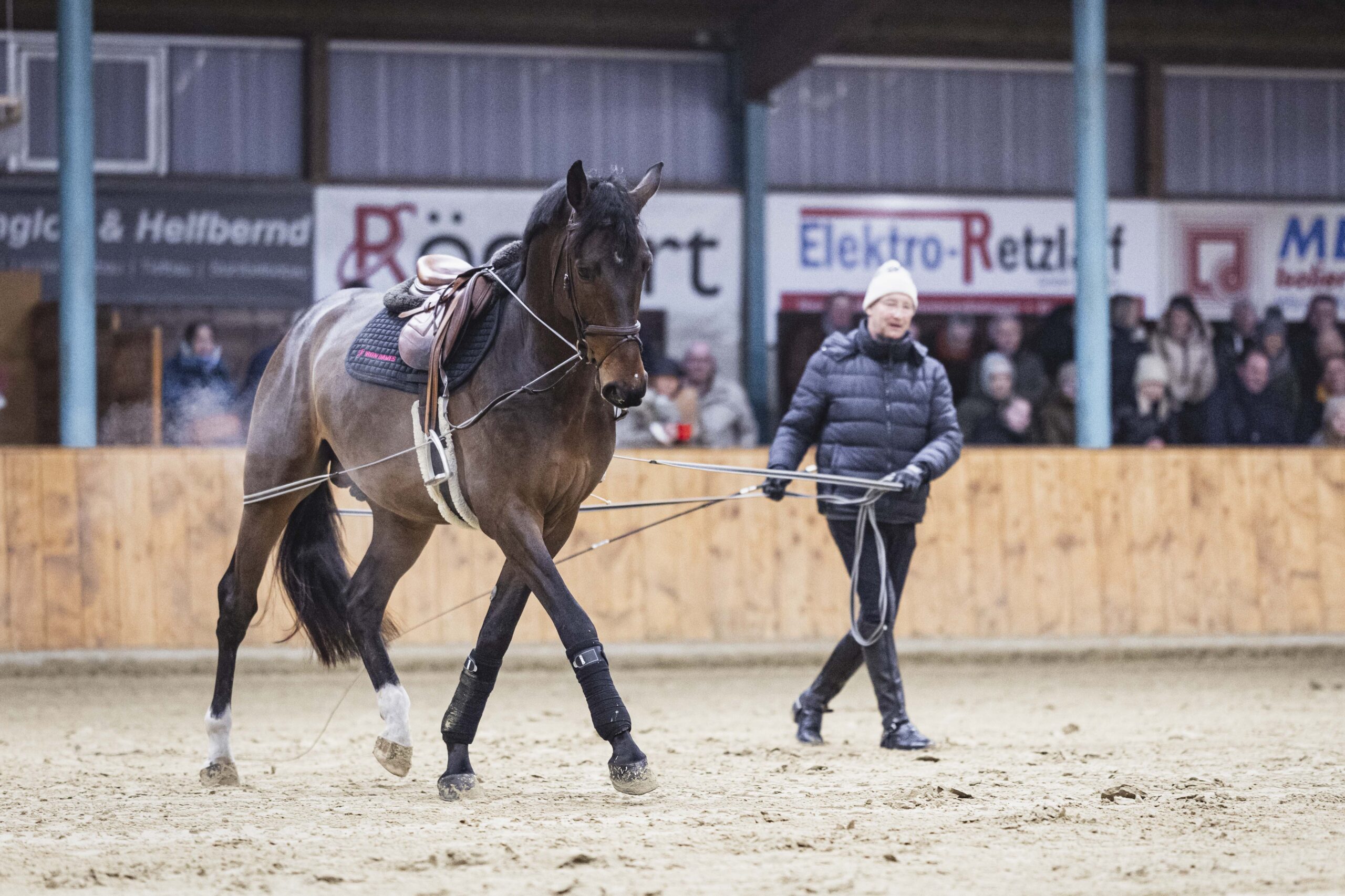
However, it all starts with a demonstration on the double lunge by Franke Sloothaak, with a horse owned by Katrin Eckermann, a five-year-old stallion with a prominent sister – Chao Lee, 2019 World Young Horse Champion and now a permanent fixture in top sport with stage wins in the Global Champions Tour. Comme Lee is the brown stallion’s name. His sire is Comme il faut and his dam is by Chacco-Blue. He won’t be jumping, but you don’t need to be a clairvoyant to see quality in him. The stallion clearly finds the unfamiliar atmosphere in the indoor arena with the many spectators on the rail exciting, but nevertheless allows himself to be led at a good walk by a helper, while Sloothaak gives a short introductory speech and explains that he prefers the double lunge because it gives him more control over the horses and because he can activate his hind leg better this way. As he talks, the microphone cracks and crackles. Comme Lee winces, but he keeps his nerve. Eventually, he gets used to the atmosphere and Sloothaak takes over the direction.
Tips for practice
The 1994 Olympic and world champion explicitly recommends lunging with a double lunge. His practical advice includes that it is better to use a shorter double lunge and to move more yourself than to have your hands full of material. Or that you should initially place the horse in a corner before touching the hindquarters with the lunge line, so that the horse can’t just rush off before it has got used to the unfamiliar feeling.
With Comme Lee, getting used to the lunge line is quick, despite the atmosphere around him. After a few minutes, Sloothaak can direct him in front of him and around him through the arena. Important: “The horse must always be in front of the lunger!” Sloothaak also advises keeping the circle small at first so that the lunger remains in control and the horse gains confidence.
Speaking of safety – working on the double lunge is also helpful if the horse doesn’t want to pass a certain point, explains Sloothaak, as it allows the horse to be trained to obey without pressure from the rider. Also important in the preparation: confrontation with the lunge whip, the extended arm, so to speak. “The horses should have respect, but not fear,” emphasizes Sloothaak as he carefully touches the stallion’s body with the whip. Comme Lee shows the way. At first, he stands tense as the line glides over his body, but then begins to relax. During lunging, he reacts to every lift and lower of the whip.
“The tension is completely normal for a young horse,” emphasized Sloothaak and praised Comme Lee’s willingness to cooperate. “Comme il faut-Chacco Blue-Kannan – that’s good blood!”, he picked up on the breeding part of the evening. And the older ones will understand him when he says that the earlier Gotthard and Pilot offspring were talked about differently.
Whether well-behaved or not – all these sires have inherited or still inherit a tremendous willingness and ability to perform. Comme Lee also demonstrates both when Sloothaak attempts to collect him in canter on a small circle. This is still difficult for the stallion, but he does his best and quickly understands what is required of him – even when Sloothaak has him canter in a counter position to improve his balance and activate the outside hind leg in canter. “The good thing is that the horses don’t forget that. Once they understand it, it sinks in,” says Sloothaak. Until the horses find it physically easier, it is a matter of physical training. Trainers have to take this into account, emphasizes Sloothaak.
Key takeaways from Franke Sloothaak’s double lunge unit
- start acclimatization in the corner to avoid rushing away
- prefer to use a shorter lunge line to be able to accompany the horse
- the horse must always be in front of the lunge leader
- prefer to work on a smaller arc – good for control and to give the horse a sense of security
- Respect for the whip, never fear
Horse II – Building trust
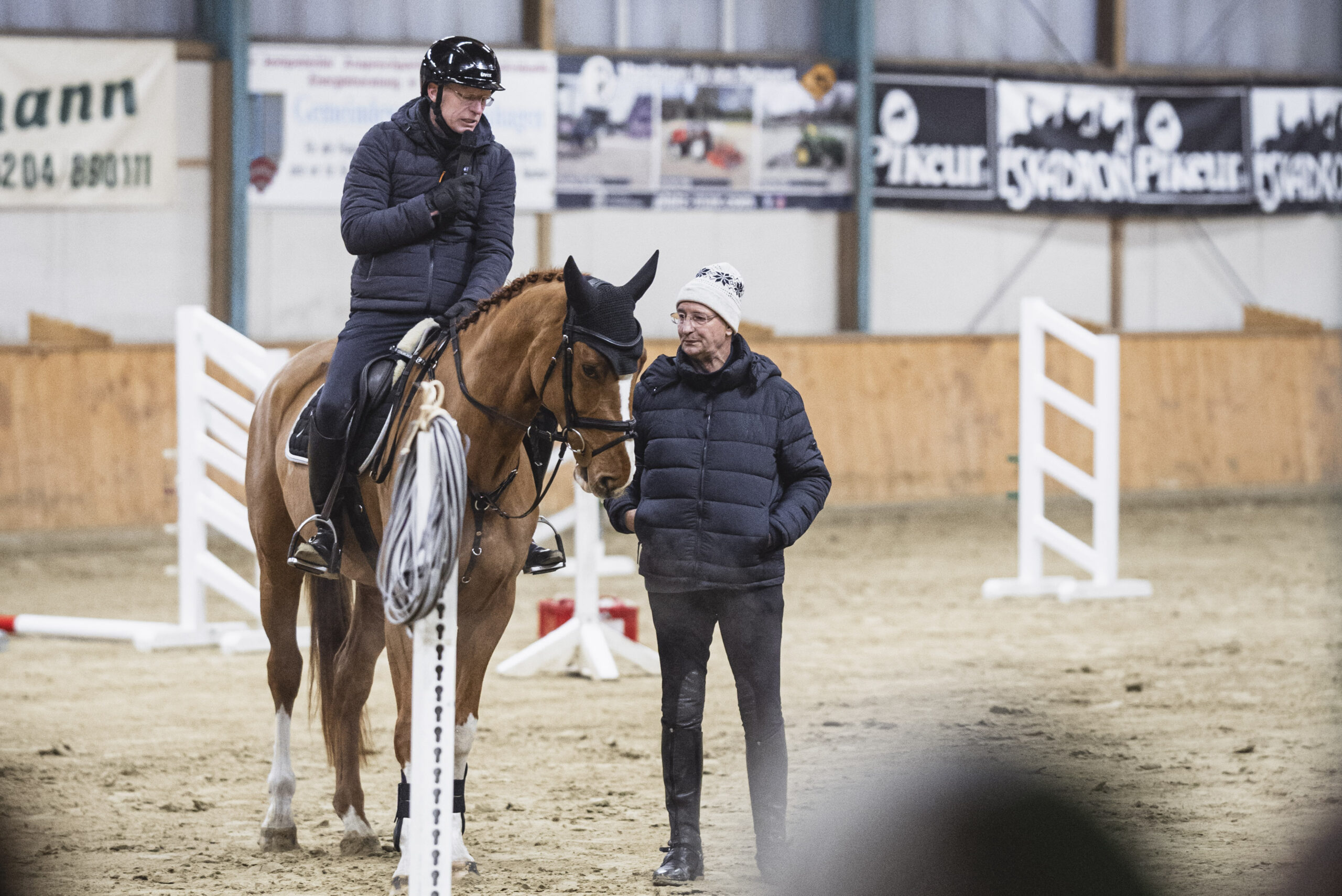
The second horse is a youngster who was still standing in the meadow last summer, was broken in and only made his first jumps under a rider at the beginning of the year, as Tim Rieskamp-Goedeking explains. He bred him himself, a colorful chestnut by Aganix du Seigneur out of the Diamant de Semilly-Kannan mare Quapitola de Beaufour. Rieskamp-Goedeking was successful in the big sport with Quapitola de Beaufour. Her son is not exactly a dream horse in terms of looks, but that doesn’t matter if he can jump. And he can, as he later demonstrates. But that is not the focus today. Sloothaak “It’s about giving the young horse an idea of what it should do. Can’t do that to perfection yet? That’s normal!”
When he starts to jump horses under the rider, Sloothaak makes it as easy as possible for them to do the right thing. For example, he doesn’t start from a canter if he can’t yet control it. “Then they sway back and forth in front of the obstacle and may lose confidence.” Instead, he approaches the jumps at a trot and places a pole in front of the obstacle at a suitable distance so that the horses understand where the correct jump-off point is. Rhythm and control are the basics. Then comes balance and so on. And another tip from Sloothaak’s wealth of experience: “I always approach unknown things at a walk and without pressure. The horses have to want to do it themselves!”
In order to strengthen confidence, he advises offering young horses a lot of variety – from A for “ride out” to Z for “leave home” and train somewhere else, so to speak.
It is also important to remember that the horses not only have to process many things mentally, but also physically. “When we go to the gym, we also find everything difficult at first,” explains the 68-year-old. It’s only fun when it gets easier. And it only gets easier if you keep at it without overstraining yourself. “Dressage work means asking yourself: Where can I support the horse’s body? In the end, the rider makes the horse,” recalls the former world champion, citing examples from the 1980s such as Deister and Paul Schockemöhle or Gladstone and Hugo Simon.
The practice
In the meantime, Tim Rieskamp-Goedeking has taken a seat in the saddle of his home-bred youngster. He rolls in first and is longer behind the saddle than in front. This makes part of the task for the dressage clear.
The former professional riding champion warms up the gelding first, then trots towards the poles laid out in a fan-shaped circle. But his four-legged partner is not quite convinced, swerves away or cheats his way over one pole instead of both. “Start at a walk!” Sloothaak instructs. TRG does as he is told. And lo and behold, the gelding soon starts looking for the poles himself. He has understood. “Horses learn much faster when they are calm,” explains Sloothaak. That’s why he always rides courses at trot and even walk at the beginning. “It’s about picking up again and again, then parading through, walking, starting again and tackling the next jump,” says Sloothaak. This also applies when it gets higher. “Then you have to slow down even more. The horses should find their own balance.”
Alongside rhythm and control, balance is essential. Sloothaak: “Most problems occur in combinations. If the rhythm isn’t right, the balance isn’t good. That is already decided at the jump-off. You have to consolidate the rhythm so that you don’t have to do much as a rider.” His tip for training: “Never build normally high combinations further than 7 meters to bring calm into the sequence. For cautious horses, 6.5 meters at normal height and 8 meters when it gets higher.”
However, none of this is yet an issue for Rieskamp-Goedeking’s youngster. The host has now switched to aiming for the poles, which are laid out along the long side. His chestnut is not comfortable with this. With a mixture of patience, Sloothaak’s calmness and consistency, Tim Rieskamp-Goedeking nevertheless manages to convince the gelding. Once overcome, the ice is broken. The gelding relaxes and shows talent at small obstacles with a forward pole. He also moves much better from behind and in balance.
Horse III – Talent with educational gaps
The third horse is an eight-year-old KWPN mare by Gaillard de la Pomme-Denzel van het Meulenhof called Noa-Cara. Tim Rieskamp-Goedeking has already ridden her in competitions, but she is still quite green for her age and has some gaps in her training, according to the horse manager. “Ambition, attitude, basic quality and ability are there, but her body is not yet where it should be.” The grey mare stands with a broad chest and long back over a lot of ground, but has an extremely stable foundation – something that Tim Rieskamp-Goedeking emphasizes is also extremely important for breeding horses.
Franke Sloothaak takes a look at the mare and says that he will first try to ride her down to “get” her back. Initially, this mainly causes her to curl up. But Sloothaak has an antidote: “Half halts – make the active horse a little slower,” he says, illustrating the collecting effect. To do this, he has Tim Rieskamp-Goedeking ride transitions, from trot to walk and back again. Absolute basics, but it’s the how that counts. “You have to ride on in the transition to walk,” he instructs his “pupil”, “and almost let them trot on again in walk”.
He emphasizes that it makes little sense to lean forward and praise a successful execution, as this will throw the horse off balance again. “The best praise is to keep the reins long.” But he doesn’t want Tim Rieskamp-Goedeking to throw the reins away. It’s about giving the mare length in the neck and at the same time bringing her in from behind. Sounds simple, but we know it’s not. But Tim Rieskamp-Goedeking implements the instructions immediately. The effect is immediately visible: the parades become more flowing and go more through the horse’s entire body.
Next item on the agenda: canter work on the circle. As with the five-year-old on the double lunge at the beginning, Sloothaak now has the grey mare canter with her trainer in the saddle in a counter position on a fairly small circle and the rider leads the horse’s shoulder outwards. Now the inner shoulder and inner hind leg no longer have to carry quite so much weight. It’s a game changer for the mare, she takes on more and more weight and becomes more flexible in her body. An aha effect.
Waiting and rest
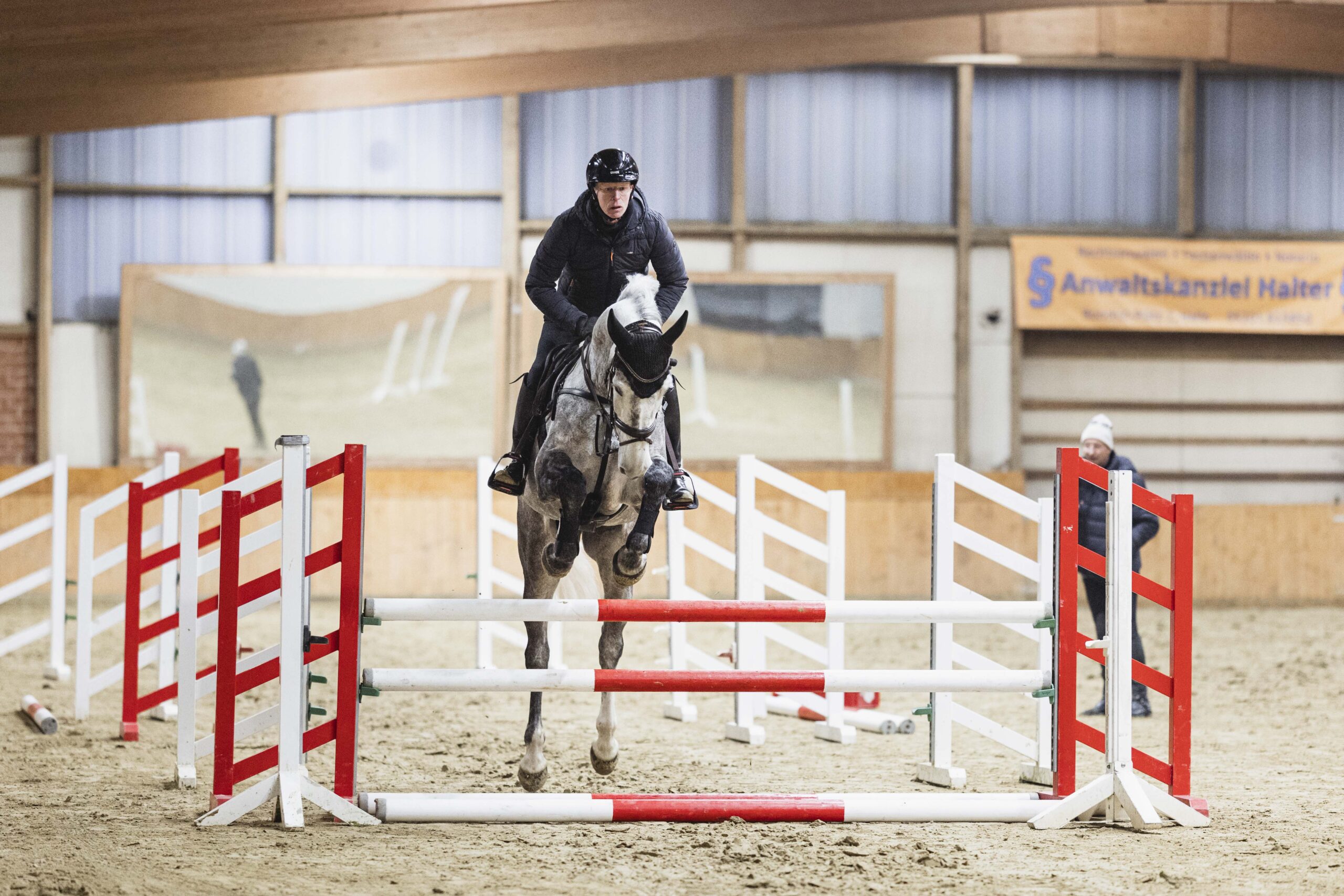
Then it’s time to jump. Sloothaak sets up a combination in such a way that it can be jumped from both sides. “I always do it this way, because even if the obstacles are the same, the situation is always slightly different from one side or the other.” If only because the exit is waiting on one side and not on the other. The most important message that Olympic champion Tim Rieskamp-Goedeking gives is: wait! Wait until the horse shows you: I want to go there. “When the ears are in front, you know it has the jump in its sights.”
When the mare has landed on the right and Rieskamp-Goedeking wants to initiate a flying change for the left turn, he is corrected again: “With young horses, don’t insist on the change straight away, but restore the balance first!” In general, Sloothaak prefers to determine the canter when landing as a rider himself. “If you want her to land on the left, put her on the left before the jump,” he advises. That works. Noa-Cara also becomes calmer and calmer and approaches the combination with more composure.
The whole time she doesn’t go near a pole. It’s easy to understand why Tim Rieskamp-Goedeking thinks so highly of the mare. When he finally parades her through to trot and lets her trot out for a few more rounds, she is completely changed. She arches her upper neck, her whole topline swings. The trot flows through her body. Another aha moment.
Message from a rider and trainer
Visibly satisfied, the mare now walks at a relaxed pace. Tim Rieskamp-Goedeking takes the microphone and jokes: “I chose the horses for tonight carefully. I also expected something from them.” He will be part of the licensing committee in Zangersheide at the end of the month. In this context, he has an appeal to everyone involved in the breeding of show jumpers: “We have to get back to a situation where the stallions are sustainable for the breeder.”
When asked later what exactly he meant by this, he explained: “As the licensing committee, we no longer really know what we are seeing.” In other words, is this a supertalented horse blessed with natural caution flying over the last oxer or is it simply a young stallion conditioned to this exact situation who is at the peak of his career on the day of his licensing and cannot reproduce such a jump on the course? That would be the opposite of sustainable, because a stallion like that is only popular with breeders until the first offspring reveal the truth.
With all due respect for the different interests involved – in the long term, nobody benefits from this, neither the associations and sellers, who profit financially from the sale of spectacularly jumping young stallions, nor the stallion stations, which put up a hyped free jumper who does not pass on his inherited talent at the last oxer in the line and does not prove himself on the show jumping course.
Sloothaak-style mnemonics
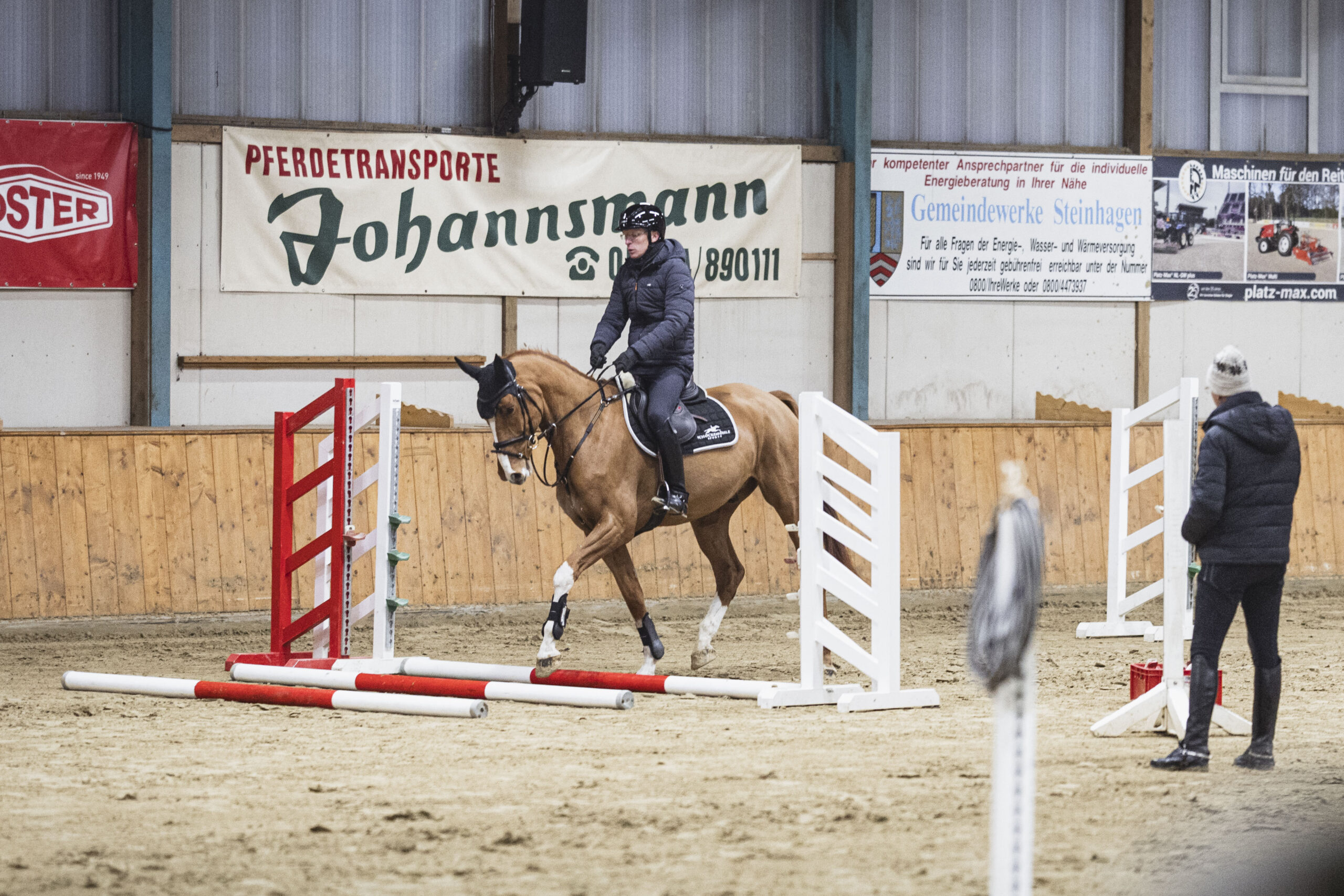
“The horse avoids the poles from the trot? Ride over them at a walk first!”
“Start at a normal pace and let the horse find its rhythm, then increase the pace later.”
“The horse has to get into balance. Then it doesn’t matter what kind of bit I use.”