Steendiek's Derrick—the s*** dressage pony that has cheated death twice
Steendieks Derrick – About a 1.45-meter pony that wins the Grand Prix
 from Dominique Wehrmann
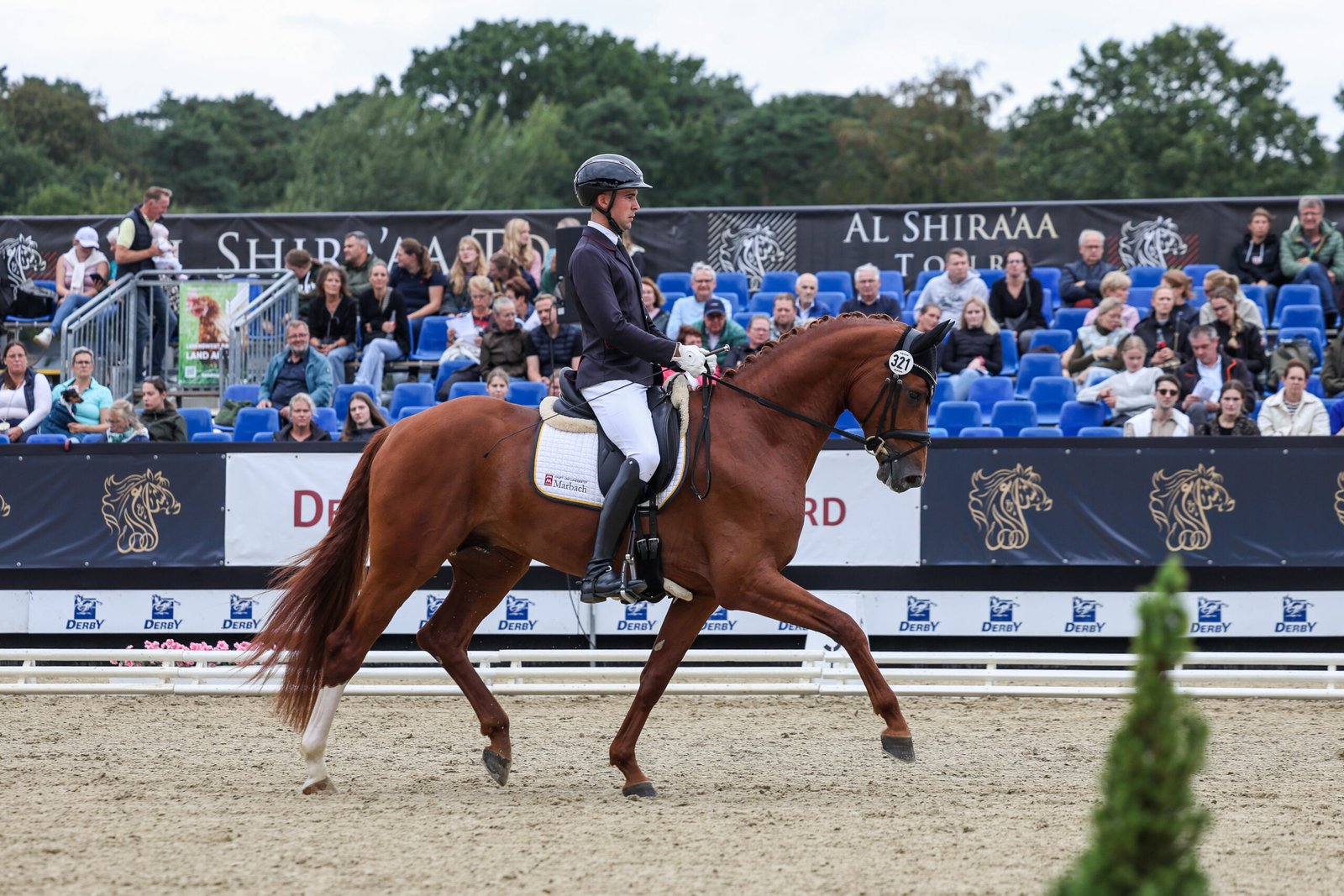
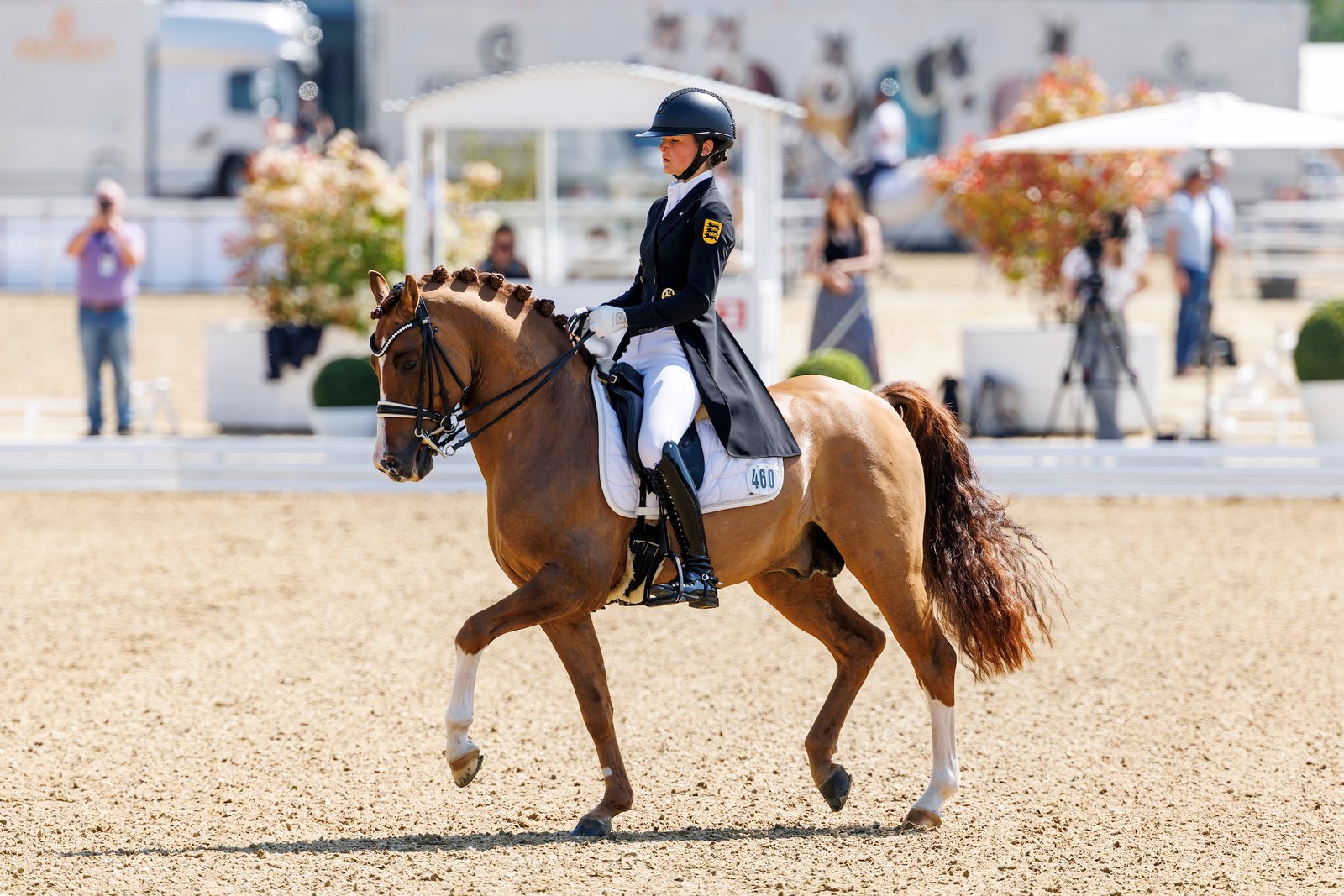 Ann-Cathrin Rieg and Steendiek's Derrick competed in the Intermédiaire II class at the Piaff Förderpreis event in Mannheim, where they finished in a strong sixth place. This year, they have won nine out of 15 S*** classes, placed second twice, third once, fourth once, and finished in the top ten twice.
Photo: sportfotos-lafrentz.de
Steendiek’s Derrick owes his name to his birthplace, the Steendiek stud farm owned by the Böge family in Schönhorst, Schleswig-Holstein. The Holsteiner champion stallion Catoki also grew up there, where Derrick spent the first years of his life. But Derrick was not destined for show jumping; he was meant for the dressage arena. That was what he had been bred for.
His sire, Steendieks Morgensterns Dalai, was bred according to the best dressage pony formula, with the two breeding heroes of the Stücker Ferienhof—FS Don’t Worry and FS Champion de Luxe—as his sire and maternal grandsire, and on his dam’s side, the bloodline that has produced, among others, the competitiveand breeding-proven FS Pavarottie, Pan Tau, and others.
Derrick’s dam, Debby v. Donnertraum-Don Pedro, comes from a line that hasn’t been quite as successful. But as of this season at the latest, Peter Böge has been able to promote additional offspring from this family under the designation “Derrick Line.” Although that was actually already the case before.
Derrick was born in 2014, at a time when the Böge family was still seeing 60 to 70 foals born each year. Peter Böge had no idea at the time that something truly special had been born. “He was a good foal, sure, but just like the others.” Böge attributes the fact that Derrick would one day become one of Germany’s most famous ponies largely to his career path. “It always depends on where they end up,” says the experienced breeder. And Derrick was lucky enough to end up with Ann-Cathrin Rieg.
The Right Pony, the Wrong Time
Even as a three-year-old, Derrick was no longer “just an ordinary” horse. Presented by Heidi Elina Takala, he made it into the top ten in the Bundeschampionat final. As a four-year-old, he competed under Wenke Kraus and won riding horse classes against larger horses. As a five-year-old, he qualified again for the Bundeschampionat, this time under Sophie Henke, who rode him to eighth place in the final. By that time, Ann-Cathrin Rieg already knew Derrick.
“In 2019, we were looking for a three-year-old—or at most a four-year-old—young pony with potential that I wanted to compete in the riding pony classes at the Bundeschampionat, then train up to FEI level and sell,” reports the 26-year-old. Her search led her to a training stable in Neumünster, where several young ponies were waiting for new owners. Among them was Derrick. Ann-Cathrin took him for a test ride, even though, at five years old, he didn’t really fit her usual criteria. Peter Böge may have thought Derrick was just a pony like any other, but from the very first moment she was in the saddle, Ann-Cathrin Rieg knew this young stallion was different—better. “The feeling was just amazing right away,” she recalls.
But she didn’t want a pony for herself; she wanted one to train and resell—much like she had already done with the European Champion Daily Pleasure, who came to her at age four, was trained by her, and later paved the way into the big arena for more than just one child. At five years old, Derrick was already too old for that. So the Rieg family headed home empty-handed. But Derrick had stuck in Ann-Cathrin’s mind.
Community of Fate
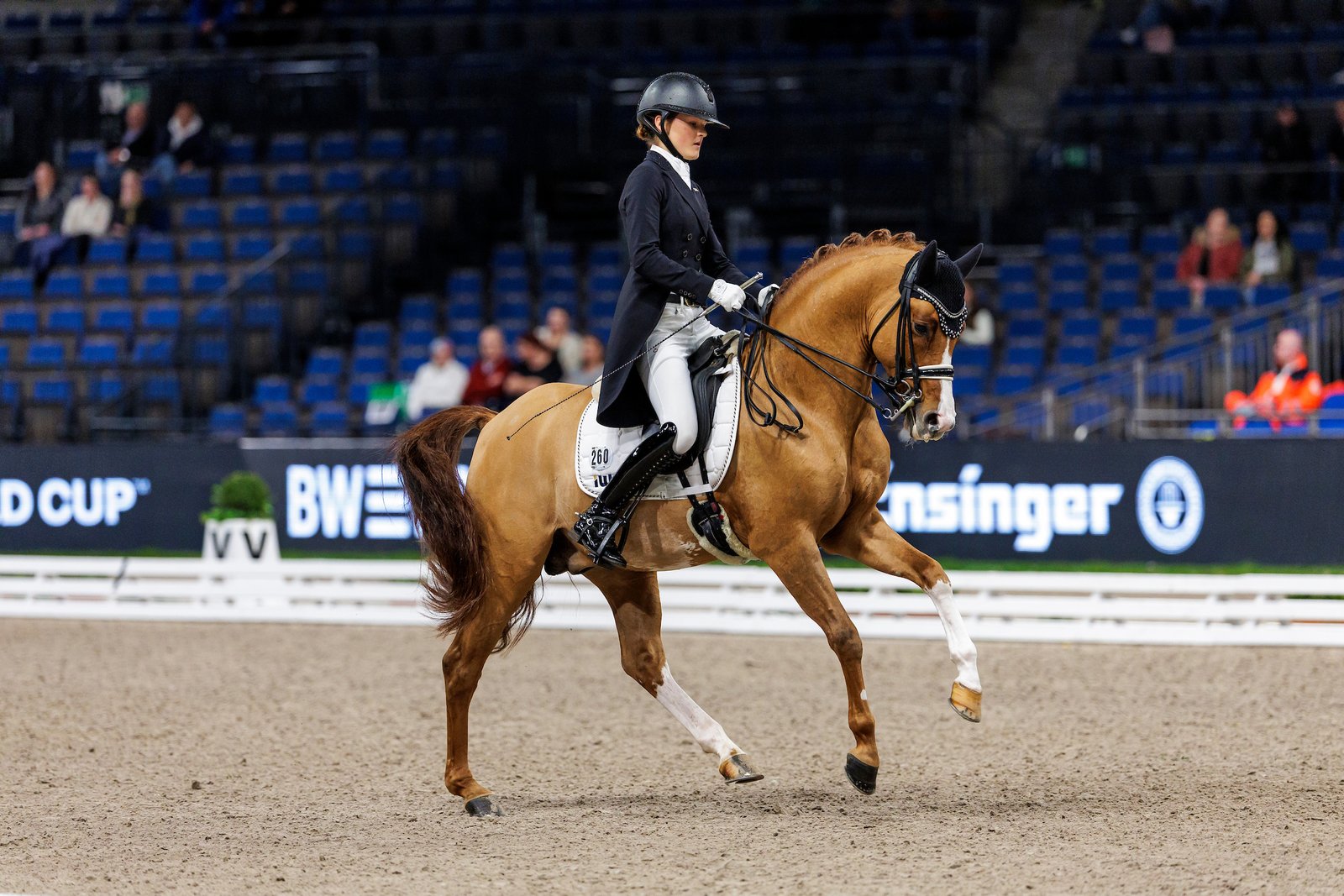
She followed his progress on ClipmyHorse, saw him at the Bundeschampionat, and knew there was so much more to this pony. Ann-Cathrin Rieg’s parents probably couldn’t stand hearing the name Derrick anymore at that point. She was constantly going on and on to them about this pony. It must have been meant to be that the two would find each other, because when the Rieg family came across Derrick again while looking for a different pony, the decision was made. At the turn of the year 2019/2020, Derrick moved to Baden-Württemberg.
He and Ann-Cathrin were able to get to know each other at their own pace. They didn’t feel any pressure from competitions, since everything had been canceled anyway due to the pandemic. When they were finally allowed to compete again, Ann-Cathrin entered a Class L dressage test. Derrick won it with a score of 8.0.
This sparked interest; the first purchase offers started trickling in, and prospective buyers came to try Derrick out. But there was always something. He had strained a muscle with the first client. When the second appointment came around, one might be tempted to suspect that Derrick had attempted suicide, because the stallion broke six spinous processes in a manner that remains unexplained to this day. Now it was no longer a question of whether to sell or keep him; now it was a matter of his life.
Back to the Beginning
Derrick’s injury was inoperable. It had to heal on its own. Or maybe not—it was a gamble. The vets said he’d need five months off from boxing. He was allowed to be led outside just a few steps, at most, to do his business. The accident happened in July. The day after Christmas, Ann-Cathrin Rieg rode Derrick again for the first time. He’d made it—not only had he recovered from the injury, but he was also ready to compete again. “That was my best Christmas present,” said Ann-Cathrin Rieg.
It took a while, though, for the riding experience to feel the same as it did before the accident. “I was totally unsure. He didn’t feel right at all. We kept going to the vet to have him examined. But the vet said everything was fine. He just needed to build up his muscles again.”
So she continued to work with him cautiously. Her veterinarian was right. Just under a year after the accident, Derrick competed again—once more in a Level L dressage competition. Although he was already seven years old, he was still allowed to compete due to his lack of competition experience. He won the class with a score of 8.7. If it had been Derrick’s intention to secure a permanent place with the Rieg family, he had now succeeded. “After the fracture, nobody wanted him anyway,” Ann-Cathrin says in retrospect.
The Beginning of an Extraordinary Career
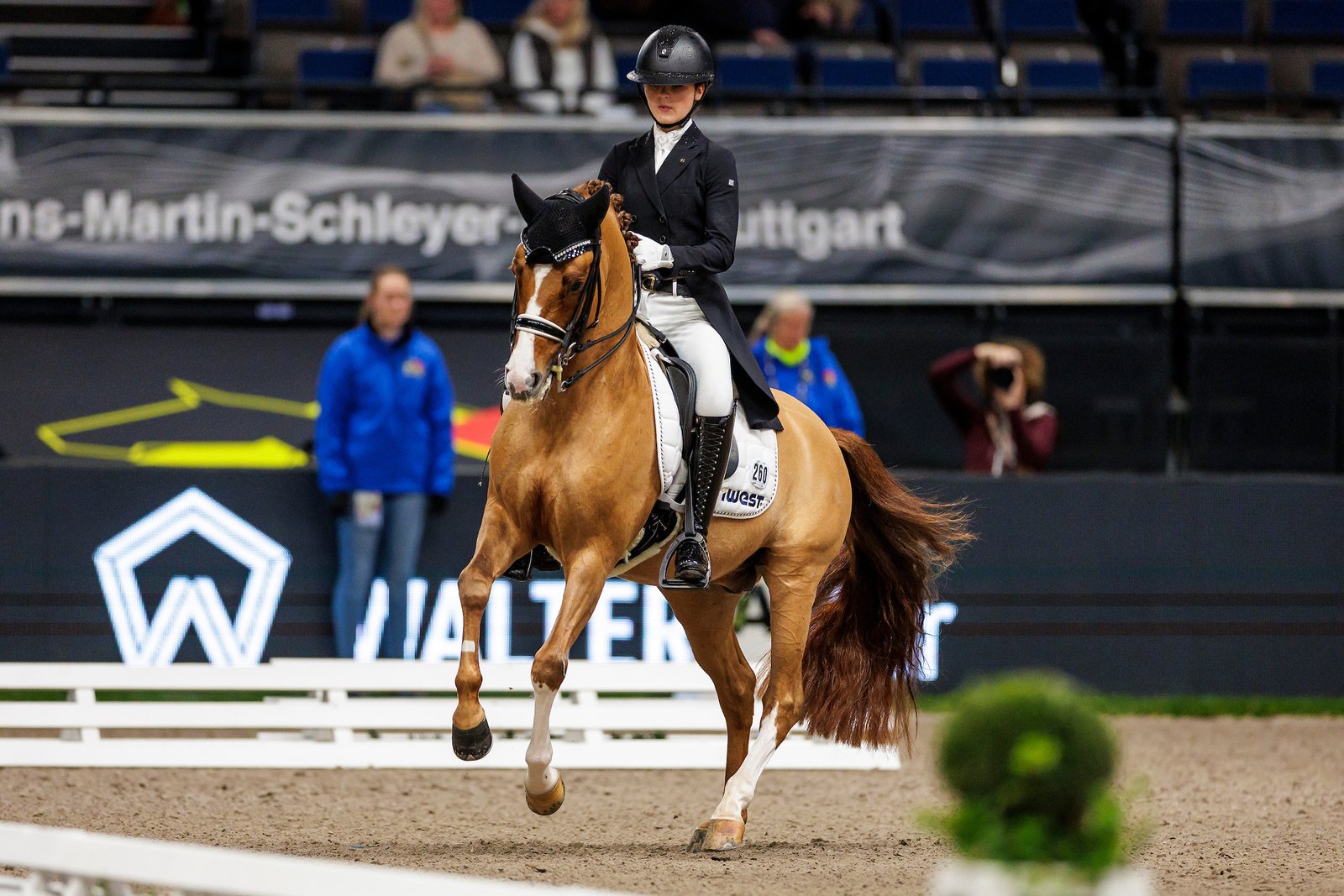
But what was she supposed to do with Derrick? Age-wise, she had long since outgrown the pony stage. But as petite as she is, her build still suited her well for ponies, which she preferred to ride anyway. She’d had her greatest successes with them, while she’d always had bad luck with full-size horses. So why not turn Derrick into a pony for the big arena? “So I thought, I’ll teach Derrick a change…” Here it became clear that Derrick isn’t just super-talented, but also super-smart. Once you taught him something, he had it down pat.
Ann-Cathrin Rieg was brave; she entered her first Class M dressage competition—and won. “It was almost always like that: he’d learn something new and was right up there at the front right away. At some point, I tried an S-level class. In the first one, he was still a step behind. He won the second one. That’s when my dad said for the first time, ‘She’ll get her Golden Riding Badge with him.’” Ann-Cathrin’s mother was rather skeptical. “No, she can’t do it, not with a pony,” she said. Derrick proved Ann-Cathrin’s mother wrong. Within a year, her daughter was able to pin the Gold Badge to the lapel of her tailcoat. You can imagine that Mrs. Rieg has been reminded of her mistake quite a few times since then. Because S was by no means the end of the story. “Derrick always told me, ‘There’s still more to come,’” says Ann-Cathrin Rieg.
Derrick Becomes a TV Star
Her instincts didn’t fail her. She continued to train Derrick, entered him in his first two-star competitions, collected ribbons in the Prix St. Georges and Intermédiaire I, and set her sights on the iWest Cup at the German Masters in Stuttgart, which is decided in the Intermédiaire I class. For her, as a native of Baden-Württemberg who lives very close by, the tournament at the Schleyerhalle is not only a sporting highlight but also a home game. You want to be there. But first, you had to qualify.
That was even more difficult, because two weeks before the last tournament—where they could still have earned the points they needed—Derrick developed a hoof abscess. Ann-Cathrin’s parents thought she was crazy when she said she still wanted to ride the recently recovered stallion in the qualifier. Once again, Derrick proved that “can’t” isn’t in his vocabulary. He secured their ticket to the Schleyerhalle.
While the Intermédiaire pony had been a regional attraction up to that point, its appearance in Stuttgart made Derrick famous throughout Germany. The two left a lasting impression. There was a pony that outshone the big horses in terms of training standards, quality, and charisma. The pair sensationally took home the silver ribbon for second place.
A pony making it into the top three in this highly acclaimed series finale—that was so extraordinary that SWR dedicated an entire episode to Derrick. Everyone was amazed by Derrick. But Ann-Cathrin knew: “In Stuttgart, he showed me that he’s got a little more gas in the tank than S**.”
A Pony on Its Way to the Grand Prix
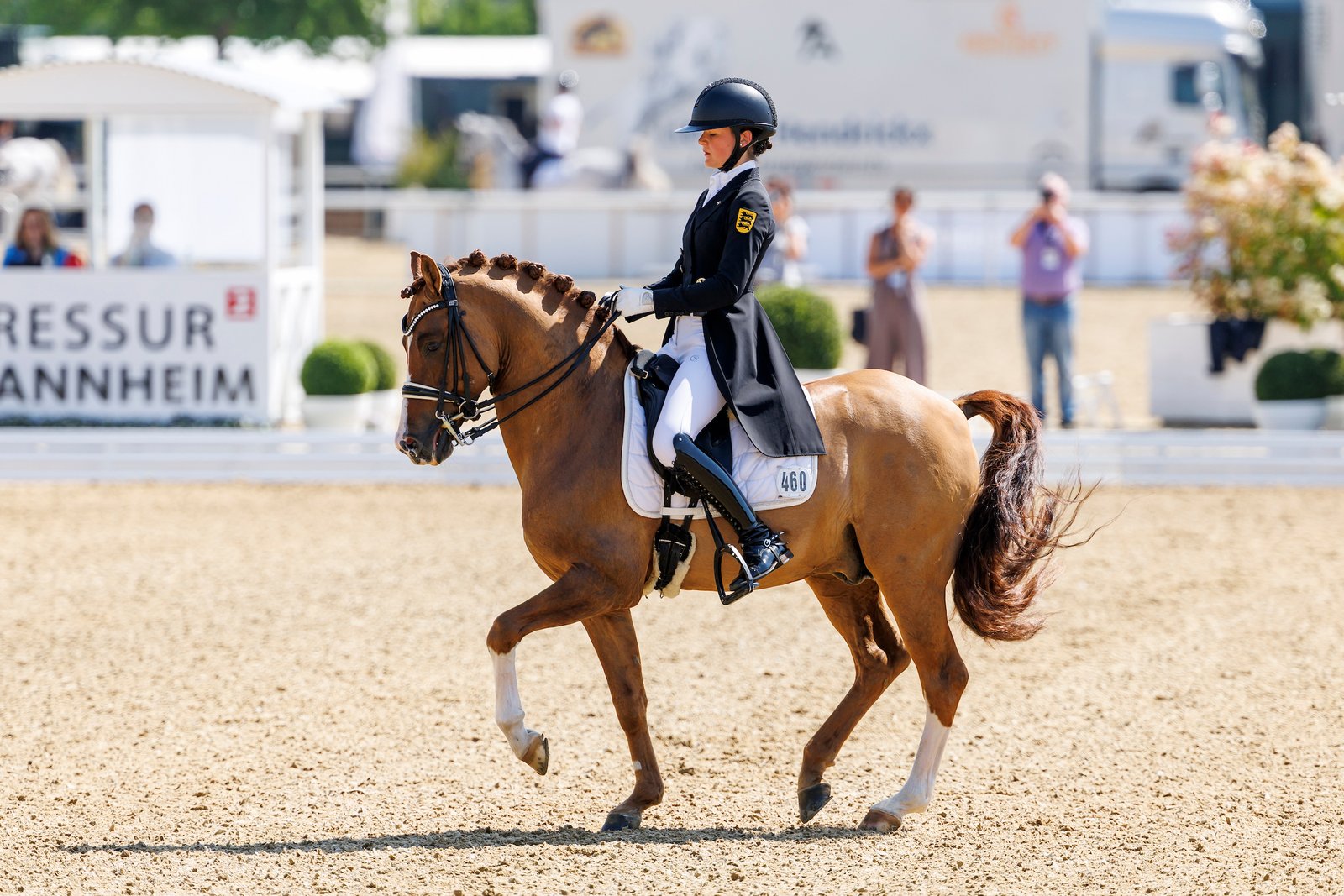
So she taught her stallion the one-tempi change over the winter and drove him to Katrin Burger to learn how to teach him the basics of piaffe and passage on the lead. Derrick picked that up quickly. It took a little longer for him to understand the aids under saddle. Ann-Cathrin gave him time, letting a season pass before she set her sights on their first S***-level tests under competition conditions. Today, piaffe and passage are among the pair’s strengths.
In 2025, they entered the Piaff Scholarship Competition. They were accepted into the competition and were so successful that they were selected for the national team. To this day, Derrick remains the first pony to have achieved this. And he will likely remain so for quite some time.
The DERBY Star of Tomorrow
Last weekend, the Southern Final of the DERBY Stars of
Tomorrow
took place at Gut Ising. Ising has traditionally served as the semifinal venue for all participants south of Frankfurt. The final itself was then held in January at Halle Münsterland. But since the southern region had consistently been underrepresented here in recent years due to weather conditions, it was decided to hold two finals—one for the south and one for the north.
If Bavaria’s local hero Franz Trischberger had thought that with his Louisdor Prize-qualified and highly talented Kinshasa, he would have a clear path to victory this year in Ising He hadn’t counted on the two stars from the Ländle, Ann-Cathrin Rieg and Steenhof’s Derrick. Christoph Hess was there as a judge and commentator. When Ann-Cathrin and Derrick had finished their precise, lively, and highly elegant test—and Ann-Cathrin couldn’t praise her stallion enough for his outstanding cooperation—he reached for the microphone. “That’s what riding is all about—truly having the horse as a friend. And you can tell that about you two. That—I think—is something a judge can sense.” And a spectator, too.
Ann-Cathrin should have said something, too, but she could hardly bring herself to do so. “I always say he has a heart bigger than the universe and the fighting spirit of a lion, and I think he’s proven that to everyone this year—and I’m so grateful for that…” She couldn’t get any further, because tears welled up in her eyes. They were tears of joy, but probably also of relief, because what neither Christoph Hess nor the audience knew was that in March, Derrick had cheated death for the second time.
Derrick’s Third Life
On the way back from a tournament, he was pawing the ground in the trailer during the ride. Even that seemed strange to Ann-Cathrin. When the stallion then lay down in his stall and wouldn’t get back up, the Rieg family didn’t hesitate for a moment and took him straight to the veterinary clinic. What a good decision! What initially looked like a normal case of colic turned into an emergency overnight.
At 2:30 a.m., Ann-Cathrin’s phone rang; it was the hospital on the other end. Derrick had a thrombosis—a blood clot in his appendix—which was causing the blockage. Time was of the essence—surgery or not? Surgery, of course. Fortunately, the clot was removed and the blockage cleared without having to remove any part of the intestine. Derrick had made it through—once again.
But the scar needed time to heal. So Derrick—in the thick of training and brimming with energy and strength—was once again forced to take a break. For ten to eleven weeks, he was supposed to be moved only at a walk. Haha, that’s a joke. After eight weeks, he started tearing apart his stall, reports Ann-Cathrin Rieg. Her advice was to ride him at a controlled walk. That was even harder than leading him. The solution was the treadmill. Set to a slight incline, Derrick jogged on it three times a day for the last two weeks. After that, he was back to his old self.
Outlook
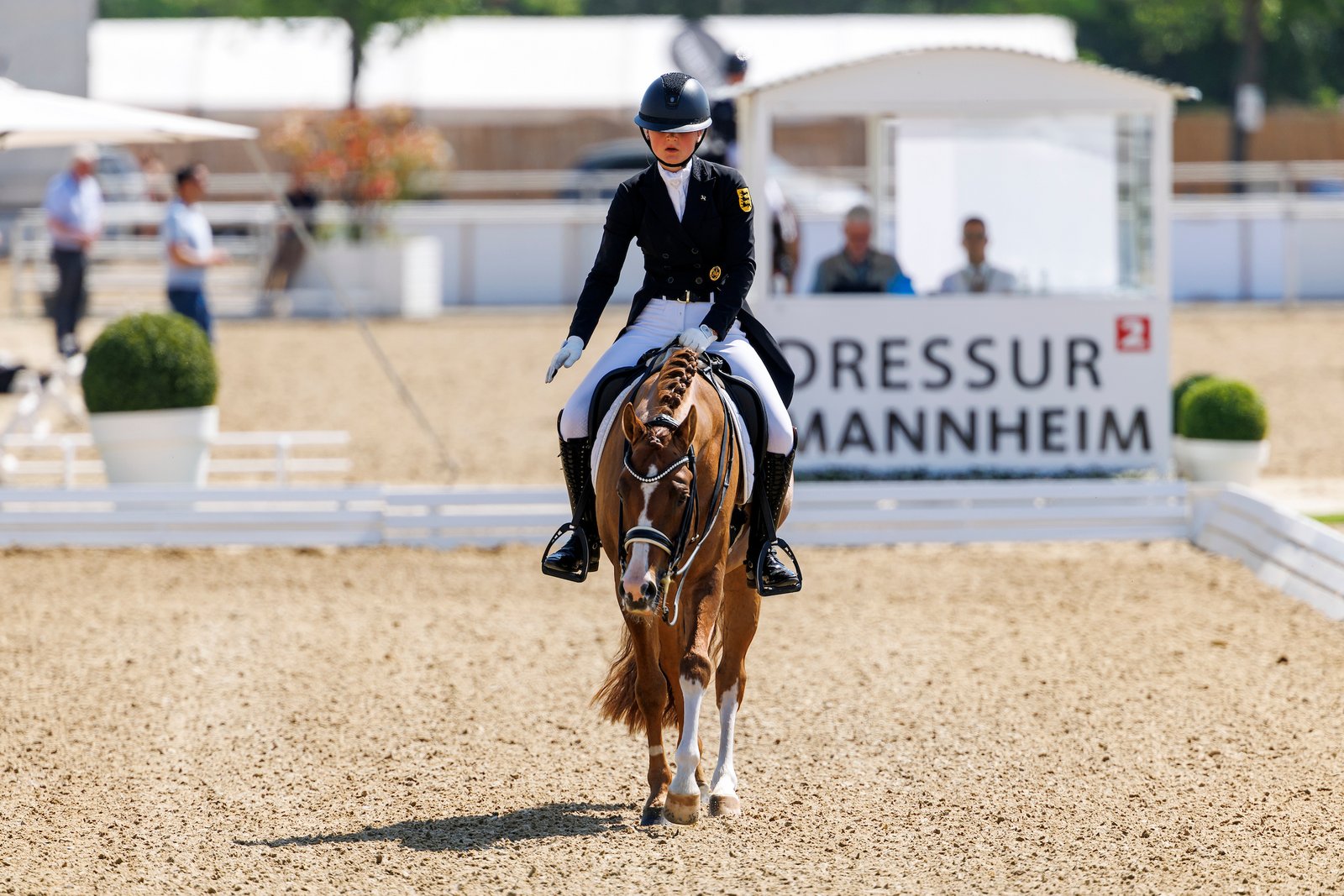
The first pony on the national team, an S*** winner, a rising star—what’s next? As far as her competitive goals go, Ann-Cathrin Rieg is aiming for her first starts in the Grand Prix de Dressage and Grand Prix Special this coming season—perhaps even on the international stage. But in the long run, she envisions a second career for her stallion. “I’d like him to be able to pass on his great genes someday. I’ve realized just how quickly it can all be over…”
In addition to Derrick, Ann-Cathrin currently has a total of five horses and ponies in training and under her care. In 2021, the family was able to lease their own facility with eleven stalls, which offers enough pasture land so that each horse or pony has access to two paddocks that can be rotated. There are paved paddocks and a horse walker, ensuring the horses have a varied daily routine year-round. In addition to her riding and managing the facility, Ann-Cathrin works in the office at her father’s timber construction company. The Rieg family also breeds horses on the side, but the mares are housed at a breeding farm where professional care is guaranteed.
When it comes to training, Ann-Cathrin is largely self-taught. Until she was 15, she took lessons from Holger Schulze, and his partner helped train her ponies. When her trainers’ relationship ended, Ann-Cathrin had reached a point where she could manage the ponies’ training up to the FEI level on her own. Since then, she has not only produced the aforementioned Daily Pleasure but also two other ponies that went on to compete at the European level: Ganymed, whom she bought as a foal, and Chilli Morning, whom she presented at the Bundeschampionat at age six on behalf of the Schmitz-Heinen family.
When it comes to her own dreams, she keeps her expectations in check: “I have some good young horses in my stable, and I’d really like to compete in the World Championships for Young Dressage Horses, the Burg Cup, or the Louisdor Prize in Frankfurt. But in sports, so much depends on luck and financial resources—I don’t even want to think that far ahead. That just puts pressure on me.”
And she’s already hard on herself enough. “I’m ambitious and a perfectionist. I usually watch videos of my rides right on the way home, while it’s still fresh in my mind. I’m mature and self-critical enough—I know when I need to take a good look at myself.” That mindset has taken her a long way. It’ll be interesting to see just how far she goes.