Dusty hay in horses: steaming, watering or dusting?
Reduce hay dust: with a hay steamer, hay deduster or by watering
 from Kerstin Wackermann
 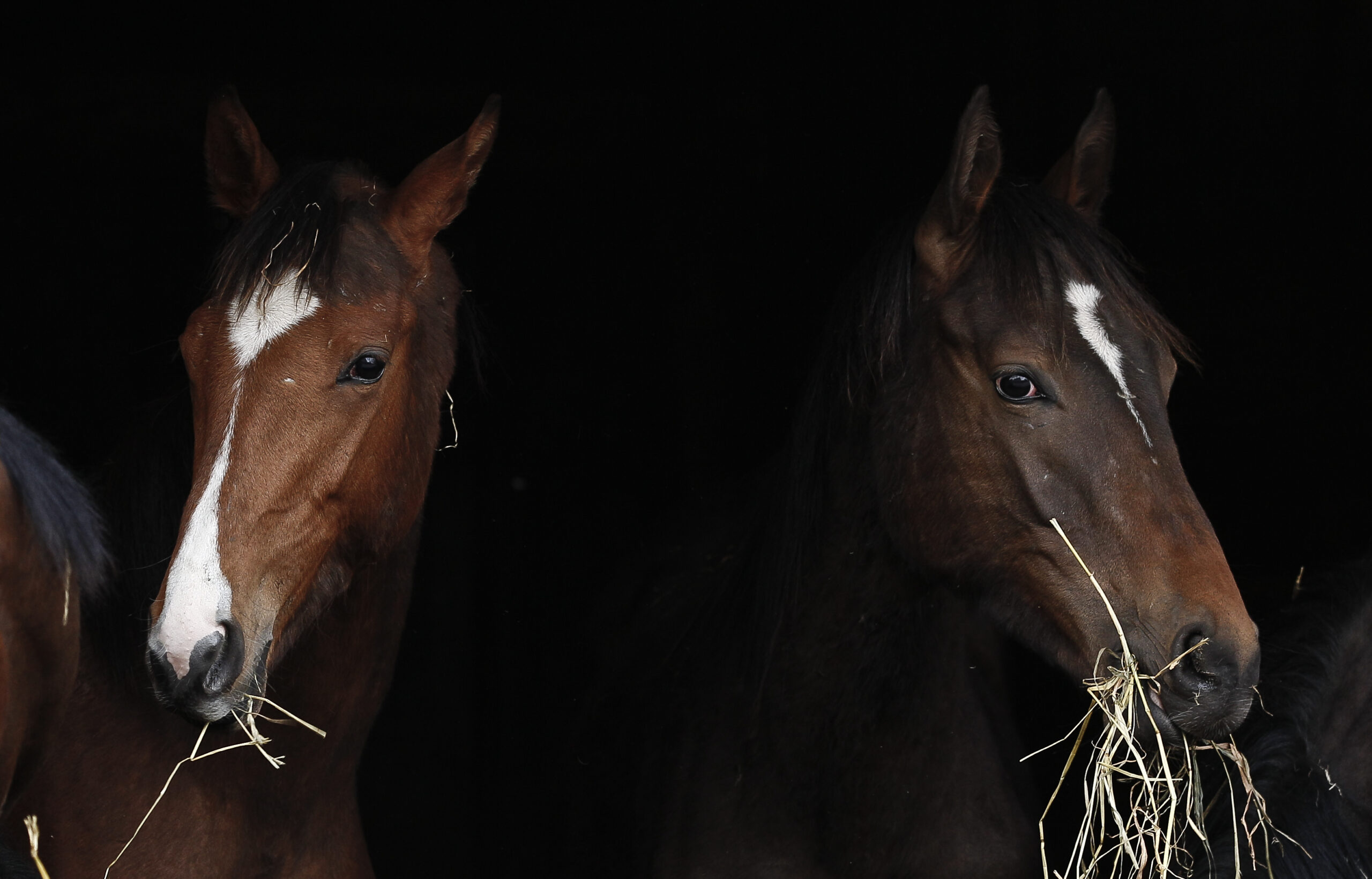 Hay is a basic feed and must be hygienic for horses of all ages. Photo: toffi-images.de
 Watering or steaming hay has long been part of the routine for many owners of horses with equine asthma. In many stables, large water tubs are therefore just as much a matter of course as large black barrels or boxes with power cables, the hay steamers.
Hay dedusters are much less common – they have only been available in a compact design for about a year. We have summarized here how well these three measures bind or reduce dust and what you should bear in mind.
An important note in advance: Bad hay can never become good hay! Hygienically questionable hay must not be fed! If you discover mold (visible spots) on a bale of hay, the entire bale must be disposed of, as the invisible mold spores have already spread.
Why dusty hay puts a strain on the horse’s airways
Anyone who has ever seen the many “dots” floating around in the backlight of a barn has only a vague idea of what is in the air we breathe, even when the air appears to be “good”. This is because most dust particles are so small that they are no longer visible – and these are particularly risky. Small dust particles float in the air for a very long time and are not stopped by the filter functions of the nose. They reach the deep areas of the lungs, where the body can no longer simply remove them, but can only render them harmless with difficulty via immune cells. This is referred to as respirable dust. Inflammation or equine asthma can be the result.
Many of these fine dust particles are stirred up, especially when eating dry hay, as measurements show. It is therefore particularly important to minimize the release of dust from feed.
What is respirable dust in hay?
Respirable dust is a mixture of inanimate particles and living microorganisms, such as:
- plant fine particles (abrasion from dry stalks, leaves and seeds)
- mineral dust (fine soil or sand particles that get into the hay during harvesting or storage)
- Mold spores
- Bacteria and bacterial components
There are various ways to bind and reduce dust. “Any form of dust control is initially positive, no matter which method you use,” explains Dr. Christa Finkler-Schade, agronomist and publicly appointed and sworn expert for horse breeding and husbandry. “The problem should actually be tackled much earlier during harvesting or storage so that not so much dust is created in the first place. But many farms have to buy in their hay and have no control over harvesting or prior storage.”
Watering hay: binding dust
The cheapest way to bind dust is to soak the hay. To do this, the hay must be completely immersed in a large tub. In measurement studies, the number of respirable dust particles fell sharply after ten minutes of soaking. However, nutrients are also washed out in the process, as another study shows:
Soaking for 15 minutes at 20 °C led to a decrease in all nutrients tested, including water-soluble carbohydrates, macronutrients and trace elements. The leaching of sugars may be intentional in metabolic diseases, but must be taken into account when calculating the ration. According to the study, the convertible energy decreased by 5 to 15 percent after 15 minutes of soaking. Around 35 percent of the small intestine-digestible (prececal) crude protein and amino acids were washed out. In addition, the horse is less able to utilize the protein that is still present in the hay after soaking. Precaecal digestibility (pcD) drops by 49 percent.
The scientists emphasize that horse owners must be aware of these losses in order to avoid deficiency symptoms or unwanted weight loss.
“Although the washing out of sugar is intended for metabolic patients in terms of nutritional therapy, the loss of protein must also be considered. The procedure is also hygienically risky. It can do more harm than good, especially if the hay is not eaten immediately,” says Dr. Finkler-Schade. This is because the microbial load can increase rapidly even during short soaking times and in the first few hours afterwards.
Vaporizing hay: effect on dust, germs and nutrients
Hay steamers heat water in a boiler and direct the resulting steam into a closed container in which the hay is located. They are designed so that the steam is directed into the hay from below or centrally. This is to prevent only the outer layers from becoming damp while the inside remains cool.
Professional devices are available for a few kilograms of hay or even larger bales, and the costs vary accordingly (for example: the Haygain 360 Compact for 6 to 8 kilograms of hay starts at around 850 euros, the Haygain HG 600 for 9 to 11 kilograms is around 2,200 euros).
What do hay steamers do?
In studies that directly measured dust particles and bacterial counts, the load was reduced by around 99 percent after steaming in individual test settings – provided that the hay inside reached very high temperatures.
A working group from the Martin Luther University Halle-Wittenberg, the Technical University of Dresden and the Julius Kühn Institute investigated the effects of steaming on nutrients: they steamed hay for 60 minutes according to the manufacturer’s instructions. At the end, the lid indicator showed an average temperature of ~97 °C, while the temperature inside the hay reached almost 100 °C in measured samples. Crude protein remained unchanged, individual minerals changed slightly.
However, the effect on the sugar content varied greatly: depending on the hay batch, the value of water-soluble carbohydrates (glucose, fructose and sucrose) decreased by up to 8 percent or even increased by up to 12 percent. Protein digestible in the small intestine decreased by 41 percent during steaming in this study.
Feeding expert Dr. Finkler-Schade illustrates this chemical change: “You have to imagine it like frying eggs, when the egg white turns brown at the edges: Amino acids and sugar react chemically to heat and this leads to the typical brown color. This so-called Maillard reaction causes the protein structure to change. This can be disadvantageous for the horse when hay is heated, as the proteins can no longer be properly absorbed and assimilated in the small intestine in this altered form.”
The scientists of the above-mentioned study write that the bioavailability of the resulting Maillard reaction products is still open and needs further investigation. They advise users of steamers not to compensate for the loss of protein with a larger amount of hay: Since energy does not decrease as a result of steaming, increasing the amount of hay would provide the horse with far too much energy. Instead, the ration should be supplemented with high-quality protein sources and amino acids, especially for sport horses, broodmares and growing horses.
Even if the protein digestibility changes, the researchers recommend steamed hay for horses with severe asthma due to the high germ reduction. However, as the levels of soluble carbohydrates such as fructans fluctuated greatly in the study and even increased in some cases, they advise against steaming hay for horses with metabolic disorders or horses prone to laminitis.
It may make more sense to use a combination of soaking and steaming, as an older British study shows: Nine hours of soaking followed by 40 to 50 minutes of steaming is the most effective method for significantly reducing water-soluble carbohydrates while maintaining hygienically clean hay. This was at least the case for the typical levels of water-soluble carbohydrates in hay from the United Kingdom, which was examined for this purpose.
What do I need to bear in mind when steaming hay?
A stable 230-volt power supply is generally required for the installation of a hay steamer (with the exception of large systems/round bale systems). The manufacturer Haygain advises consulting an electrician to ensure that the power supply for the steamer and all other electrical consumers is sufficient – a separate circuit may be required, especially in older barns.
A steaming process takes 60 minutes on average, but can be extended to up to 1.5 hours in extremely cold outside temperatures in winter. According to the manufacturer, approx. 4.5 liters of water are used per cycle and the hay remains hygienically stable for at least 24 hours after the process.
To reliably reduce germs and dust, the hay must be loose in the container so that the steam can penetrate all areas evenly and reach a very high core temperature. If the hay is only moistened or heated unevenly, the microbial situation can even deteriorate. This is why homemade hay steamers or insufficiently insulated systems are no substitute for professional equipment.
It is also important that the hay lies loosely in the appliance. Overly compressed bales or very tightly stuffed nets can prevent the steam from reaching all areas.
Hay deduster: remove dust without water
Hay dedusters are devices that work dry and remove hay dust mechanically from the roughage: They turn the hay and shake it up, the dust released in the process is extracted. About ten years ago, the first stationary bale shredder with suction was launched, which can pick up and process round or square bales.
Due to the size of this machine, dusting hay is also offered as a service or you can buy hay that has already been dedusted.
There are now also more compact versions on the market that can be accommodated in the barn, such as the Heubatec Duremo E (approx. 7,600) and the german horse tech DEXTR1550 (approx. 7,990 euros incl. fine dust filter on request). They can be used to remove around 10 kilograms of hay dust per process.
In contrast to the hay steamer, the devices work without steam and water, which Christina Schindler from german horse tech believes is the advantage of such systems. “You don’t have to reach a certain temperature to effectively remove the dust from the hay, as with a steamer. This saves electricity costs and time, as the hay is ready after ten minutes. You also don’t have to top up the water or descale it regularly. As the system works dry, there are no problems with frozen pipes or components in winter.”
Above all, the aspect of saving electricity is a decisive purchase criterion for her customers, says Schindler: “The deduster works with an output of 2.3 kW. Due to the short processing time, it costs – based on an electricity price of €0.30/kWh – 1.15 cents to remove dust from one kilogram of hay.”
The appliance removes around ten percent of the hay’s weight in the form of dust, pollen and fine broken material. The material ends up in a dust collection bag.
“On request, we also offer a 1-µm fine dust filter, which means the device can also be used in the stable aisle,” says the manufacturer of the DEXTR1550.
For expert Dr. Finkler-Schade, this is an important point with such devices: “Dusty hay should not be shaken up near horses or people. Unless you use special filters to prevent the fine dust from escaping from the extraction system and being inhaled.
Scientific studies on mechanical hay dedusting are rare. A doctorate on the “Hygienization of roughage and bedding in the horse industry” is currently underway at the HfWU Nürtingen and DHBW Ravensburg universities. Ann-Cathrin Doelzer is investigating steaming in large bales, watering, spraying a 3 to 5 percent oregano oil solution and mechanical dedusting (directly in the field in a large machine). It is still too early for the first results, but Ann-Cathrin Doelzer has already been working intensively on the topic: “Dusting will most likely reduce dust and mold spores. The study will show how strong this effect actually is. At the same time, we need to check whether valuable, easily brittle leaf components are lost during loosening and vacuuming, as this is where a large proportion of the hay’s energy and nutrients are found.”
We will report on EQUI PAGES as soon as the first results are available.
Pay attention to stable management!
“With all variants, one thing is crucial: there is no point in steaming, watering or dusting hay for just one horse if the neighboring horse continues to get its hay ‘dusty’. In the long term, there will be no success if the management of the entire stable area is not changed. As horses in stables often share a common air space, the dust particles from the box next door also affect the horse with lung disease,” says Dr. Christa Finkler-Schade.