Training the horse in the cold
Does cold air irritate the horse’s airways?
 from Kerstin Wackermann
 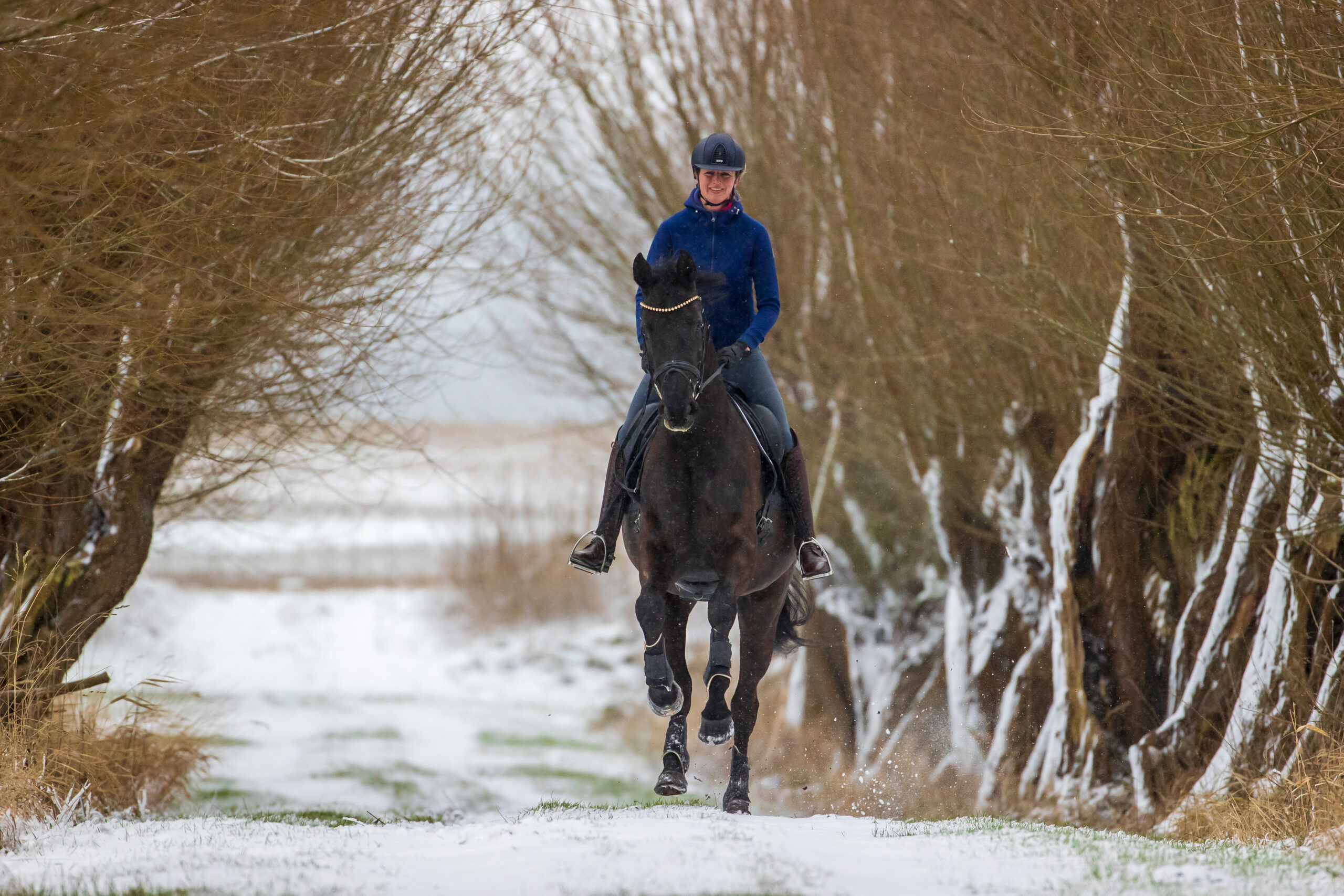 For a healthy horse, galloping through the snow is not a problem. But horses that already suffer from equine asthma should not be exposed to additional stress in winter, as the cold irritates pre-damaged airways. Photo: Sportfotos-lafrentz.de
 Wintertime is coughing time for many horses – which is usually due to the way they are kept and fed: dust from hay and bedding, less fresh air and exercise are factors that put a strain on the respiratory tract. Are the sub-zero temperatures that we are currently experiencing in many places adding to this?
“Just yesterday I had another horse that has been suffering from equine asthma for years and is currently getting worse,” says vet Dr. Annette Wyrwoll. “In my view, cold temperatures contribute to exacerbating respiratory problems for two reasons: Firstly, in some stables the windows are closed day and night in sub-zero temperatures to prevent the drinking troughs from freezing. Secondly, ice-cold air irritates already damaged bronchial tubes.”
Cold air in the airways
Many joggers know from their own experience that cold air can irritate the airways. Studies show that the upper airways can no longer sufficiently warm and humidify cold air when breathing in and out intensively (i.e. under exertion). The cool, dry air mixture reaches the deeper airways. There it cools and dehydrates the mucous membranes, which can lead to microscopically detectable changes in the mucous membranes.
Adapt training in winter
Whether and how a horse with equine asthma can be trained depends on its condition and the stage of the disease. “Horses that suffer severely from equine asthma cannot be exercised so intensively anyway. But there are many cases where light dressage work is possible even in cold temperatures,” says Dr. Annette Wyrwoll. However, the vet would advise against a fresh gallop through the snow or in the outdoor arena with an asthmatic.
As always, it is best to ask the attending vet for advice on how training should be organized in principle, observe the horse and adjust the training accordingly if coughing increases.
What scientists say
Allergens such as mold spores, pollen or dust are often the cause of equine asthma. They lead to an inflammatory reaction in the airways. More mucus is produced and the airways narrow. Cold air acts via a different mechanism, without allergens being involved, but leads to the same reactions, explains scientist Dr. David Marlin. Together with Dr. Michael S. Davis and other colleagues, he has worked intensively on this topic and has been involved in several studies.
In an experimental primary study with six horses, the scientists were able to prove that mucosal damage occurs in the airways of healthy horses during an intensive gallop (6.6 m/s, i.e. approx. 24 km/h) at 4 degrees. Using bronchoalveolar lavage (BAL), they found that cells of the mucous membrane had become detached. The horses did not show any symptoms such as coughing or nasal discharge. As no long-term consequences were documented, it remains unclear how far-reaching these irritations or slight damage to the mucous membrane are.
If the cough occurs later
Under stress, horses breathe so quickly that there is not enough time to preheat and moisten the cold air sufficiently before it reaches deep into the lungs. In a further study with eight horses with healthy lungs, the scientists proved that the bronchial tubes constrict as a result.
The horses were galloped at -5 degrees for 15 minutes and after 5, 24 and 48 hours the researchers tested various parameters of the lungs, such as the airflow resistance in the airways.
There were no abnormalities in the first measurement after five hours. But two days after exposure to the cold, the resistance of the airways was significantly increased, i.e. the bronchi had contracted.
The study concludes that the period in which these changes in airway mechanics develop in horses is longer than in other mammals. This makes the cold air treacherous, as the reaction (the so-called “late-phase bronchoconstriction”) only occurs when the actual training has long been over.
Scientist Dr. David Marlin therefore advises to avoid intensive work on very cold days or in the morning hours, especially for horses that have already had respiratory problems.
Studies
Davis MS, Royer CM, McKenzie EC, Williamson KK, Payton M, Marlin D. Cold air-induced late-phase bronchoconstriction in horses. Equine Vet J Suppl. 2006 Aug;(36):535-9.
https://www.ncbi.nlm.nih.gov/pubmed/17402479
Davis MS, Lockard AJ, Marlin DJ, Freed AN. Airway cooling and mucosal injury during cold weather exercise. Equine Vet J Suppl. 2002 Sep;(34):413-6.
https://www.ncbi.nlm.nih.gov/pubmed/12405726