Taking Stock After the 2026 Dressage World Championships: Judging, Back Action, Rock Concert
 from Jan Tönjes
 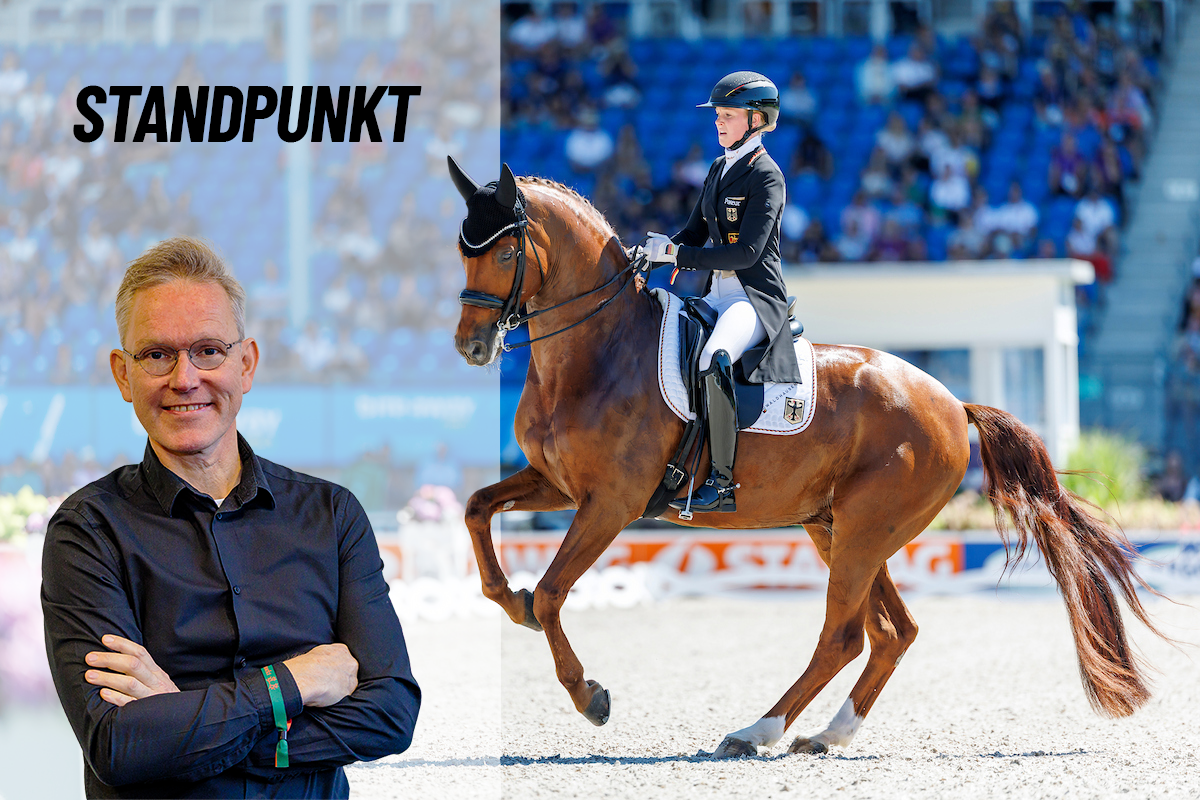 Katharina Hemmer and Denoix PCH OLD at the World Dressage Championships in Aachen. Photos: sportfotos-lafrentz.de
 Championships—especially the major ones, like the Olympic Games and World Championships—are always an opportunity to assess where the sport stands. As far as dressage is concerned, the Paris Olympic Games marked a turning point. Shaken by the Dujardin scandal, it was clear to everyone involved that the discipline was once again under intense public scrutiny. Discussions about nosebands and blue tongues had already made the road to Versailles bumpier than many had hoped.
There was no massive backlash in 2024. But it was also clear that all stakeholders should remain aware of their responsibilities and that the public wouldn’t simply go back to square one and enjoy the sight of dancing horses without any criticism.
What will we remember most about the World Dressage Championships in Aachen?
Dressage in Aachen will go down in history primarily because of the freestyle. More than 40,000 spectators, a balmy summer night, an atmosphere like at a festival. Add to that royalty, prominent politicians, and IOC President Kirsty Coventry in the stands. Atmosphere, excitement—so far, so good.
You have to admire the horses that had to perform in this cauldron. The size of the stadium and the distance from the spectators help. It’s quieter inside than in the stands.
An audience clapping—even during the competition—makes old-school dressage fans turn up their noses. On the other hand, there are those who market the sport. They’re delighted by the “enthusiasm” in the stands. Marketing and selling go hand in hand. Bread and circuses—the concept has always worked. And the images from that night in Aachen that were broadcast around the world are likely of great significance. They send a signal to everyone outside the “horse bubble” that this is a sport that’s fun. And emotions. That’s the currency of perception.
I have nothing against emotions, nor against enthusiasm in the stands. But please, let’s not take it any further than that.
Level of Difficulty – The New Concept Is a Success
Among the 18 pairs that made it to the freestyle, there wasn’t a single one that delivered a performance that wasn’t a pleasure to watch. The horses coped with the atmosphere to varying degrees—age and experience play a role here. What was refreshing: There were virtually no freestyle routines packed with complicated sequences of movements—the kind that only look beautiful when executed perfectly—that actually failed; consequently, there were no horses that appeared to be overwhelmed. No scrambling to keep up with the music, no sudden stops, no straining. Under the regulations in effect since April 2026, failed sequences of movements are penalized. This approach seems to have paid off.
What does the free skate decision at the World Championships teach us?
But let’s be honest—the free skate doesn’t reflect the current state of dressage. That’s what the Grand Prix and Grand Prix Special are for. Nothing can be hidden there. No compensation, no “wild card.”
Katharina, the Bronze Medalist
Katharina Hemmer’s performances were absolute highlights—and not just from a German perspective. The Grand Prix was even more impressive than the Grand Prix Special—not that this is meant to detract from the performance the pair delivered in the Special, which was rewarded with a bronze medal.
But this Grand Prix at the World Championships in Aachen once again highlighted the problem with dressage. There weren’t 40,000 spectators in attendance. But those who were there could see what seven judges failed to recognize: Katharina Hemmer and Denoix certainly did not deliver only the fifth-best performance of the competition. For the two of them, it was a personal best. You can’t put that in the report card of the seven ladies and gentlemen stationed around the arena. Yes, it’s a judging marathon that needs to be endured. But even so, especially toward the end of the competition, it seemed once again that the rider’s name was more important than the performance in the arena.
Questions
It’s easy to criticize judges. Sweeping judgments miss the point. But we must be allowed to ask questions:
Why are incorrect sequence changes still awarded scores above 5? Why does it carry little or no weight for certain pairs when the horses clearly step backward in the piaffe? And finally: When will horses with insufficient back engagement be penalized in international competitions just as they are—not always, but increasingly often and quite rightly—at regional shows?
Additional Questions
When will people recognize the connection between open mouths—which, of course, were also present in Aachen—and firm toplines? When will a fluid canter in a clear three-beat rhythm be rewarded, and a stiff, scraping canter be penalized? Also: Why don’t Raphael Netz, Cathrine Laudrup-Dufour, and Katharina Hemmer—and a few others, though these three have stuck in my memory—receive eights or, yes, even nines for their clearly defined collected walk? And finally: Is it not allowed to give a 10 for a strong walk? And while we’re at it: Why isn’t the full range of the scoring scale utilized, even for the celebrities?
It would be desirable for this issue to be discussed during an evaluation of the dressage competitions at this World Championship.
: Riding More Beautifully
There were many rides that were a pleasure to watch. I often particularly enjoyed the performances of the riders from the much-discussed “second tier”—such as Maria von Essen from Sweden or Nadja Aaboe Sloth from Denmark. Beautiful riding, content horses. I can’t remember ever mentioning calm, swaying tails so often in my writing. There were reasons for that.
I was impressed by the progress made by Lottie Fry and Glamourdale. Four years ago in Herning, I wasn’t one of the pair’s biggest fans. The progress made over many lessons and the black stallion’s vastly improved hind-quarter engagement show that when harmony earns more points than “spectacular movements,” that’s where the focus lies—both in the arena and during training at home.
New Faces I – Thank you, “Katha” and “Raphi”!
With Katharina Hemmer and Raphael Netz, German dressage has new, young faces—and now they’re also making their mark on the international stage with medals around their necks. Of course, Netz—a two-time World Cup finalist—and Hemmer—who placed fourth at the 2025 European Championships—are no unknowns. But on the international stage, they’ve not only promoted themselves, but also the art of good riding. They’ve championed training based on the German riding philosophy. They’ve showcased horses that radiate through their suppleness. And they’ve demonstrated—in some cases, nearly to perfection—what the future of this sport must look like. They are role models for those who are passionate about dressage. For all the little girls and boys who dream of earning a riding badge so that one day they, too, can ride as beautifully at competitions as “Katha” and “Raphi.”
New Faces II
There are new horses, some of which—though still relatively inexperienced or even quite young—have made it to the freestyle final. For a long time, the Dutch were among the gold medal contenders at championships. But increasingly vocal criticism of their riding style has caused their dominance to crumble. The fact that eventually even the last judge began to understand that not every horse ridden by a Dutch rider is automatically a Totilas has also contributed to this shift in the situation.
Mauro Turfhorst and Zantana
Dutch dressage is now back on the rise. The former stars—represented by names like van Grunsven/Janssen, Bartels, and Minderhoud/Gal—have had their day. Two Dutch riders, Dinja van Liere and Marieke van der Putten, made it to the freestyle, where they presented their highly talented horses, Mauro Turfhorst and Zantana—both by Zonik—using subtle aids.
Van Liere, in particular, was so much more impressive to watch than when she was riding Hermes, with whom she had won bronze in Herning in 2022. One might certainly ask whether a nine-year-old really belongs at a World Championship. But one must also keep in mind that the stallion has already gained quite a bit of experience. He impressed early on in public appearances and gained valuable experience. He placed second in the Dutch stallion performance test and was a finalist at the World Championships as a five-, six-, and seven-year-old. At age eight, he won the Kleine Tour in Aachen. The black stallion’s talent for piaffe and passage—inbred to Ferro—is genetically assured. This comes easily to him, as does the transition to Grand Prix competition. That is why he never seemed overwhelmed at any point. Nevertheless, this talent should be nurtured with care.
Conclusion
In terms of public perception, dressage was among the winners. There was no major backlash on social media. But that shouldn’t be misunderstood. There were plenty of images of horses with their mouths open. Horses that were moving too tightly, too. Riders who occasionally had to apply more force were there as well—especially when things didn’t go as planned, or when horses, due to tension and the atmosphere, didn’t react the way they did during training at home. And all of this took place under the watchful eyes—or rather, cameras—of a global audience.
When these images occurred, they could mostly be explained. At earlier World Championships, open mouths, wide-open eyes, flared nostrils, and sweat were a daily occurrence in the warm-up arena and part of the system. That system has now all but become obsolete.
Finally.
Now it is up to the judges to judge the remnants of the Ancien Régime as they deserve.
For the sake of the sport, but above all for the sake of the horses.
Ähnliche Beiträge