Comment: Discussion about the riding of Charlotte Dujardin (GBR) in Amsterdam
Dujardin’s Amsterdam debacle – “Collectif” failure?
 from Jan Tönjes
  Jan Tönjes comments on the discussion about Charlotte Dujardin (GBR) riding off in Amsterdam. Photo: Facebook, sportfotos-lafrentz.de
 Black and white. Just no nuances. The fronts are hardened. Between animal rights activists, self-proclaimed or actually organized, and representatives of top-class sport. The activists film and publish on social media how the riders act in the warm-up arenas. Or they photograph blue tongues, which the others then claim are not blue. And they also claim that there is no scientific evidence that blue or dark purple tongues affect the horse. So much for the initial situation.
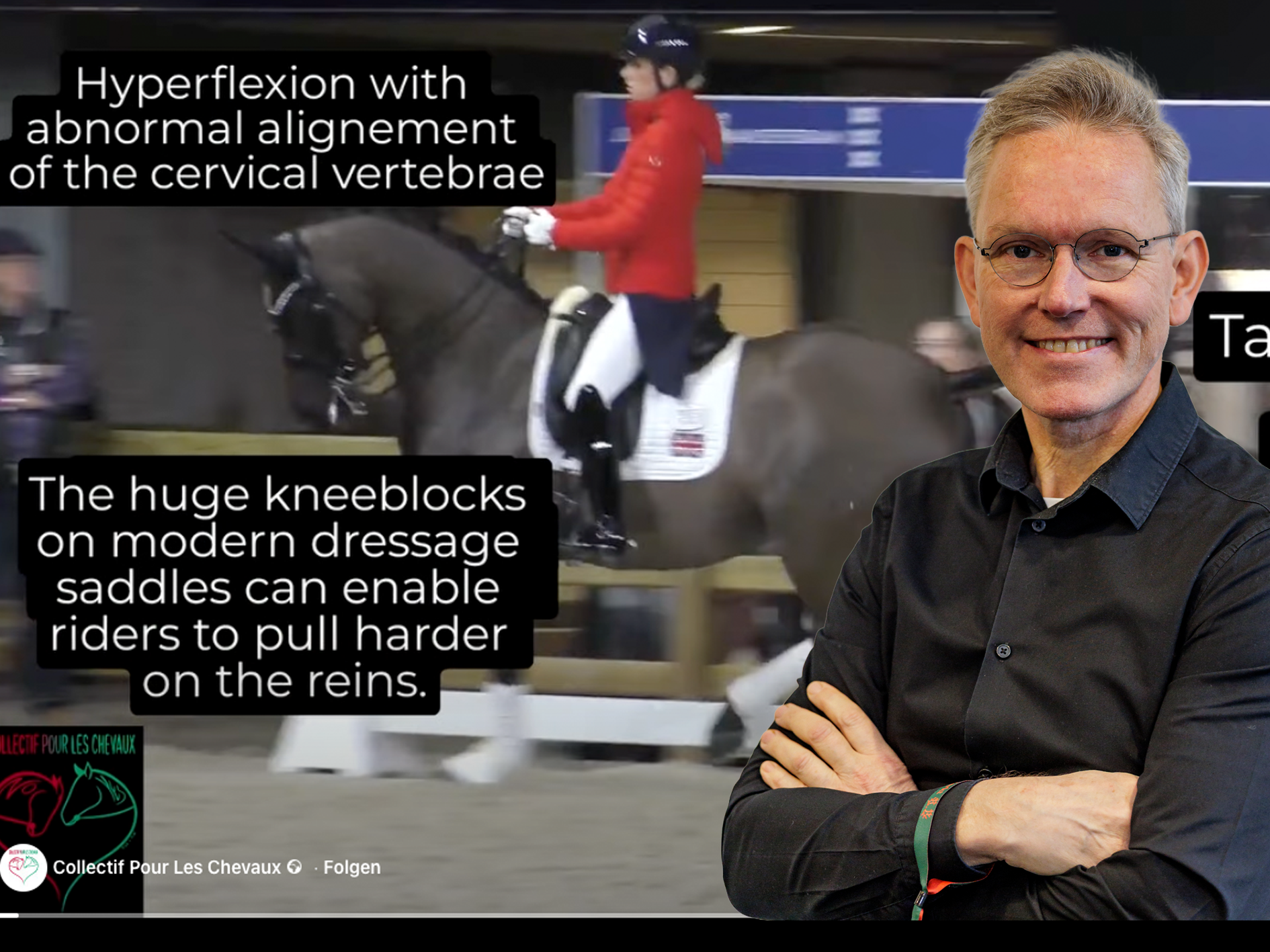
The “Collectif Pour Les Cheveaux” led by Flemish vet Eva Van Avermaet once again filmed the warm up ring of the World Cup show in Amsterdam. Several athletes were criticized, above all Charlotte Dujardin. The three-time Olympic champion promoted dressage in her native Great Britain for a long time. Then, shortly before the Olympic Games in Paris, a horrible video was released, earning the mother of two a ban and a loss of image. Back in the business, she rode Alive and Kicking in Amsterdam.
Riding off Charlotte Dujardin in Amsterdam
British The Times took up the issue of Amsterdam, probably because the video of the horse being ridden was much discussed and even more shared on Facebook. Author Owen Slot, head of the sports desk – not just anyone – spoke to the creator of the video and to several vets. All with expertise as both practitioners and in equine welfare research. People whose expertise the World Equestrian Federation (FEI) is also happy to draw on as part of its “FEI Equine Welfare Strategy Action Plan“. The double-page spread in the Times – a piece of well-researched journalism. And a slap in the face for Charlotte Dujardin and, once again, for equestrian sport.
The Times is not suspected of being politically close to the often quoted “vegan nutters”. A closer look on the text is therefore noteworthy. Owers points out that one of the critics of the pictures from Amsterdam is Roly Owers, managing director of the animal welfare organization World Horse Welfare, “whose patron is Princess Anne”. The Princess Royal, herself once at home in top-class sport and mother of Zara Tindall, the 2006 world champion, is therefore being addressed indirectly. That is remarkable, I think.
How to deal with films on social media?
We at EQUI PAGES were already discussing the matter as soon as the videos appeared. Undoubtedly anything but beautiful riding (not just by Dujardin, by the way!), borderline – those were our first impressions. And the question: Should the stewards have intervened? We asked Martin Plewa, former national coach for the German eventers and a much sought after ambassador for the sport based on good riding for his assessment back then. The original videos were still circulating at the time, without the text blocks added in the later version. Riding master Plewa agreed with us. According to Plewa, in Germany the rider “might have had to be spoken to” based on the list of criteria. Problem: There is no such detailed treatise internationally.
So again the question: How to deal with it?
Ignoring it is certainly not an option. It is easy to pass judgment from afar. Anyone who wasn’t on site will only see the excerpts that the authors want the viewer to see. The black and white principle also applies here. What we were able to see in Amsterdam (presumably, since we weren’t there) was certainly somewhere between the 7:42 minutes with the blocks of text critical of equestrian sport and the slow-motion studies with smiling people patting their horses. Reality is not black and white.
The criticism voiced is justified
It would be wrong to simply dismiss the criticism. The sport is under scrutiny, the Times is far more than just a Facebook page of activists. The footage of various top female riders was not the kind of thing you would edit into an instructional video on “perfect riding”. Even though they are all individual medal winners. So on the one hand, some of the activists’ criticism was justified. The call for a discussion was understandable. On the other hand, the Collectif Pour Les Cheveaux also makes itself untrustworthy, if not ridiculous, when everything is condemned across the board.
The saddle? With animal cruelty knee rolls, built so thick to be able to pull better on the reins (physically you actually need pulleys for this, I would think).
The bridle? With an ear cap that restricts ear play.
The bandages? They’re only put on to cause overheating of the tendons – honestly? you don’t need a great knowledge of math to work out the approximate value of one of the legs of international show horses. Grilling them would be burning money. Nobody wants that.
Collective condemnation
Betty Moody, who won the Fairness Prize, is also categorized as a horse abuser. The reason: first she arms up without spurs, later she takes on some. She also uses the spur a few times. But exactly as it should be. For giving an impulse to get the horse back in front of the driving aids. Then calm again. What you see from her is beautiful riding.
What needs to happen in dressage?
Danish judge Hans Christian Matthiesen, who incidentally is a vet like Collectif founder Van Avermaet, emphasized to me in a podcast interview at the beginning of the year how welcome he thinks a mark for warming up would be. And that everything goes too slowly in dressage. He’s right about that, in my opinion. What is judged is what takes place in the arena. And Charlotte Dujardin made a much more horse-friendly impression inside the arena.
But the fact that Alive and Kicking was not always relaxed could/must have been included in the judges’ decision in the Grand Prix. Because the artificial kicks, some kind of two-beat movement, like a bad passage in fast motion, where the front leg doesn’t go where it was initially pointing to, were not only consciously ridden in the warm-up arena. In the test too, on the short side, where collected trot is required, you could see this “twitch trot”, which has been part of the sport for so long. Not only with Dujardin’s horses. Martin Plewa told us to score this movement as “below 5”. Dujardin received a 7.5 twice …
Conclusion: Overly harsh critics who reject everything out of hand may sometimes put their fingers in the right wound. But their generalizations don’t help because they prevent a substantive discussion. But that’s what you need, if you look at the videos from Amsterdam.
Good riding – one is inclined to say “warming up properly is enough” (having in mind the words of wisdom always repeated by the late Albert Stecken, among others the trainer of Ingrid Klimke, “riding correctly is enoigh” – helps everyone.
Those who love the sport. And the horses.
Stewards accompanied at tournaments
What do stewards actually do at international horse shows? The hosts of the podcast TELL ME ABOUT THE HORSE got up early for their latest episode and looked over the shoulders of the stewards at the VR Classics in Neumünster.

A report for the ears with lots of information about the job, which is an honorary position by the way. Click here to go directly to the episode.