



Justin Verboomen

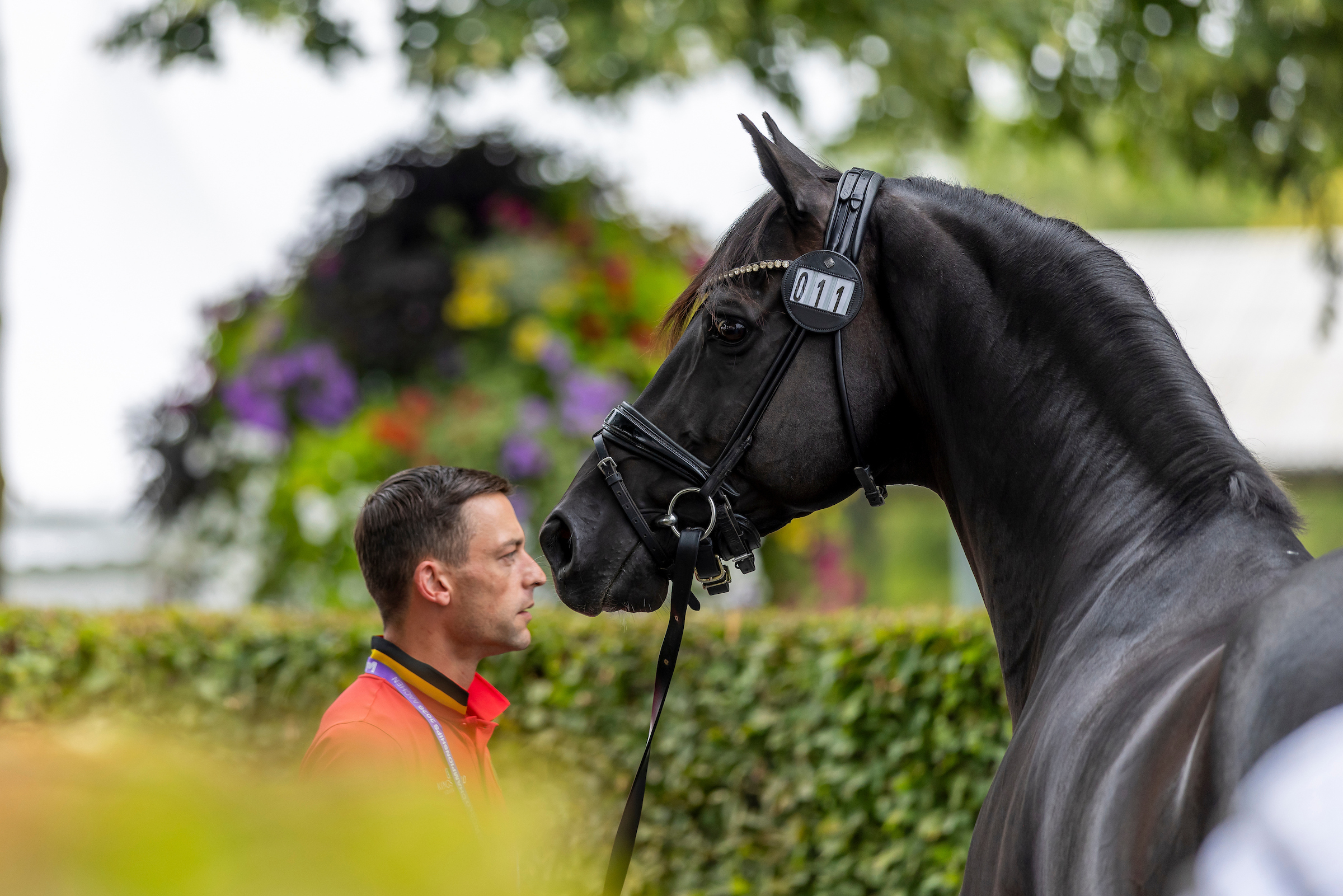
How beautiful can a horse be? Justin Verboomen's Zonik Plus. Photo: sportfotos-lafrentz.de
He doesn’t just say it—he lives by it. For Justin Verboomen, it’s not primarily about percentages and rankings; it’s about the connection he feels with his horse. A victory that doesn’t feel like a victory in the saddle is worth nothing. “That connection is more important to me than winning,” he says. He seeks harmony, unity with his horse. That is the secret to his success. Riding his stunning stallion Zonik Plus, he has shaken up the dressage world, becoming a two-time European champion with him in Crozet and winning the Grand Prix of Aachen on his first attempt. Suddenly, Belgium is a dressage powerhouse. That’s due to Verboomen’s riding, but above all to his special horse. Or so people thought. Until last winter, when he took Djembe de Hus—a son of Don Juan de Hus—from zero to a hundred, turning him into one of the most intriguing horses of the entire indoor season.
Zonik Plus is a showman; Djembe de Hus used to be (he is now sold, which was planned from the start), on the other hand, is like Verboomen himself—full of talent, but too shy to show it. When Verboomen dances around the arena with Zonik Plus, you get the impression that it’s the horse’s talent that outshines everything else. When he rides Djembe de Hus introduced, it was clear that it was Verboomen’s talent that made these performances possible—the chestnut horse, full of uncertainty and doubt, and his rider, with a keen sense of just how much he could demand and when he needed to give Djembe de Hus time. Witnessing that was nothing short of a revelation. Even more so than with the black horse. It restored one’s belief that peak performances in the arena are possible both WITH the horse and FOR the horse. It’s safe to say that Justin Verboomen has, for all to see, restored the classical spirit to dressage. That didn’t happen by chance.
Influenced by Iberian horses
Born in 1987, Justin Verboomen grew up around horses. His father was also a trainer, specializing in Iberian horses—PREs and Lusitanos—and influenced by icons such as Nuno Oliveira. This has shaped Justin Verboomen’s work. He says, “I’m truly grateful and happy that I was able to ride these horses. Because, as a rule, they aren’t as physically strong as warmbloods. So you really have to be attuned to their mental state and be careful not to overwhelm them. You have to find ways to help them rather than just demand more from them.”
Working with sensitive horses like Djembe de Hus—helping them let go, relax, and thereby reach their full potential—is what he enjoys most about riding. You don’t just see it—you can feel it—when you watch the Belgian ride. These days, he works largely on his own. The only time he received any help was during Zonik Plus’s training, from the German Claudia Kicheiss, whom Verboomen describes as neither a professional rider nor a trainer. But she has an unerring eye, honed by endless hours spent observing riders and horses, both in person and via ClipMyHorse.
A chance discovery
Whether professionally or not, she certainly did a “good” job at Zonik Plus. The black horse is a Rhinelander, a son of Zonik out of a dam by Hohenstein-Donnerhall, raised in Portugal. That’s where Justin Verboomen discovered him. He was actually looking for a Lusitano with the potential to compete at the highest level. But he couldn’t find a horse that really “clicked” with him, not even in Portugal. He was feeling somewhat frustrated when, after another fruitless day of horse-hunting, he was sitting in a restaurant with some friends and they were talking about their day. A fellow diner overheard the conversation and said he might know where Verboomen could find a horse just like the one he was looking for. Verboomen decided to give it a try—and found Zonik Plus. It was the beginning of a great story that is far from over.
-
European Championships
- Individual ranking2x
 0x
0x
0x
0x
Latest News



EQUI PAGES & Cookies
Funktional
Always active
Die technische Speicherung oder der Zugriff ist für den legitimen Zweck, die Nutzung eines bestimmten, vom Teilnehmer oder Benutzer ausdrücklich angeforderten Dienstes zu ermöglichen, oder für den alleinigen Zweck der Durchführung der Übertragung einer Nachricht über ein elektronisches Kommunikationsnetz unbedingt erforderlich.
Preferences
The technical storage or access is necessary for the legitimate purpose of storing preferences that are not requested by the subscriber or user.
Statistiken
The technical storage or access that is used exclusively for statistical purposes.
Die technische Speicherung bzw. der Zugriff erfolgt ausschließlich zu anonymen statistischen Zwecken. Ohne Vorladung, freiwillige Zustimmung Ihres Internet-Service-Providers oder zusätzliche Aufzeichnungen Dritter können die zu diesem Zweck gespeicherten oder abgerufenen Informationen in der Regel nicht dazu verwendet werden, Sie zu identifizieren.
Marketing
The technical storage or access is required to create user profiles to send advertising, or to track the user on a website or across several websites for similar marketing purposes.