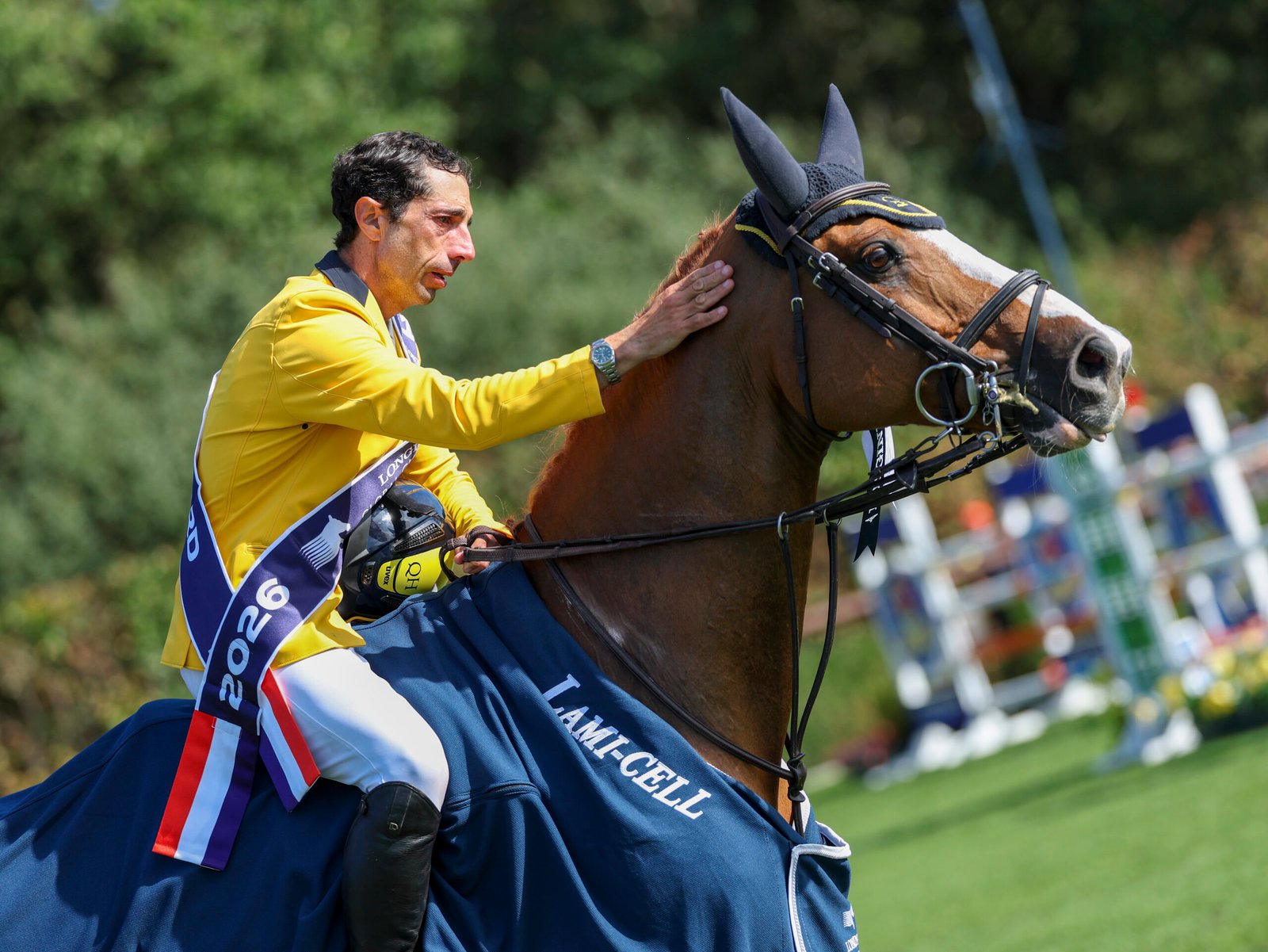
Cortisone compound found in Lillie Keenan's "Kick On"
Lillie Keenan’s “Kick On” Tested Positively at TSCHIO Aachen
 from Dominique Wehrmann
  Lillie Keenan and Kick On in Aachen in the spring of 2026.
Photo: sportfotos-lafrentz.de
Lillie Keenan and Kick On in Aachen in the spring of 2026.
Photo: sportfotos-lafrentz.de At the TSCHIO Aachen from May 21 to 24, Lillie Keenan won the second qualifier for the Rolex Grand Prix riding Kick On. The 12-year-old stallion was required to undergo a doping and medication test. He tested positive for the substance triamcinolone acetonide.
:
A Well-Known Medication
Triamcinolone acetonide is a corticosteroid preparation used in human medicine to treat skin conditions (including those affecting mucous membranes), as well as joint problems, allergic reactions, and inflammatory diseases such as asthma or COPD.
In horses, it is most commonly used to treat joint problems. A prominent case in the 2000s was Shutterfly, ridden by Meredith Michaels-Beerbaum. This year, Josch Löhden’s Schabernack, among others, tested positive for the same substance in Basel. It falls under the category of “controlled medication.”
‘s Fast-Track Procedure
Since none of Lillie Keenan’s horses had ever tested positive before and the substance found falls under the category of “Controlled Medications,” the U.S. rider was free to opt for the FEI’s Fast-Track procedure. By doing so, she accepts the administrative penalty and must pay a fine of 1,500 Swiss francs as well as 1,000 francs to cover the costs incurred. In addition, she will be disqualified, lose her placing, and consequently forfeit her ranking points and prize money.
What happened?
Lillie Keenan told EQUI PAGES that Kick On had been treated with the medication in preparation for the CSI5* Aachen in May. The FEI specifies a 7-day detection period for the medication.
Keenan now says: “I worked openly with the FEI and my veterinarians throughout the entire process to determine that the detection of triamcinolone acetonide during the competition was unforeseeable. My veterinarians and I followed the guidelines established by the FEI, and the fact that the drug was still detectable in the joint is an anomaly. Nothing is more important to me than the care and well-being of my horses. My team works diligently to comply with competition regulations, and that is exactly what we did in this case.”
Problematic Time Specifications
In fact, the case involving Josch Löhden (as well as two other cases at the time) unfolded in a very similar way. If you speak with FEI veterinarians, you’ll learn that this is a well-known problem. The FEI only specifies the elimination period. This was determined by administering the drug under test in a therapeutically effective dose to a limited number of horses and then measuring how long it took for the substance to become undetectable. However, these figures are always only guidelines and do not represent the entire horse population, because every horse’s metabolism is unique. The FEI also explicitly points this out.
The FN specifies a withdrawal period of 56 days for the same substance. This is calculated by taking the elimination period and the mechanism of action of the drug in question as a starting point and adding a safety margin that accounts for the individual metabolic characteristics of horses.
Three additional cases listed
Lillie Keenan is one of four riders currently on the list for the Fast Track procedure. The others include Alexis Gourdin of France, whose horse Chacido tested positive for the anti-inflammatory and painkiller meloxicam during a CSI1* event in Royan (FRA) from July 20 to 25.
Then there is the Spanish dressage rider Juan Antonio Jimenez Cobo, whose horse Quatar tested positive for cannabidiolic acid—the active ingredient in the hemp plant—at the CDI3* in Lier in early March. This substance is said to have a calming effect but is also used to treat joint and stomach problems.
Finally, firocoxib—also an anti-inflammatory and pain reliever—was detected in the horse MRF Nonchalant, ridden by U.S. eventing rider Catie Cejka, during the CCI2*-L competition in Kalispell, Montana.
The cases will be available for viewing for four weeks after publication. Here is the link.