In Rosengarten, in the Harburg district, an Oldenburg foal was attacked by a wolf and seriously injured
Wolf attack on a warmblood foal in southern Hamburg
 from Dominique Wehrmann
 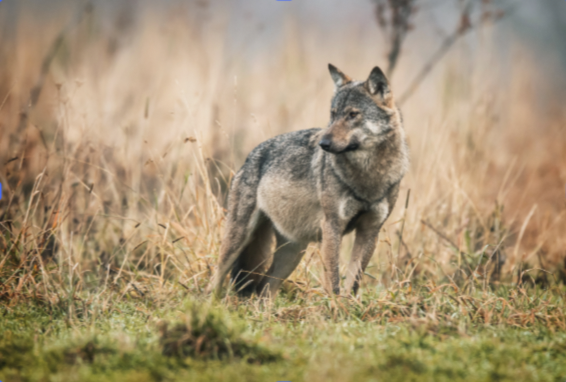 Stock photo: Adobe Stock
 Early in the morning of June 11, at 6 a.m., veterinarian Kristin Schütt, who runs the Eichenhain Veterinary Practice in Rosengarten, went to feed her horses in a pasture in Alvesen. Schütt breeds Oldenburg and Trakehner horses. At the time, there were three adult horses and a foal in the paddock in question—a daughter of Dante Weltino out of a Sandro Hit dam, who had recently been awarded Elite Foal status by the Oldenburg Association. As can be seen from the videos and photos on Schütt’s social media account, this is a very correct and typey foal that was actually supposed to be sold at the “Oldenburg Special Edition Auction” last weekend. But that didn’t happen.
Wounds with a distinct pattern
When Kristin Schütt went out to the paddock on Thursday morning, she found the foal with serious injuries to its hind legs. As she told the *Hamburger Abendblatt*: “The foal looked terrible; its hind legs were covered in blood and had deep gashes.”
While she was treating the wounds, she recalled that she had recently treated a client’s horse that had identical injuries. “They were the same holes, spaced the same distance apart,” Schütt said. It was only then that she suspected a wolf attack and notified the authorities.
The wolf as the culprit
Schütt notified the relevant authorities. Predation experts arrived, examined the foal, and collected DNA samples. However, Schütt admitted to EQUI PAGES: “As a veterinarian, my first priority was to treat the wounds. At first, I didn’t even think of a wolf or securing DNA evidence.”
Schütt: “The typical 4.5-centimeter bite mark was observed time and again. It also couldn’t have been a stray dog, because I was last at the paddock at 11 p.m. and then again at 6 a.m. No one walking a dog would have passed by during that time.”
But even if laboratory analysis detects dog DNA in the sample, that is not proof in itself, Schütt has learned. “I’ve only just learned that there are almost no purebred wolves left,” Schütt said. Since DNA analyses cannot yet distinguish between them, it is possible that even if a wolf carries only 20 percent dog DNA, the DNA analysis will return a result of “dog,” even though it was a wolf hybrid.
The predation investigators were able to narrow down the “circle of suspects” based on more than just the bite marks. They are convinced that it was a lone, migrating young wolf. The fact that the foal survived supports this theory, according to Schütt. “If there had been two, one would have held the foal down while the other bit through its throat,” said the veterinarian, who has studied wolf hunting techniques more closely in light of recent events. There is indeed a pack nearby with a female currently nursing pups and the male of the pack. But the experts at the Chamber of Agriculture also rule out the male as the culprit because they are certain that he, too, would have killed the foal, according to Schütt.
Schütt is certain that the mare must have chased the wolf away.
What happens next?
How is Kristin Schütt handling the situation now? She has just had another foal, a long-awaited filly from a top Trakehner dam line, and she is overjoyed. This makes her concern all the greater. But the equine veterinarian also says: “I want the foals to grow up in a way that’s appropriate for their species!”
So getting them out of the paddock isn’t an option. Not least because the mares don’t want to leave the herds and made such a scene on the smaller pastures near the house that Schütt says: “I had to realize that I then had the choice of whether the foals would die at the hands of a wolf or because their mothers were going crazy.”
She has now reached a compromise and moved the horses to a pasture with a covered shelter, where they can be stabled at night. She also reports that they have now upgraded all the fences to meet the requirements.
She had researched livestock guard dogs extensively, but had repeatedly come to realize that it takes at least two years for dogs, herds, and humans to become such a well-coordinated team that the dogs can provide effective protection. She also observed, through a shepherd who had used Kangals to protect his animals on a neighboring pasture, that the local community did not accept the aggressive defensive behavior of livestock guard dogs.
In Search of Ways to Coexist
On the subject of acceptance, Schütt reports: “What shocked me the most were the personal attacks I faced, simply because I said it was a wolf.”
She emphasizes that she has nothing against wolves, “not even now, after what happened to us!” Her conclusion: “We have to find a way to live together. But it’s not entirely clear yet what that path will look like.”