European Equestrian Federation (EEF) General Assembly Confirms New President and Elects New Board Members
Quentin Simonet Re-elected as EEF President; Philine Ganders-Meyer Joins the Board
 from Dominique Wehrmann
 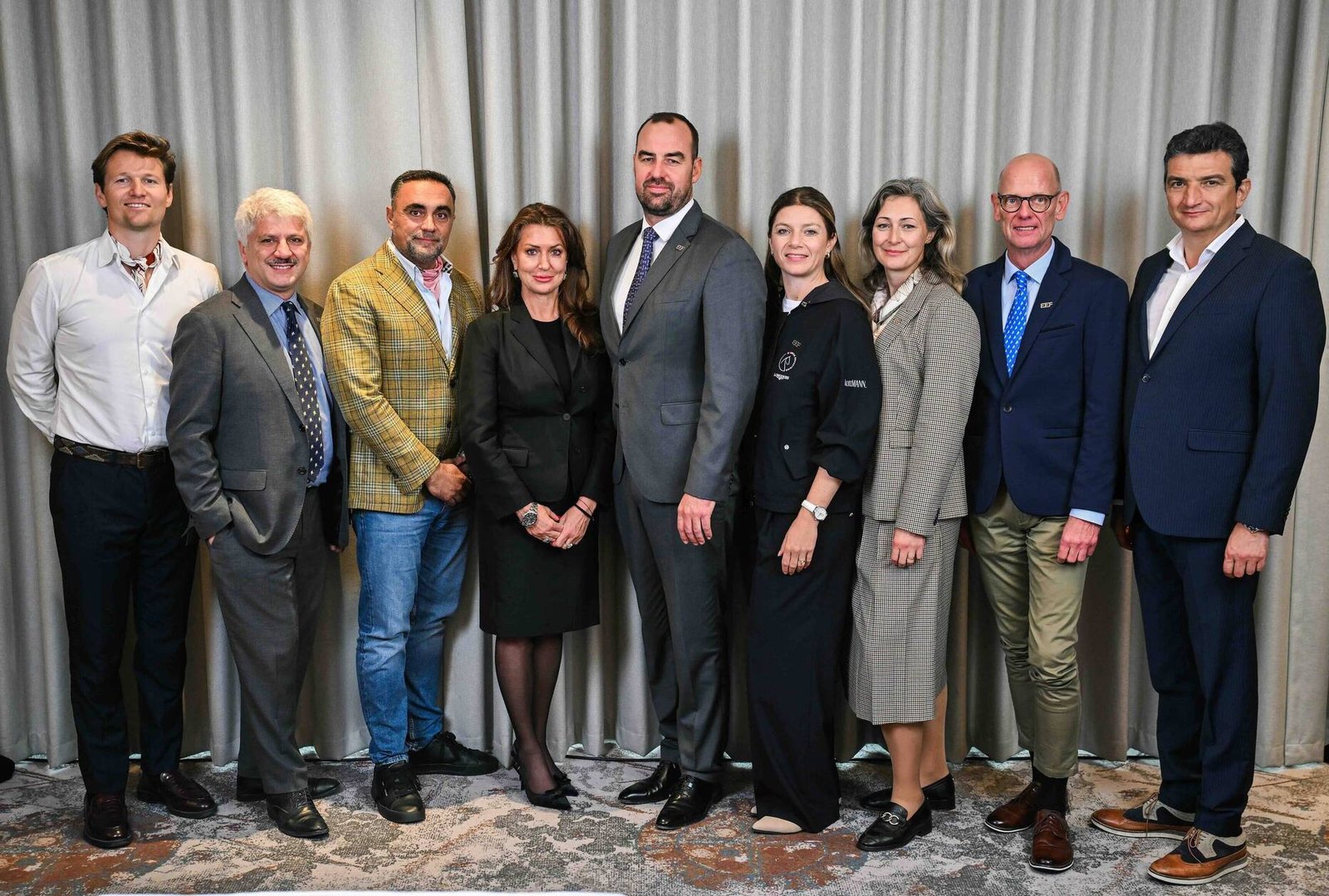 The EEF Board of Directors, featuring (from left) Emil Flam (NOR), First Vice President Simone Perillo (ITA), Second Vice President Peter Cholakov (BUL), Board Member Marilena Mladin (ROU), President Quentin Simonet, Nayla Stössel (SUI), Sandra Ruuda (SWE), Klaus Roeser (GER), and Secretary General Teodor Sheytanov (BUL). Philine Ganders-Meyer is not pictured.
Photo: Sam Barnes/Sportsfile
The EEF Board of Directors, featuring (from left) Emil Flam (NOR), First Vice President Simone Perillo (ITA), Second Vice President Peter Cholakov (BUL), Board Member Marilena Mladin (ROU), President Quentin Simonet, Nayla Stössel (SUI), Sandra Ruuda (SWE), Klaus Roeser (GER), and Secretary General Teodor Sheytanov (BUL). Philine Ganders-Meyer is not pictured.
Photo: Sam Barnes/Sportsfile 38 nations were represented at the EEF General Assembly, which lasted two days.
Strategic
According to the association, items on the agenda included, among other things, the approval of the annual and financial reports for the 2025/26 fiscal year, budget planning, and the rules for the EEF Nations Cup Series in show jumping for the 2027 season. It was also agreed that Israel would move from the Northern Region to the Southern Region.
The General Assembly also approved the EEF’s strategy for 2027 through 2030. This strategy calls for intensifying support for national federations, further developing European equestrian sports, highlighting the value of horses in society, and building a stronger European voice.
Simonet Re-elected
When Theo Ploegmakers was forced to step down
from
his
position
in the spring of 2025 for health reasons, Frenchman Quentin Simonet (40) succeeded him. Simonet has a background in driving; he has worked for the French Equestrian Federation for more than ten years and has also served on the EEF board for several years. He has managed the French equestrian team as Chef de Mission at three Olympic Games. He has now been elected EEF President for the standard four-year term.
“I am honored by the trust placed in me by our national federations and am very aware of the responsibility that comes with this mandate. The EEF is a collaborative organization, and the progress we make is the result of close cooperation with our Board of Directors, our national federations, and all our stakeholders. My goal for the next four years is to keep the EEF united and independent and to focus on delivering results for its members and European equestrian sports,” said the president .
Ganders-Meyer on the Board of Directors
In addition to the presidential election, new members were also elected to the EEF Board for the upcoming term from 2026 to 2030. After several rounds of voting, Philine Ganders-Meyer (GER), Emil Flam (NOR), and Marilena Mladin (ROU) were elected to the Executive Board from among seven candidates. Ganders-Meyer is responsible for coordinating the eventing discipline within the DOKR at the German Equestrian Federation (FN) and is herself a highly successful rider. Among other achievements, she became the 2023 German Amateur Eventing Champion. She also serves as something of a “foreign minister” for equestrian sports in Germany; she heads the “International – FEI/EEF” teams and, since 2023, has also been the director of the youth competitive sports division.
International Board
The EEF President thanked all seven candidates who had run for election and praised the breadth of experience and perspectives they had brought to the assembly, as well as their willingness to contribute to the community of 40 associations. During their presentations, the candidates highlighted priorities including youth development, education, sustainable growth, horse welfare, innovation, and strengthening Europe’s voice. He also thanked the outgoing board members for their contributions to the federation.
The EEF Executive Board now consists of President Quentin Simonet (FRA), First Vice President Simone Perillo (ITA), Second Vice President Peter Cholakov (BUL), and members Nayla Stössel (SUI), Klaus Roeser (GER), Sandra Ruuda (SWE), Philine Ganders-Meyer (GER), Emil Flam (NOR), and Marilena Mladin (ROU).
‘s
Outlook
Looking ahead to his upcoming term, Simonet emphasized the importance of putting the newly adopted strategy into action and strengthening the ties between the EEF and its national associations.
“We have a clear strategy for the next four years, and now our task is to put that strategy into action. This means bringing the EEF closer to our national federations, giving Europe a stronger voice, supporting the development of our sport, and ensuring that the horse and its value to society remain at the center of our efforts. At the same time, we want to build a strong and resilient EEF that is ready to support our members and the sport over the long term.”