When are riding lessons subject to sales tax?
FN Provides Information on the Sales Tax Regulations for Riding Lessons
 from Dominique Wehrmann
 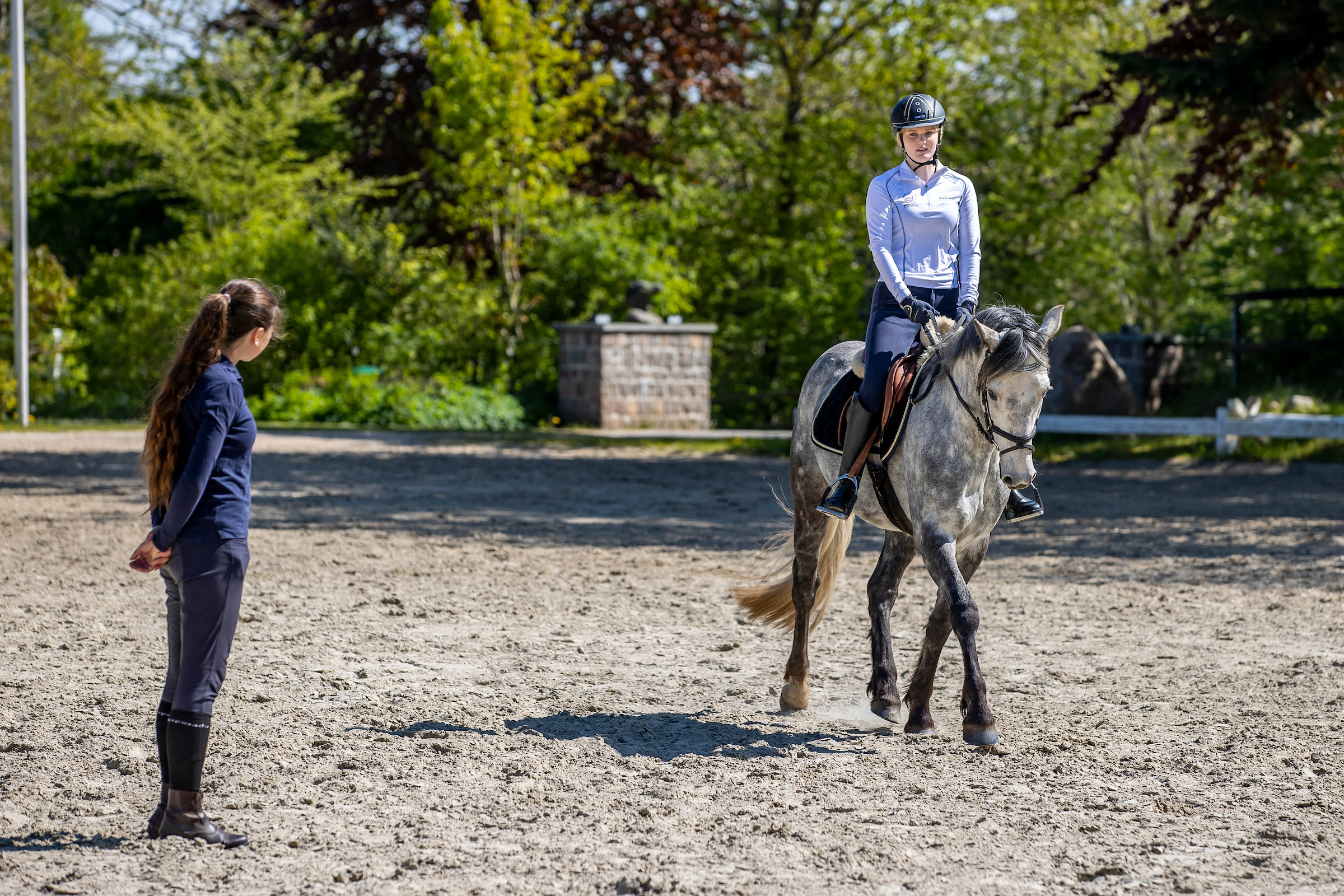 Featured image: Sportfotos-lafrentz.de
 Here is the full text of the FN article
Why is sales tax suddenly a concern for many riding clubs?
In riding clubs, lessons for children, teenagers, and adults are often part of the club’s daily routine. In many places, it has been assumed until now that these services are tax-exempt or, at the very least, unproblematic. However, several court rulings and ongoing changes in tax law have led to a closer scrutiny of the taxation of riding lessons today. In particular, the question of whether or not riding lessons are subject to sales tax is currently causing uncertainty.
Principle: Riding lessons are not automatically tax-exempt
The Federal Fiscal Court (BFH) has ruled that horseback riding lessons do not generally constitute a tax-exempt educational service. In the court’s view, horseback riding lessons often serve as a recreational activity and therefore do not automatically meet the requirements for a tax exemption.
This applies in particular to lessons offered to children, teenagers, and adults who ride horses as a recreational or popular sport. Important: The mere fact that lessons are provided does not mean that they are tax-exempt.
The Annual Tax Act of 2024 expanded the general tax exemption for educational services. Since then, the provision has covered, among other things, school instruction, vocational training and continuing education, as well as vocational retraining. However, according to the prevailing view, this does not result in any fundamental change for traditional riding lessons in recreational and popular sports. Riding lessons that are primarily for recreational purposes do not automatically become tax-exempt as a result.
Does that automatically mean I have to pay sales tax?
No. This is precisely where a common misunderstanding lies. Nonprofit riding clubs must determine the tax basis on which the lessons are conducted. In addition to the question of a possible tax exemption, classification as a so-called “special-purpose operation” also plays an important role.
As a general rule:
- Taxable services provided by a nonprofit association through a special-purpose operation are often subject to the reduced value-added tax rate of seven percent pursuant to § 12. (2)(8)(a) of the Value-Added Tax Act (UstG), provided that no specific tax exemption under § 4 UstG applies or the so-called small business exemption is applicable.
- Under certain conditions, however, riding lessons may also be completely exempt from sales tax.
It is therefore not possible to make a blanket statement that applies to all clubs.
When can riding lessons be tax-exempt?
For nonprofit riding clubs, tax exemption under Section 4 No. 22a of the Value-Added Tax Act (UStG) is particularly relevant. This provision applies to instructional courses and events conducted by nonprofit organizations. Of particular interest to equestrian clubs: The tax administration’s VAT application decrees explicitly cite riding lessons as an example of eligible sports instruction.
According to this, riding lessons may be tax-exempt if:
- the association is recognized as a nonprofit organization,
- the instruction is provided as part of a tax-exempt operation and
- the revenue is used primarily to cover costs.
The tax authorities make it clear that neither a specific curriculum nor a final exam is required as part of the lesson plan.
What is a special-purpose entity?
Put simply, a special-purpose operation exists when the activity in question directly serves to achieve the nonprofit association’s goals. For riding clubs, for example, this means:
- The classes are designed to promote sports.
- The association’s objectives can only be achieved through appropriate programs.
- There will be no greater competition with commercial providers than is unavoidable for the fulfillment of the association’s purpose.
Whether these requirements are met must always be assessed based on the specific circumstances of the club in question.
What should clubs do now?
Clubs should by no means ignore this issue, but they shouldn’t panic either. Here’s what we recommend:
- Review the current tax classification of riding lessons.
- Work with your tax advisor to determine whether the requirements for a special-purpose operation are met and whether a tax exemption is possible.
- Review existing course offerings and billing models.
- Seek tax advice early on when introducing new or extensive course offerings.
Precisely because the assessment of sales tax depends heavily on the specific circumstances of each case, blanket solutions are rarely possible.
Key Points at a Glance
The question of whether riding lessons at your club are subject to sales tax cannot be answered with a simple yes or no. While the Federal Fiscal Court has clarified that riding lessons are not automatically considered tax-exempt educational services, nonprofit riding clubs still have options for offering lessons exempt from sales tax under certain conditions.
Since tax authorities and local tax offices are paying increasing attention to this issue, organizations should have their situation reviewed as soon as possible. Seeking tax advice early on can help avoid future tax assessments and financial risks.
Note: This article is intended for general informational purposes only and is not a substitute for tax or legal advice. Given the complex legal situation, each association should review its specific circumstances with a tax advisor.
Source: pferdesport-deutschland.de