2026 National Championship for Five-Year-Old Dressage Horses Won by Viva Weltina
Viva Weltina Wins the National Championship Title with “Equestrian Culture at the Very Highest Level”
 from Dominique Wehrmann
 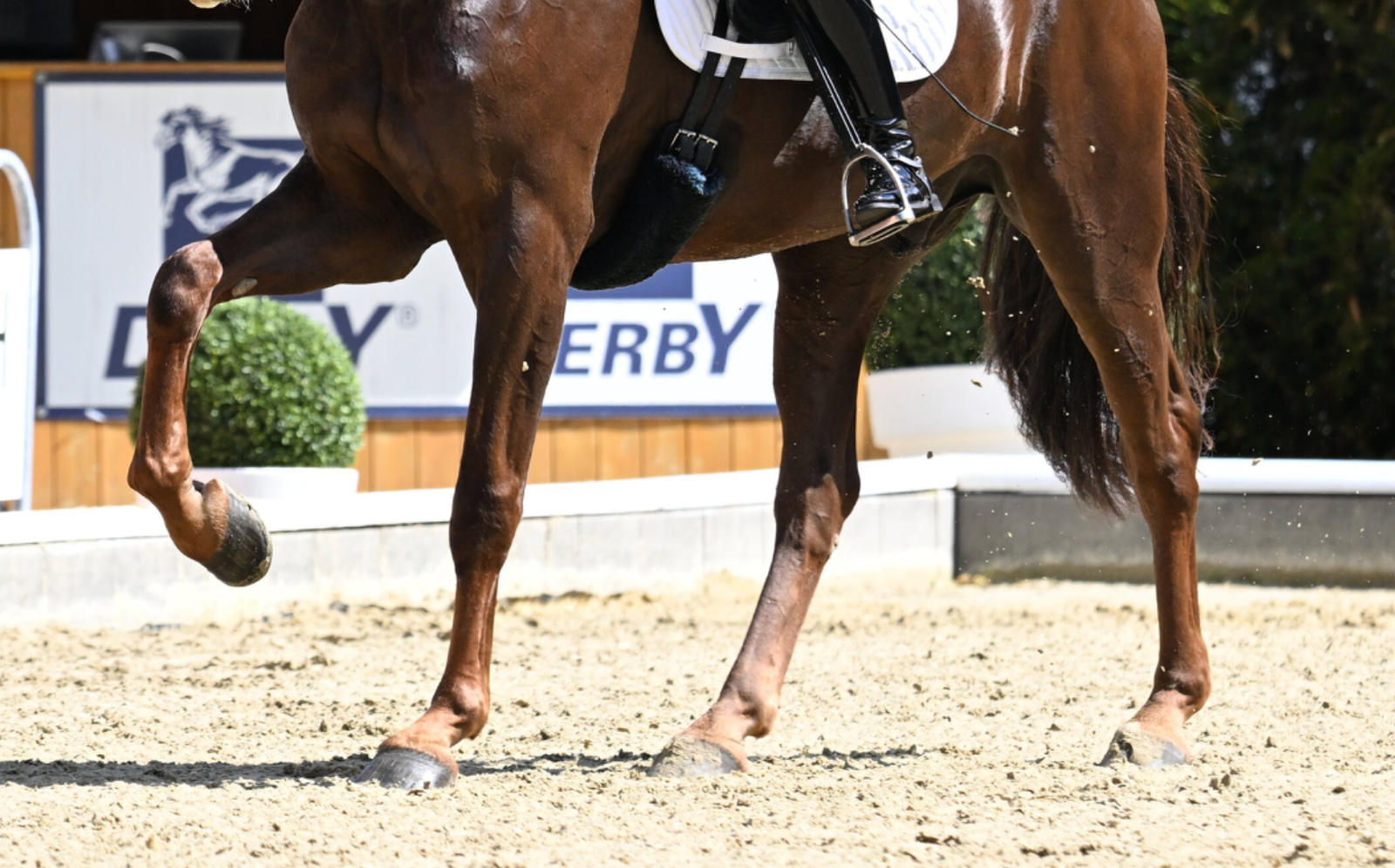 Stock photo: Dressage National Championship.
Photo: Mirka Nilkens
Stock photo: Dressage National Championship.
Photo: Mirka Nilkens That was the Hanoverian chestnut mare Viva Weltina, by Viva Gold-Dante Weltino, bred by Marietta Kappelhoff-Dorenkamp, owned by Ralf Hartmann, and ridden by Carola Koppelmann.
When it comes to color and markings, the mare takes after her sire, but she has much more physical substance, stands tall, and is already very well-balanced, even when cantering on the outside.
Viva Weltina has three consistently good basic gaits, which she demonstrated with great naturalness today. She was already able to be guided back into collection with confidence and also impressed with her drive and energy in the extensions. The second simple change, in particular, was a highlight.
Minor quibbles: The transition from canter to trot at C was a bit halting, and letting the horse chew on the reins afterward could have used a bit more extension toward the rider’s hand. But otherwise—Nicole Nockemann explained the scores to the judges with a comment, and it could hardly have been more positive.
Comments on the Scores
Nockemann’s opening statement alone gave a hint of where things were headed: “That was a performance that I believe we’ll see more often in training sessions, because it so perfectly embodies what we want to see here: riding training, harmony, trust, and mindset.”
She always began her commentary on the individual scores with the trot. Here, she praised Viva Weltina for combining “such a high degree of naturalness with athletic engagement from a securely carried hindquarters.” The mare demonstrated an “incredible willingness to carry weight during the circles,” which she then “truly showcased through the turns.” Nockemann: “This is how we want young horses to trot. That has to result in a special score—9.6.”
Regarding the walk, she said: “Unaffected by external influences, very relaxed; however, to earn the very highest scores, the horse might need to show a little more freedom in the shoulders and also a slight overreach on the same side. But—and this is the most important thing—we want the horses to walk using their entire bodies. The horse demonstrated that—8.6.”
Nicole Nockemann described the canter as “metronomic,” with one stride following seamlessly after another. Here, too, she highlighted the mare’s willingness to carry weight and the opportunities this creates for the outside canter. In addition, the mare has improved “in her ability to maintain the tempo straight down the entire long side.” On the other hand, the simple changes were executed with a great deal of suppleness in both transitions and with a “direct, clear stride phase.” Score: 9.3.
All of this was also reflected in the last two component scores. “In terms of suppleness, nothing was left to be desired. That was riding artistry at the very highest level. Perhaps when letting the horse chew with the reins out of hand, the corner of the mouth could open just a tiny bit more, but here we’re very close to perfection—a 9.7 for suppleness.”
Combined with a 9.5 for the overall impression, this resulted in a final score of 9.34.
Since Viva Weltina was the first horse to compete in the final after the short break, Carola Koppelmann didn’t know it yet, but she and her chestnut mare—who had been competing together since the start of this season—had just completed the ride that earned them the title in the five-year-old dressage horse class at the 2026 National Championships.
Silver Again for Benjamin Franklin
At just four years old, the Celle state stud stallion Benjamin Franklin and breeder Janina Tietze won silver in the riding horse stallion class in Warendorf. Now, the son of Bon Vivaldi and Royal Blend, bred by Wilhelm Kamps, has once again placed second. In the qualifier, he and Tietze had edged out Viva Weltina. But today, the judges placed the supple bay behind the mare.
Benjamin Franklin also impressed with the naturalness of his movements during the trot and his well-engaged hind leg, which the stallion consistently used to drive uphill. He flowed seamlessly from one exercise to the next, whether in the turns, at a working pace, collected, or in medium trot. Throughout, Janina Tietze consistently worked to keep his neck up and his nose in front of the vertical. It was a pleasure to watch.
In the walk, one would have liked to see a bit more extension. The transition to the canter at the end of the diagonal was a bit muddled, with a few trot strides, but the canter itself was then performed very clearly uphill with good extension. This stallion also already showed a clear willingness to collect, and he practically flew down the long side at a medium canter. The outside canter on the right lead wasn’t quite even in his stride, but letting the reins hang loosely at the end was executed once again with beautiful balance and extension.
Commentary and Scores
It took a while for the scores to be announced. But then Nicole Nockemann got started and immediately began raving about the “incredibly wonderful, expressive, and powerful” trot sequence. “The horse wants to work and shows this expression—the expression that the horse is ready to perform and that this is enhanced by its energy. That’s close to the ideal.” Nockemann explained that the ride didn’t earn a 10.0 due to a “very slight” deviation in the right-hand volte. The overall score today was therefore 9.7.
Regarding the walk, she said the judges could attest that the horse was released immediately and walked with good engagement of the body. To earn the absolute top score, it would have needed “even more freedom in the shoulders and more reach in the hind legs.” But 8.8 is still a high score.
In the canter, the judges noted “a great many perfect criteria”—the medium canter along the long side uphill. The canter received a score of 9.6. The judges factored the slightly uneven rhythm in the right-side outside canter into the suppleness score of 8.8. Here, Nockemann praised the horse’s energy and enthusiasm, but in addition to the right-side outside canter, they also noted an irregular rhythm in the first simple change following that right-side outside canter—both of which are important criteria in Class L, so a 9 was not awarded this time.
However, the overall impression was a 9.5 for “an absolute top athlete on the right track with the right mindset,” according to Nockemann.
Bronze for the Beautiful Black
Horse
Bronze
went to the very first horse in the class, the stunning Westphalian black horse Le Noir, a son of the Nuremberg Burg-Pokal winner Life Time out of a Desperados dam. Le Noir was bred by Antonius Richter; he is owned by Domus Equus Niedner SC, and has been ridden since the start of his competition career last year—beginning with his first riding horse classes—by Justine Ludot, a Frenchwoman based in Luxembourg.
Three weeks ago, Ludot and Le Noir also competed at the World Championships for Young Dressage Horses. Here, the black horse didn’t quite stand out. Yet the stallion impresses with three good basic gaits characterized by great naturalness, an eager hind leg that always kept up even in the already very small-scale half-turn, a high degree of elegance, and a contented overall impression. That overall impression would have been even more pleasing if his neck had remained more stable at its highest point.
Before breaking into a canter, the black horse stumbled briefly, and in the left turns, one would have liked to see a bit more solid footing and bend—which was later reflected in the score for responsiveness—but the 8.86 at the start of the test was quite impressive.
Commentary on the ride
Right from the start, Nicole Nockemann’s first horse had her raving: “The trot work, from start to finish, was characterized by light-footedness, elegance, and good elasticity; the rider truly shone by timing each pace perfectly. In a working trot, the serpentines were executed confidently; both medium trot sequences showed good shoulder freedom and a steady push-off, as well as a clear willingness to collect. The left volte was still a bit under-collected. But the quality of the trot work today was rated a 9.0.”
And it continued like this: “The walk was outstanding, with very confident, steady movement and good body engagement, and the horse also approached the bit very conscientiously, accepting the extended rein without ever breaking the rhythm. In the very last transition back to walk before the canter, we would have liked to see even more stability, hence the 8.5.”
“A remarkable tendency to move uphill was evident in the canter. The jumps became larger and longer without any change in frequency. And then, with stable contact, he transitioned into a good collected sequence—and, significantly, the transition from the inside canter to the outside canter was executed very confidently. Therefore, a 9.0 for the canter work.”
“In the passage, we saw a short turn that was executed very evenly, with the reins allowed to hang very loosely from the rider’s hands.” Minor shortcomings: “The first transition wasn’t quite perfect when shifting to a walk, and the posture during the trot work could be a bit more consistent. 8.8.”
The overall impression also earned a solid “very good.”
A close race for the medals
: Behind the bronze medalist’s score of 8.86, fourth and fifth place were separated by just two hundredths of a point each. An 8.84 went to the highly elegant Oldenburg dark chestnut gelding Louboutin by Las Vegas-Feinrich (breeder: Eva Krijnen), whom Ricarda Mombach presented for owner Julia de Ridder. He received a 9 in trot, canter, and prospect. He also earned an 8.5 in walk and an 8.7 in suppleness.
Coming in fifth was the Hanoverian Marco Polo e Fonteabeti, a son of Jovian-Franklin, presented by Tessa Frank and bred and owned by Soc. Agricola Allevamento Fonteabeti. He trotted to a 9.2, cantered to a 9.5, but scored only a 7.6 for his walk today. Combined with an 8.8 for responsiveness and a 9.0 for potential, this resulted in a score of 8.82.
You can find all the results here.
Similar posts