2026 National Championship for Seven-Year-Old Dressage Horses: Felice FRH
Felice FRH is National Champion for the second time—and what a victory!
 from Dominique Wehrmann
 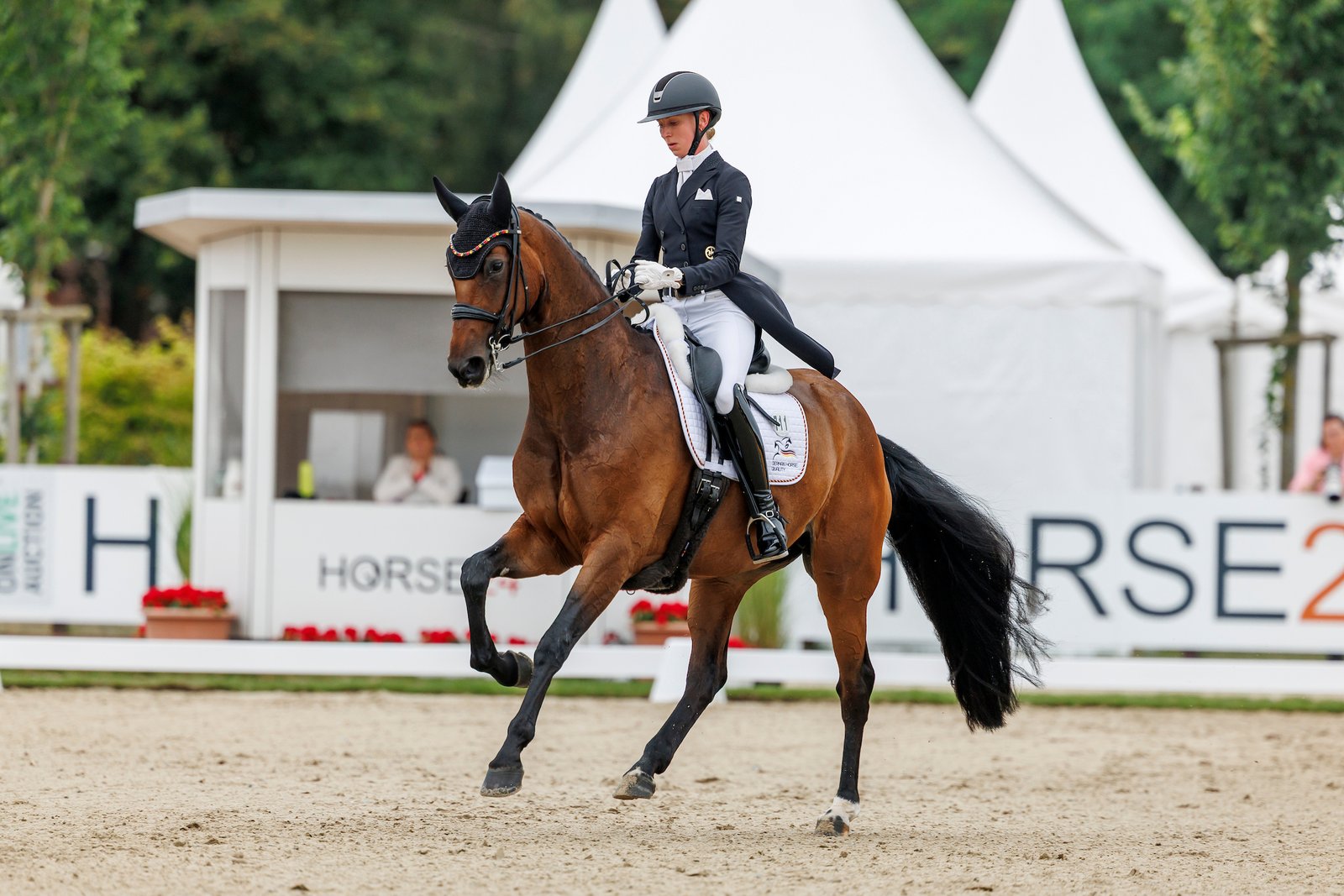 2026 National Champion among seven-year-old dressage horses: Felice FRH with Greta Heemsoth (pictured here at the World Championships for Young Dressage Horses). Photo: sportfotos-lafrentz.de
 Felice FRH – A Rider Shapes the Horse at Its Best
Two years ago, the Hanoverian mare was Felice FRH v. Fürst Samarant-Riverside-Sandro Hit, bred by René Janzen and owned by Ingo Pape and Ken Steele, with Greta Heemsoth in the saddle, was crowned National Champion among five-year-olds. Back then, she was a real little thing, yet highly elegant and clearly on the right track in terms of training. Now, two years and two top-ten finishes in World Championship finals later, she has developed into a powerful dancer. She is still a delicate horse, but she has gained substance and plays effortlessly with the advanced-level movements.
With her light neck, there is a high risk that the mare will become too tight and fall behind the vertical. The fact that this does not happen is thanks to Heemsoth’s training, as she has mastered the art of consistently directing the flow of energy from the hindquarters to the forehand. As a result, Felice FRH was one of only a few horses today to demonstrate true frame expansion in the extensions. Very few horses manage this even at the Grand Prix level, even though it is actually the litmus test of true collection and carrying power. On curved lines, the mare moved as confidently along the track as if on rails. Add to that the lateral movements—in time like a metronome, supple and bent to both sides. She chewed on the reins promptly and willingly, lifting from the withers. Here, her nose could have been carried a bit further forward.
Her walk was relaxed, in time with the beat, and had good reach. In collection, her back remained supple and she maintained the rhythm. Only during the walk pirouette to the left did the mare lose her balance ever so slightly once.
Then the canter—not a hypermobile rocking-horse canter, but a true transfer of weight with every stride. During the double half-traverses, the change wasn’t quite executed cleanly, and the mare tilted slightly to one side. But Heemsoth regained control of her immediately and built up great momentum right up to the point, with a secure take-off and a well-executed change. The pirouettes—to the left, Felice could probably already jump a full pirouette without any trouble. To the right, she jumped with both hind legs today. The subsequent change went well. The series of changes were secure, even though the mare always jumped the change to the right with a bit more expression than the one to the left. One more “wow” full parade at the end, and she was done. Great round!
Commentary
by
“A trot performance that leaves little to be desired,” said Nicole Nockemann as she began her commentary, in which she explained the judges’ scores. She spoke of a “high degree of elasticity,” of “truly flowing energy, always moving uphill,” and of the evenness of the gait. Heemsoth was able to regulate the mare’s transitions “as if using a dimmer switch.” The trot received a score of 9.5.
In the “Step” section, they praised the rhythm and grandeur of the formation. In the “Reinforcement” section, they noted that they would have liked to see even more forward movement and transitions. For this, they awarded a score of 8.0.
At a gallop, Nockemann praised the mare’s commitment and willingness to carry weight. However, he noted that she still needed to engage her back more, “so that her stride remains even more relaxed as she moves uphill.” The score: 8.5.
The score reflected, on the one hand, the excellent trot work and, on the other hand, two minor mistakes during the flying changes: 8.8.
The overall impression, however, was once again “very good”—that is, a 9.0. This added up to 87.6 percent for quality. In the category of technical execution of the lessons, which Thomas Keßler rated a C, the score was 75.606 percent. Overall result: Superior National Champion with 81.603 percent.
Silver for Richter and Found Gody PS
Another pair competing in their third Bundeschampionat—though they had yet to win a medal—are the tall Oldenburg gelding Found Gody PS by Foundation-Vivaldi, bred by Gestüt Lewitz —the gelding is another representative of the highly successful Gesine line from the Schockemöhle stud—and his trainer, Ellen Richter.
They had won one of the qualifying divisions, so they were among the co-favorites. Found Gody moved smoothly through the trot sequence, but didn’t always seem entirely comfortable in the bit and frequently fell behind the vertical. When allowed to chew with the reins out of hand, he tended to curl in rather than stretch toward the bit. On the other hand, however, he performed very beautiful lateral movements and well-developed extensions.
However, even in the walk, one would have liked to see more response to the rider’s aids at that brisk pace. The collected walk, on the other hand, was exceptionally graceful and precise in its rhythm.
The highlight was the canter. Although Ellen Richter had to keep an eye on the gelding here as well to make sure he didn’t curl up, his active hind leg—which springs powerfully from the ground—not only makes it easy for him to perform the movements, but also allows him to show plenty of expression.
Commentary
: Nicole Nockemann aptly described Found Gody as a “long-legged, tall athlete,” before noting that, even at seven years old, he still hasn’t quite settled into his body. In the trot, she praised his light-footedness and push-off, his drive, and the relaxed flow of movement through his body. However, she also noted: “Here, too, the contact isn’t always optimal.” Nevertheless, his trot score was a 9.0 for the first time.
In the walk, the judges praised the horse’s rhythm and diligence, but noted that its willingness to extend still needed improvement. “Given the steady rhythm,” however, it still received a score of 8.2.
The positive energy in the canter, that “drive from the ground,” as Nockemann put it, clear weight-carrying, etc., resulted in a score of 8.8.
With regard to suppleness, the judges noted that the horse’s self-carriage—that is, “supported contact”—needed to be improved to achieve an “even more stable upward tendency with the forehead line slightly ahead of the vertical.” Nevertheless, this is part of the development of a horse that is otherwise well ridden—8.4.
Combined with their overall score of 8.6, the two reached exactly 86 percent. They added 73.181 percent in the technical category. That brought their total to 79.590 percent, earning them the silver medal.
Bronze for Zuccador QD
In 2023, the Oldenburg gelding Zuccador QD by Zenon-Lauries Crusador xx, bred by the Kasselmann farm, was sold at the PSI auction for 150,000 euros. Today he is owned by Angie Quin, and since the middle of the year, he has been ridden by Kasselmann stable rider Nicole Wego-Engelmeyer. Previously, the tall bay was ridden by Lydia Jordan, with whom he had already competed at the Warendorf arena as a five- and six-year-old. Now he has won his first medal.
Zuccador has appealing basic gaits, though his trot could perhaps use a bit more natural momentum. Here, one got the impression that the rider still had to actively support the gelding quite a bit. The lateral movements were executed smoothly and with good bend on both sides, and the horse maintained rhythm and flow with confidence.
The stride is excellent at all three tempos—relaxed, with good flexibility and a wide reach at medium and fast tempos, yet brought back into collection with precise timing.
Both in the canter and in the trot, it would have been nice to see the neck held more open and the nose positioned further forward of the vertical. The figures in the actively extended canter are already being executed quite confidently. However, especially in the pirouettes, one might have expected him to carry more weight and thus have a freer forehand—particularly since the gelding actually maintained very steady rhythm and continued to jump actively as he collected. The flying changes were executed with nice, energetic forward momentum.
’s
Commentary
: A more open frame and flow in the lateral movements were among the points highlighted in the judges’ commentary. Both factors were reflected in the fluidity score. For the mechanics, development of momentum, and elasticity in the trot, the judges awarded an 8.8. In the walk, commentator Nockemann spoke of “incredible forefoot engagement” and “confident extension,” along with the ability to collect. This earned a 9.0.
In the canter, the judges praised the smooth jumping rhythm with an upward tendency, but once again noted the forehead-to-nose line. During the extended stride, it was evident that the horse had the potential to jump through. The horse also demonstrated the ability to carry its weight in the pirouettes, earning an 8.5 for the canter.
One small caveat: “Yes, the nose and forehead line in the foreground needs to be more natural—7.8 for openness.” Nevertheless, Zuccador is a horse with “clear prospects and good riding qualities—8.6.”
This gave the gelding a qualitative score of 85.4 percent; combined with 73.636 percent for the technical execution of the task, this resulted in a total score of 79.518 percent and a bronze medal.
Zaubermann Fourth
Franz Trischberger’s Westphalian gelding Zaubermann by Zoom-Belissimo M had arrived in Warendorf as a nearly undefeated horse. Of the eight competitions he has entered this year, he has won seven and placed second once. He also placed second on Friday in the qualifier. The piebald chestnut was bred by Winfried Albers and comes from the same bloodline that produced Scarlett O’Hara (ridden by Lena Haßmann), a competitor in the World Dressage Championships and the Burg Cup.
Like the others, Zaubermann also impressed with plenty of drive; however, he may have been held back a bit too much by the hands—especially in the trot—so that he showed little expansion of the frame during the extensions and tended to become narrow at times. Both the changes of tempo and the position and bend in the lateral movements were carefully worked out. When allowed to chew with the reins out of his mouth, the gelding stretched forward confidently. His collected walk was textbook-perfect. In the canter, one would have preferred to see the chestnut respond better to the driving aids and come back on his hind legs. He executed most of the dressage movements successfully, although he still tended to lean to one side and drop his head during flying changes, both individually and in series.
In light of the issues with the contact and the need to further develop the strength, the judges awarded a 7.6 for fluidity. However, when combined with, among other things, a 9 for the trot, the quality score still came out to 84 percent. For C, the score for the technical execution of the movements was 74.393 percent, resulting in a final score of 79.196 percent.
You can find all the results here.
Similar posts