FEI Unveils New International Dressage Routines
Starting in 2027: Let horses chew on reins held in the hand at Grand Prix events, and more
 from Dominique Wehrmann
 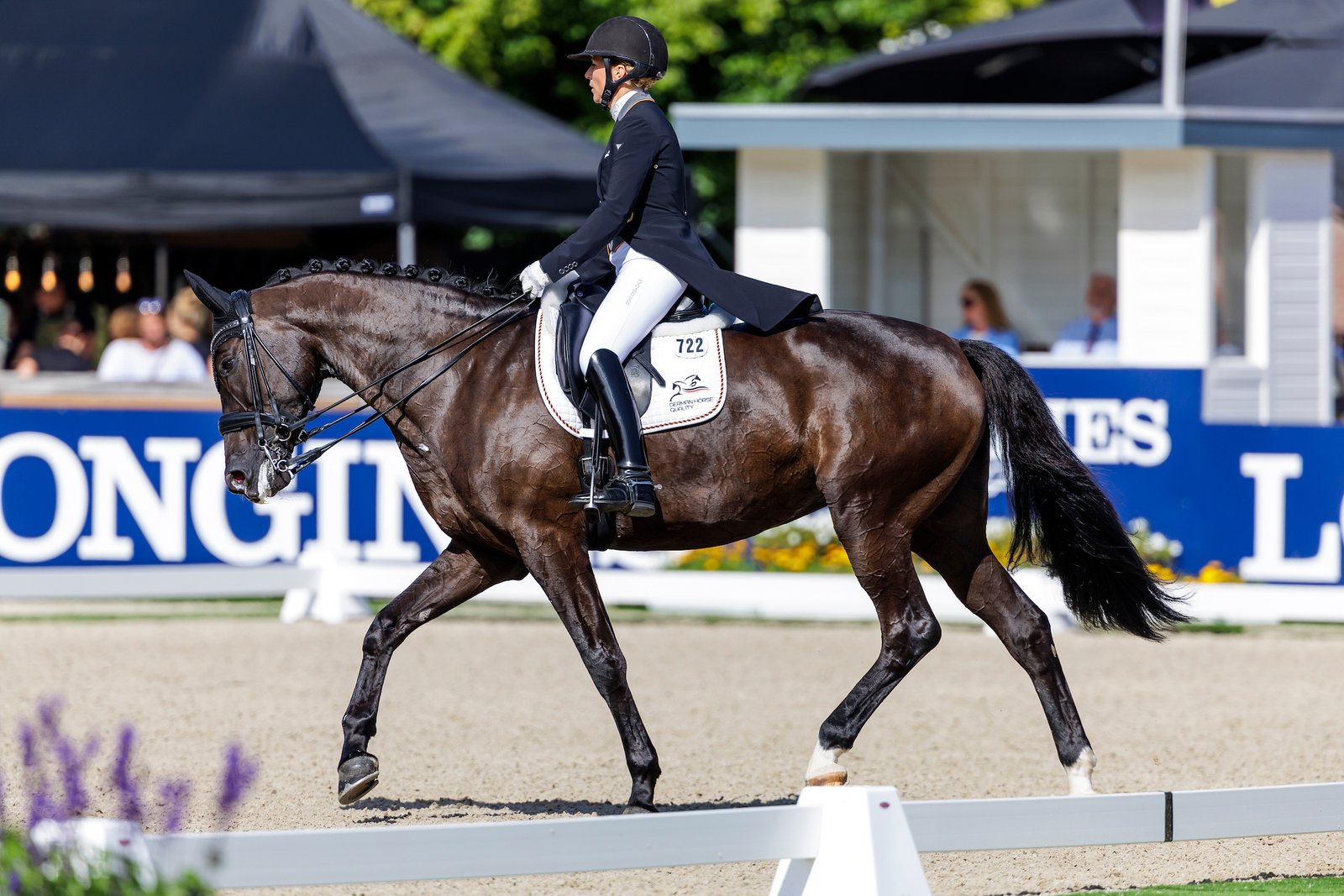 Allowing the horse to chew on the reins in Grand Prix competitions will be permitted starting in January 2027. In young horse competitions—such as here at the World Championships for seven-year-olds—it is already standard practice.
Photo: Archive, Sportfotos-lafrentz.de
Allowing the horse to chew on the reins in Grand Prix competitions will be permitted starting in January 2027. In young horse competitions—such as here at the World Championships for seven-year-olds—it is already standard practice.
Photo: Archive, Sportfotos-lafrentz.de For some time now, certain experts have been calling for the introduction of “chewing the reins from the hand” in the Grand Prix as a way to assess suppleness, contact, and balance. Now it’s happening. And that’s not the only change the FEI is introducing as part of its revision of the international dressage tests. Here’s an overview.
Grand Prix de Dressage
The FEI refers to these as “minor changes,” but the fact that riders are now required to let the horse chew on the reins while on the circle in the Grand Prix de Dressage is a new requirement that many have long been calling for. It is incorporated into the final part of the test. After transitioning from a canter to a trot, the horse moves onto the circle, where an extended gait is required between R and S. Whether riders choose to trot lightly or sit the trot is up to them.
In its summary of the changes, the FEI states that the Grand Prix Special will remain unchanged. However, the competition program itself indicates that, on the short side after breaking into a canter from passage, riders are required to perform a sweeping movement for three to four canter strides.
CDI2* Tour with a New Name
The so-called “Middle Tour” is no longer called Intermédiate A and B, but rather Intermédiaire II A and Intermédiaire II B. In addition, there is a new Grand Prix A (not to be confused with the one in para-dressage), which is to be ridden at CDI2* tournaments and in the Diamond Tour at amateur events.
As before, the piaffe may be performed over a distance of two to three meters while moving forward and has no coefficient.
In the Small Tour, the horse is also required to chew the reins while they are held out of the hand and to perform a
”
” The requirement to
let
the horse chew the
reins
held out of
the hand
is now also being introduced in the Prix St. Georges, although riders may choose whether to trot lightly or sit the trot in this case as well. New in the Intermédiaire I, similar to the Grand Prix Special, is a three- to four-jump canter stride, required after the triple changes and before the pirouettes on the short side at C—that is, in front of the judges.
Competitions for Young
Riders
For the Young Riders, similar to the CDI events, both a “chewing the rein out of the hand” exercise in the team event and a “sweeping over” exercise in the individual event were introduced.
In the junior team event, both the backward alignment and the step pirouettes remain . In the individual event, however, the latter are omitted. In addition, the single change is assigned a coefficient.
For pony riders, the individual test was modified in particular by introducing a backward movement and a test in which the horse is allowed to chew on a loose rein.
In the Children’s class , the canter sequence in the individual test was modified in particular. It became apparent that the serpentines in the outside canter and the simple change from outside canter to outside canter were too challenging for riders in this age group, especially when younger children are riding large horses.
Tests for Young Horses
The young horse tests for five-, six-, and seven-year-olds have each been supplemented with a simplified qualifying test (Preliminary A), which, however, is only used at “regular” competitions. Preliminary B is used at the World Championships for Young Dressage Horses and in the qualifying events for them.
For six-year-olds, for example, they must already be shown how to let a rein hang from their hand.
For the five-year-olds, the canter sequence has been adjusted; it now includes two simple changes and is longer overall. The walking lines have also been slightly adjusted.
For the seven-year-olds, the previous qualifying test has been replaced by a new test, Preliminary B, which includes, among other things, a short turn. The second trot extension was placed after the canter sequence to give the horses an opportunity to demonstrate improvement following the canter.
A brand-new addition is an international Grand Prix for 8- to 11-year-old horses, which is based on the requirements of the medium tour and also includes a “chewing the rein out of the hand” exercise.
You can find an overview of old and new tasks here.