2026 National Championships: Qualifying Round for Seven-Year-Old Dressage Horses: Former National Champion Felice FRH Stakes Her Claim to the Title
National Championship for Seven-Year-Old Dressage Horses: Felice Clearly in the Lead
 from Jan Tönjes
 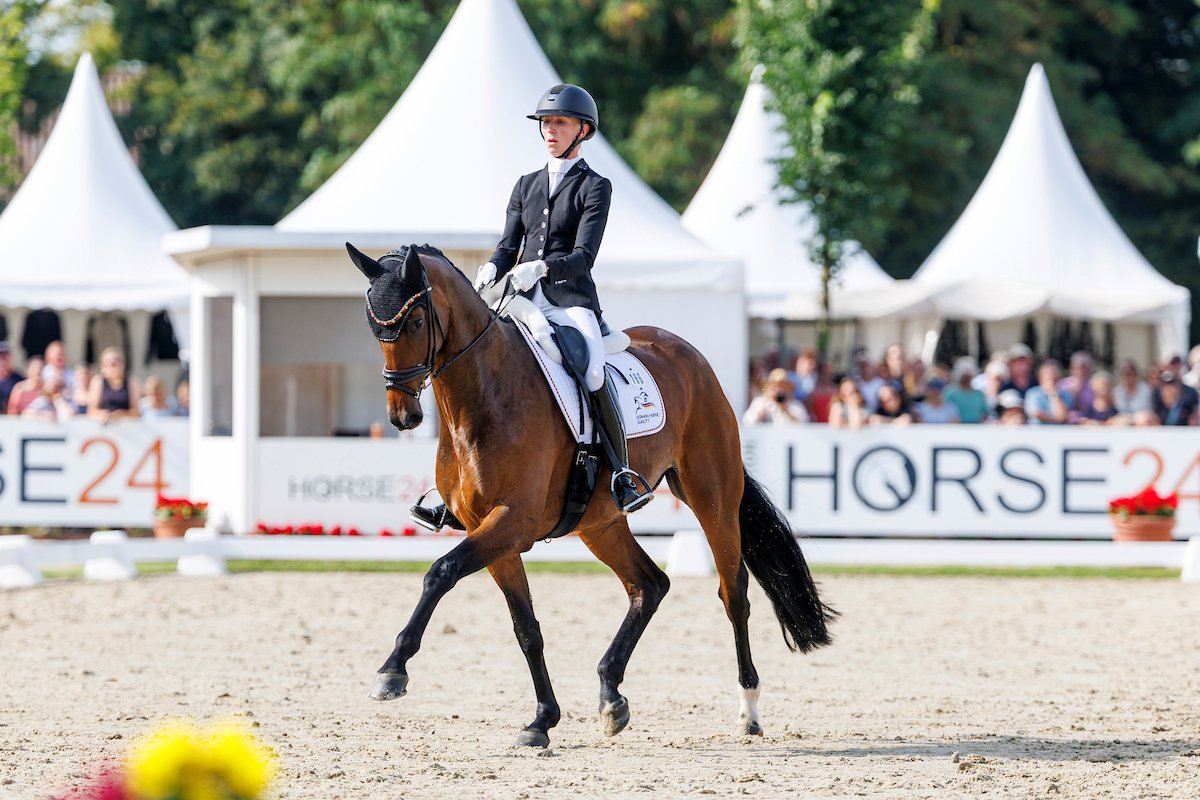 Felice FRH and Greta Heemsoth, pictured here in the final of the 2025 World Championships in Verden (file photo). Photo: sportfotos-lafrentz.de
 A pair of judges at E, Thomas Keßler and Henning Lehrmann, were responsible for evaluating the basic gaits, responsiveness, and overall impression; in addition, a judge at C, Elke Ebert, assessed the execution of the required movements in the Class S dressage test for seven-year-olds. In addition, there were 48 horses, not all of which—as harsh as that may sound—should have made the trip to Warendorf. For alongside top performances, there were also some pairs for whom one might give the benefit of the doubt, given that the horses had not yet experienced such a large audience or such an atmosphere. Nevertheless, some seemed overwhelmed, and with others, one got the impression that they were not sufficiently familiar with the principles of the training scale to compete at the national elite level.
In the top group, however, there were horses of exceptional quality and, for the most part, excellent riding to be seen in the arena. This was especially true of Friday’s highest-scoring pair by far.
Ready for the next track?
Greta Heemsoth and Felice FRH have fond memories of the arena in Warendorf. Two years ago, they won the Bundeschampionat here, and one could sense that this self-confidence was also reflected in their performance in the arena. Since then, the mare has been a finalist twice at the World Championships for Young Dressage Horses, finishing in the top ten both times. The elegant, almost delicate daughter of Fürst Samarant has gained strength, allowing her to develop even more fluidity in her trot sequence. Above all, however, she and her trainer, Greta Heemsoth, are an absolute dream team.
There was hardly any assistance visible throughout the entire test. This was evident, for example, in a truly well-ridden, collected walk. In the strong walk, there was still a need for a bit more reach and a bit more forward movement.
That is why rhythm is the foundation of all good riding
It is exemplary how the mare never lost any momentum or cadence—let alone her rhythmic trot—during the trot exercises, whether in the half-passes, shoulder-in, or on the volte. A well-balanced horse that was always presented in the correct frame.
While cantering, the mare hesitated ever so slightly during the second phase of the flying changes.
In the trot, the “quality judges” awarded a 9.5 and two 9.0s—for responsiveness and overall impression (total: 88.6 percent). Technically, the Hanoverian mare scored 75.192 percent. Both were clearly the highest scores. The impression: We can already look forward to next year and the Nuremberg Burg Cup. (Quality: 88.6 / Elements: 75.192, Total: 81.896 percent).
Franz Trischberger and Zaubermann: The First Will Be the Second
Franz Trischberger and Zaubermann were the first of the 48 pairs to take the arena. The pair made more than just a good first impression. Trischberger really set the bar high for the competition!
This striking chestnut with four rather long white legs has inherited much of his appearance from his maternal grandfather, Belissimo M. Trischberger presented the gelding with great poise and maturity. Although one or two floating strides slipped in now and then during the trot sequence as he slowed down (which the “quality judges” also took into account in the suppleness score), but the Westphalian son of Zoom demonstrated a rhythmically precise, collected walk, which—upon the rider opening his hand—immediately developed into a supple, powerful walk that showed sufficient overreach and, above all, impressed with its absolute suppleness.
Overall, the chestnut could carry himself a bit better with even more active hindquarters. This was evident in minor contact issues and balance problems, for example during the trot circle. Overall, he was able to earn some more points during the canter sequence. Although the gelding became tight when initiating the canter pirouettes, Trischberger was already able to present the seven-year-old very confidently in the half-canter pirouette on the tightest circle—something hardly any other horse demonstrated during the rest of the test. The flying changes were executed, albeit with slight tension. But everything was exactly as one would expect from a seven-year-old at this stage of training. (77.957/72. 115/77.957)
Secret, what else…
The third-place finisher in the first division, the Hanoverian Semenyo N by Secret, also had a Belissimo M dam. However, this large-framed bay, presented by Christian Alexander Kömpf, is a completely different horse from Trischberger’s “Zaubermann.” The gelding, endowed with large, lively, and elastic movements, became increasingly relaxed as the test progressed, which was particularly evident in a direct comparison of the two canter sequences. One minor shortcoming: In collected walk, the horse maintained the rhythm but could have walked with a bit more suppleness and naturalness, so that the front leg truly steps where it points at first glance.
In a strong walk, the horse improved steadily along the diagonal. One might have wished for a slightly longer neck overall and, above all, that this son of Secret would take the bit more clearly on his own initiative. The lateral movements at a trot were supple; on the trot circle, however, the gelding lost momentum and his neck was also slightly bent backward. On the other hand, unlike many others, Kömpf rode a circle that was truly only eight meters in diameter. Most of the horses did come quite close to the center line in this exercise.
In the canter, the gelding showed a lot of uphill drive, but should have worked more supple across his entire back, especially in the first strong canter. In the half-passes, one would have liked to see even more bend at times. The bay executed the flying changes confidently. (81.4/72. 5/76.95).
The rest of the placings in the first division were taken by offspring of Zackerey, Escamillo (2), Secret, and Belamour.
Second Division to Ellen Richter
Found Gody PS has inherited both the color and conformation of his sire, Foundation, but also the high-legged gait and elegance of his maternal sire, Vivaldi. Ellen Richter skillfully presented the tall gelding, although she was unable to keep his nose consistently in front of the vertical. During the canter test, the horse already showed great balance, especially in the half-canter pirouettes. The large gelding executed the flying changes confidently. A recurring impression throughout the test was that the gelding could, on his own initiative, engage more consistently with the bit in all gaits. He performed the flying changes with precision, including those in a series. But here, too, a bit more natural forward momentum would not have gone amiss. (GGA: 88.0, Exercises: 73.846, Total: 80.982).
Trischberger Likes It Colorful
Franz Trischberger focused on the colorful chestnuts with snow-white legs in this class. His second horse, FBW Emiliano H. E.—an Escolar son out of a Lingh dam, bred in Baden-Württemberg—also matched the color of the runner-up in the first division, Zaubermann. Emiliano showed great verve in the trot sequence. His strong walk was in a clear four-beat rhythm, once again deeply relaxed. The horse moved confidently to the hand, something few horses demonstrated in the test. The confident canter sequence might have been enough to overtake his stablemate. But the final flying change of leg was unsuccessful. (83.00/72.692/77.846).
Zuccador QD and Nicole Wego-Engelmeyer were required to perform a strong trot on the diagonal as part of the exercise, which lowered their scores; the Oldenburg stallion by Zenon has a dam by Lauries Crusador xx. At times, the horse’s nose line repeatedly slips behind the vertical. A highlight of the pair’s performance is the strong walk: with ideal foot placement, gaining plenty of ground both by reaching out from the shoulder and taking long strides (8.0). The collected walk was also confident and in time. What marred the picture: The bay horse tended to throw his neck back. (83.6/70.192/76.896).
Da Costa (2x), Don Frederic, So Unique, and Jovian were the sires of the other placers in the second division.
Results of the Final Qualifying Round for Seven-Year-Old Dressage Horses
Similar posts