


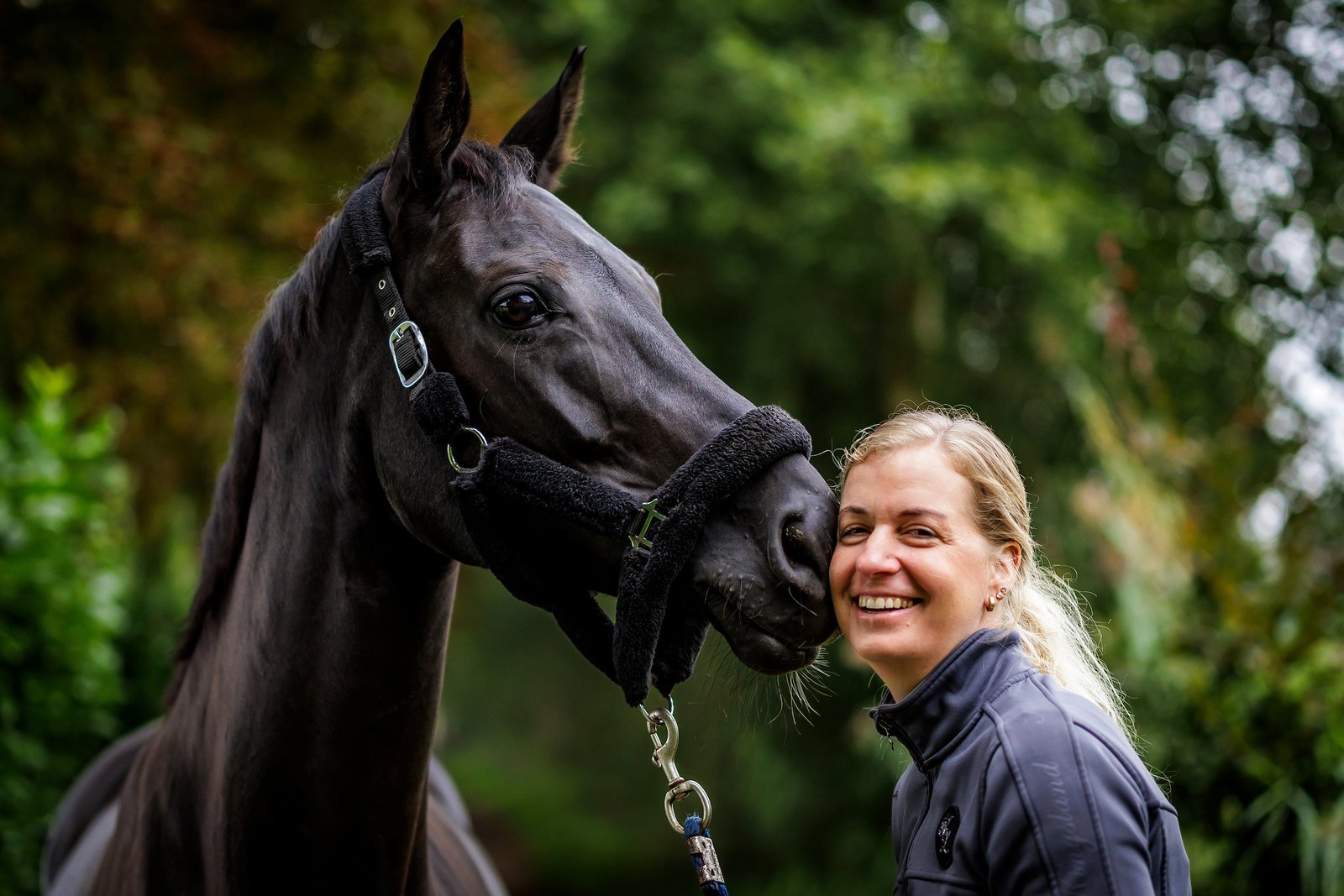
Heidemarie Dresing, Grade II
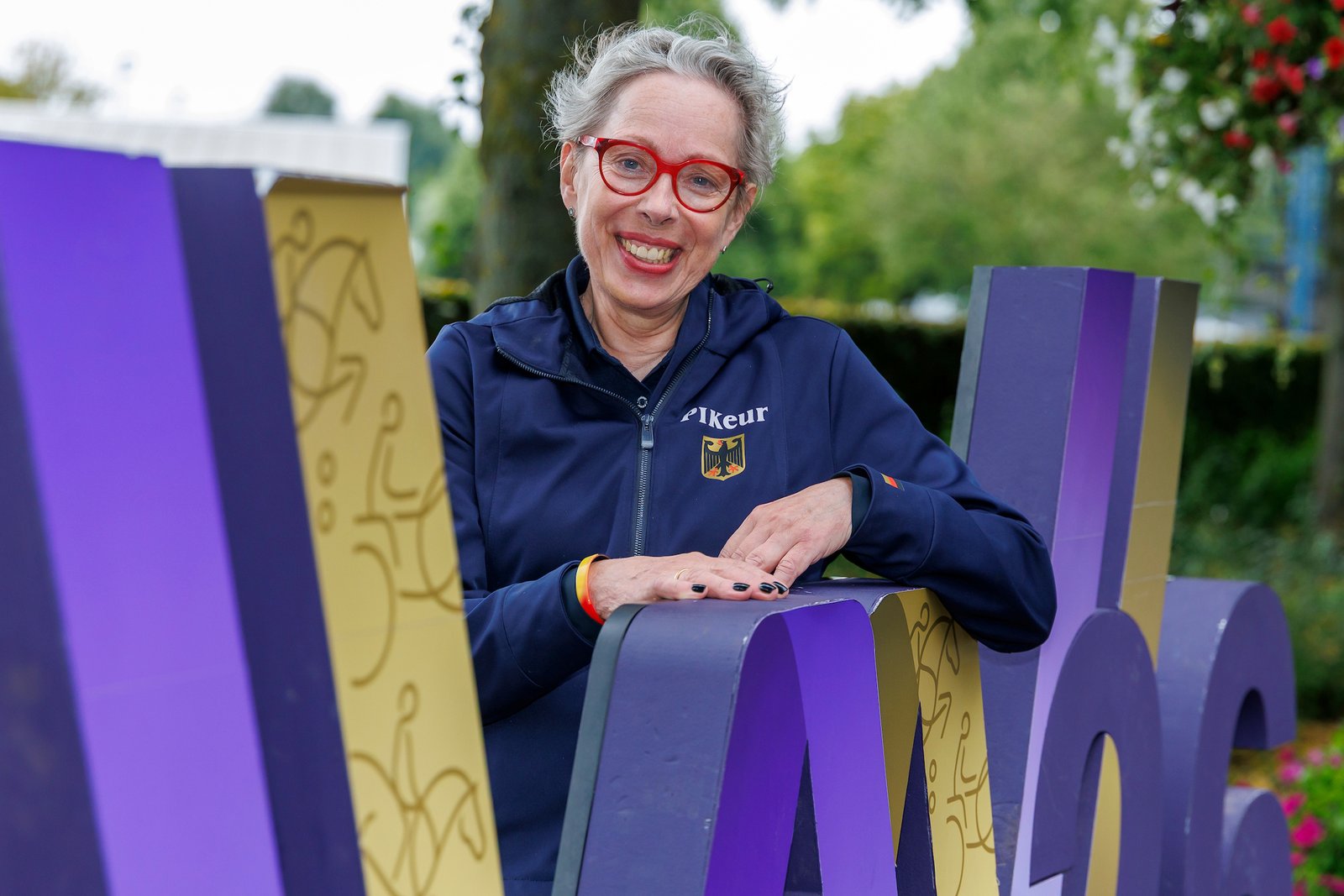
Heidemarie Dresing Photo: sportfotos-lafrentz.de
Heidemarie Dresing is the architect of her own success—in both senses of the word. Before her athletic career with the German para-dressage team, she worked for many years as an architect and a civil engineer. Horses have always been a part of her life. “My first love was named Lotte—she was a cow, but I always thought horses were just more beautiful,” Dresing laughs. Her grandmother made sure she got to ride a pony, led by someone. But that was just the beginning.
Heide, as everyone calls her, sticks with her hobby. She competes successfully in show jumping up to the M level and also competes in tournaments abroad. Then she gets a horse that’s meant to be trained more in dressage. This horse becomes the foundation for higher classes up to Intermediare I. She earns her Silver Riding Badge, which leads to her being entrusted with more and more horses to present. She also makes a name for herself as a breeder, always on the lookout for the perfect foal.
MS, or Multiple Shock
But everything changed on her 50th birthday. “We’d been celebrating, and the next day I was riding a horse,” Dresing recalls. “Then I was supposed to trot, but for some reason I couldn’t lift my left leg anymore.” She also notices changes at the office: she can’t see well and has balance issues. “The others were whispering about whether I was drunk because I was really staggering.” A doctor prescribed her computer glasses; others suspected phobic vertigo and wanted to consult a psychologist. It took six long years before she received a diagnosis: multiple sclerosis.
“That really came as a shock to me, and I was truly scared,” Heidemarie Dresing said thoughtfully. She knows of a case in her family where someone suffered greatly from MS and could barely hold their head up. For Dresing, that’s a terrible thought. Her life with the disease began with her diagnosis in 2011. And with it came limitations on her horseback riding.
Discovering Para-Dressage
“I’d heard of Para-Dressage, but I had a completely wrong idea about it and thought, ‘Huh? What’s that? Do you want to ride with them?’” Two women would play an important role in Dresing’s future path. One of them is Hanne Brenner, Germany’s most successful para-dressage rider to date. She takes an interest in a difficult mare owned by Dresing. Heidemarie Dresing tells her that she wants to give the horse away because she has a disability. Brenner’s response: “So what? I have one, too!”
And then there’s Almut Schlingenkötter from the German Board for Therapeutic Riding. She met with Dresing and convinced her to give para-sports a try. “So I competed in the German Championships against 18 other riders and came in 17th. Great.” Dresing can still laugh about it today, but her competitive spirit is also kicking in: How does she need to ride to keep up with the best?
She finds a horse with which she wants to give it another try. She rides it in a demonstration for Rolf Grebe, co-head coach of the German Para-Dressage team. Heidemarie Dresing initially competes in Grade IV. This competition class includes a wide range of impairments, and the riding is at the L** level. This is difficult for Dresing, because her spasticity and her numb left leg mean she can’t always meet the requirements. “In Grade IV, you have to ride the circle at a medium canter. For me, that was like riding a chain carousel—and on top of that, with my dizziness. No, that didn’t go well.” A reclassification results in her being placed in Grade II. Dresing has to swallow hard when she hears this. In this grade, riders with severe impairments in trunk balance and leg function compete against one another. The arena measures 20×40 meters, and the exercises are ridden in walk and trot sequences. The canter may also be included in the freestyle. “Looking back, I have to say: That was exactly the right decision. I no longer have spasticity in my hand—everyone could see that right away.”
The Steep Climb to Success
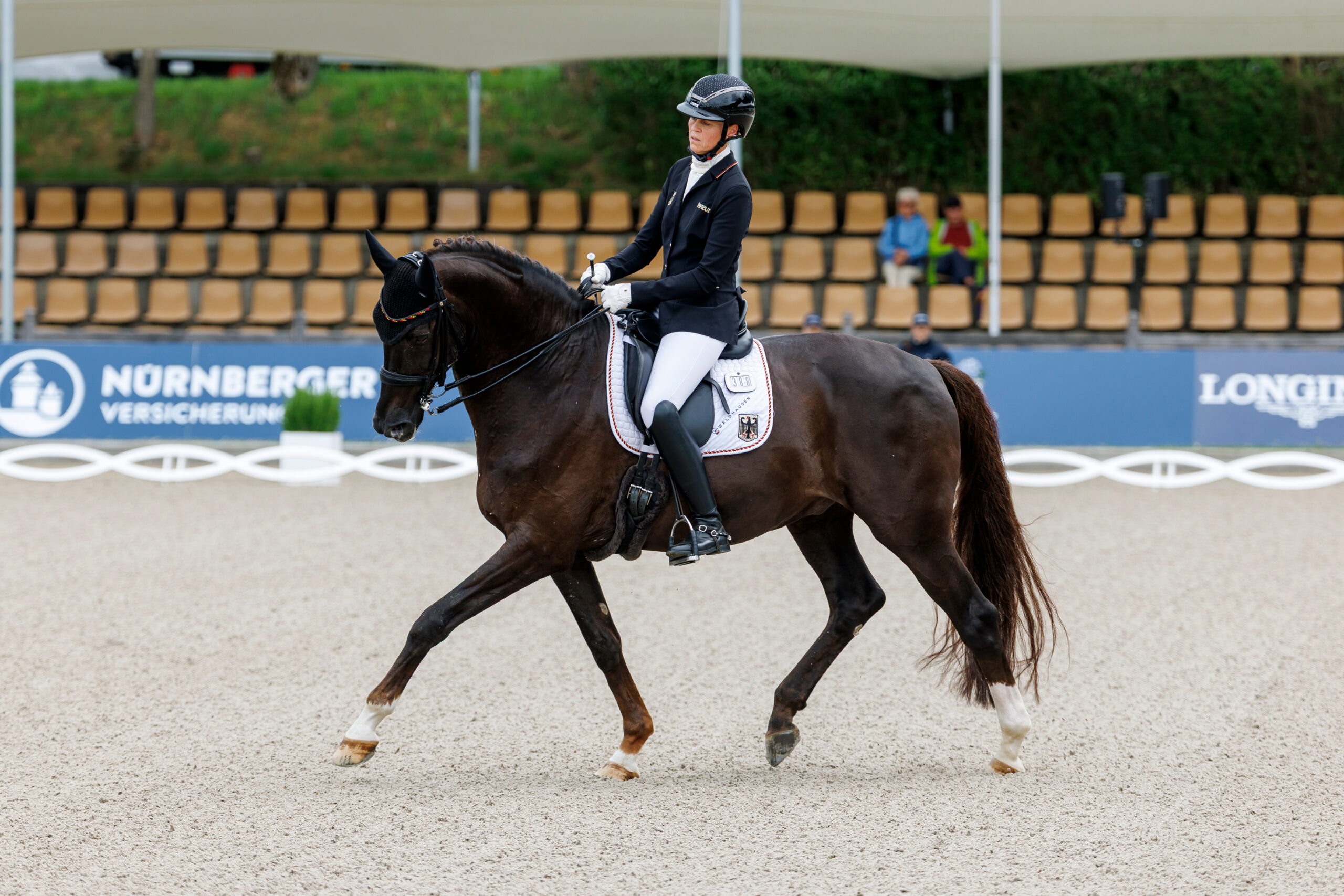
Her competition level dropped, but her success took her to the top of the world. Riding her mare La Boum, she became German champion twice, placing fourth at the Paralympics in Tokyo and in the freestyle at the 2022 World Championships in Herning. Next came another title with Horse24 Dooloop, as Dresing became European Champion in 2023 in Riesenbeck in the individual competition and the freestyle. She also won silver with the team. “I’d only gotten Dooly in February, and by August we were already European Champions.” She still can’t believe it. “Though he’s not exactly easy to handle. He’s a Grand Prix horse trained by Nadine Plaster. I had to figure out how to handle him at first. If you’re not careful, he’ll break into a passage or piaffe in no time.”
Her competitive journey continues with him, just as it does with her young horse, Poesie. Riding Poesie, Dresing wins three titles at the 2025 European Championships and defends her title at the 2026 German Championships. The fact that she is now in her 70s is no obstacle for Dresing—nor is her neurological condition.
“The beauty of para-sports is that you can compete at a level appropriate to your medical condition. Even if you’re very ill, you can still reach the top,” says Heidemarie Dresing. She wants to keep competing for as long as possible.
-
Paralympics
- Team ranking0x
 0x
1x
0x
1x - Individual ranking0x
0x
1x
-
European Championships
- Team Standings1x
1x
0x
- Individual Standings5x
0x
0x
-
World Championships
- Team ranking0x
1x
0x
- Individual ranking1x
0x
1x


EQUI PAGES & Cookies
Funktional
Always active
Die technische Speicherung oder der Zugriff ist für den legitimen Zweck, die Nutzung eines bestimmten, vom Teilnehmer oder Benutzer ausdrücklich angeforderten Dienstes zu ermöglichen, oder für den alleinigen Zweck der Durchführung der Übertragung einer Nachricht über ein elektronisches Kommunikationsnetz unbedingt erforderlich.
Preferences
The technical storage or access is necessary for the legitimate purpose of storing preferences that are not requested by the subscriber or user.
Statistiken
The technical storage or access that is used exclusively for statistical purposes.
Die technische Speicherung bzw. der Zugriff erfolgt ausschließlich zu anonymen statistischen Zwecken. Ohne Vorladung, freiwillige Zustimmung Ihres Internet-Service-Providers oder zusätzliche Aufzeichnungen Dritter können die zu diesem Zweck gespeicherten oder abgerufenen Informationen in der Regel nicht dazu verwendet werden, Sie zu identifizieren.
Marketing
The technical storage or access is required to create user profiles to send advertising, or to track the user on a website or across several websites for similar marketing purposes.