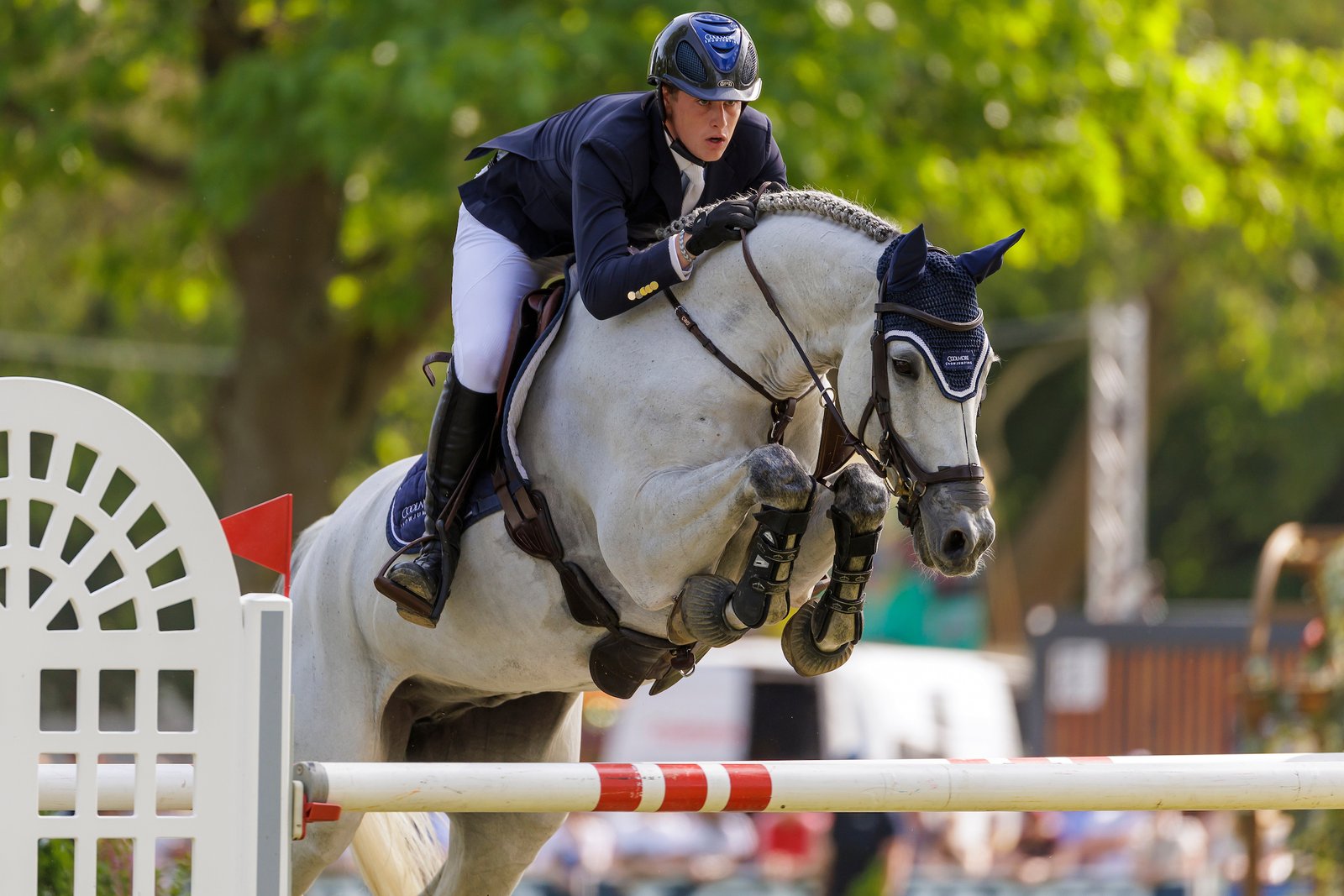
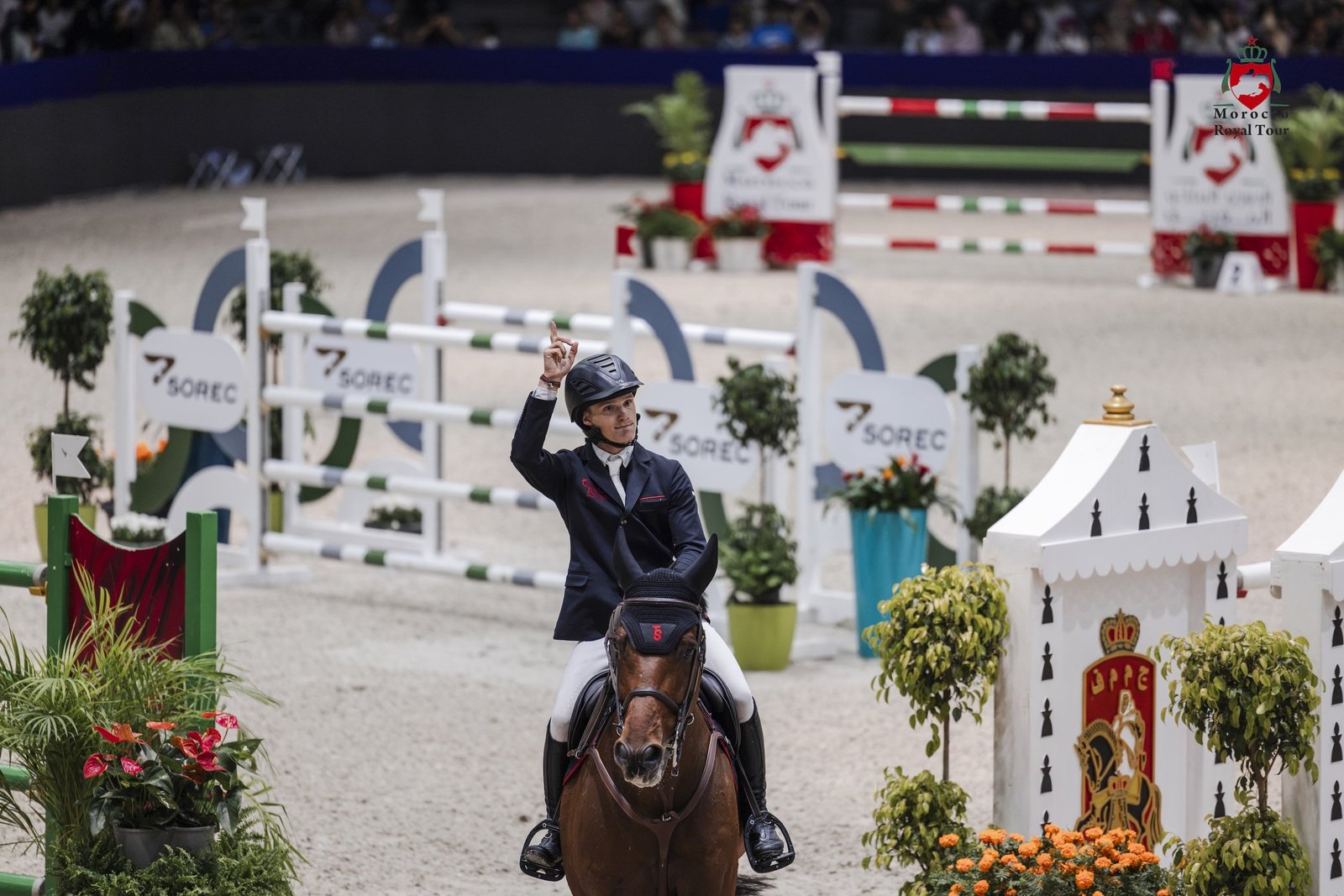
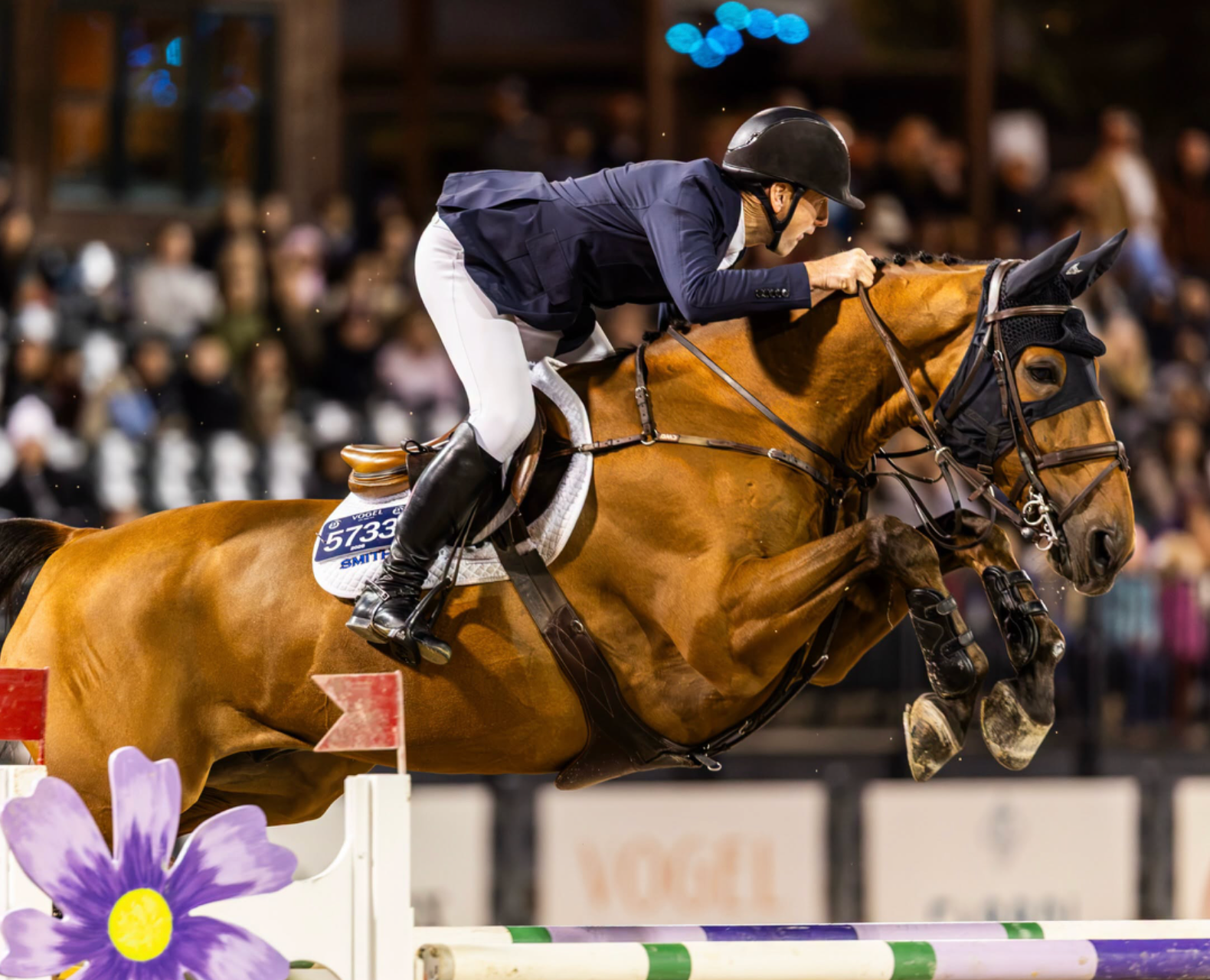
World Championship Show Jumping: Germany Leads After First Round at World Championships; Epailard Wins Ahead of Harrie Smolders and Scott Brash; Sophie Hinners Finishes Fourth
World Championships Time Jumping: Germany Leads After the First Round at the World Championships
 from Jan Tönjes
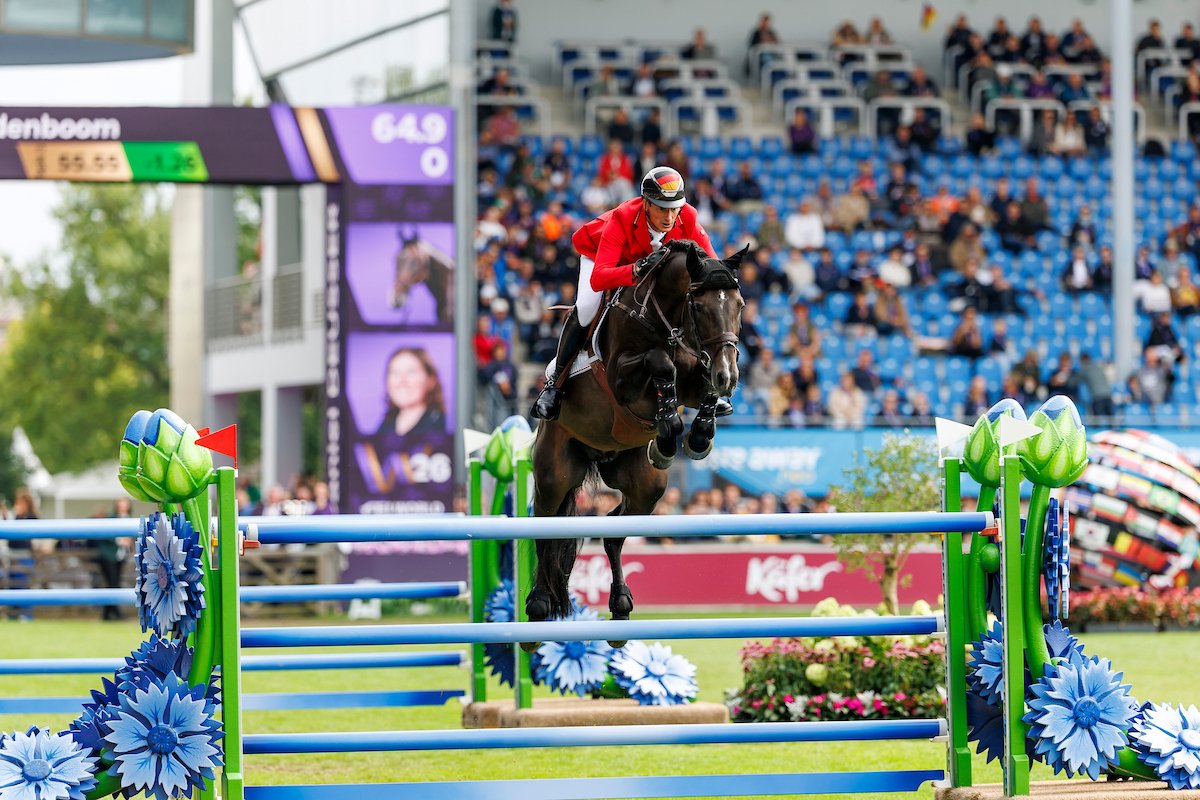
 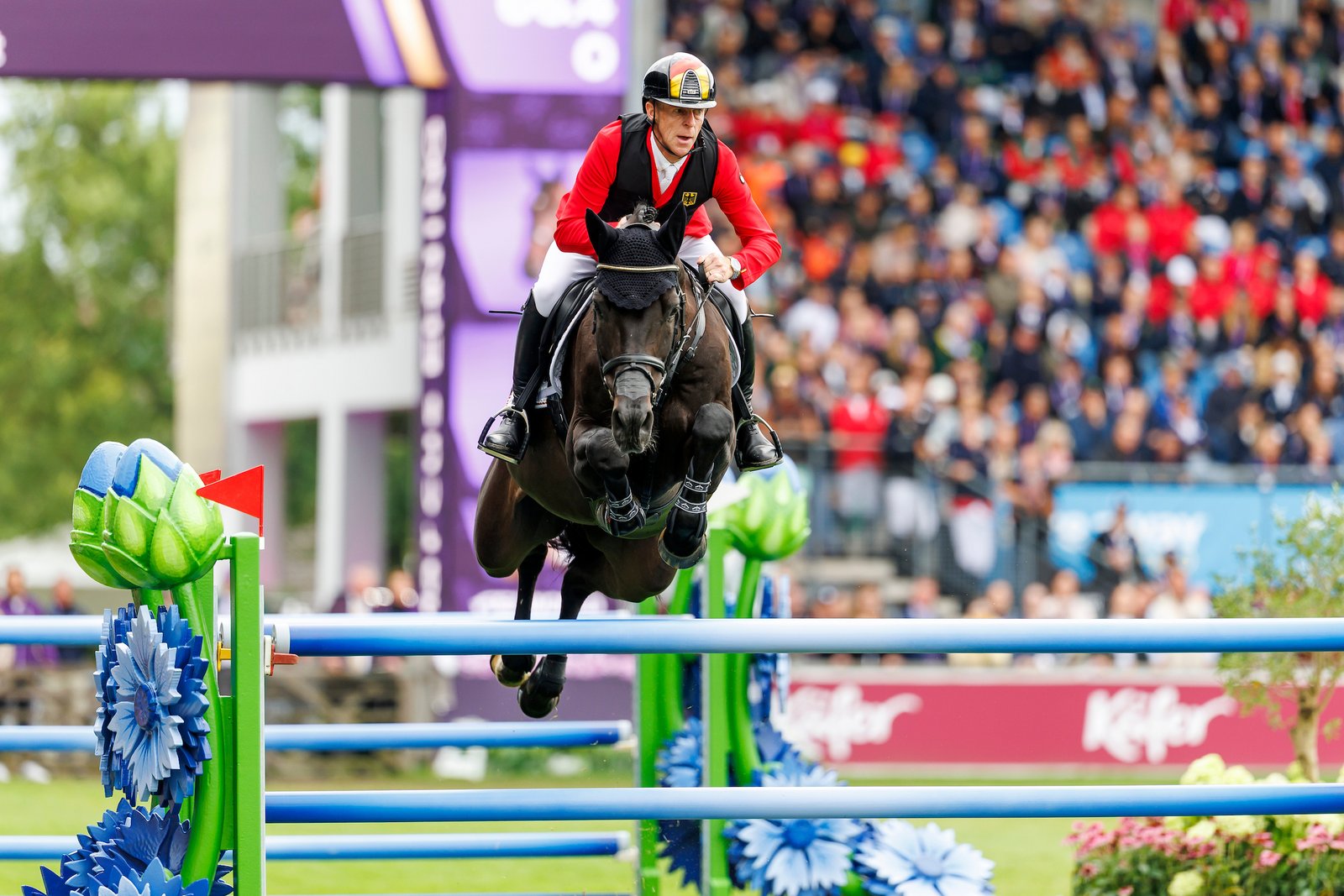 National team coach Otto Becker awarded a 9.0 for the style with which Marcus Ehning and Coolio opened the 2026 World Show Jumping Championships.
Photo: sportfotos-lafrentz.de
National team coach Otto Becker awarded a 9.0 for the style with which Marcus Ehning and Coolio opened the 2026 World Show Jumping Championships.
Photo: sportfotos-lafrentz.de 6:34 p.m.
Team Standings
: After the first qualifying round, Germany is in first place, followed by Belgium and the U.S. Just over one jumping fault separates first place from seventh place. Germany has 3.48 penalty points. Belgium has 3.69 penalty points, and the U.S. enters the Nations Cup “with a score of 4.85.” Scoring for the U.S. team were Laura Kraut/Baloutinue (72.72/11th) and Lillie Keenan (72.94/14th).
Among the teams that surely would have hoped for a better position after the time trial are Sweden and Switzerland, currently in 12th and 13th place.
6:24 p.m.
There’s an update regarding the Hungarian horse. The clinic reported that it is merely a tendon injury. It’s painful, but nothing serious.
5:05 p.m.
The time jumping is over, which means the first qualifying round of the 2026 World Show Jumping Championships has been decided.
Frenchman Julien Epaillard has once again proven the success of his training approach. He heads into the next special stage—the Nations Cup, which begins tomorrow at 9 a.m.—as the leader. His 1.36-second lead is a world apart—a masterful performance.
After the conversion, Dutch rider Harrie Smolders is in second place with 0.68 points on Mr. Tac. British rider Scott Brash, who had been in the lead for quite some time on Hello Mango, trails by 0.8 penalty points.
Sophie Hinners is the top rider on the German team. She and Singclair are 0.84 penalty points behind the leader. Daniel Deußer and Otello de Guldenboom are 0.86 penalty points behind and, along with Steve Guerdat and Dynamix de Belheme, are tied for fifth place.
Marcus Ehning and Coolio are in 20th place. They are just 1.78 penalty points behind Julien Epaillard.
There was one incident: Egano van’t Wingerdhof Z, a 13-year-old black stallion by Elvis ter Putte, suddenly began galloping on three legs between jumps 10 and 11. The horse was unsaddled in the arena and shielded from view with tarps. The stallion was loaded onto a trailer and taken to a veterinary clinic for further examination. There is currently no further information regarding the horse’s condition.
4:56 p.m.
Just noticed: One of the most consistent pairs on the Belgian team, Nicola Philippaerts and Katanga vh Dingeshof, rode their way into the top ten a while back: 72.61 seconds.
4:45 p.m.
Now that the jumping competition is drawing to a close, Daniel Deußer offers a positive assessment. He also shares his outlook on what he expects in the coming days:
“A quick clear round—exactly the result we were hoping for. Of course, today’s height is only 1.55 meters, not 1.60 meters, and in the coming days it will even be 1.65 meters. It’s a different competition—we’re doing a timed jump today. So the hole is definitely even deeper than it will be tomorrow or the day after. The course layout and the technical demands will likely be more challenging tomorrow. But I hope that works in our favor.”
4:42 p.m.
Rodrigo Pessoa (BRA) and Major Tom —a beautiful round to watch in the rain. 74.37 seconds—currently one place behind Marcus Ehning.
4:31 p.m.
: Defending champion Henrik von Eckermann (SWE) rides Minute Man smoothly, but not “at breakneck speed.” 75.52 seconds for an impressive clear round.
4:17 p.m.
. The Saudi Abdullah Alsharbartly and Diriyah—formerly known as Dubai du Cedre and fourth-place finishers at the Olympics with Julien Epaillard—were moving very quickly. But at platform 9a, the D-train made an unscheduled stop. Stop at platform 9a.
4:08 p
.m.
The jumping is still underway, but national team coach Otto Becker has already summed up the day. “All four put on a top-notch performance. But of course, it has once again been confirmed what we’ve been saying over the past few years and what we said going into the competition: that the competition is very, very close, both in the individual and team events.” The national coach was also surprised by United Touch S’s mistake.
3:58 p.m.
: Harrie Smolders’ joy over his ride is likely to last a while. But he’s no longer in the lead. The Frenchman Julien Epaillard has made sure of that. Riding Fringan de Vesquerie by Mylord Carthago, he made the course look almost effortless. Epaillard simply guided the chestnut gelding from obstacle to obstacle. And not only did he do so without any faults, but in an unbelievable 70.6 seconds! He’s now in the lead, with an incredible 1.36-second advantage. Just to put that in perspective—if you look at who is 1.36 seconds behind Harrie Smolders in second place, you’ll find they’re in 15th place!
3:55 p.m.
The first runners had praised the track, but now it’s raining. Let’s see how the sacred turf holds up.
3:49 p
.m.
Here’s another name that’s one of those about whom people say, “A jumping competition isn’t decided until XY crosses the finish line”: Harrie Smolders. The Dutch rider and his compact bay, Mr. Tac by Nonstop, are galloping through the course without much fanfare. And: they’re in the lead! 71.96 seconds!
3:45 p.m.
A glance at the weatherman: He’s pulled out his umbrella. It’s raining, and it’s been cold all day.
3:37 p.m.
Richard Vogel and United Touch S (here’s a recent biography) gallop across the course in long strides. Despite the stallion’s powerful stride, the first double combination poses no problem. United Touch S recovers well at the takeoff. The turn afterward is very tight. Even so, Vogel still manages to clear the wavy plank at its lowest point. It looks great. But on the approach to jumps 10 and 11, Richie has to give a clear hand signal. However, it’s not enough—United Touch S gets too close to the red-and-white vertical jump. Knockdown! Overall, he takes 73.36 seconds, which would place him somewhere around 20th. But the four-second penalty for the knockdown causes the pair to slip down the rankings: 77.46 seconds. But anyone who does the math will quickly realize: Despite the knockdown, the pair—who are currently ranked number two in the world—are less than one knockdown away from Scott Brash, who is in the lead at this point. But many others are even closer.
3:08 p.m. Interim results after three team riders
As I mentioned earlier, the time trial usually doesn’t have much of an impact on the final results. Still, partly because it’s so nice to read, here’s a quick look at the interim results: Germany has a total of 219.36 seconds, and Great Britain has 221.28. That’s a fact. And it sounds pretty good, doesn’t it, to enter the Nations Cup as the leading team?
2:56 p.m.
: Sweden’s Peder Fredricson and Alcapone des Carmille power through the course with explosive strides. In the process, the bay loses a shoe. In the end, the Diamant de Semilly son simply can’t generate enough length in the final double combination, and the poles fly off at the takeoff. Peder rides to the spot where the horseshoe came off, dismounts, and leaves the stadium on foot. The horse in one hand, the horseshoe in the other.
2:15 p.m.
The Swiss Jason Smith is considered one of the dark horses. His gray stallion Picobello van’t Roosakker is a horse everyone wants to own. Anyone who’s seen this 11-year-old in action over a jump knows why that is. But even a highly favored combination has to clear a double combination sometimes: At 3a, the stallion crept too close under the oxer. Picobello tried to salvage what he could. There wasn’t much to that oxer. He soared into the air, then landed with his hind leg on the rear oxer pole. The other jumps, as the name suggests, were picobello—with lightning-fast front legs, a feast for the eyes—but: 83.92 seconds for the Swiss horse, who originally hails from Scotland.
1:44 p.m.
If we were being unfair, we’d say that the English translation of “spoilport” is Scott Brash. But since we’re fair, we’ll say: Hats off to Team GB! Even in Great Britain, not everyone understood why Scott chose the gray mare Hello Mango—a daughter of Untouchable—as his World Championship horse. On paper, the pretty mare is more like his third-string horse. But in the United Kingdom, people know that Brash knows what he’s doing. He proved it with a blisteringly fast ride: 72.19 seconds—nine hundredths of a second faster than Sophie Hinner, who is now in second place.
1:35 p.m.
Daniel Deußer and Otello de Guldenboom —what an amazing round! A lively canter right from the start. And at jump four—the undulating planks after the about-face—it was clear to everyone what national team coach Otto Becker meant when he said, “If necessary, Daniel can probably go a little faster still.” That was more of a half-canter pirouette than a mere turn. It was a jump-off on the first day. And Otello powered through with confidence. It’s practically a family tradition to live up to. Otello’s sire, Tobago Z, had also finished second in the Aachen Grand Prix after a super-fast jump-off. At the black-and-white oxer, number 10, the stallion barely touched the bar. The turn after jump 11 onto the last of the three double combinations in the course was precise, tight, and fast. The clock stopped at 72.32 seconds—four hundredths of a second slower than Sophie Hinner’s time and just as fast as Dynamix de Belheme and Steve Guerdat.
1:15 p.m. Short lunch break – Hinners continues to lead
First, a quick apology: the internet here is doing exactly what the competition does when, for example, Michi Jung comes around the corner—it goes down on its knees. Uploads are taking a while. Just to clarify.
A few fast top pairs have been on the course since then. But they were all slower than Sophie Hinners. If this were tabloid journalism, the alliterative headline would probably be: “Everyone Falls Behind Hinners.” But let’s stick to the plain facts:
Three fast rides still need to be added to the tally: Mark Bluman, riding for Israel, didn’t spend much time giving aids. He let the Zangersheider gelding Landon de Nyze jump over the obstacles with his neck extended. Less interference means greater speed. The strategy paid off: Bluman is in third place in the interim standings after 73 rides (72.5 seconds).
Belgian rider Peter Devos also rode his Casual DV Z calmly but quickly around the course (72.76). He is in sixth place at the “midpoint” of the competition.
12:40 p.m.
That was a real close call: Steve Guerdat, the Swiss Olympic silver medalist, delivered a typical Stevc ride with his European champion Dynamix de Belheme. Forward momentum, minimal, unobtrusive aids. It was a hair’s breadth that left him behind Sophie Hinner—0.04 seconds, with a time of 72.32 seconds. Even though experience shows that the results of the speed round don’t play a huge role in the final standings, Guerdat’s ride was still important for the Swiss team. That’s because the opening rider, Martin Fuchs, had to contend with a fault on Connor Jei in the first double combination. The Holsteiner simply wouldn’t move there. On the next line, he had to Martin Fuchs to “get his legs right,” meaning he brought the brown one back in front of the driving aid to gain distance on the subsequent jumps. It remained at that one knockdown (80.64).
12:15 p.m.
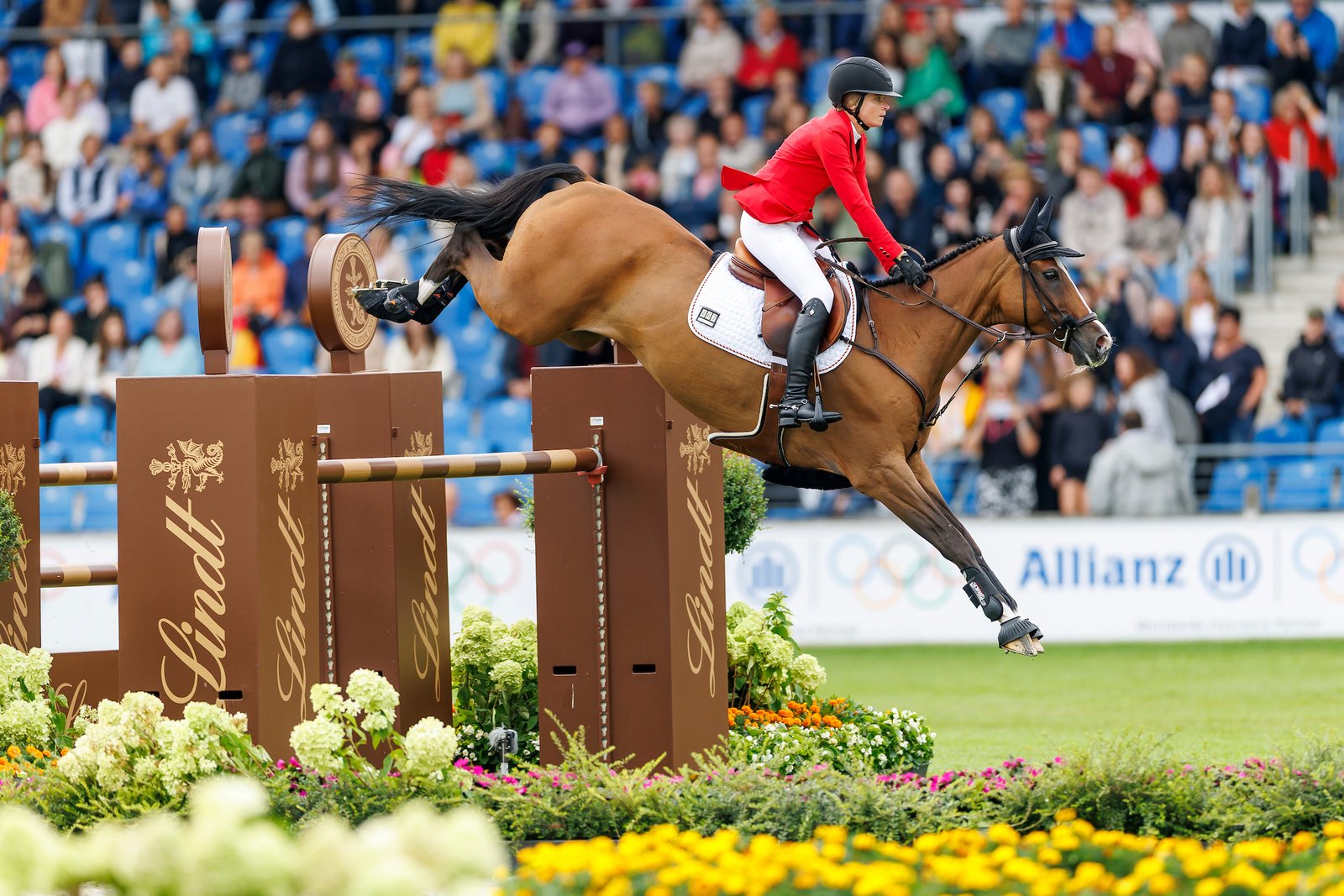
Sophie Hinners and Iron Dames Singclair galloped into the arena as the 37th pair to compete. And they left 36 competitors looking sheepish. Because this round wasn’t just fast—it was super fast. Powerful over the jump, then straight ahead again on the landing. 72.28 seconds—a new personal best, and they took the lead!
11:00 a.m.
Marcus Ehning was the first of 144 competitors to enter the Soers arena. The Holsteiner Coolio put in a confident performance.
The veteran rider said that pretty much everything went according to plan. “On the final straight, I drifted a bit to the outside. That’s when I thought the final strides were going to be too long. In hindsight, I could easily have taken one less (gallop stride) and would have been a second faster. Having to ride first wasn’t exactly my ideal scenario. It certainly makes it easier once you’ve watched the other twenty riders. But first and foremost, I was incredibly pleased with him.”
Unpopular starting position number one for Marcus Ehning
The decision to have Ehning enter the stadium first was made by national team coach Otto Becker. “We discussed it at length because Daniel was actually supposed to go first. But in the end, you can argue back and forth all you want. Someone has to go first, and in this case, it fell to me,” says Ehning.
Ehning, who is competing in his seventh World Championship, says it’s thanks to Coolio that it looked so effortless. “He just gave me an incredibly good feeling, even yesterday. He’s incredible with me. I think we’ve become one. And of course, that makes me extremely happy. As I said, I could have skipped one gallop stride on the final line, but the rest was easy.”
“Reaches Temperature Immediately”
The course isn’t too difficult. “Well, it’s a 1.55-meter course, which I think is about right, since there are 144 riders competing here. We’ll see how the ground changes as the day goes on. So far, it feels really great.” Ehning’s personal take: “It was a good, solid round, but it wasn’t quite at top speed yet. It was a perfect start, I hope.” As relaxed as Coolio seemed during the warm-up, he was fully focused at the decisive moment. “I know exactly that when he enters the course and I take the reins short—as you could see—I move toward the wall. Then he looked around a bit, did a little buck: That’s when I know he’s immediately up to speed. We know each other well enough by now for that.”
National Team Coach Otto Becker: “Marcus Has a Plan”
National Team Coach Otto Becker was relieved, for one thing, that it wasn’t him who drew the unpopular No. 1 starting position—“it was decided by a draw.” He was more than satisfied with the start: “Marcus handled it in a truly unique way—it was a flawless lap. You could really see all his experience this morning.”
Well, I think he would have gotten a 9.0 in the style jumping competition, too.
Ehning explains why he had to ride first: “I think Daniel is still a little more flexible. Markus sticks to his plan and rides it, and Daniel can, if necessary, maybe ride a little faster: That’s what ultimately tipped the scales in favor of starting with Markus. So that seems to have been the right decision—at least as things stand now.”
Ben Maher in the Lead for Now
After the first 37 rides, Britain’s Ben Maher was in the lead with “Point Break.” The round looked effortless. The 2021 Olympic champion was always moving forward. Maher barely had to pick up Action Breaker —the son of the recently deceased horse—even once; 72.61 seconds set the best time.
Also riding at a blistering pace: American Laura Kraut and the experienced Baloutinue (72.72 seconds). Egyptian rider Ayelo Nassar rode ESI Ali almost perfectly along the ideal line the entire time, with tight turns, a smooth flow, and the horse perfectly balanced—that’s what efficient riding looks like (73.41). Behind Marcus Ehning (74.16), French rider Nina Mallevaey—currently the top-ranked woman in the world—initially placed second (74.46).
The Course for the Speed Jumping Competition
In
the speed jumping competition
—the first event of the World Show Jumping Championships—there are 13 obstacles with 16 jumps. Course designer Frank Rothenberger has opted not to include a triple combination. Instead, there are three double combinations on the course.
A steep jump (1) on the left side, positioned diagonally across from the entrance, kicks things off. The course then turns left over an airy yellow oxer (2), and after a right turn—about eight gallop strides—the first double follows: An oxer (3a) with a total of three (!) poles in the NRW colors and white flower boxes, followed by a steep jump with two poles (3b).
Right after that comes the first opportunity to save time: the course turns right into a hairpin curve. There is a steep jump with three narrow, wavy planks (4). This is followed by a straight line across the entire arena, roughly parallel to the dressage arena, which is still in the center but is decorated with lots of flowers and the emblems of the six disciplines.
An oxer with light-colored poles and FEI pictograms as uprights (5) is followed, after five gallop strides, by a chocolate-brown oxer (6) with gold stripes. Nine gallop strides later, a wall awaits. Neoclassical columns, a mint-colored (copper) roof—it looks a bit like the Brandenburg Gate. Only the center is marked off as a jump (7). The ground here was already a bit slippery right from the start.
Would you like one more double?
After a right turn, there is a massive oxer (8) about [number] gallop strides away.
Another seven gallop strides later, the second double combination awaits: two Liverpools. At the approach (9a), the ditch is located in front of the vertical jump, and at the landing (9b), it is behind the white birch poles.
The course continues with a right-hand turn over a black-and-white oxer (10), landing on the left; five canter strides ahead is a red-and-white vertical (11). Riders can make up some time here, depending on how tightly they take the turn into the next double combination, which is entirely blue. It consists of two oxers (12a/12b). Then it’s important to continue riding smoothly, as the final jump—a massive red-and-black oxer—comes after eight powerful canter strides.
In this speed jumping competition, jumping faults are penalized with four penalty seconds. At the end, the time difference in seconds from the winning round is divided by two and converted to a decimal. The winner of the speed jumping competition then enters the next event with an ideal score of 0.0. For example, if the second-fastest rider were 0.2 seconds slower than the winner of the speed jumping, he would enter the first round of the Nations Cup tomorrow, Thursday, with 0.1 penalty points.