World Championships in Aachen: Katharina Hemmer and Denoix Set Personal Bests in the Grand Prix; Carl Hester Second in the Interim Standings
World Championships in Aachen: Katharina Hemmer and Denoix Deliver the Best Ride of Their Lives—So Far
 from Jan Tönjes
 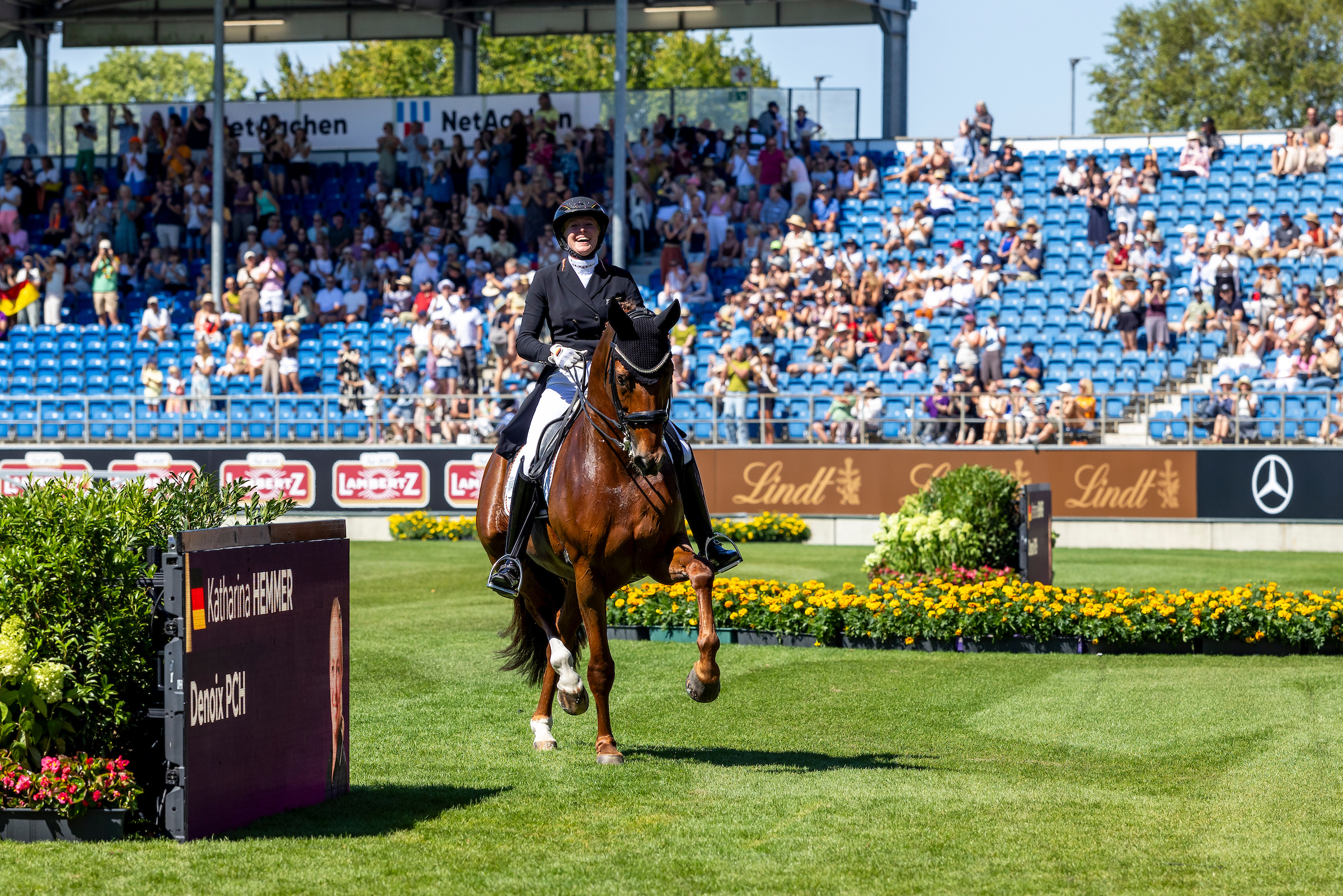 That moment when you ride out of the Aachen stadium after having sparked absolute enthusiasm at a World Championship… Katharina Hemmer and Denoix—this Grand Prix was one to remember.
Photo: sportfotos-lafrentz.de/Sharon Vandeput
That moment when you ride out of the Aachen stadium after having sparked absolute enthusiasm at a World Championship… Katharina Hemmer and Denoix—this Grand Prix was one to remember.
Photo: sportfotos-lafrentz.de/Sharon Vandeput At 12:30 p.m., Katharina Hemmer entered the stadium in Aachen with Denoix at a walk, with the reins held almost loosely. She kept patting the Oldenburg horse on the neck. The chestnut showed some tension, but his rider did not at all, as Monica Theodorescu explained afterward. “He was a little unsure coming in because people were clapping. But Katha just kept riding calmly at a walk, didn’t get flustered. ‘Let’s walk calmly onto the sand, then turn around, and then start cantering.’ Totally confident, mentally very, very strong. And I mean, there’s no question that she can ride, but this is incredible.”“
A textbook-perfect side view
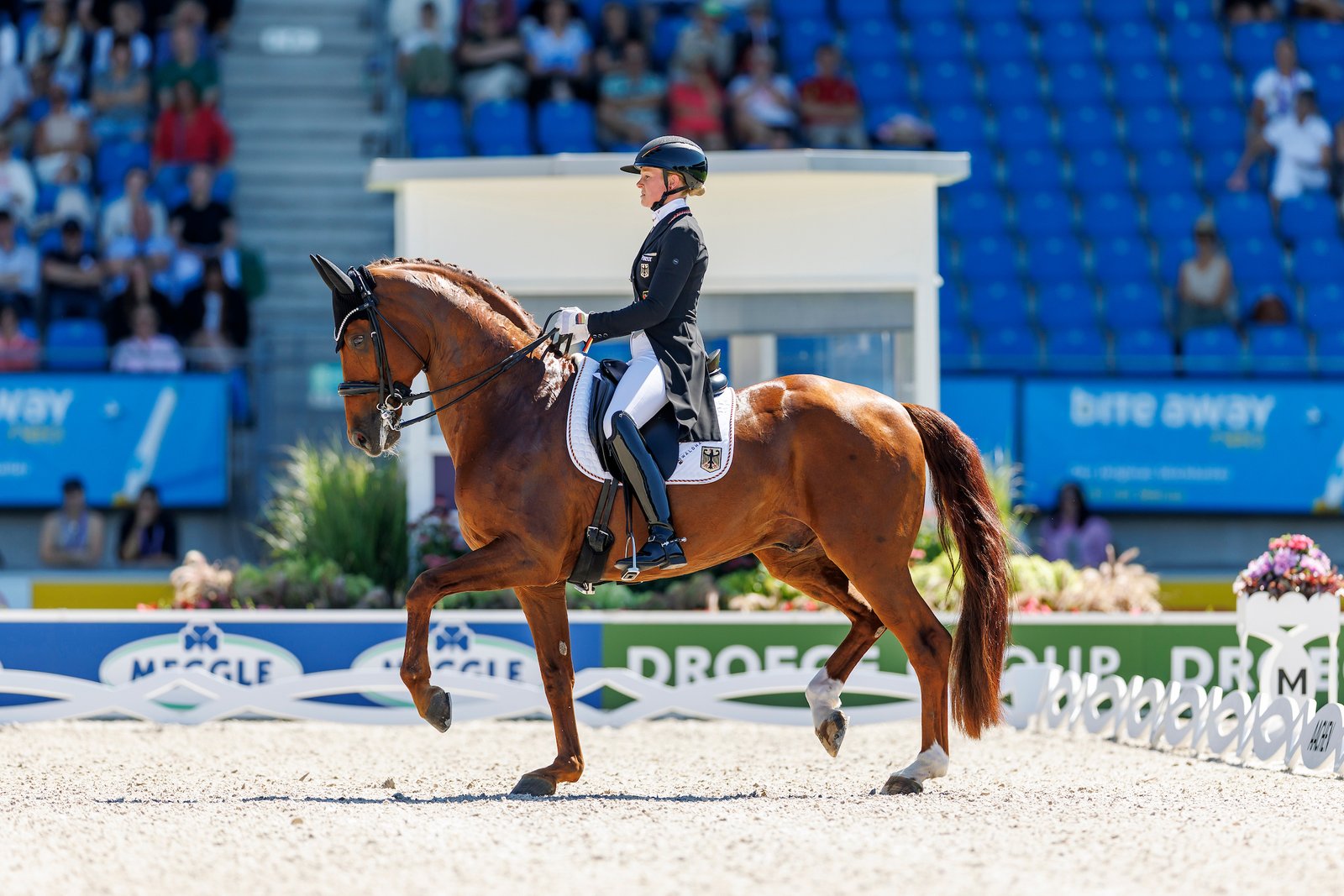
The consistently light contact and the magnificent silhouette are also incredible. This is exactly what dressage should look like. Wide, elastic traverses to start things off. For the first time during the World Championships in Aachen, the scoreboard at the side displaying live scores shows a score of over 80 percent in a test. This is followed by springy passages, just as lively as they are active. In the first piaffe, the 14-year-old moved forward perhaps 24 centimeters. Here, too: active, diligent, everything light, everything textbook-perfect.
The strong stride was executed confidently; the collected stride was a highlight. A perfect four-beat rhythm—diligent, yet also collected.
If you want to know what a piaffe should look like, just check out the second piaffe on Clipmyhorse, including the smooth transitions. In and out—it gives me goosebumps.
Challenging Horseback Riding Tour
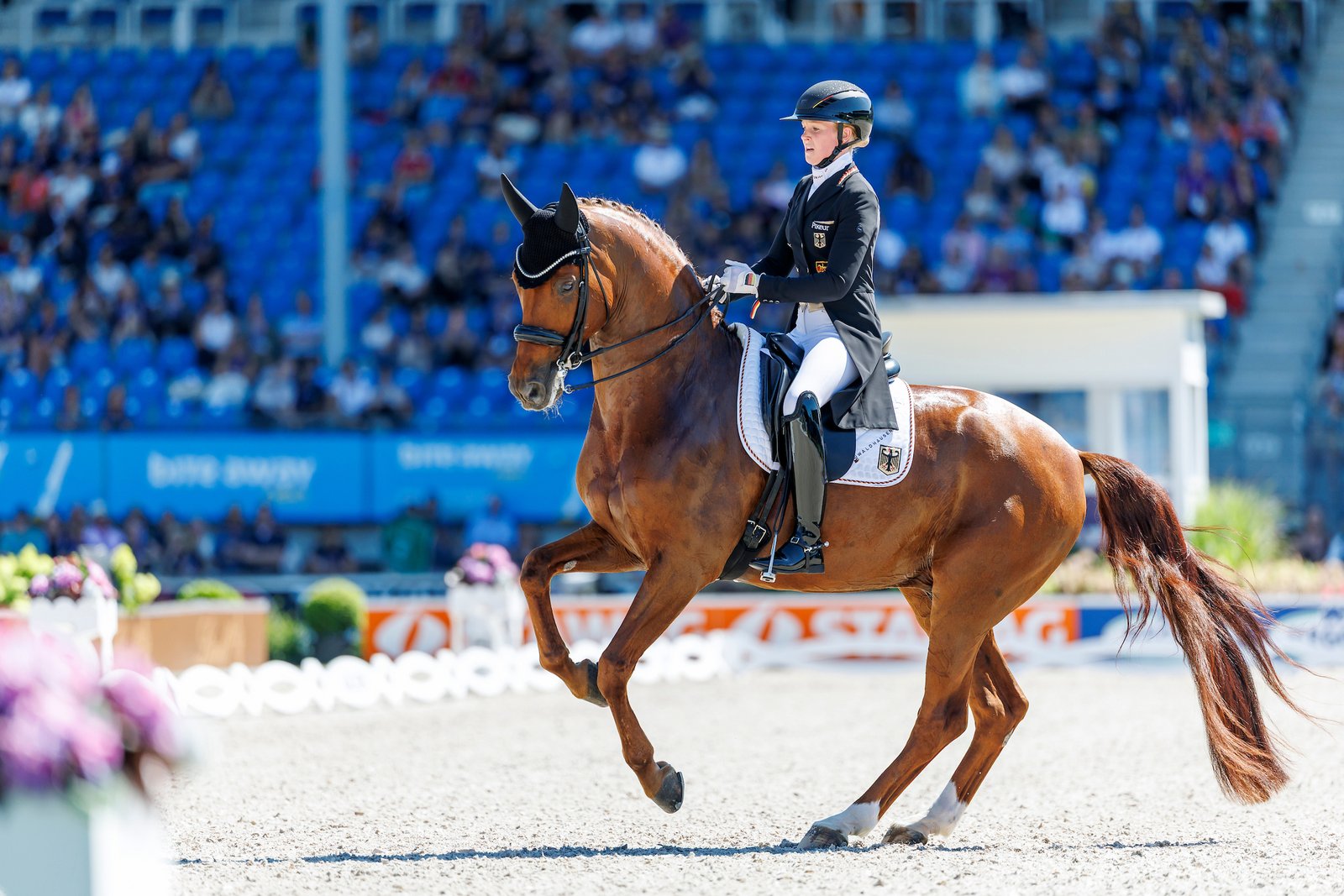
The pair changes were perfectly timed, with the fifth flying change right on the X. During the strong canter, one could almost sense a hint of caution. Denoix executed the zigzag half-passes far to the left and right of the center line. The 15 single changes—textbook, yet again!
The first pirouette: perfect; the second, almost just as good. A slight flaw in the transition to the collected trot. And then the final centerline: an absolutely world-class passage, piaffe, and passage all the way to point G. 79.294—a new personal best. Katharina Hemmer admits that she was moved to tears during the final meters.
But otherwise, I was completely focused: “I’m totally focused on the horse and try to instill a sense of security in him. I think that worked out well today. Even if his attention wandered a bit at times, I’d give him a little nudge so he really knew he could count on me.”
Pressure? Not a chance.
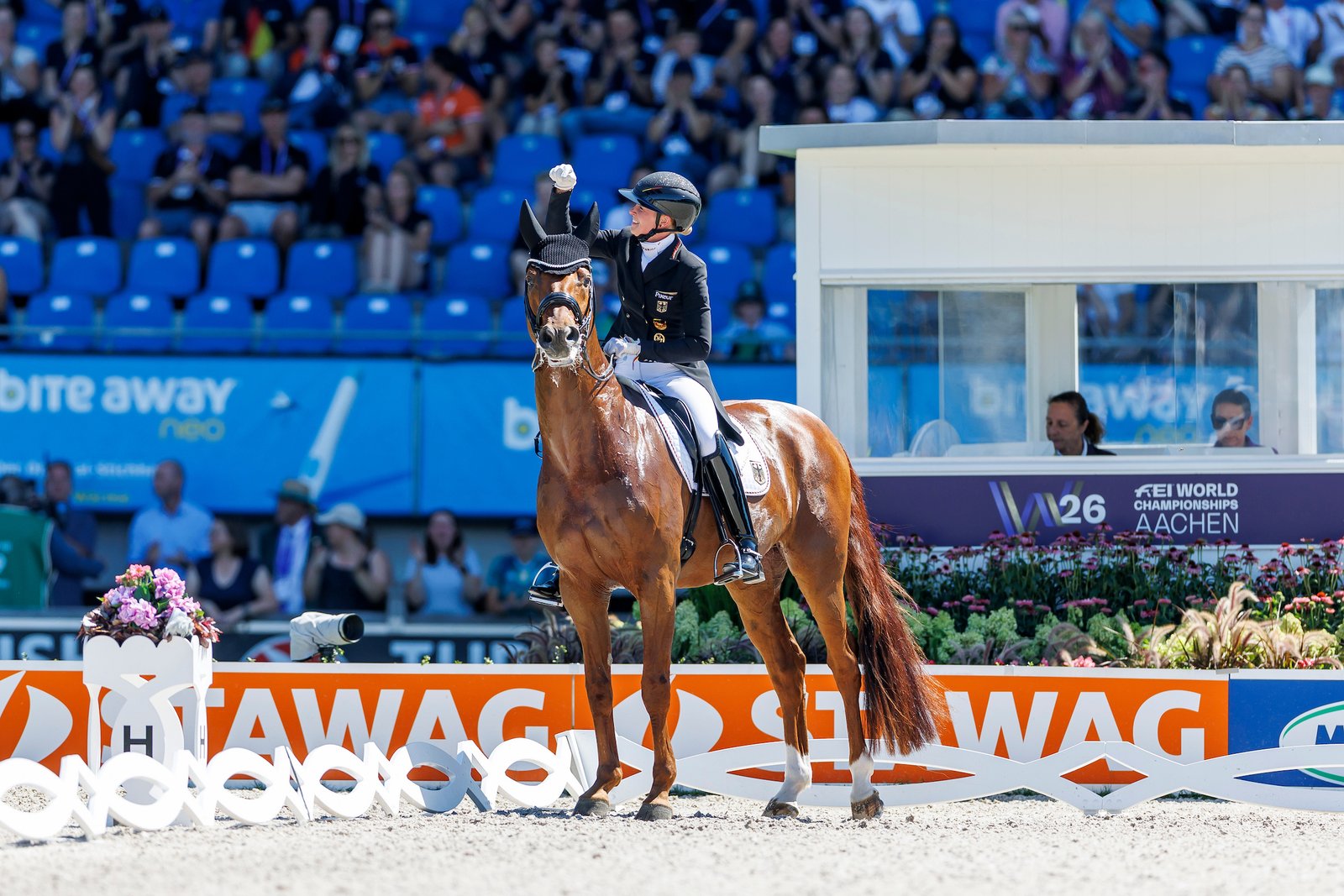
Aachen. Gold within reach—Katharina stays cool. “The guys set the bar really high yesterday, and I already thanked them yesterday. You took a lot of the pressure off for today. But luckily, I don’t really let pressure get to me anyway.”
After the ride, Katharina Hemmer was clearly ahead of Carl Hester, who showcased Fame in top form during his farewell performance from championship competition.
Carl Hester and Fame
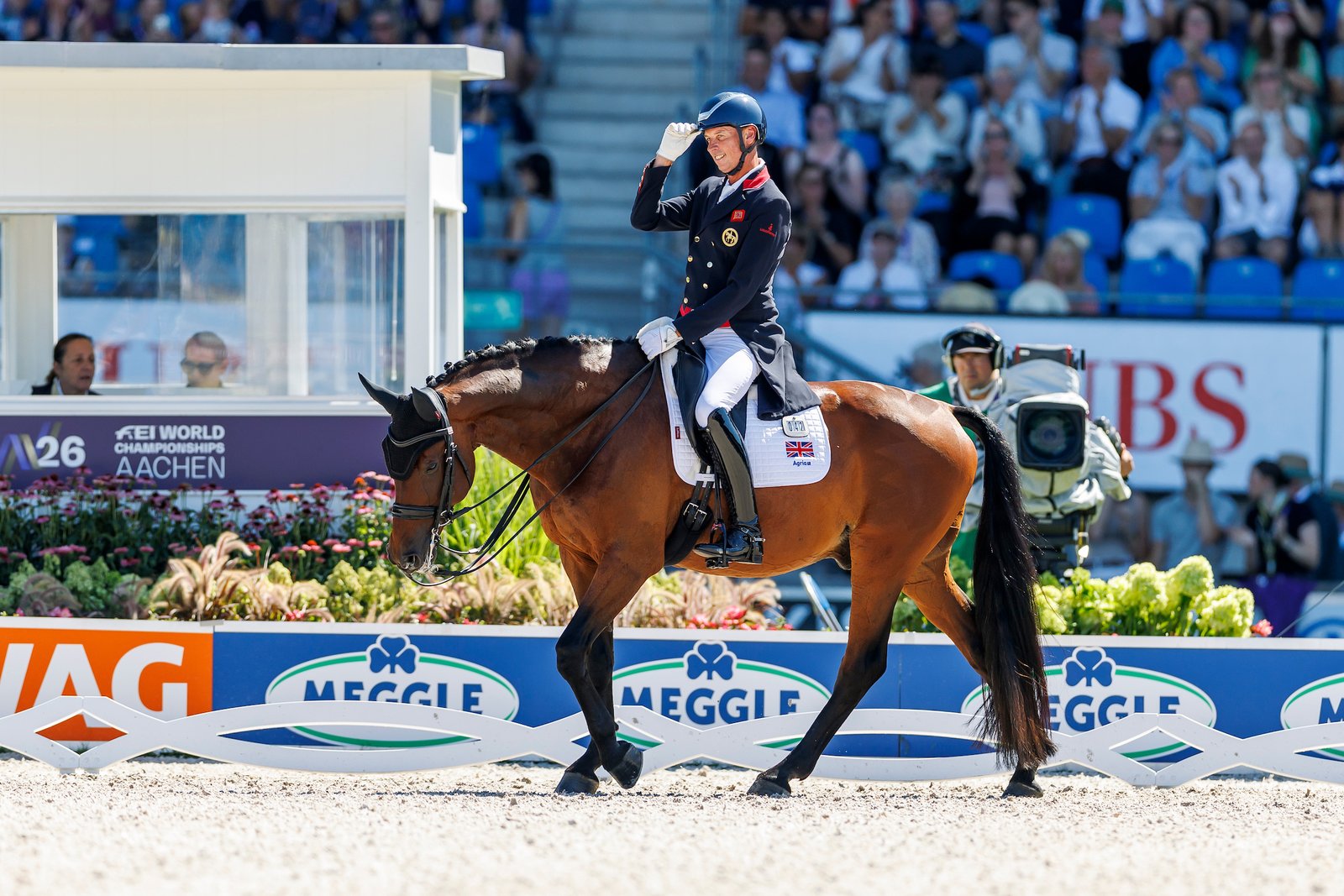
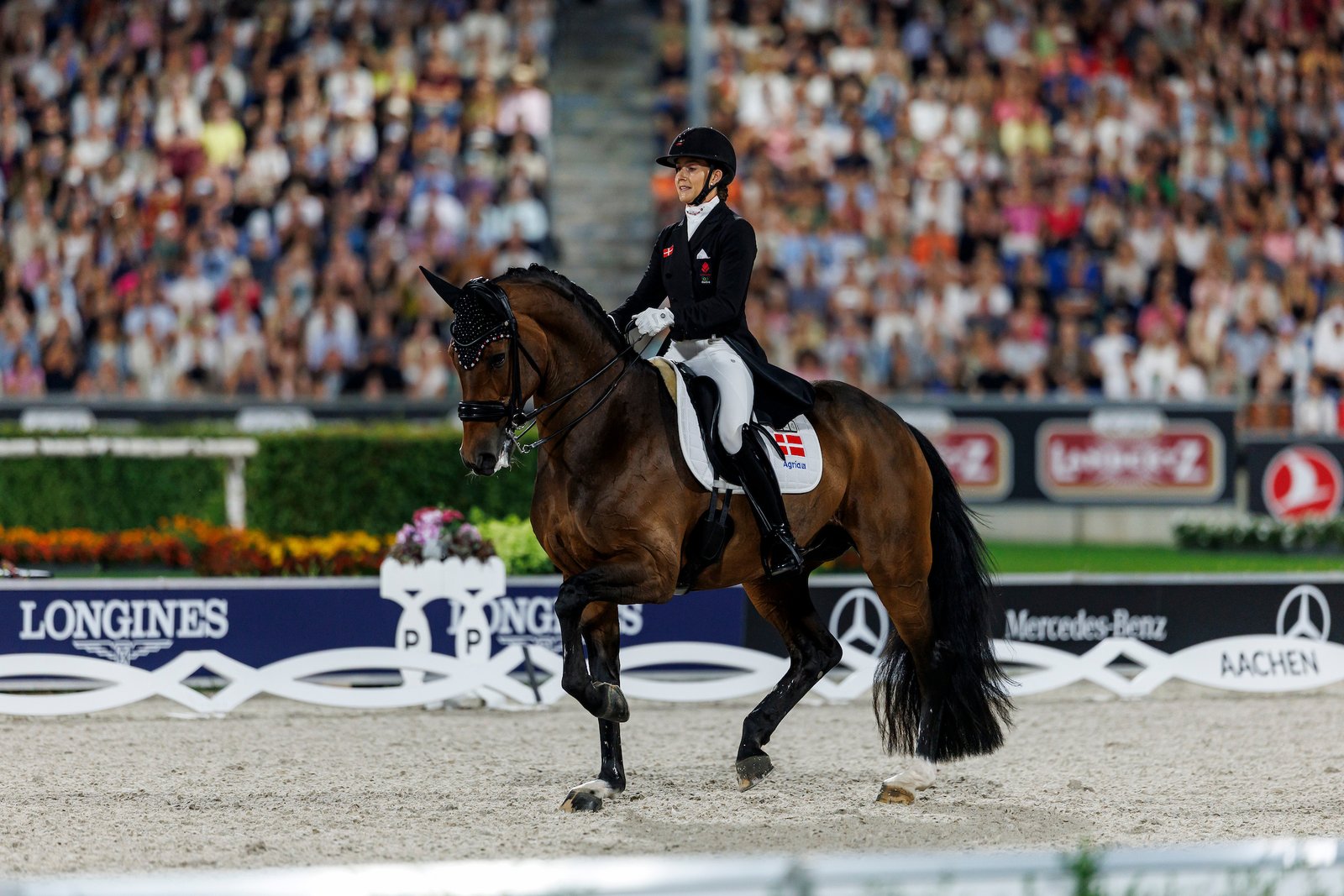
Carl Hester trotted lightly once more before cantering into the arena. The son of Bordeaux has a tendency to move too tightly. Hester seems to have worked on that again. Rarely did the gelding slip significantly behind the vertical with his forehead-to-nose line. The backing up was one of the best of the day. The first piaffe was confident and precise, though the neck was a bit tight at the end. Although the strong walk was executed in a clear four-beat rhythm, a bit more overreach would have been a nice touch for this experienced pair.
In the passage, one would have liked to see more powerful push-off from the hind legs. The transitions between two-beat gaits were confident, but in a strong canter, the KWPN gelding could have shown even more extension. At a collected pace, the rhythm was sometimes borderline. It made one mentally click one’s tongue a bit.
Hester Highlight
The absolute highlight of the ride: the two canter pirouettes. It’s hard to imagine them being any better. Performed on a very tight circle, without bracing, with clearly bent hocks. 77.314 percent—crucial points for Team GB.
Daniel Bachmann Andersen and Flash Gordon
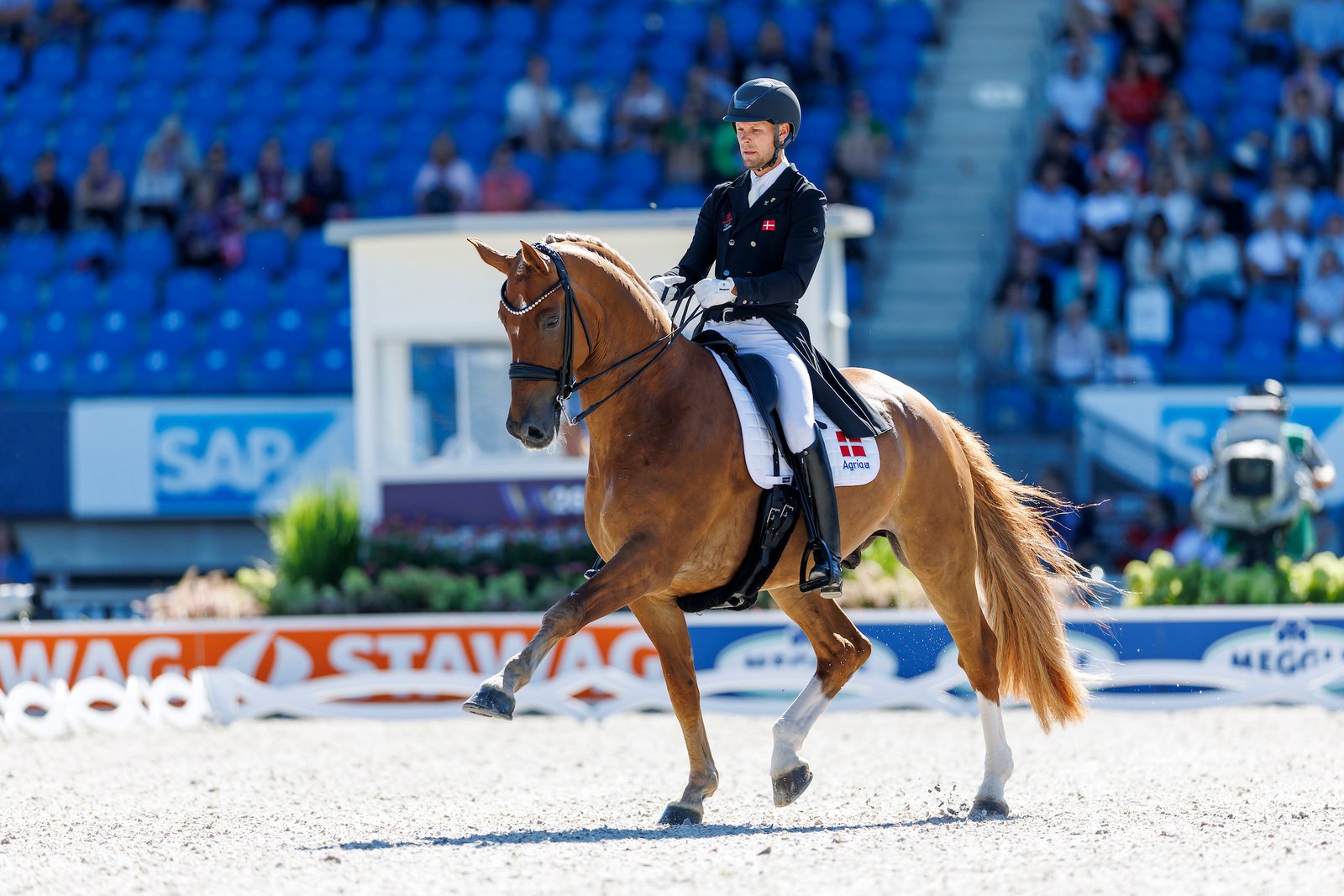
Daniel Bachmann Andersen and Flash Gordon from Oldenburg have been a team for less than two years. But judging by how polished their round—the pair’s championship debut—looked today, it was hard to believe. It was only their fifth international Grand Prix together. And they finished it with a personal best.
’s Potential
The gelding has continued to develop from competition to competition. Daniel Bachmann Andersen is one of those riders who consistently succeeds in producing championship-caliber horses through his collaboration with Nathalie zu Sayn-Wittgenstein. With Flash Gordon, it seems he has achieved this in record time. This outstanding chestnut is still “a work in progress.” When it comes to piaffes and passages, he may still occasionally slip slightly behind the vertical with his forehead-to-nose line. But the impulsion comes from behind, and the Fiderbach son is carrying himself better and better.
The transitions leading into the piaffes, which still had a slight forward momentum, leave you wanting more.
The pair lost points in the walk. The chestnut horse should have stretched out more and taken more expansive strides. The walk also wasn’t entirely free of tension, which was certainly due to a lack of experience and the stadium setting.
Just shy of an 8 in many canter exercises
The pair demonstrated confidence and expressiveness in their canter. From very well-timed, straight, and uphill double and single changes to a left pirouette rated “extra good.” The final piaffe could have used two or three more strides. With a score of 74.876 percent—a personal best—Bachmann Andersen put Denmark back in the medal race.
The rising stars of the Netherlands
—
, Dinja van Liere, and Mauro Turfhost—are not just newcomers to Dutch sports. They could also be the wild cards for the dressage team from the neighboring country.
At nine years old, the stallion is the youngest horse in the field. His youthfulness is evident in his liveliness and enthusiasm for movement. On the other hand, the pair also impress with their confidence in the dressage movements. Whether in the elastic, powerful trot or in the half-passes—even if there was a moment at the end when one might have wished for a bit more suppleness in the jaw. The backing-up was executed very well; the cue to break into a trot came a split second too late. These were all minor details in a ride that was more than convincing, even in the highest-level collected movements.
Everything was there, and much of it was already very well developed
The pair performed their first piaffe in the arena. Dinja van Liere didn’t overdo it; her approach was rather understated. This tactic gave the performance its special charm. On Hermes—with whom she stood on the podium at the 2022 World Championships in Herning—things had usually looked quite different. Hermes was the obedient tin soldier; Mauro Turfhorst is a solo dancer.
This was also evident in how relaxed the Zonik son looked as he moved at a strong walk across the diagonal. To earn an 8—and scores of this caliber are certainly within reach for this pair—the horse could have taken a slightly longer stride. The extension from the shoulder, however, was exemplary.
During the second piaffe, the stallion hesitated once. After the first few steps, however, the black horse quickly found his rhythm again.
Canter? Great!
The positive impression from the trot sequence carried over into the canter: the flying changes were beautifully executed with good forward movement, and there was no tail swishing. In the strong canter, there was a bit of a “crosswind from the left” at the end of the diagonal. Perhaps Dinja van Liere could have initiated the first piaffe in a slightly more collected manner. But here, too, the potential of this elegant stallion was clearly evident.
With a clearly defined passage and a smooth transition into the final piaffe, the Dutch duo made another strong impression on the final center line.
Literally in the final meters, the pair made their only mistake. Just before coming to a stop, there was a misstep.
The fact that Danish judge Kurt Christensen scored the ride at just 71.848 percent caused the first stir when the judges’ scores were announced at this World Championship. With a score of 74.161 percent, this young pair has sent a strong message ahead of L.A. 2028.
Interim Results: Dressage Grand Prix, World Championships in Aachen
Three Horses Disqualified
Article 424.5.6.2 of the Federation of Equestrian Sports (FEI) Rules is commonly known as the “blood rule.” If the steward, who inspects the horse’s mouth and flank area after each ride, finds traces of blood, this results in disqualification.
That was the case for two horses in the Grand Prix, the team competition at the World Dressage Championships in Aachen.
Wendi Williamson is from New Zealand. Her Hanoverian, Don Vito MH, was born in New Zealand. This pair, along with Jale Ibrahimzade from Turkey—who trains with Morgan Barbançon and had ridden the 18-year-old Hexagon’s Double Dutch—had to withdraw from the competition after the test due to blood in the horse’s mouth. The chestnut stallion competed internationally with Dutch rider Thamar Zweistra until February 2023.
Dreamboat by Voice entered the arena representing Thailand and Suphakamol Vuntanadit. Vuntanadit lives in Belgium with her sister. She honed her riding skills at the Bartels Academy in the Netherlands. The pair was withdrawn from the competition due to lameness.
Similar posts