Qualification of seven-year-olds at the World Championships for Young Dressage Horses in the United Kingdom; four horses eliminated under FEI rules
World Championships for Seven-Year-Olds: Dujardin’s “Secret Agent” Wins, Four Horses Eliminated
 from Dominique Wehrmann
 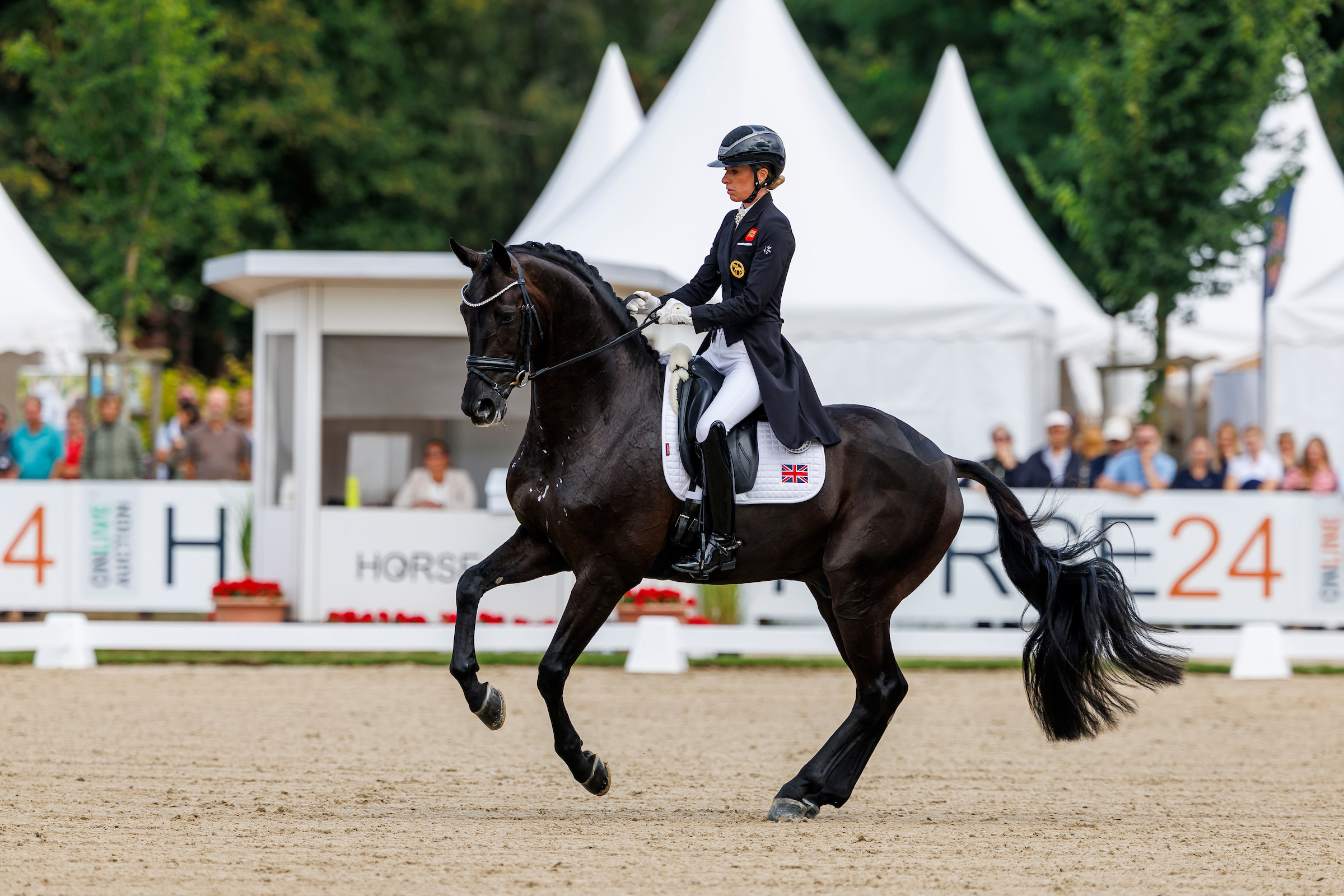 Charlotte Dujardin and Secret Agent, one of seven (!) Secret offspring in the seven-year-old qualifiers.
Photo: Sportfotos-lafrentz.de
Charlotte Dujardin and Secret Agent, one of seven (!) Secret offspring in the seven-year-old qualifiers.
Photo: Sportfotos-lafrentz.de Even among the six-year-olds competing in the 2026 World Championships for Young Dressage Horses in Verden, four horses were eliminated—two in the qualifiers and two in the Small Final. This was due to irregularities in their movement patterns.
Blood Twice, Manipulation Twice
Today, in the qualifying round for seven-year-olds, four of the first twelve competitors were eliminated. However, all four had received scores and were therefore still able to complete the test. They were subsequently eliminated following intervention by the stewards. Upon inquiry with the International Equestrian Federation (FEI), we received the following explanation:
“With reference to your inquiry regarding the FEI WBFSH Dressage World Breeding Championship for Young Horses (World Championship for Young Dressage Horses), we would like to inform you that during the equipment checks following the competition in the seven-year-old class, the FEI Stewards discovered issues that required further review by the Ground Jury.”
Following this review, four riders were disqualified in accordance with FEI regulations.
Two riders were disqualified in accordance with the FEI rules on equipment in dressage (Section 9.4); this rule pertains to artificial adornments on the horse as well as the use of substances or practices that could conceal an existing wound or injury.
Two additional riders were disqualified in accordance with Article 424.5.6.2 of the FEI Dressage Rules, which stipulates disqualification if fresh blood is found in the horse’s mouth, around the mouth, or in the area of the spurs during the post-competition inspection.
The FEI does not comment on individual cases or the riders involved in connection with ongoing competition matters. Decisions are made by the panel of judges after reviewing the facts of the case and in accordance with FEI rules and established procedures.
“The FEI rules provide a clear framework for safeguarding horse welfare, protecting the integrity of competition, and ensuring fair conditions for all riders.”
What exactly happened?
One of the riders who was eliminated was Adrian Muñoz Jurado, the Spaniard who worked for many years as a trainer in Aubenhausen but is now self-employed. He rode the Hanoverian gelding Vitaliano by Vitalis. Although the horse has German owners, he was bred in the UK and was therefore part of the British World Championship team. The pair were eliminated by the steward following the bit check.
The 26-year-old reports: “Vitaliano had a small wound below his canine tooth on the side, facing toward his incisors. The bit does not touch that area. The steward was also shocked at how he could have sustained a wound there.”
It might have happened while he was being bridled, but the Spaniard isn’t sure. “We’ll have the vet take a look at it after the weekend to figure it out.”
For him, it was his first appearance at a World Championship for young dressage horses, after making his championship debut at the U25 European Championships last year. The World Championships are now over for him. “That’s a shame, but it could have been much worse—namely, if the injury had been caused by the rider’s actions,” he says.
The other horse that was eliminated due to blood was Fibonacci, owned by Sophia Boje Obel Jørgensen. According to the Danish delegation, the cause was a bleeding insect bite behind the saddle pad.
Creme was found on the pastern of the KWPN stallion O’Toto, owned by Diederik van Silfhout. Osaka P, who is also registered with the KWPN, was disqualified due to the FEI rules regarding equipment in dressage (Section 9.4).
British Winner
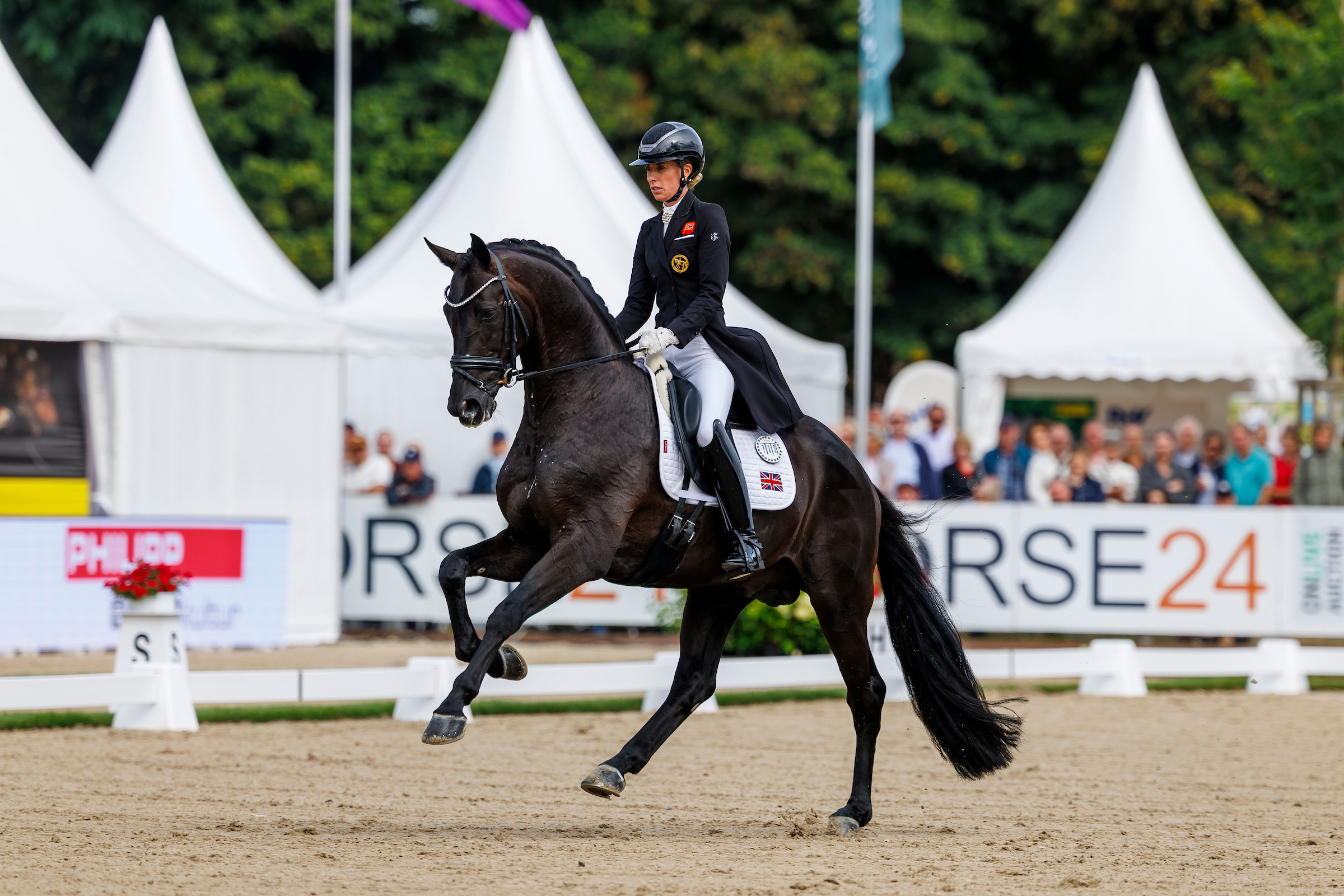
That left 37 horses that had completed the test, and the best of them was the British Champion, Charlotte Dujardin’s Hanoverian stallion Secret Agent by Secret-De Niro, bred by ZG Nicole and Friedrich Sievers and owned by the rider. She purchased the elegant black horse as a two-year-old, when he was not yet licensed, and it’s easy to imagine what she saw in him.
Secret Agent trots with great elasticity, a long stride, responsive mechanics, and a natural tendency to move uphill. However, the long-legged and rather narrow stallion still seemed to be struggling with his balance today. In particular, the first half of the trot sequence lacked evenness and a steady rhythm. After the first trot sequence—featuring a half-traversal to the left, a volte, and shoulder-in to the right—the walk sequence follows.
His collected walk was noticeably off-beat. Even in his strong walk, the stallion couldn’t find his relaxation today and repeatedly called out for his friends in the warm-up ring. As a result, his stride length was also limited. The trot sequence went better on the left rein.
The canter was performed on a similar scale to the trot. Here, the stallion was already responding well to being guided back. The first pirouette was still a bit stiff, but the second was better. The flying changes—both individually and in a series—were already executed quite straight and confidently, though still somewhat stiff at times.
The technical scores were judged by Agnieszka Majewska of Poland for Group B and Mats Eriksson of Sweden for Group B. The former awarded 76.607 percent, and the latter 73.571 percent. Elke Ebert was responsible for evaluating the basic gaits, suppleness, and perspective in Class C. She awarded a 9.2 for the trot, a 7.0 for the walk, a 9.0 for the canter and responsiveness, and an 8.9 for perspective. Final score: 80.645 percent.
Top Team
Charlotte Dujardin later declared her love for her horse: “I truly love this horse—him and his potential, his incredible character, and the way he responds to training. I’ve never ridden a horse that’s so naturally supple and elastic. He makes me smile every day.”
Although Secret Agent has already been crowned British Champion this year, a setting like the one in Verden is new to him. That said, he was remarkably well-behaved, not only during the competition but also at the award ceremony, where he looked around with curiosity but immediately let his rider calm him down. She says, “The great thing is: we have such a strong partnership. I trust him 100 percent, and I knew he would give it his all out there in the arena.”
She’s very excited about today’s competition. But that’s just a small piece of the big puzzle. Dujardin’s goal with Secret Agent is something else: “Grand Prix competition.”
Silver Medalist on Track for Silver
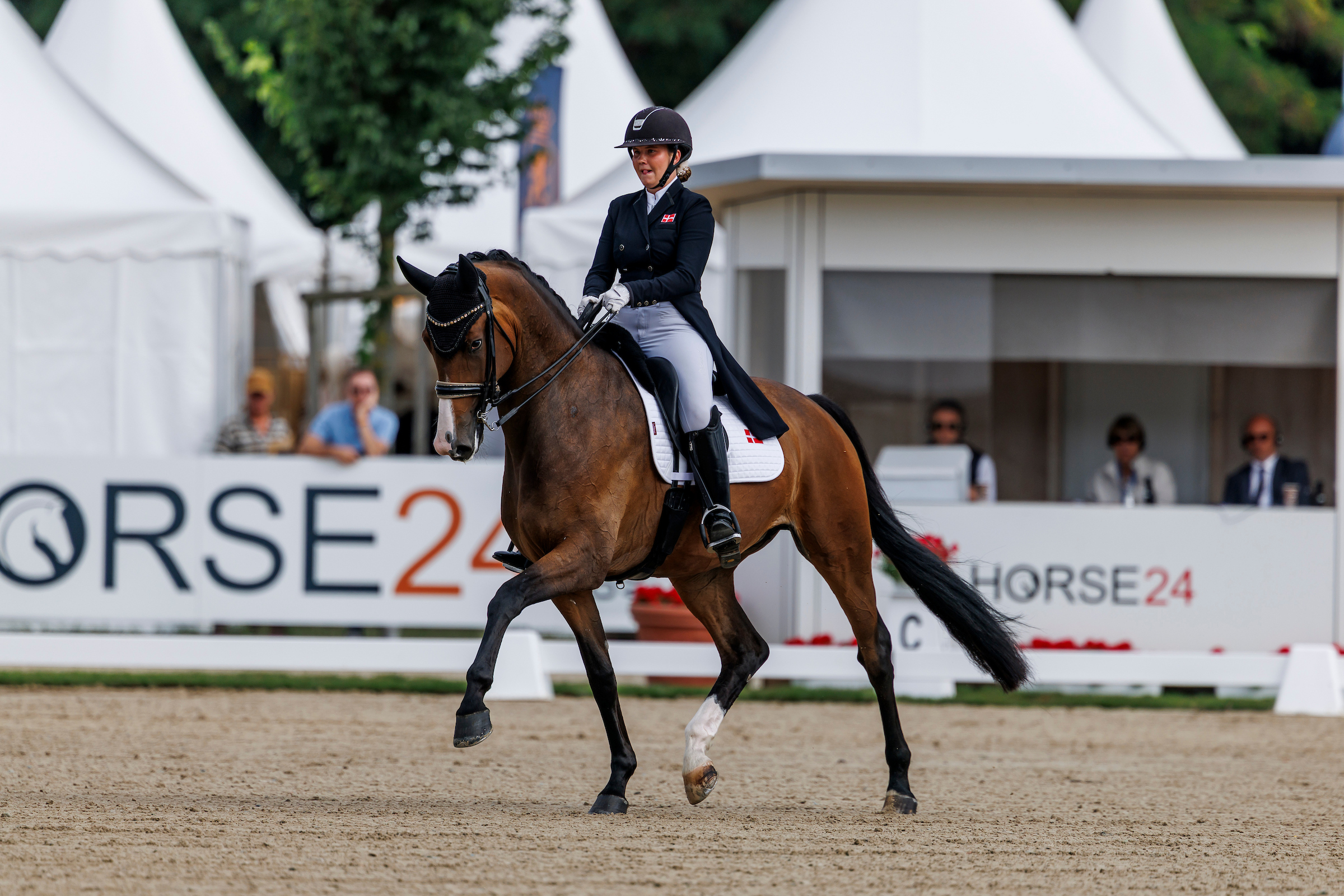
Last year, the Danish warmblood mare Brandtbjergs Divya by Hesselhøj Donkey Boy-Don Olymbrio L had already won a silver medal, at that time with Anders Sjøbeck Hoeck in the saddle. Since then, the mare—bred at the Buhl family’s Brandtbjerggaard stable—was sold as a young horse to 20-year-old Theresa Rosenkilde, a two-time European Junior Championships medalist, who also presented her today.
Brandtbjerg’s Divya is characterized by a light-footed yet powerful trot with plenty of drive and natural cadence (8.8). Theresa Rosenkilde managed to keep the mare securely in response to the driving aids and, despite not always handling the reins calmly, presented her with a beautiful lateral profile. The pair carried the momentum from the trot very nicely into the lateral movements, which were slightly more supple to the left than to the right.
The collected walk was certainly in rhythm, but a bit loose. In the extended walk, the mare should have dropped her neck more and sought more contact in order to achieve even greater reach (8.8).
At a canter (8.6), the mare did not yet seem fully responsive and appeared slightly stiff in the back. As a result, her pirouettes were not very centered. Although the changes were mostly executed straight and confidently, they were flat. When transitioning from the strong canter on the diagonal, Divya “stole” the change from her rider.
Combined with an additional 8.8 points each for transparency and perspective, in addition to the technical scores of 71.607 and 73.750 percent, the pair’s total came to 80.140 percent.
The Netherlands in third place
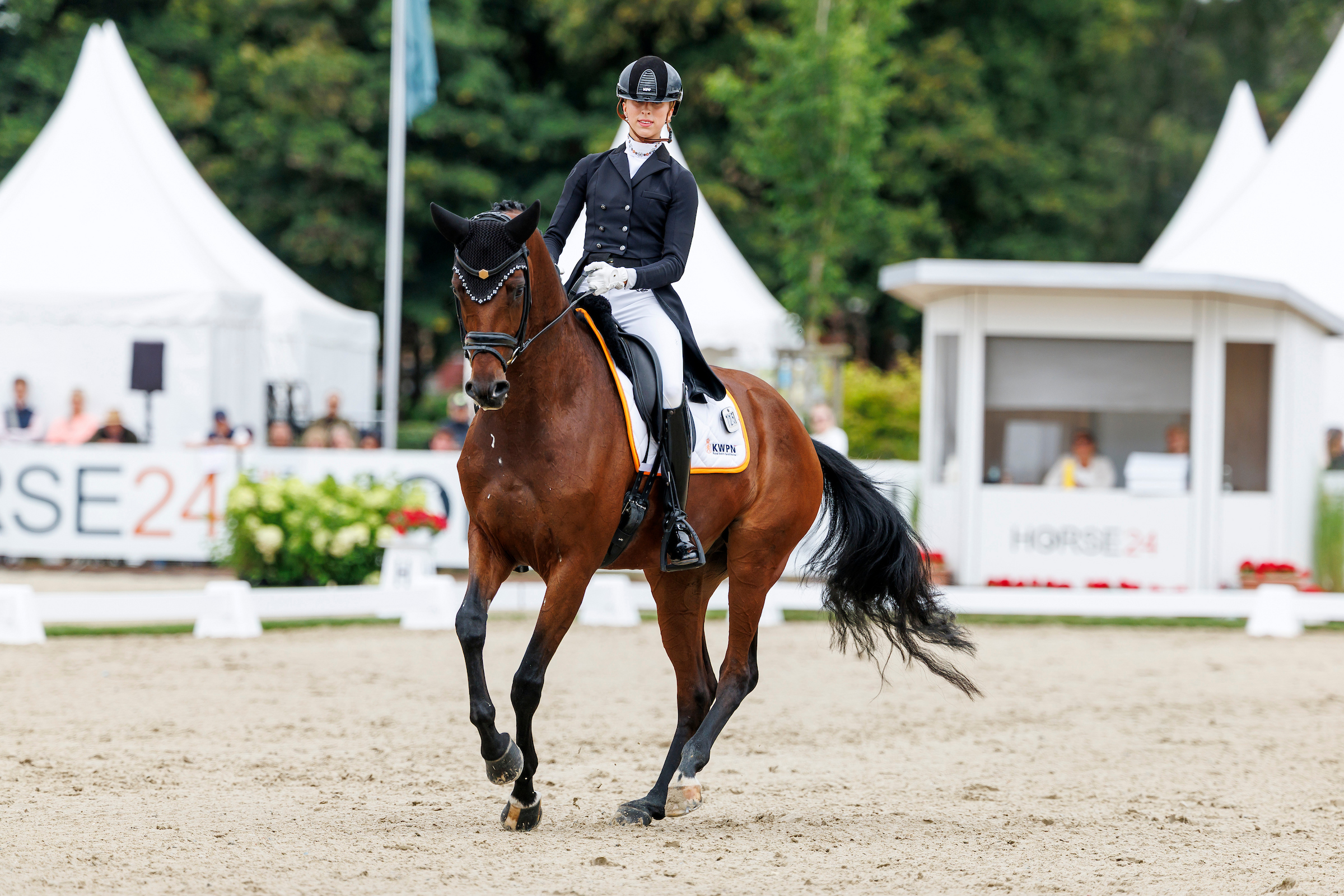
Until shortly before the end of the competition, it still looked like a German pair would finish in the top three, but that was prevented by the KWPN mare Odi Murona by Farell-Johnson (breeder: J.J.M. van de Broek, trainer: BG Van Belois) and Tessa Kole, representing the Netherlands.
The mare impressed with her light, dance-like movements and, in harmony with her rider, presented a very elegant overall appearance—a quality further enhanced by the confident, stable contact that characterized their performance, particularly during the trot sequence (8.4). The mare does not have the very largest stride in any of her three basic gaits, but she presented herself as very rhythmic and diligent, already very well collected, confident in her balance, and highly willing to carry her weight—a quality that was particularly evident in her centered, actively springing pirouettes. The judges awarded an 8.5 for the walk and an 8.8 for the canter. For suppleness, the pair earned a 9.0, and Elke Ebert also awarded a straight “very good” for prospects. Final score: 79.593 percent.
Secret Again
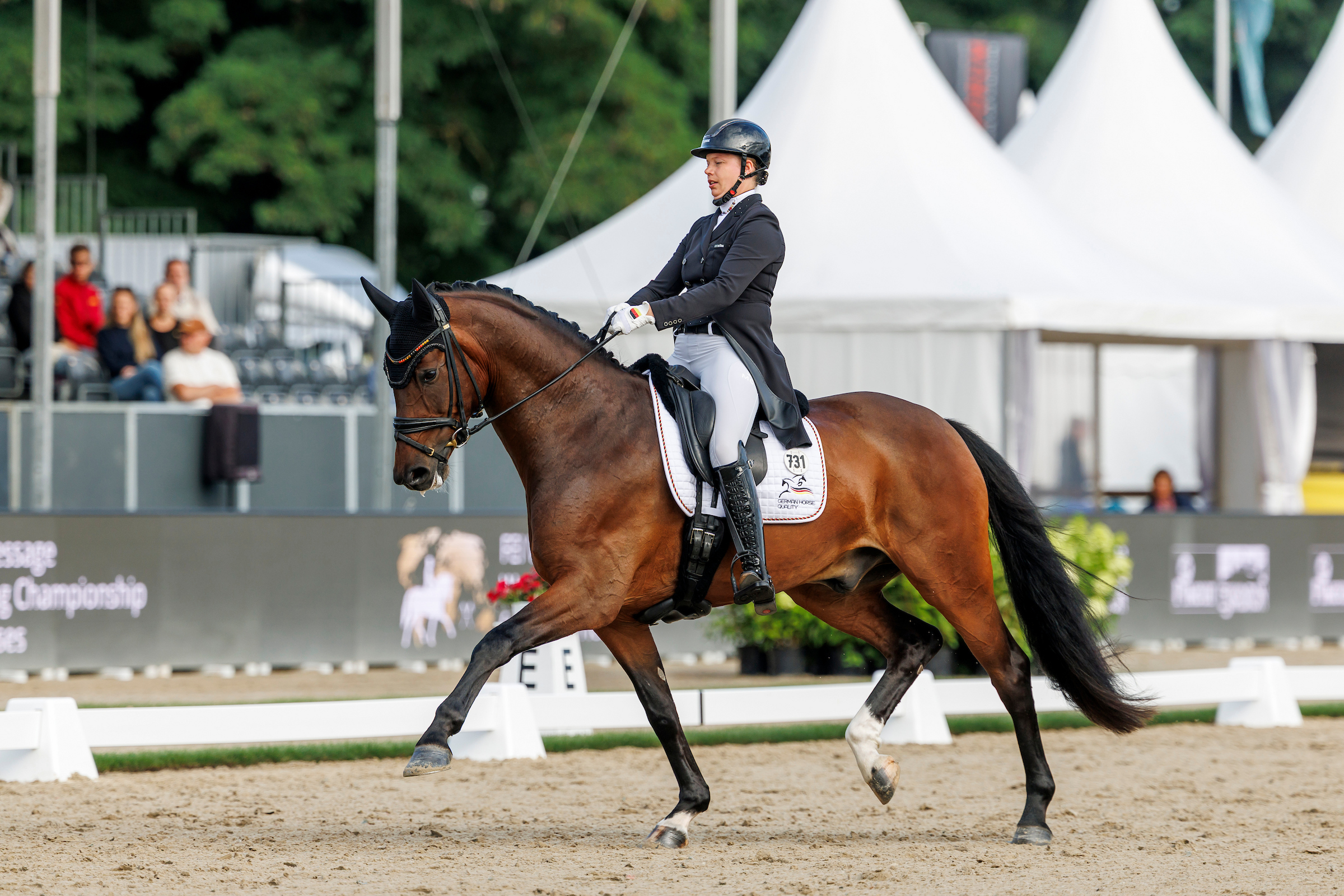
With two sons among the top four and seven offspring in the field overall, there’s no question that Secret, the former World Championship silver medalist, is one of the defining sires of this World Championship. In addition to the winner, he also sired Ann-Christin Wienkamp’s Oldenburg horse Schatzmeister MZ OLD. Last year, Wienkamp and the bay horse—bred by Ewald Grotelüschen out of a De Niro dam—already placed fifth in the final. They kicked off this year’s World Championships in fourth place with a score of 78.847 percent.
At a trot, this bay horse—still registered as a stallion but now gelded—impresses with his relaxed, flowing stride, unwavering rhythm, and a great deal of elasticity and energy. The extensions were nothing short of textbook-perfect in terms of expanding the frame while simultaneously engaging the pushing and supporting hindquarters. The lateral movements were supple and graceful, with great freedom in the shoulders, and the halts were responsive. Perhaps one might have wished for a bit more forward drive overall in the trot; 8.8.
The collected gait was certainly in rhythm, but lacked collection and nobility. In the extended gait, Schatzmeister extended well to the hand and began to stride, but lost his balance slightly (8.2).
At a canter, the picture is similar to that at a trot—a horse that carries itself with true collection and a supple back, and actively leaps uphill. With great sensitivity, Wienkamp knew exactly how to demand only as much weight transfer in the pirouettes she had carefully prepared as Schatzmeister is capable of providing at his current stage of training. A 9.0 for the canter. All in all, a very nice test with slight tension in the flying changes, which definitely has medal potential if everything goes well. The score for suppleness was 8.6, and for perspective, 8.8.
Dribbler Faces Two-Time World Champion
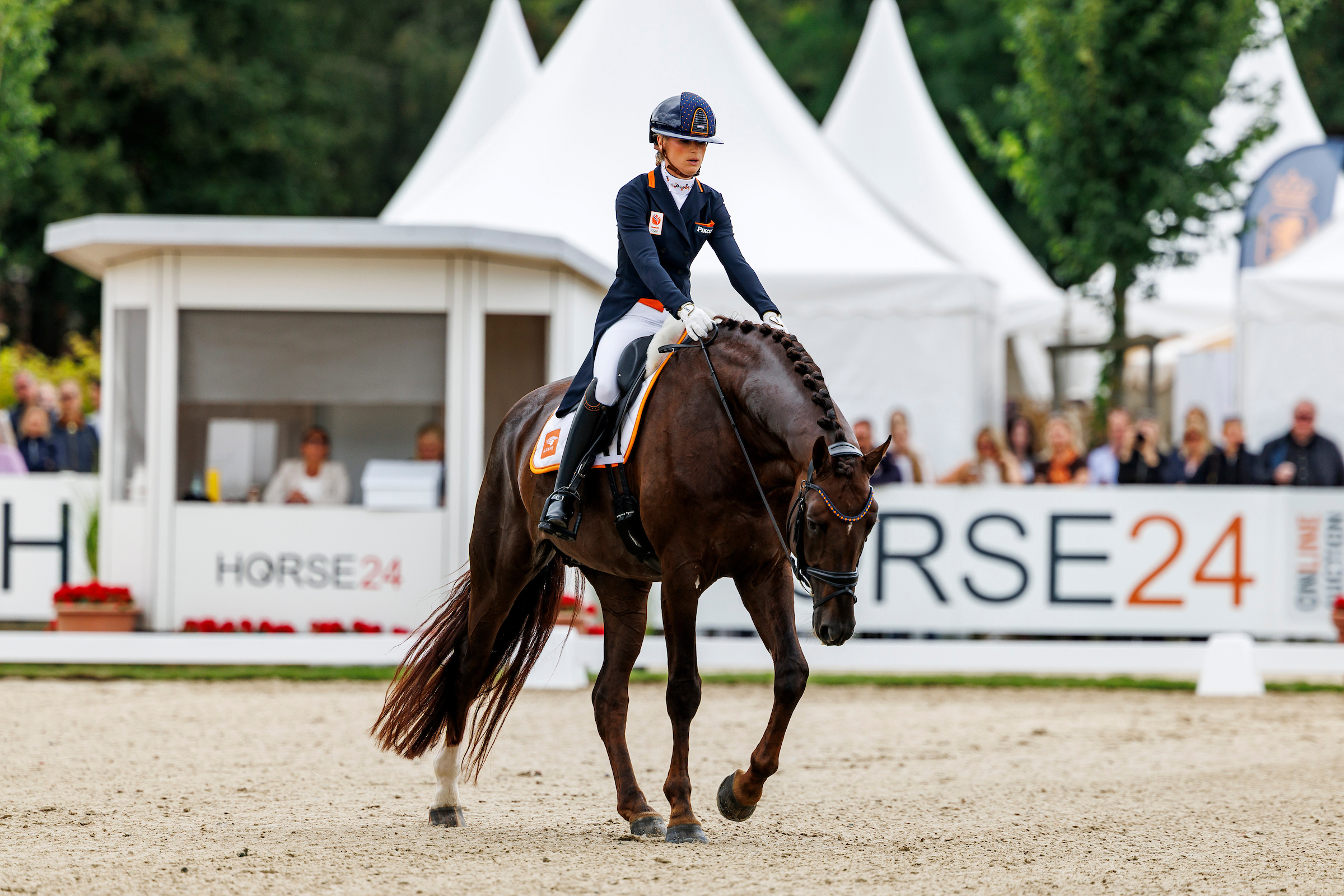
If Schatzmeister is the powerful athlete, the second German horse to qualify directly for the final is the graceful dancer. We’re talking about the Hanoverian gelding Dribbler by Don Martillo-Dancier, ridden by Senta Kirchhoff. The chestnut was bred by Angelika Fitschen and is owned by Kirchhoff’s partner, Henri Ruoste. The pair delivered a very appealing performance characterized by great balance, which earned them seventh place today with a score of 76.436 percent.
In doing so, they left behind, among others, the two-time world champion from previous years, the impressive KWPN stallion Red Viper, ridden by Dinja van Liere. The Romanov son, bred by Coen Kerbert, is significantly behind in his training after being sidelined for six months due to a persistent dental problem. He only managed to qualify for the World Championships at the very last minute. Perhaps that’s why not everything went smoothly for the pair in today’s test, especially during the canter sequence. Scores of 9.0 in trot, 8.3 in walk, 7.8 in canter, 7.3 in responsiveness, 8.2 in perspective, and 75.824 percent overall still earned them eighth place and thus direct advancement to the final.
Charlotte Tollhopf and Galleria’s Fancy Fergie FRH also made it through. The Hanoverian mare by For Romance I – Catoo (breeder: Hof Brüning, owner: Sportpferde Galleria GmbH) and her rider are a well-coordinated team. They were among the finalists two years ago as well. Back then, they placed 14th. Last year, they won silver at the Bundeschampionat. Today, too, the pair delivered a very appealing, confident, correct, and fluid performance, though there was room for improvement in the pirouettes—where she jumped once to the left—and slight tension in the flying changes. The judges awarded 75.511 percent, and it speaks for itself that the mare received scores between 8.0 (walk and canter) and 8.2 in all criteria. This placed them tenth.
Chances in the third-place game
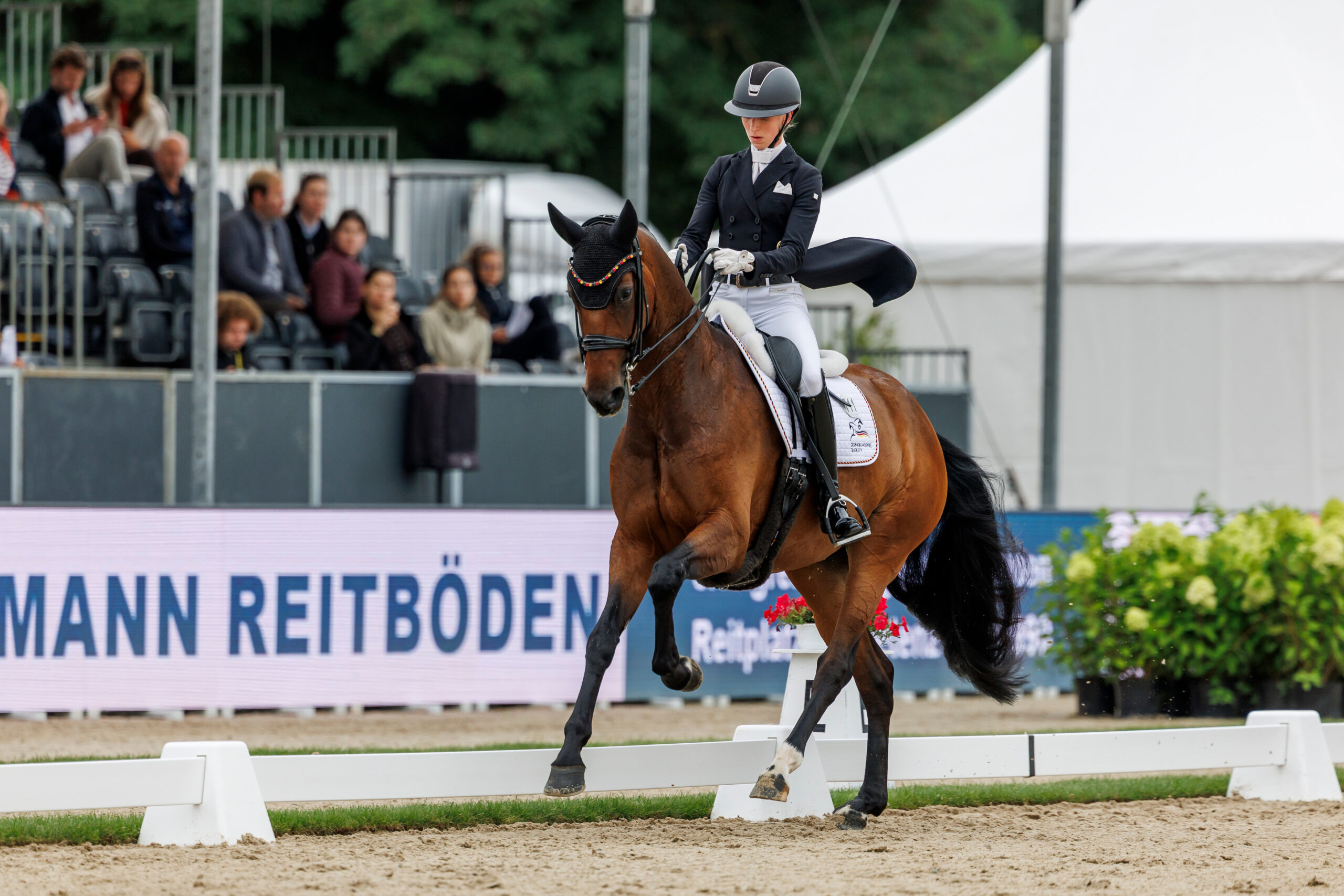
The top three pairs from the small final will advance to the final, joining the top 12 from the qualifying round. In addition, three other German pairs still have a very good chance of competing on Sunday. Nina Verina Braun rode the Holsteiner Sullivan ABN by Secret-Carpaccio (breeder: Anja Nygaard, trainer: Michael Kramarsch) to 13th place with a score of 73.863 percent.
She was followed by the 2024 National Champion and 2025 World Championship seventh-place finisher, Greta Heemsoth’s Felice FRH, a Hanoverian mare by Fürst Samarant – Riverside (breeder: Rene Janzen, owner: Ken Steele, co-owner: Ingo Pape). She scored 73.863 percent.
Last year’s 10th-place finisher, the Oldenburg Escamillo daughter La Jolie SW OLD —bred and owned by Sabine Wehle and, as always, presented by Carina Scholz (72.718)—finished in 15th place.
Among the pairs that—unfortunately—didn’t make it to the finals on their first try were the Swedish duo Lina Dolk and Livia, a daughter of Livaldon. The dainty chestnut mare is certainly not a horse that strides out under the lights and gallops as if she were touching the ground only out of courtesy. But in terms of harmony, proper training, and contentment, they were right up there with the best. Today they placed 19th with 72.052 percent.
Things didn’t go as well today for Leonie Richter and the Westphalian stallion Glamdale WP NRW, bred and owned by ZG Pleines. The son of Glamourdale—out of a full sister to the Bonhomme stallion Maracanà—was one of the horses everyone was eagerly watching as the silver medalist of the W; 2024. Today, however, he seemed a bit overwhelmed by the task. Even Leonie Richter’s exceptional riding skills couldn’t change that. Today, they had to settle for 24th place.
You can find all the results here.
Similar posts