Conclusions from Trakehner Breeding Director Neel-Heinrich Schoof following the Trakehner National Tournament, which featured riding horse competitions held in the traditional format
Two Questions for Neel-Heinrich Schoof, Trakehner Breeding Director and Association Executive Director
 from Dominique Wehrmann
 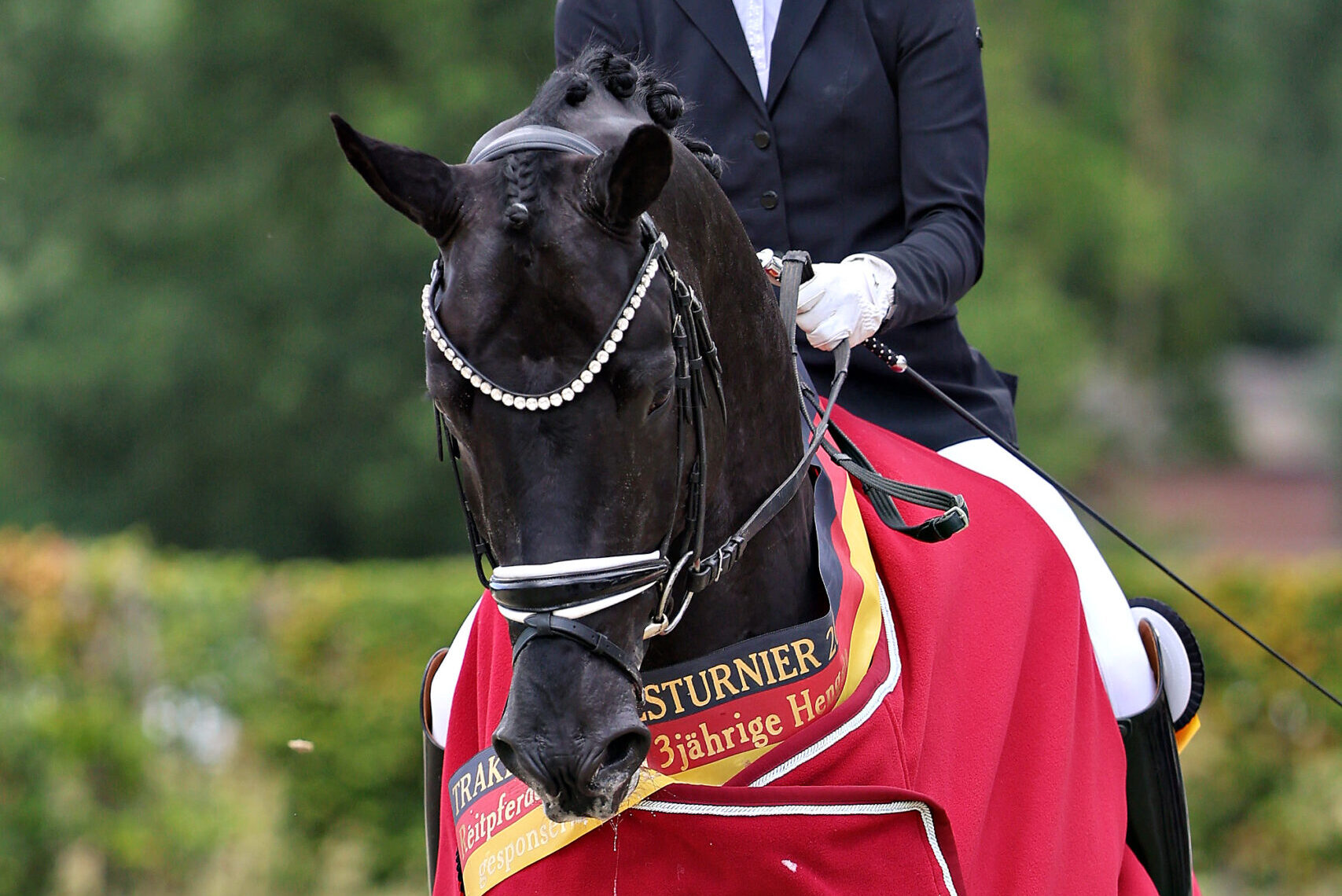 Champion of the three-year-old Trakehner stallions: Hannu Hakoon ND by Scaglietti. Photo: Trakehner Verband/Bauernschmitt
 EQUI PAGES: Mr. Schoof, this year’s National Riding Horse Championships look different from previous years—there is now only one class for three-year-olds, and there is no longer a test with an outside rider for four-year-olds, but instead a Class A dressage horse class in place of an aptitude test, as well as the elimination of the conformation evaluation immediately after the test. Almost all associations have taken this into account and adjusted their championships accordingly. You haven’t. Why?
Neel-Heinrich Schoof: We have decided in our committees that we will not simply abandon a proven model, especially since there is no clear rationale for such a step. The situation we will see at the National Championships is the result of a compromise. Originally, the three-year-old classes were supposed to be eliminated entirely. So an agreement has now been reached on the current format. But we are convinced that the structure of the previous competition system was entirely appropriate for the horses, provided it was carried out correctly. However, the Trakehner Association has also made a minor adjustment in the course of its riding horse championships—this year, we conducted the classes with one outside rider instead of the usual two.
It is particularly important to us that the riding horse classes remain a single unit consisting of the presentation under the horse’s own rider, the conformation evaluation, and the test with a guest rider in the final. This is informative and interesting for spectators and provides the judges with important insights. The judges at the Trakehner National Tournament confirmed this once again and expressly welcomed our approach.
And what do you think of the new rule that three-year-olds in Warendorf now only run once?
Here, too, I am of the general opinion that the original model—with a preliminary test and a final—was a good one. In the past, this allowed one or two horses in the final to better demonstrate their fundamental qualities than they had in the preliminary test, where environmental factors often had an even greater influence on their presentation. For evaluation and ranking, this was undoubtedly the better system. What’s far more important, however, is the manner of presentation; if the focus is on this, we’re on the right track.
For me, a completely different aspect is important—one that receives too little attention in the entire discussion—and that is the horse’s individual development; that’s what we should focus on. There are horses that mature late, for whom starting in competitions at age three isn’t suitable; other horses, on the other hand, need to gain experience—for example, for their mental development—and in these cases, participating in several competitions can be beneficial for their further training. If we don’t focus on the horses themselves from a professional standpoint, but instead prioritize short-sighted action, we won’t make any progress.

Ähnliche Beiträge