Denmark Claims a Commanding Victory in the Falsterbo Dressage Nations Cup; Freestyle in a League of Its Own
Cathrine Laudrup-Dufour and Freestyle Put on a World-Class Performance in Falsterbo
 from Dominique Wehrmann
 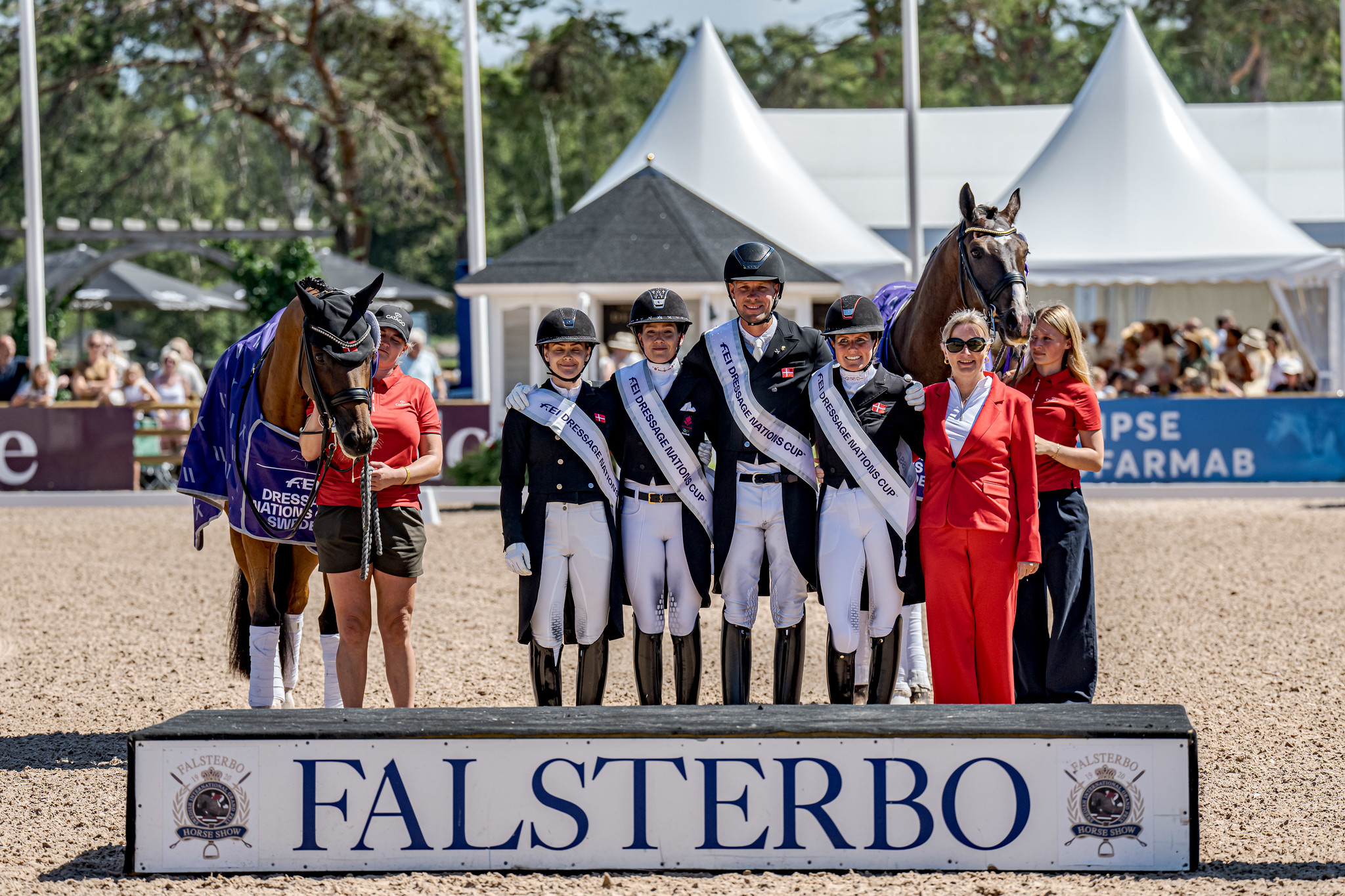 The winning Danish team from Falsterbo. Photo: FEI/Kim Lundin
 If Denmark had competed in Hagen with the same lineup it fielded in Falsterbo at the Dressage Nations Cup, Germany’s victory there would have been far less decisive. Germany scored a total of 231.107 percent in Hagen, Denmark scored 229.653 percent today in Falsterbo—against the host nation Sweden, which finished second with 212.609 percent, followed by the German team with 211 percent and the Netherlands with 207.457 percent.
World-Class Form in Denmark
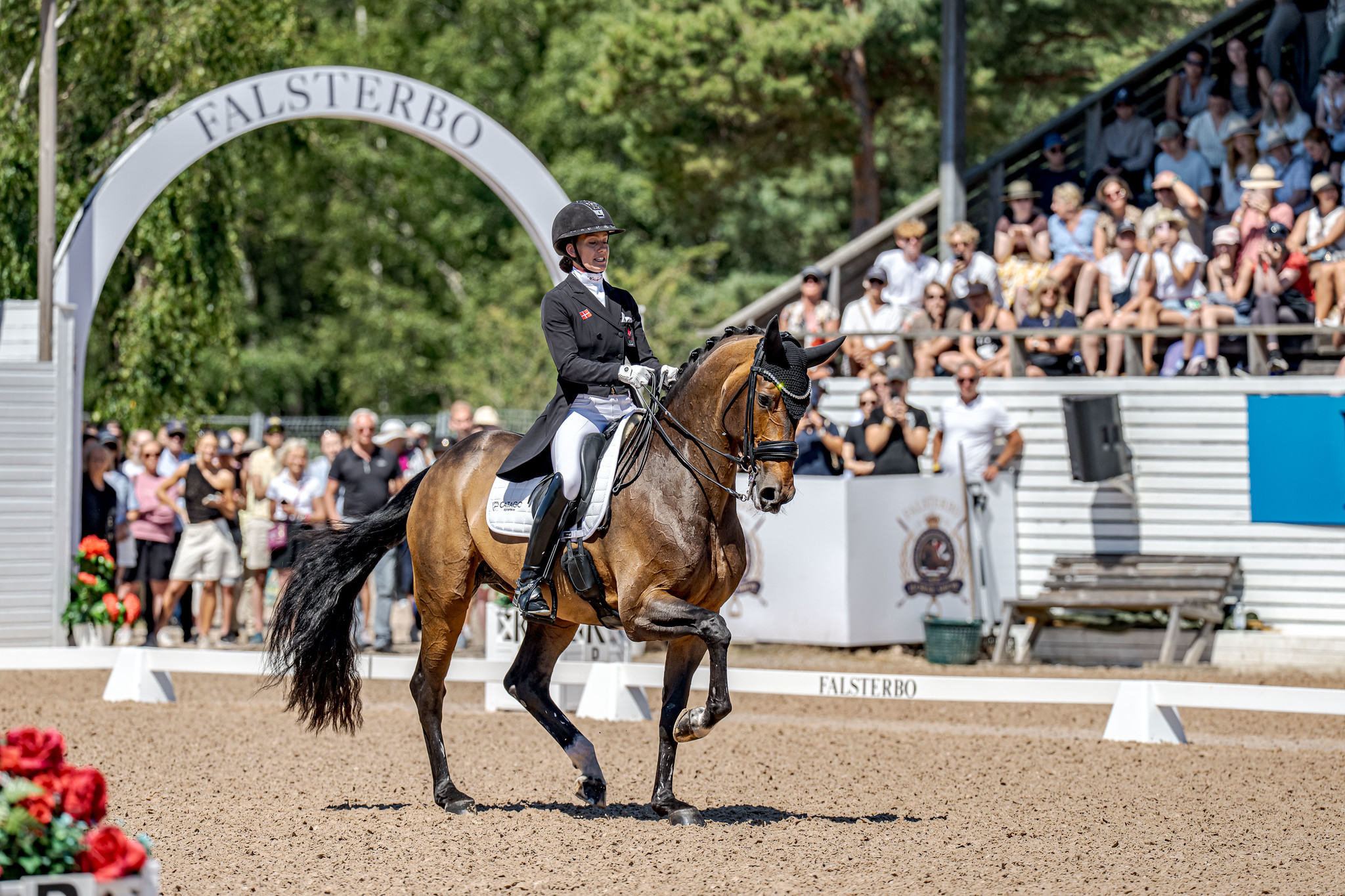
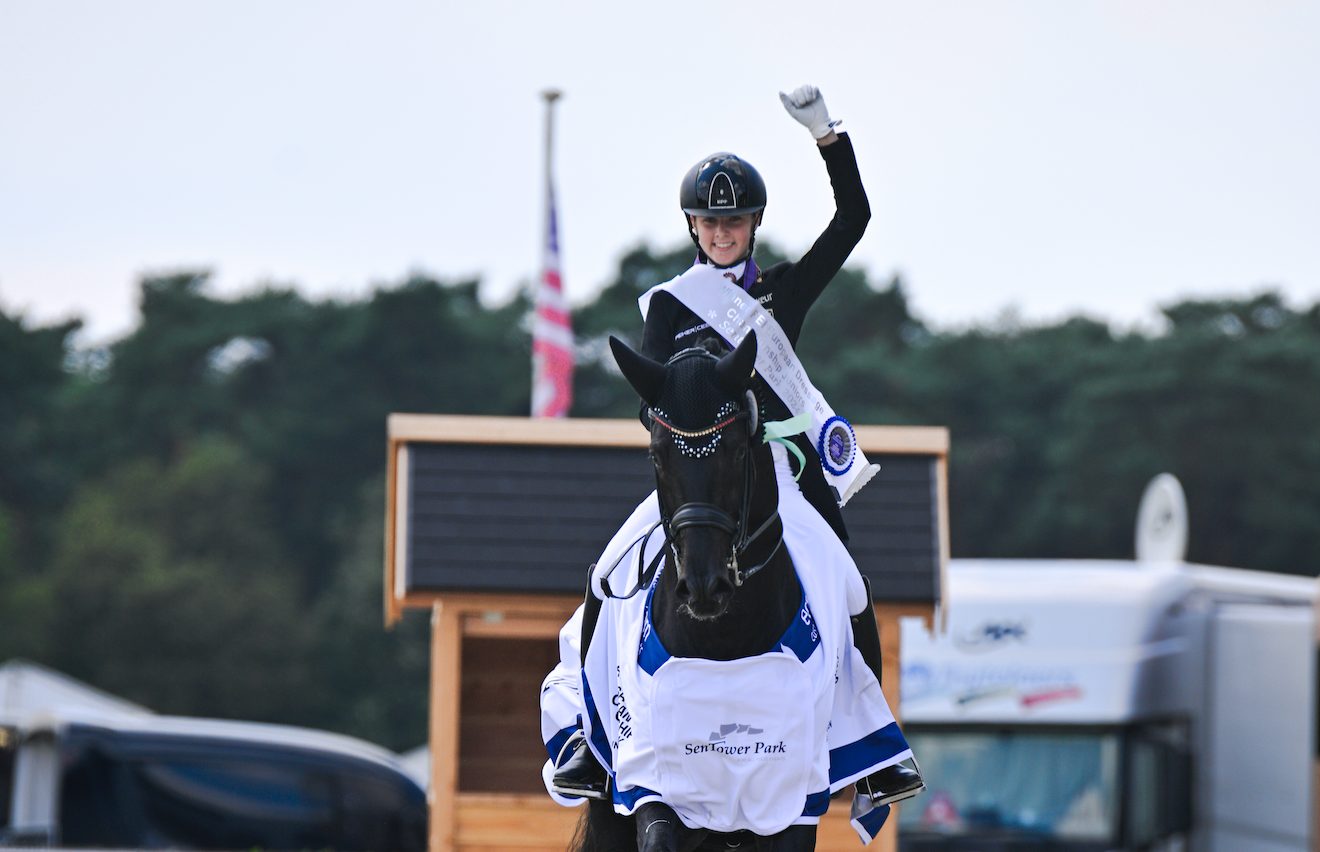
The Danish team was led by Cathrine Laudrup-Dufour and Freestyle, the two individual silver medalists at the European Championships in Crozet, who had already won the Grand Prix there ahead of the eventual European champion, Justin Verboomen, riding Zonik Plus. After today’s ride, one has to say: If the Danish-Hanoverian duo (the 17-year-old Freestyle is, after all, a Hanoverian daughter of Fidermark) can show the same form in the Special and Freestyle at the World Championships that they displayed today in the Grand Prix at Falsterbo, they’ll be very, very hard to beat in Aachen. And rightly so.
In our last newsletter, my colleague Jan Tönjes discussed, among other things, in his editorial the importance of the backward movement as an indicator of suppleness, back engagement, and responsiveness. He referred to Raphael Netz, who—thanks to his beautiful riding—has fortunately made it onto the German team with Camelot. The backward movement is one of the pair’s standout moments. The same goes for Cathrine Laudrup-Dufour and Freestyle. They received scores of 8 or 9 from all the judges today (okay, not from her compatriot Kurt Christensen, who gave them only a 7 here. For whatever reason). As with Netz and Camelot, the backing up by this pair also demonstrated what applied to the entire test: that was dressage riding just as you’d hope it would be.
After the initial greeting stance—which was not yet fully closed—the mare never once lost her balance, the required rhythm, her suppleness, or her contact throughout the entire exercise. Her nose was always slightly ahead of the vertical, she approached the bit with confidence, and she presented herself with an air of utmost contentment.
Unlike a Zonik Plus, which impresses with its energy, power, and light-footedness, Freestyle captivates with its calm grandeur and composure. And that is exactly what Cathrine Laudrup-Dufour celebrated in every lesson. The pair didn’t put a foot wrong. They scored 83.718 percent. That’s slightly less than their personal best, which stands at 84.174 percent. Tiny details left room for improvement —the first halt, which wasn’t quite closed; the strong stride, which was executed with a generous march but where the extension to the rein could have been more consistent; and the piaffes, in which the mare’s forehand lagged slightly behind, with the last one also executed well in front of the X.
But who cares? If you’re not excited by something like this, you should find another hobby.
Flash Gordon wants to go to Aachen
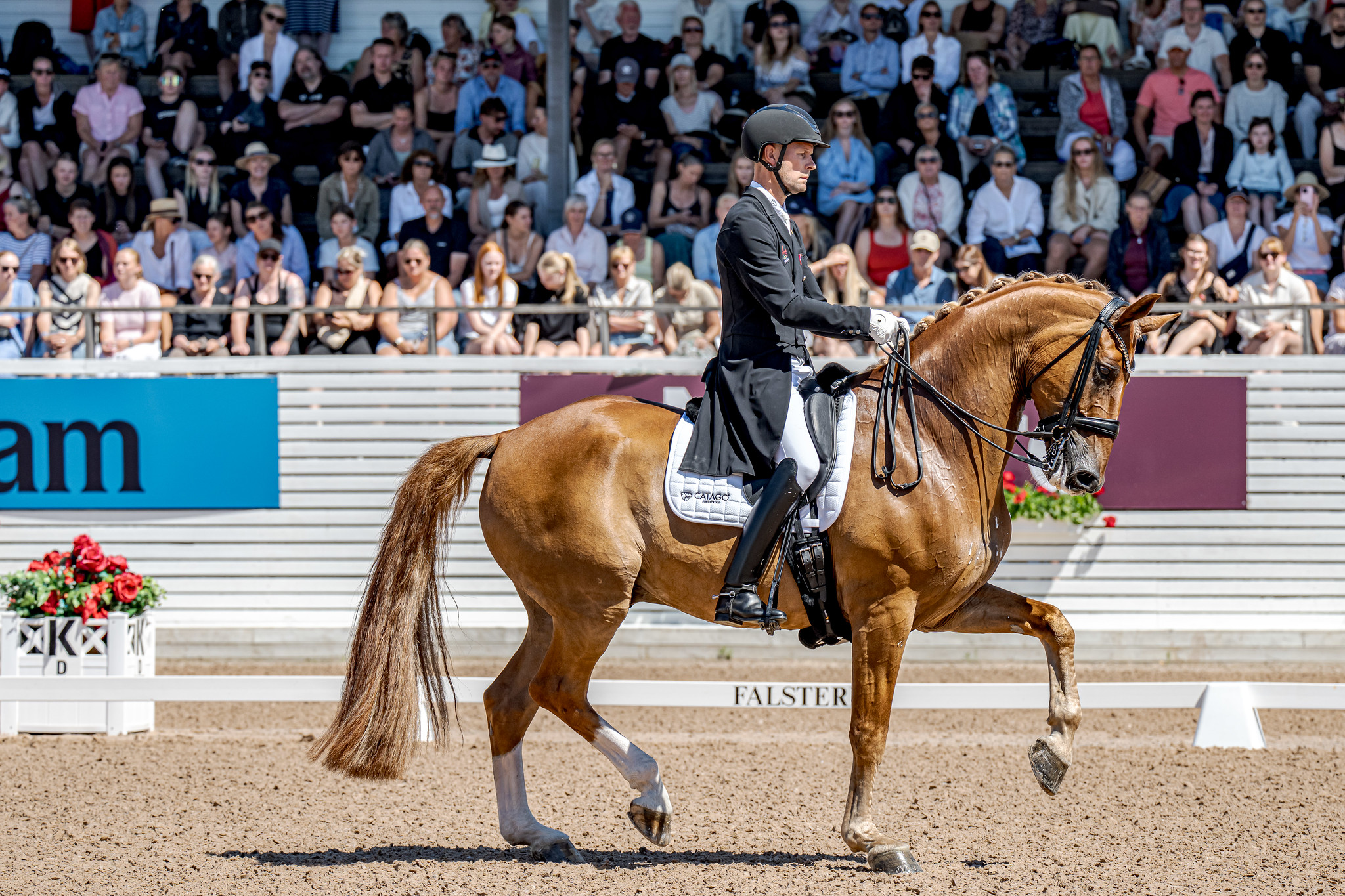
The second-best pair on the team—and in the competition—were Daniel Bachmann Andersen and the 12-year-old Oldenburg stallion Flash Gordon, a son of Fiderbach (and thus a close relative of Freestyle, breeder: Jan Lüder Cornelius), who scored exactly 74 percent. Unlike Freestyle, who had already gained championship experience at the age of nine with her trainer Charlotte Dujardin, Flash Gordon is still quite inexperienced on the international stage. The chestnut was trained for Grand Prix competition by Mathis Goerens. Daniel Bachmann Andersen began riding him in early 2025. Falsterbo marks their fourth CDI start.
Perhaps Flash Gordon still needs a little time to gain more confidence in the arena. Overall, he didn’t quite seem to be in his element yet; he looked around here and there, staying with his rider, but he still lacked that positive drive forward. Nevertheless, Flash Gordon demonstrated his extraordinary quality in the Heder test, and it was a masterful riding performance by Daniel Bachmann Andersen, who repeatedly brought the gelding in response to his driving aids and completed the test without any faults. Conclusion: A pair that is still at the beginning of their career—but one that shows great promise for the future.
Two more couples over 70 percent
The other two Danish pairs also received scores above 70 percent. One of them was Nadja Aboe Sloth with her charming horse, Favour Gersdorf. The pair had already contributed to Denmark’s team bronze medal at last year’s European Championships and delivered another pleasing ride today, which was scored at 71.935 percent. This made them the fifth-best pair in the competition.
The team was rounded out by Anna Zibrandtsen and Quel Filou. It’s clear that both of them take advice from Cathrine Laudrup-Dufour. Zibrandtsen always strives for a gentle contact and subtle aids, which results in a harmonious overall impression. With errors in the double-counting single changes, the pair scored 70.174 percent today.
Sweden, with a World Cup champion and a newcomer
As expected, it was Patrik Kittel and Touchdown, the 2024 World Cup champions, who posted the highest score for the Swedish team: 73.174 percent. Therese Nilshagen and her son Navarro—a Negro horse ten years her junior—are increasingly coming into the spotlight. Despite a slip-up in the single changes, the pair scored 72.065 percent, thanks in part to an otherwise strong canter sequence featuring very beautiful pairs, zigzag half-passes, and pirouettes.
Beata Söderberg’s horse Talento made a strong impression in the truest sense of the word; he certainly lived up to his name, especially in the Grand Prix classes, but gave his rider quite a challenge. The pair scored 67.370 percent.
Anita Roslund and her 11-year-old Fontanell ran into some problems today. The son of Fürstenball is also still new to the CDI circuit. He made his international debut exactly one year ago at the CDI3* Tour in Falsterbo, scoring 67.522 percent in the Grand Prix. After that, Roslund presented him again in Stockholm, where, however, she withdrew from the Grand Prix. Today, she did ride the test to the end, but the first piaffe was essentially not performed because the black horse had spotted something that caused him to buck backward; it was judged accordingly, as was the corresponding transition, so the pair did not score higher than 60.826 percent.
Beautiful performances by the German pairs
Team manager Hendrik Lochthowe was very pleased with his riders’ performances. Helen Langehanenberg and Daniela, a daughter of Damsey, had already turned heads this spring at the Hamburg Derby with very harmonious and precise rides. They delivered another such performance today and celebrated a new personal best of 69.283 percent on their debut as part of a Nations Cup team.
The second pair representing Germany were Evelyn Eger and the impressive Global Power OLD. The pair had some very beautiful moments (e.g., in the changes of gait), but time and again Eger had to struggle to keep the nine-year-old son of Grey Flanell from responding to the driving aids. They managed to do so almost until the very end, but two mistakes toward the end—one in the transition from canter to trot, the other in the final piaffe—proved costly: 68.511 percent.
Leonie Richter made her debut on a German Nations Cup team with her horse Lord Europe. With great riding skill and standout moments—including in the passage reprises, the flying changes, and the zigzag half-pass—Richter rode the Lord Leatherdale son, who is also only ten years old, to the German team’s best score: 71.152 percent. This placed them sixth in the overall standings, securing a spot in the rankings.
Right behind him was the German team’s youngest member, Moritz Treffinger, performing “Fiderdance.” Scores ranging from 69.674 percent at the lower end to 72.283 percent at the upper end of the scale added up to 70.565 percent.
Monica Theodorescu watched the competition from afar and was pleased with her athletes’ performance: “I’m glad we managed to secure a spot on the podium. With Leonie Richter, Moritz Treffinger, and Evelyn Eger, we had a relatively young team competing. It’s also encouraging that we’ve regained the lead in the Nations Cup series.” And since Falsterbo was the final stop of the season—following Wellington (second place for Germany), Lier (third place), Falsterbo (victory), and Hagen (victory)—this also means the overall victory for the season.