Germany Wins the Dressage Nations Cup in Hagen
Despite a last-minute change, German dressage riders secure an unchallenged Nations Cup victory in Hagen
 from Dominique Wehrmann
 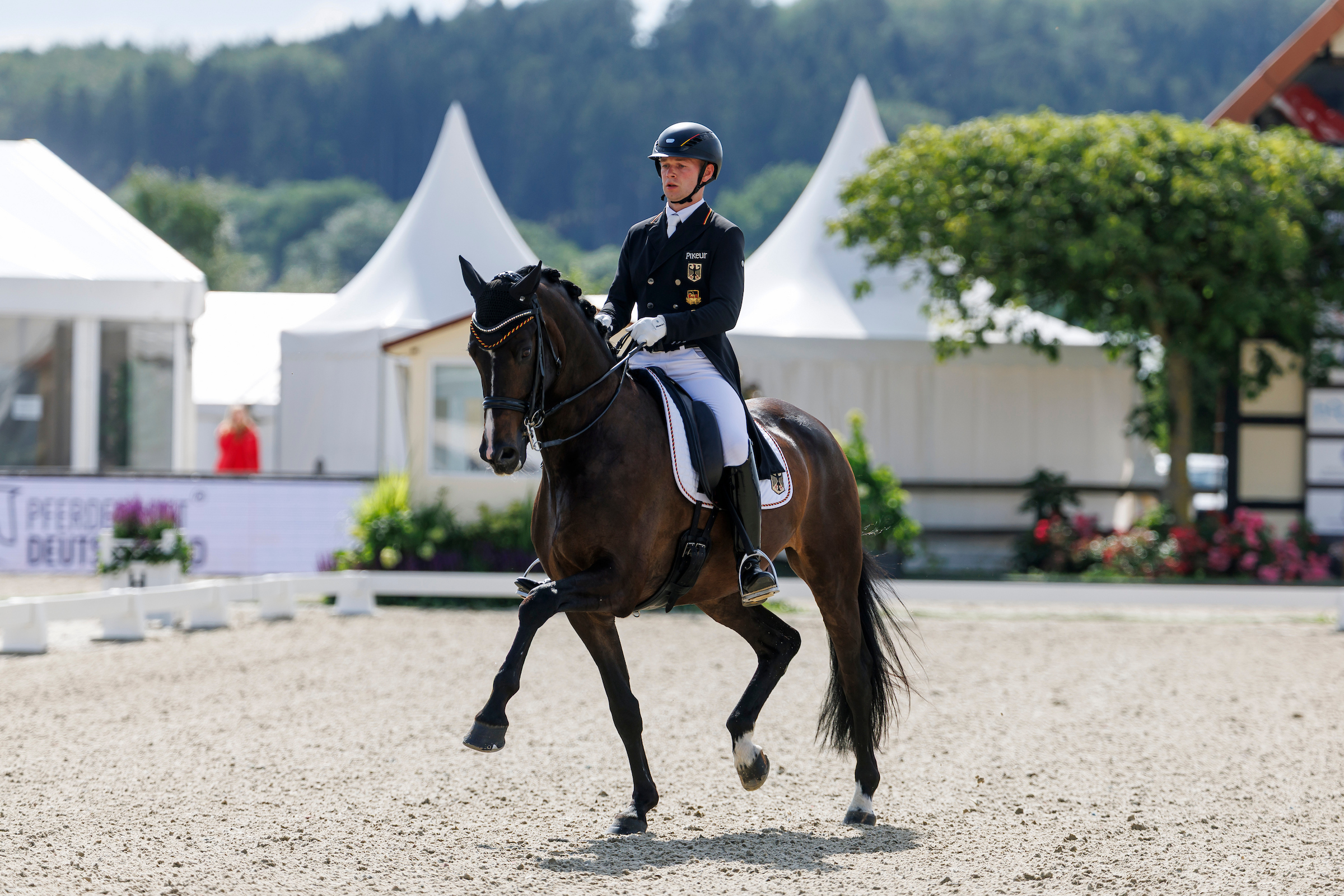 It's just always a pleasure to look at: Raphael Netz and Great Escape Camelot.
Photo: sportfotos-lafrentz.de
It's just always a pleasure to look at: Raphael Netz and Great Escape Camelot.
Photo: sportfotos-lafrentz.de Neither Denmark nor Great Britain had sent a team to the Nations Cup in Hagen. As a result, the German team’s victory was never in doubt, but it was not particularly indicative of how they would fare at the World Championships. For the German team’s selectors, however, the Grand Prix was certainly informative nonetheless.
Germany won the Nations Cup with a score of 231.107 percent, ahead of Spain (212.892) and the United States (210.957).
Netz and Camelot
The first to enter the arena for Germany was Raphael Netz with Great Escape Camelot, who had stepped in for Charlott-Maria Schürmann because her German Championship bronze medalist, Dante’s Pearl, was not fit. The pair delivered as usual—Netz riding with the utmost sensitivity, his 15-year-old Johnson son eager to do everything just right. All the judges rightly awarded an 8.0 for harmony in their final score. Highlights included, for example, the beautiful contact, the carefully executed and fluid transitions, and the well-prepared pirouettes. Unfortunately, Camelot took a double-leg jump in the single changes. With 73.696 percent, the pair fell just short of their personal best of 73.783 percent, which they had achieved in the Munich Grand Prix. That was definitely what the team had expected from him.
Semmieke Rothenberger and Farrington Ferrari
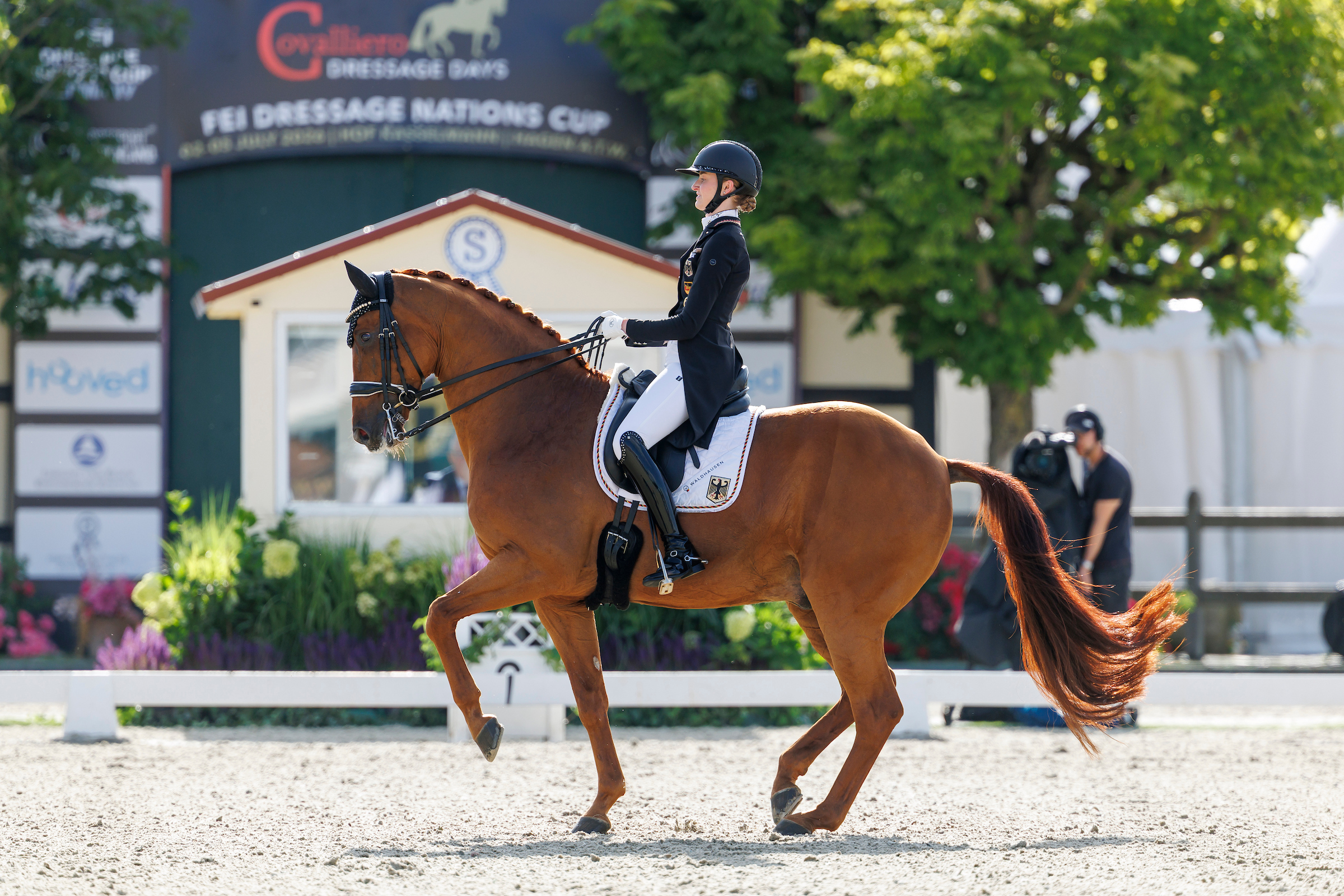
Semmieke Rothenberger and her horse Farrington—the bronze medalists in the freestyle at the German Championships in Balve—managed to do just that, at least until the canter sequence. Okay, the extensions in both trot and canter are at the lower end of the scale, but the way Rothenberger rides precisely from point to point while her chestnut remains stable and upright in front of her is a sight to behold. The half-passes were fluid and executed and bent to perfection; the backing up was well done. Semmieke Rothenberger tried to keep the first piaffe on the spot, causing Farrington to lose some of his enthusiasm and evenness; she executed the next two with a bit more forward movement. In the passages, the chestnut moved like a metronome. Perhaps one might have wished for a slightly lighter contact from time to time. There was a brief moment of tension before the canter was initiated.
The two-tempi changes were executed confidently, straight, and with a relaxed, flowing stride. However, during the one-tempi changes, Farrington failed to respond to the aids on several occasions. That cost them dearly. The pair managed to make up a little ground at the end with a great centerline. With a score of 71.935 percent, however, they fell slightly short of their potential.
Frederic Wandres and Bluetooth
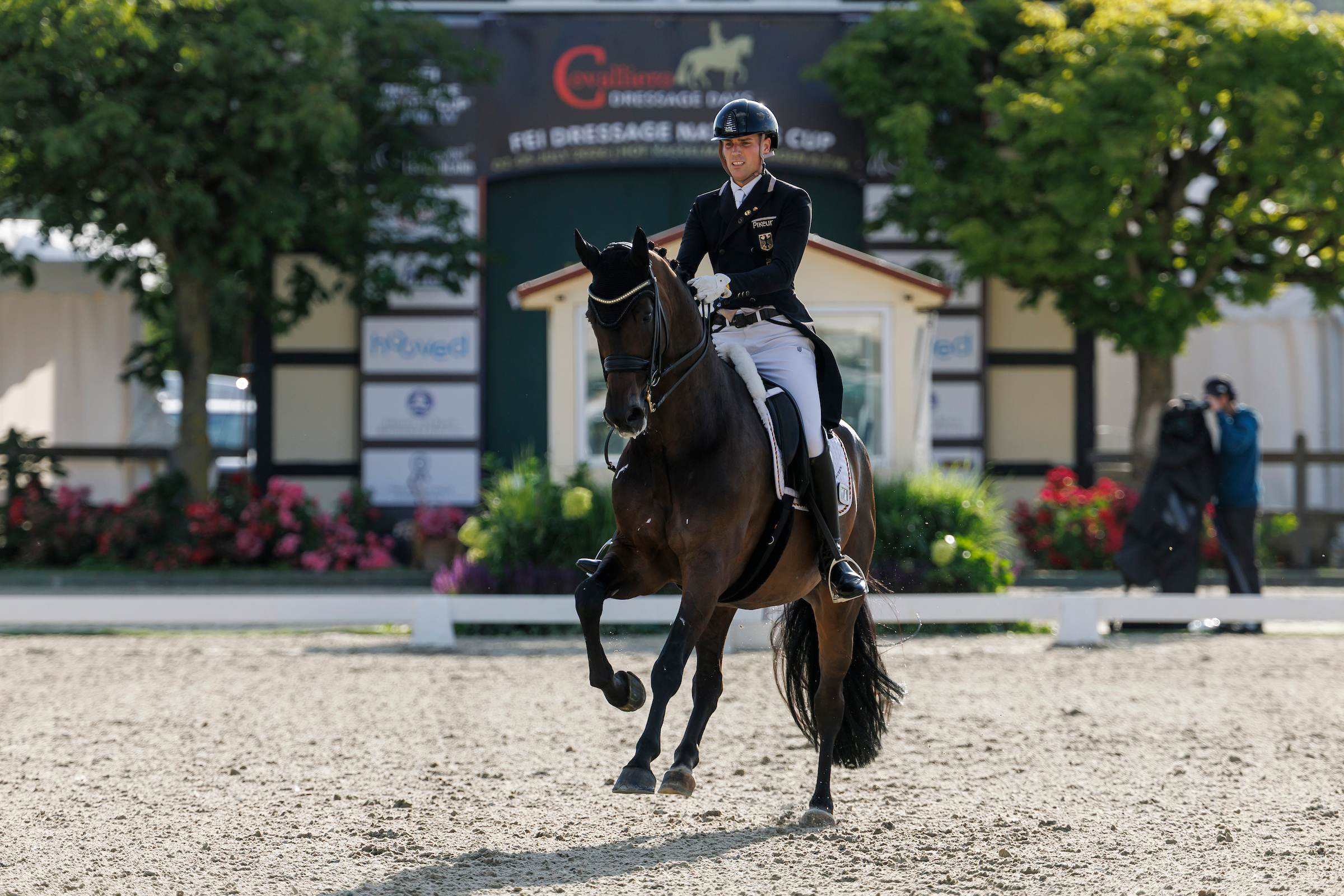
Wandres seemed determined to prove himself today in front of his home crowd in Hagen. He pushed his loyal Bluetooth to the limit, and the 16-year-old Oldenburg son of Bordeaux gave his all, as always. After a strong trot, he took a single little hop forward during the transition to the passage. His rider had probably asked him a bit too forcefully to carry the drive from his hind leg. In the first two piaffe-passage sequences, one would have liked to see a more even rhythm, even though Bluetooth lowered his hindquarters exemplarily and the transitions were successful. He demonstrated on the final straight that he can piaffe and passage with absolute evenness and even greater liveliness. That was a real highlight.
Unfortunately, the two of them also made a mistake in the sequence changes—though in the two-count steps, while the one-count steps went off without a hitch. In the zigzag traverses, Bluetooth jumped the changes with both feet once and switched back and forth once. Most of the judges, however, didn’t seem to have noticed this. Here, the side judges awarded a 6.0 and a 6.5, while the rest of the scores were two 8.0s and one 7.5.
During the right pirouette, Blutooth had trouble balancing on his inside hind leg. However, he was able to make up at least some of the points he lost there on the final line mentioned earlier. With a score of 76.087 percent, the pair held the lead for a long time.
Werth and Wendy
The final pair for Germany were Isabell Werth and Wendy, who sealed the deal for the German team with a score of 81.051 percent. Nevertheless, Isabell Werth wasn’t beaming from ear to ear as she usually does after a successful round when she left the arena. That was likely because the pair couldn’t avoid a change-of-lead error today either.
In the trot, riders still prefer a more supple back and a lighter contact overall, although the side view is very nice.
The right-side half-pass was executed smoothly, with good positioning and engagement. The left-side half-pass was not quite even. The halt was performed with suppleness and cohesion; the backing up was willing but somewhat hurried. In the first piaffe-passage sequence, as always, the horse demonstrated solid rhythm and activity. The suppleness and the swing through the body were better in the second piaffe-passage sequence and at their best on the final center line.
The strong stride was very nice—relaxed and in time with the beat, diligent with good reach and a clear extension toward the hand. In collection, the rhythm was still steady.
Then came the canter sequence. The flying changes started off a bit wobbly, but were quite relaxed. However, around the X marker, the horse clearly became tense, and that’s when the mistake happened. Isabell Werth didn’t let that throw her off; she rode the strong canter boldly forward and all the way to the end of the diagonal. Before the single changes, she briefly lifted the reins again to get Wendy to move away from her hands. That worked at first, but then a mistake crept in. Still, the single changes were better today than the double changes.
The pirouettes were centered, but especially in the right-turn pirouette, one would have liked to see more angulation in the major joints of the hindquarters—that is, hock flexion. As mentioned, the final centerline was once again a highlight of the test.
“Ones to Watch”
In the end, the Germans took first (Werth), second (Wandres), third (Netz), and fifth (Rothenberger) place. In between, Henri Ruoste—a Finnish rider based in Germany—held his own in the saddle of a horse that would definitely make you stop in your tracks at the warm-up arena: the 14-year-old Tailormade Temptation daughter Tiffany Diamond. The black mare is not only beautiful and has powerful movements, but she also possesses a distinct talent for Grand Prix exercises. Had these two not also made a major mistake in the flying changes, their score would have been even higher than 72.783 percent, placing them in fourth place.
Spain on the Rise
For the Spanish team, which placed second, José Antonio Garcia Lena posted the best score—71.696 percent—riding the 15-year-old Lusitano Gladiador Do Lis. The dun horse is an enthusiastic piaffer. Walking, however, isn’t really his thing.
Riding the 12-year-old Oldenburg mare Flaconi W (by Foundation-Breitling), bred by Wolfram Wittig, once again proved to be a horse ready for international competition; today she demonstrated considerable talent—not only, but especially, in the Grand Prix movements—and left the arena with a score of 71.652 percent. The third-best performance came from Lucía Gallardo and her KWPN gelding Hip by Johnson, who set a personal best of 69.544 percent. Rounding out the team were Claudio Castilla Ruiz and Jota Das Figueiras, also a Lusitano, with 68.848 percent.
The U.S.: Enjoying Work
For the U.S., Hagen is also an important final warm-up for Aachen. The team is currently missing pairs such as Laura Graves and Verdades. Still, Adrienne Lyle won the CDI3* Grand Prix this morning with her Olympic horse Helix, who had been on a long break following the 2025 World Cup Final, where he completely ran out of time. Today, the pair scored 70.891 percent. However, Lyle had actually said that she would not be available for the World Championships.
Christian Simonson, currently the best rider on the U.S. team and a World Cup runner-up—and a student of Lyle’s—made the same announcement regarding his top horse, Indian Rock. Instead, he rode his second horse in the team today, the Dutch horse Fleau de Baian—a full brother to Parzival—who had been trained by Adelinde Cornelissen. The pair achieved a score of 70.478 percent, with highlights in the canter sequence. One would have liked to see even more natural carrying and self-carriage from the chestnut.
This also applies to Jordan La Placa’s highly agile and talented Gold Play, who posted the best U.S. score of 70.631—and set a personal best to boot. The Oldenburg is a fantastic horse with immense potential.
One pair that, while not without mistakes, clearly enjoyed themselves were Geñay Vaughn and the KWPN gelding Gino, trained by Holga Finken. They danced their way through the routine with ease, and the 15-year-old son of Bretton Woods seemed very content. It was a pleasure to watch and was rewarded with a score of 69.848 percent.
Ranking fourth on the U.S. team were Meagan Davis and Toronto Lightfoot, a son of Oldenburg’s Totilas, who finished with a score of 68.565 percent.
You can find all the results from Hagen here.
Similar posts