Interview with young eventing star Libussa Lübbeke
Libussa Lübbeke – the quiet, ambitious talent at the top of the world
 from Gloria Lucie Alter
 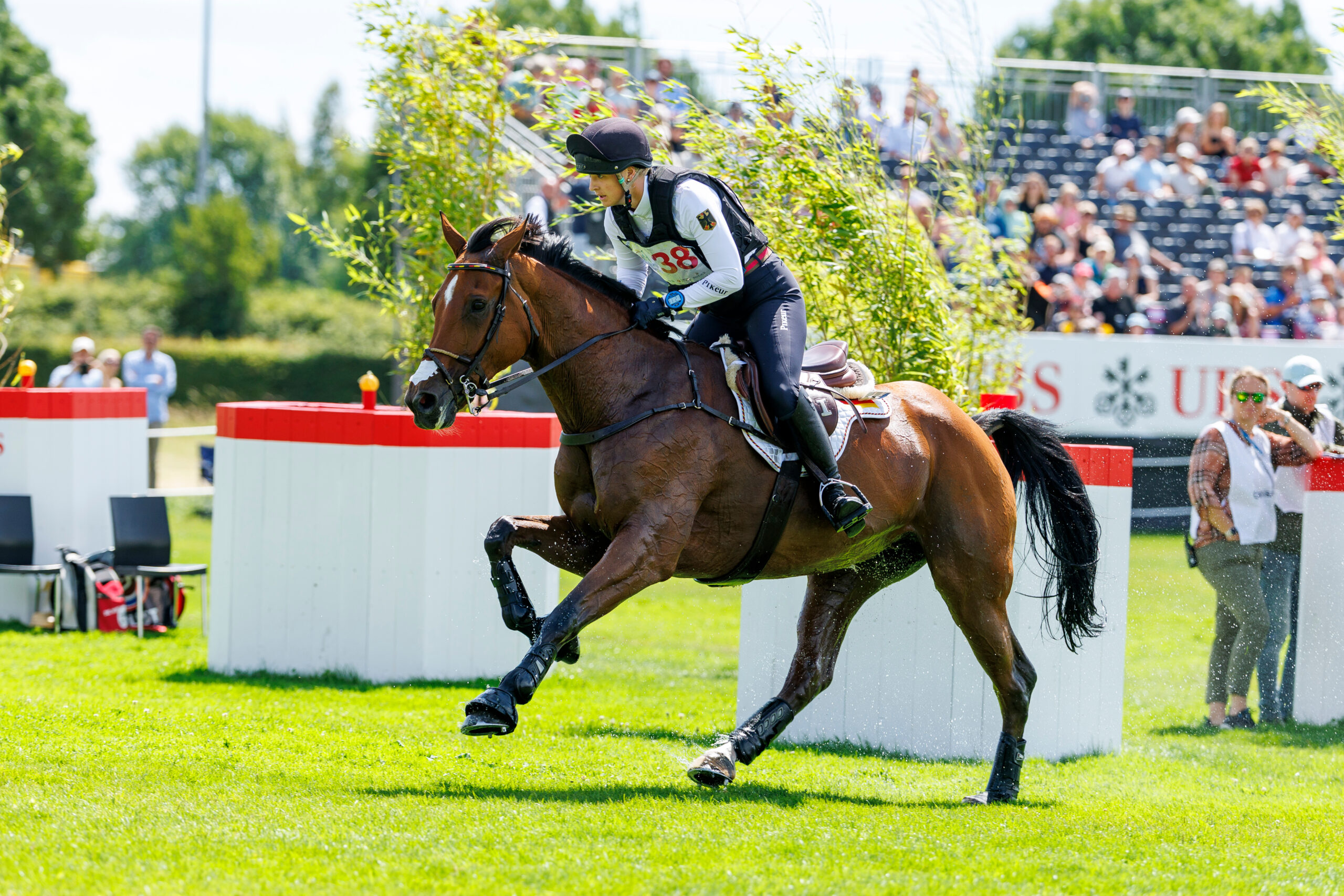 Two who know each other inside out: Libussa Lübbeke and Caramia FRH. Photo: Archive sportfotos-lafrentz.de
 Libussa Lübbeke is one of the shooting stars of the eventing world. A description that she herself would probably find strange. But the facts speak for themselves: four European Championship appearances from the ponies to the young riders to the seniors, three gold and one silver with the team and always in the individual rankings. Last year, the 25-year-old made her championship debut at the European Championships in Blenheim and played her part in the German title.
Last weekend, she shone in the first Nations Cup of the season in Marbach with Caramia FRH, who she bred and trained herself. The two were the first pair to take on the hilly four-star course around Baden-Württemberg’s main and state stud. They made the whole thing look like child’s play and laid the foundations for the German victory. The following pairs then showed that it was no child’s play.
Time to get to know Libussa Lübbeke better. An interview.
Libussa Lübbeke in conversation
Gloria Alter: Tell us, how are you and your horses at the moment? How are you looking ahead to the coming season?
Libussa Lübbeke: Fortunately, I and my horses are doing very well, everyone is healthy and I’m just looking forward to what’s to come and the upcoming season.
At the age of six, you jumped over the same self-made jump at least 20 times with your gray pony Sissy because she was supposed to jump “exactly where you wanted her to”. Is this perfectionism still a motivation today, or is it sometimes a burden?
If I do, then it’s more of a drive and definitely not a burden. I think it’s a bit of perfectionism, this ambition to get better every day. I don’t think you can get far in sport without trying to get better every day.
This also applies to horses, by the way. A horse has to want to do this sport, a human can’t do everything 100 percent right at all times, especially in our sport. Horse and rider complement each other. Regardless of the sport, there simply has to be harmony between horse and rider.
Tell us about the basic training you had to complete as a sports soldier. What was it like for you, what did you take away from it?
It was a bit different to how it normally works because of corona. For example, we didn’t have a “train night”, i.e. an evening with a graduation party, which was canceled because of corona, so I think that’s why others had a slightly different feeling in normal times. It was still cool though, you learn a lot of discipline.
One thing that has stuck with me is that the team is only as strong as its weakest link. Everyone has to pull together and you have to be prepared for that. That’s real team spirit, you take that with you and also self-confidence. For example, over the years you learn to lead a team yourself and lead an exercise. That has given me a lot of self-confidence, because I’m not normally the type of person to stand at the front and say: “So, now do this and that.”
You are currently training to become a master of equine management – alongside all your horses. It’s also a lot of driving between home with the family and in Warendorf. How do you manage to juggle it all?
Yes, the days are a bit longer (smiles). Fortunately, the master is connected to the horse part, at least a little. The attendance times are also restrictive, I’d say, so you don’t have any vacation. If you go to a show with just one horse, that’s your annual vacation, you have to say.
Because I have my horses in Warendorf and my parents have their farm, it has always been the case that one parent has usually stayed at home and the other has gone off with the children, usually my mom and dad had to work. My brothers still do it today, they still love to come along and support or one of them does the yard at home.
What was the subject of your master craftsman’s examination?
It was about training a horse that has a goal and documenting this training. In the test, you then had to ride the target. In my case, the target was a 1.30 to 1.35 meter course with Daroca de Rioja FRH ( including two-time bronze medal winner of the Bundeschampionat and best horse in the cross-country final in 2025, editor’s note. ). The entire training of the mare was documented and analyzed daily in the master’s thesis.
Your stay with Andrew Hoy ended earlier than planned due to corona. What did you take away from this short time that is still part of your work today?
I got to know the natural aquatrainer for the first time there. In England, you have the opportunity to go out into a field with the horses. You let the horses run through it extremely slowly and in detail, i.e. at a very slow pace, and use the mud on the field instead of water. That wouldn’t work in Germany, of course, and it always depends on the horse whether it has a positive effect.
Caramia, the mare with the fighter’s heart, was first your brother Fritz’s horse. He was successful with her up to CCI3*-S. Did you feel any pressure to take over this horse, which already had a successful history in the family?
I wouldn’t say pressure. I always hoped that it wouldn’t be like that, that we wouldn’t begrudge each other anything. I always had respect for the fact that if things went better for me because I did something different, there would be comments from outside that would have a negative impact on us as siblings. Fortunately, that wasn’t the case at all. He is just as happy as I am about the successes.
I think we complemented each other perfectly when it came to training the horse. I don’t think Caramia would have become such a cross-country machine if my brother hadn’t ridden her before. He used to give her such a sense of security that today she just knows her job.
And: she is a horse that you have to deal with 24/7. I think the fact that I had so much time for this opened new doors.
How would you describe Caramia, what makes it so special?
Caramia is very people-oriented. She is not such a cuddly horse, so she is not pushy, but she is one hundred percent fixated on the people she knows. She is highly sensitive. She feels most comfortable when she has her routine and with the people she knows.
She has definitely matured over the years. As a young horse, she was actually like a puppy. Sometimes she didn’t fully appreciate her body. I think we really grew and matured together with her. Today, it doesn’t matter what you want to do with her – she trusts you one hundred percent.
How is Caramia doing now, what do you have planned for her this season? Are you looking towards the World Cup?
Caramia is doing very well, she has come out of the winter very fit and motivated. The WEG inspection in Avenches is definitely on my agenda. I have my sights set on Aachen, but we’ll do it without any pressure, just as the horse presents itself.
Your family deliberately only breeds one or two foals a year, and with Caramia and Benedetta, who has already started in Blenheim, the breeding success rate is impressive. What else can we expect, who is next in the starting blocks?
We have a lot of very young horses, the oldest is three this year. We make something of the foals that are there. The three-year-old is out of Benedetta’s full sister ( eleven-year-old homebred daughter of Bonaparte N AA, with whom Libussa came third in the CCI4*-S in Luhmühlen last August, editor’s note. ) father is Diacontinus. We organize the breaking in individually according to the horse, also depending on how much time we children have. The three-year-old is now back out in the meadow over the summer, and we usually don’t start until he’s three at the earliest. If they are to become bush horses, they learn the basics of cross-country over three days at the age of four and then go out to the summer meadow again, but it always depends on the horse.
In addition to Caramia, you also have younger horses under the saddle. What are your other goals for the coming season?
This year is all about Caramia. I would like to ride the seven and eight-year-olds at three-star level this year. The younger ones, I have a five and a six-year-old, should go VA, maybe a VL or 2*, depending on their age. In general, I’m a fan of giving the horse time, especially to develop more self-confidence.
How would you describe Libussa Lübbeke to someone who doesn’t know her? What makes her special as a person? What passions or passionate dislikes does she have?
For someone who doesn’t know me, I would say: very calm. No matter what the horses are about, I always try to maintain a certain calmness.
My passion is horses, of course. My whole life has been about horses, back then I came out of school and got straight onto a pony. Of course, now in the big sport you sometimes have doubts because it simply takes a lot of work to get far. But I think this is simply the path I’m supposed to take in life.
In relation to horses, I have a passionate aversion to it when I notice that there is pressure behind it somewhere. If I notice that the horse has to do something it doesn’t want to do – that’s something I don’t like at all.
Personally, I like to be quiet. People who talk a lot and find it difficult to listen are not my cup of tea. I also have a passionate aversion to dishonesty. You don’t have to tell everyone everything, but if you tell something, it should be true.
What does your life look like when you’re not at the stables? Do you even have time for other things besides horses?
Yes, there are, and these few hours of my life consist of non-horse things. I like to meet up with friends outside of equestrian sports, I consciously use this time to be away from the stable, because these hours are numbered. You have to have a good balance between enjoying being at the stables and enjoying the time when you put on something other than your riding breeches, I think that’s really important. Just like the horses sometimes have a day off.
Ähnliche Beiträge