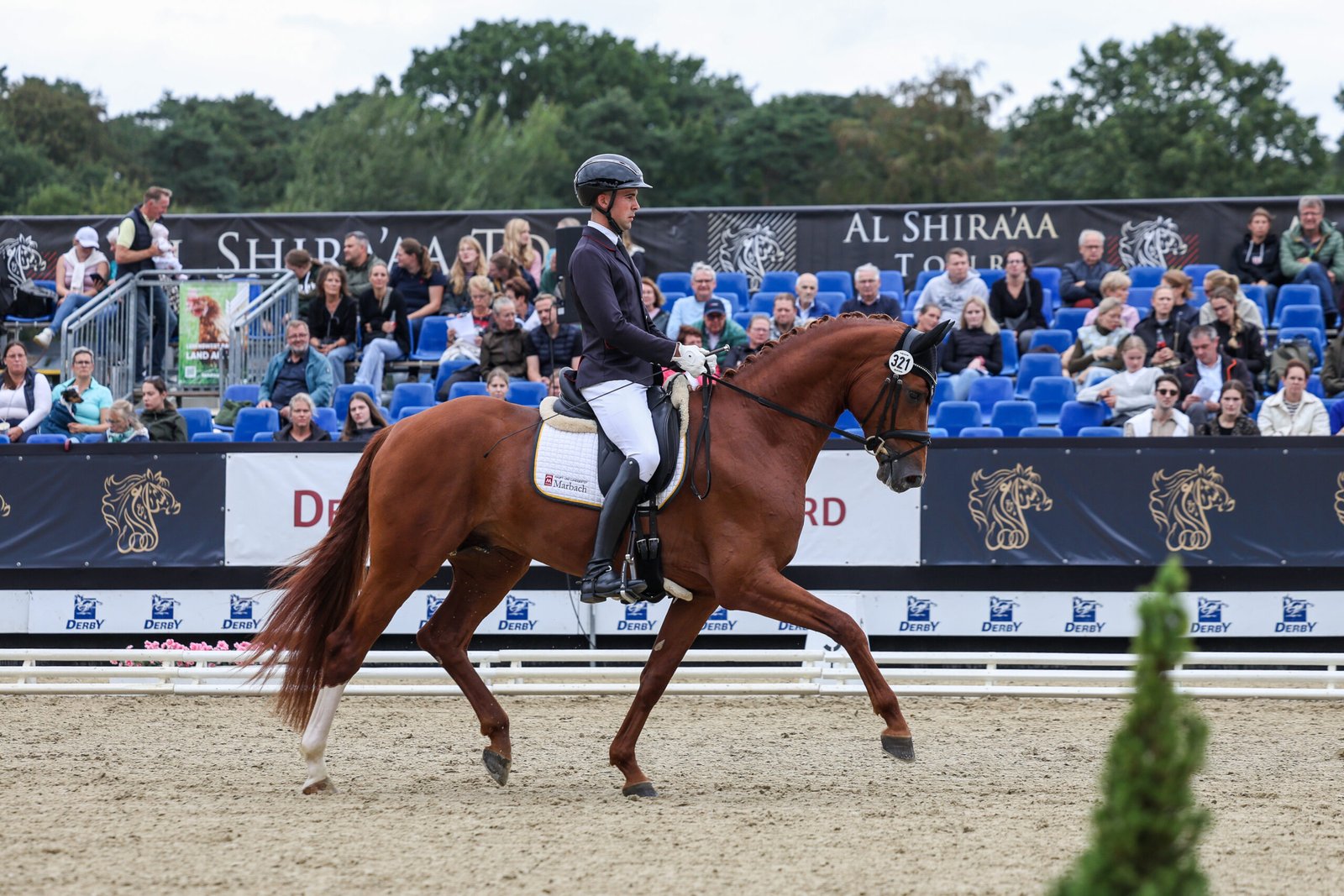
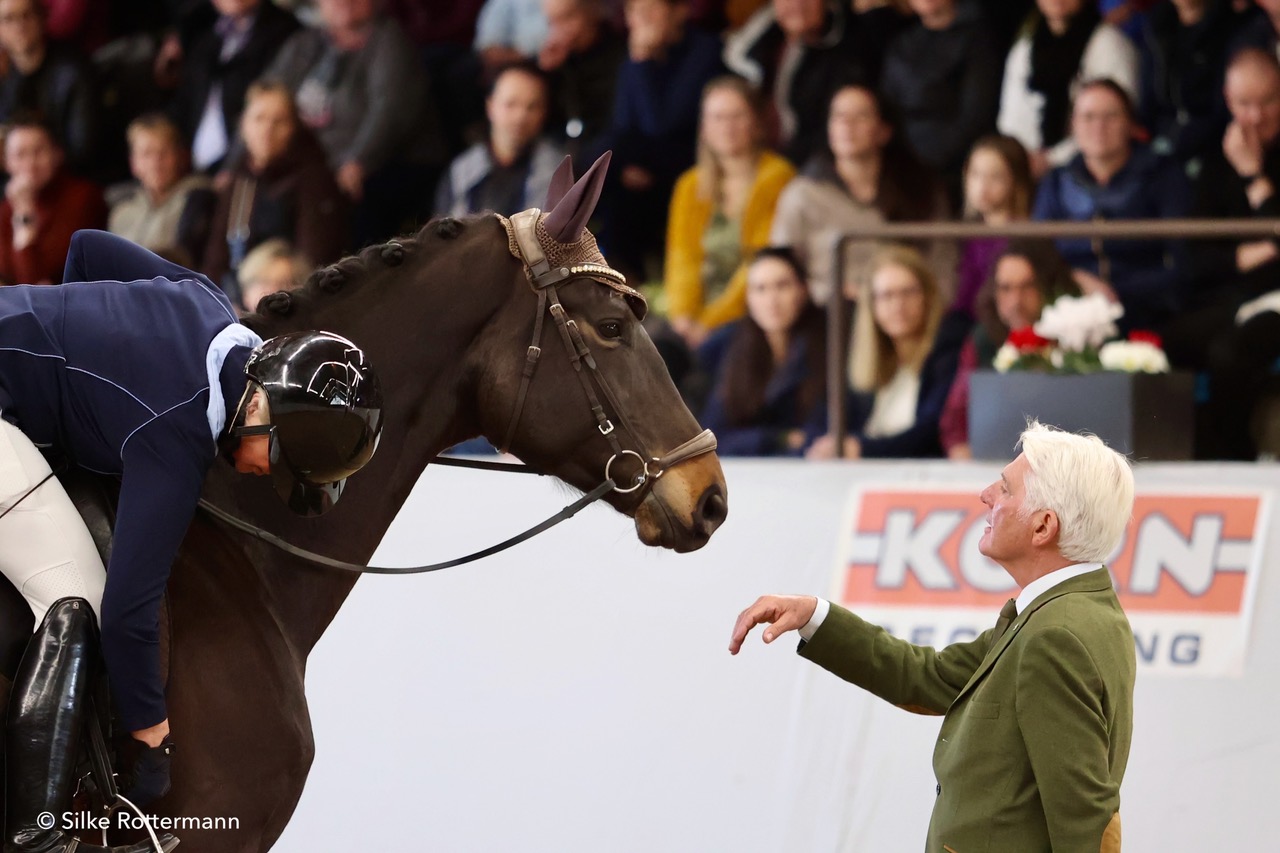
 Uta Gräf's horse, which every rider dreams of and which also made Martin Plewa regret not having taken a trailer with him to Marbach, bears the fitting name Herzenswunsch. Photo: Silke Rottermann
 Saturday, March 7, was the arrival day for the Xenophon members who had found their way from all over Germany to the Main and State Stud Marbach on the Swabian Alb for the 20th anniversary of the association – many with fond memories of courses at the well-known State Riding and Driving School at Dolderbach. Those who wanted to were able to watch the stallion show at the stud that took place that evening. If you didn’t want to, you missed out. It was an interesting evening that convinced many a person who had expressed doubts beforehand as to whether a stallion presentation could be the right way to get in the mood for a Xenophon weekend. More on this elsewhere.
New Management Board
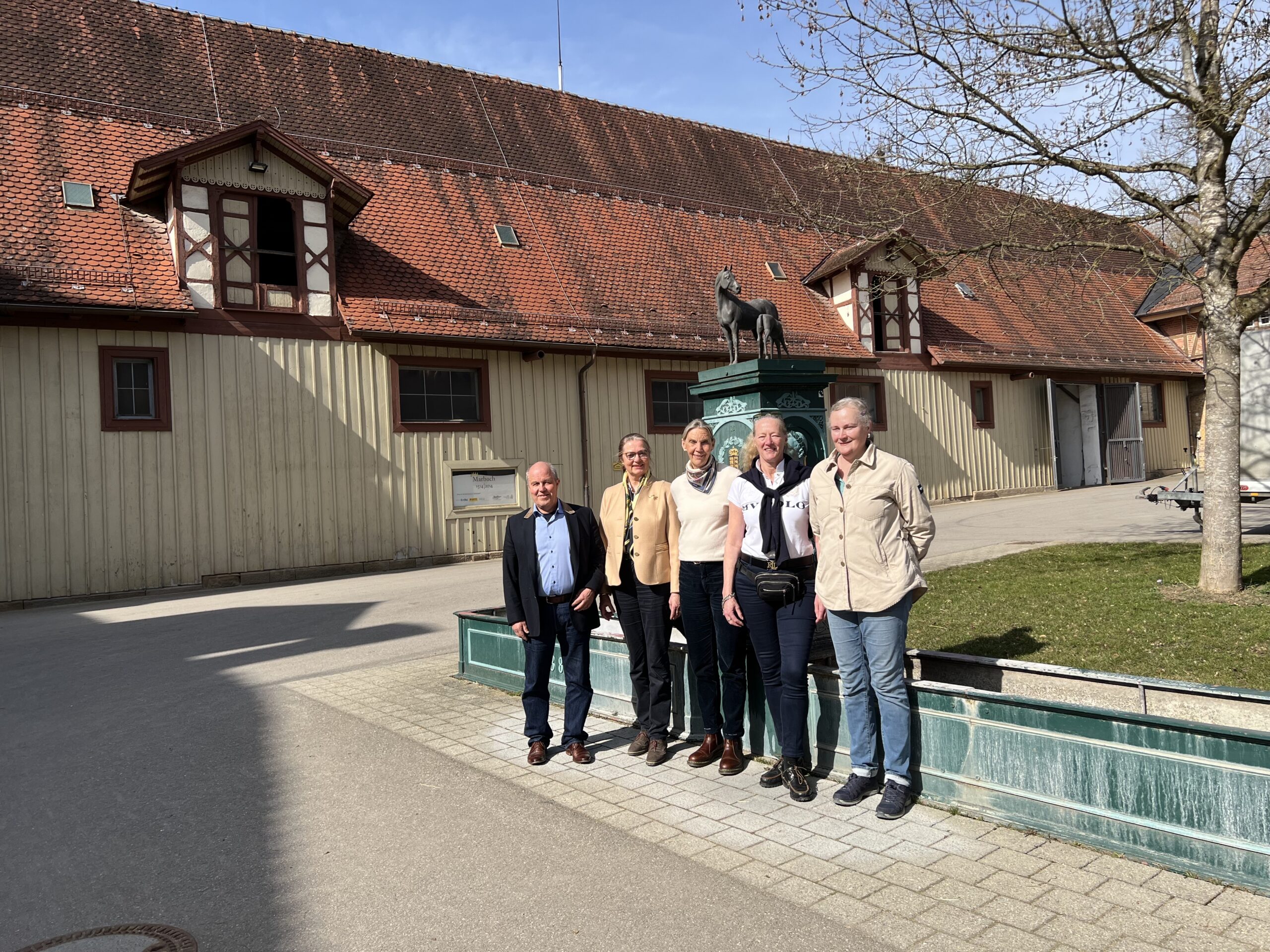
Sunday morning was reserved for the general meeting. After Managing Director Jutta Jäckel presented the positive annual financial statements for 2025, one of the items on the agenda was the vote on the new association body EQUI PAGES. The 30 or so attendees unanimously expressed their approval. As Dominique Wehrmann is the founder and Managing Director of EQUI PAGES together with Jan Tönjes, she was no longer available for re-election to the Xenophon Board in order to avoid compliance conflicts.
Three new creative minds are now enriching Xenophon’s board work. Firstly, there is Helmut Alt, a master of equine management from Bavaria, who travels all over Germany as a saddler. At his side is Daniela Noesen-Steiger, who has been successful in the saddle up to medium (M) level and is familiar with the work of the Board from her work as Director of the Association for Organic Agriculture in her adopted country of Luxembourg, and Marianne Kähler, who has been successful up to advanced (S) level and was previously the contact person for Xenophon members from the Hesse region. All three were unanimously elected to office.
After the formalities, there was time for an exchange of opinions and discussions before heading back to the Marbach Main and State Stud, where the real highlight of the weekend awaited: the practical seminar “Training and gymnasticizing horses with ease” with Uta Gräf and Stefan Schneider, moderated by Martin Plewa.
An afternoon to write behind the ears
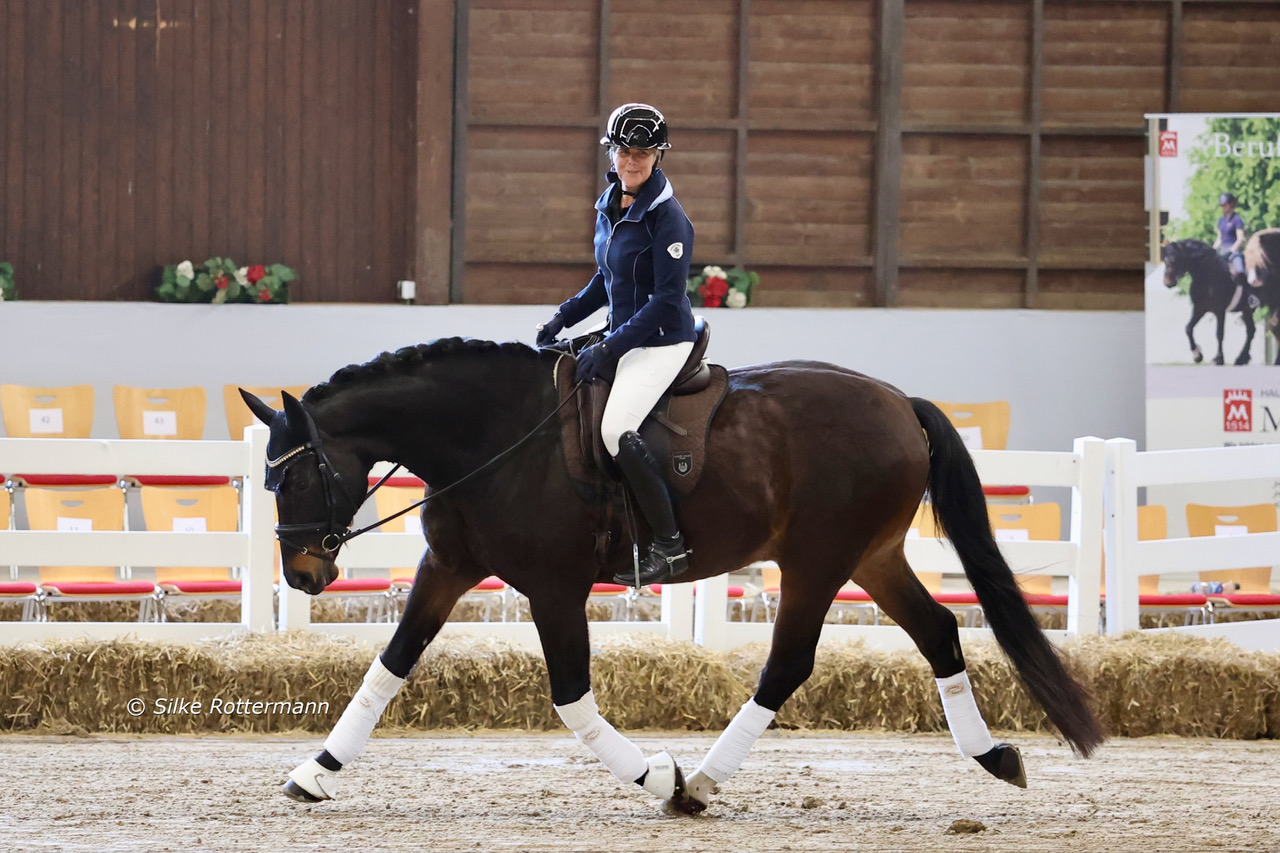
More than 350 Xenophon and personal members of the FN experienced some instructive hours in Marbach. Uta Gräf had brought along a 14-year-old S-winning gelding as well as an eight-year-old young horse that is on the way to Grand Prix. Her husband Stefan Schneider, veterinarian and an expert in handwork, showed a trained Lusitano on long reins. Xenophon Supervisory Board member Martin Plewa accompanied the afternoon as commentator.
Uta Gräf’s advanced (S) level winner named San Diamond didn’t necessarily look like a model athlete – it had probably been a while since his last clipping, but his cozy little belly perfectly matched the slightly ponderous shuffling stride with which the bay came into the Marbach arena. Interested, but deeply relaxed, he took in his new surroundings and was not fazed by the many spectators. A horse of the teddy bear variety. Uta Gräf let him walk to get the stiffness from the journey out of his limbs, then finally picked up the reins and trotted off. “SD” – as he was nicknamed – held on tightly for the first few laps. Gräf gave him time, he was allowed to choose his own head and neck position, Gräf hardly had any contact, really only the weight of the reins.
Parades on young horses or horses that have not yet been loosened up should be ridden out.
After a few minutes of light trotting, she started with transitions, cantered at the beginning of the long side, let SD canter to the end of the arena and parried through again – always on the second or third hoof, by the way. These were not abrupt parades, but rather a soft glide into the next basic gait. Martin Plewa comments: “It has been forgotten, but in the past the guidelines even stated that parades on young horses or horses that have not yet loosened up should be ridden out.”
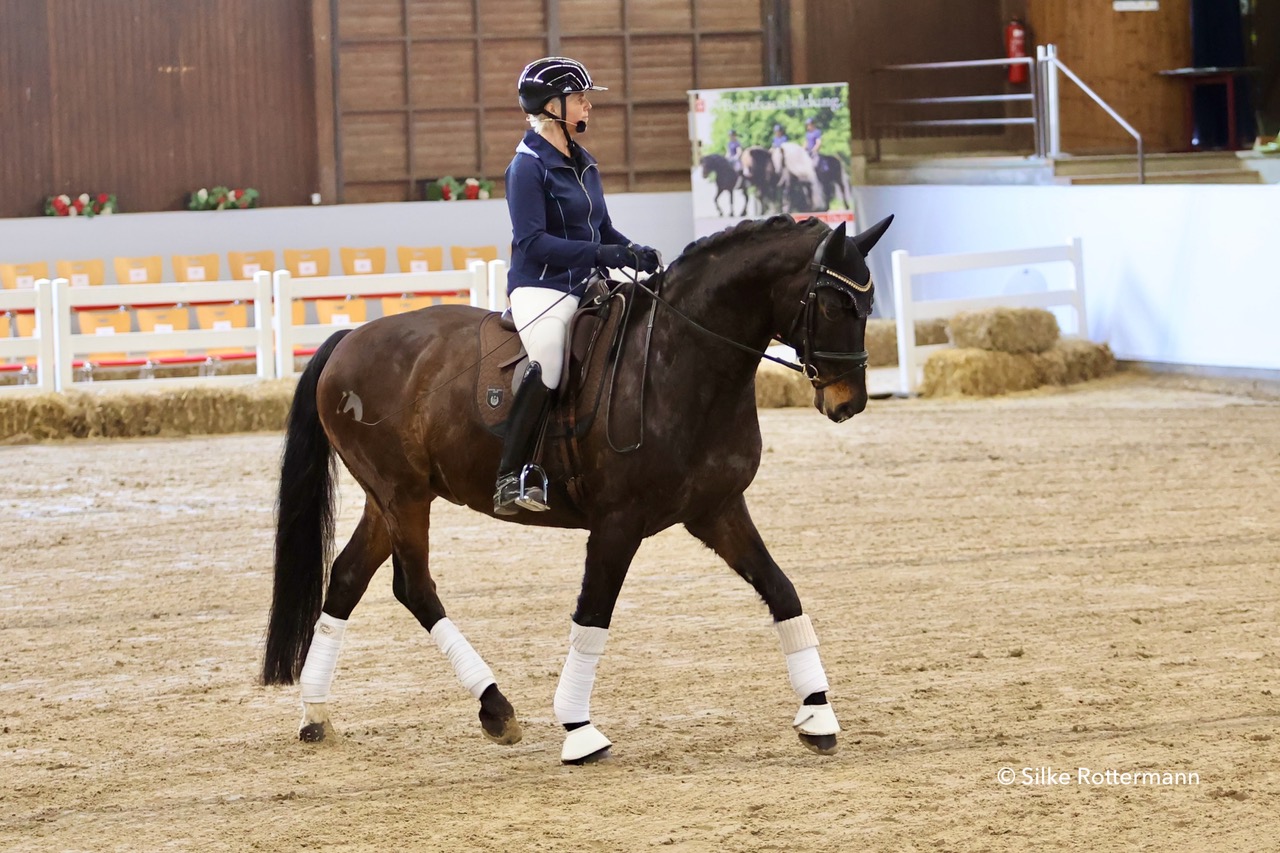
SD appreciated his rider’s approach. After two or three repetitions on both hands, the horse’s image changed. The movements became supple and diligent. The gelding began to swing and seek the contact. At the same time, he was not really deep. Plewa: “Often, when I see riders trying to bring the horse deep by hand, I ask them why they are doing this. The answer is always: to loosen the horse. But where does it say in the guidelines that you should release long and deep?” Rather, the prerequisite for rhythm and suppleness is balance. “That means they have to be able to keep their own pace,” says Plewa. Uta Gräf presented this like something out of a textbook. You hardly ever see her clearly driving anyway. Now she also took the reins in one hand and SD simply cantered on, changing neither beat, pace nor posture.
The rider is responsible for ensuring that the exercise is successful.
In the work phase, Gräf rode transitions and lateral movements, all of which were effortless and refined. At the same time, she explained what she was doing – that she was now asking for more bending, more diligence etc. and each time she ended with: “… and now I’m taking the aids away again.” As a rider, she wants to do as little as possible in the saddle. Plewa confirmed: “We have to get back to allowing more collection and reinforcement.” In other words, less active pushing, more riding in “benevolent comfort”, as Gustav Steinbrecht once put it. Plewa’s reminder that it is not the rider who trains the horse, but “the exercise” also fits in with this. “The rider is only responsible for ensuring that the exercise is successful.” This applies to everything, from the trot-walk transition to the traversal to the piaffe.
At the same time, Gräf keeps her horses attentive by surprising them (not overpowering them with the aids!). If the horse assumes that a flying change is coming, she continues riding in outside canter. If the horse wants to come back too much in the pirouette, she rides out of the circle and so on.
The professor
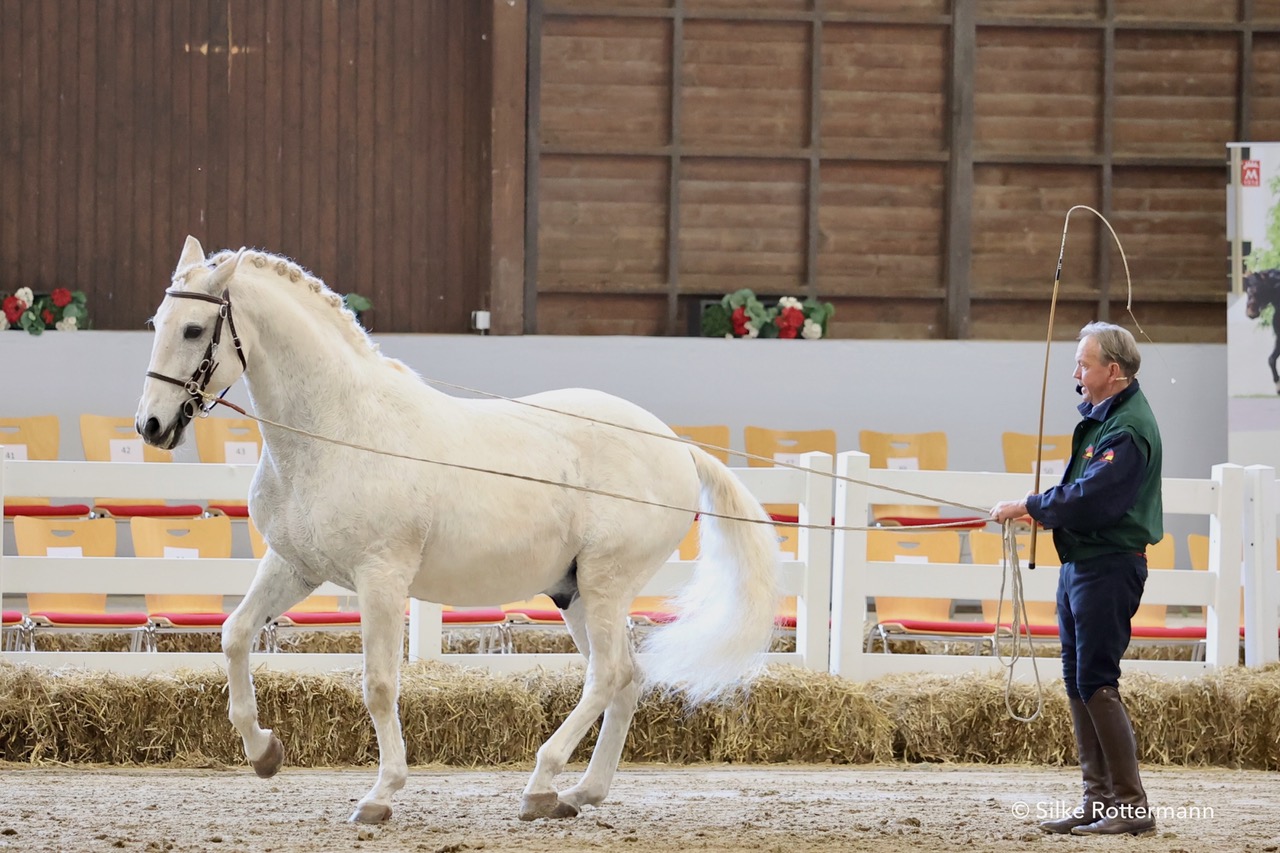
Stefan Schneider’s long rein work was a wonderful demonstration of how sensitively horses can react to the subtlest of touches. His stallion, a Lusitano in his 20s, but still in top condition and always “on the air”, reacted to the slightest signals from humans on the ground. The effect of the reins on the nose did not seem to play the most important role – although Schneider pointed out that the Monty Roberts bridle he uses only allows the bit to be hooked in, but he can hook the reins into the rings on the side of the noseband. Schneider: “The horses understand the effect via the nose more easily.”
It
is easier for the horses to understand the influence of the nose.
This, in combination with Schneider’s perfected body language, meant that the gray horse could be turned, placed, bent, parried and started again at the slightest sign. That was impressive. Especially as Schneider explained that most beginners with long reins underestimate how challenging this work is – precisely because most horses react very sensitively to both the lines and the body language of the human. “Try having the horse walk straight ahead of you on the quarter line. It’s much more difficult than it looks,” says Schneider’s experience. He therefore recommends getting an expert to help you when you start working on the long reins.
Why is this worthwhile? Schneider starts with all young horses on long reins. “It has an educational effect. Even the young stallions quickly realize that I, as a human, am in charge.” And that’s not all: lazy horses become hard-working, hot horses learn composure, peepers develop courage and self-confidence because they have to lead the way, so to speak.
The horse that every rider dreams of
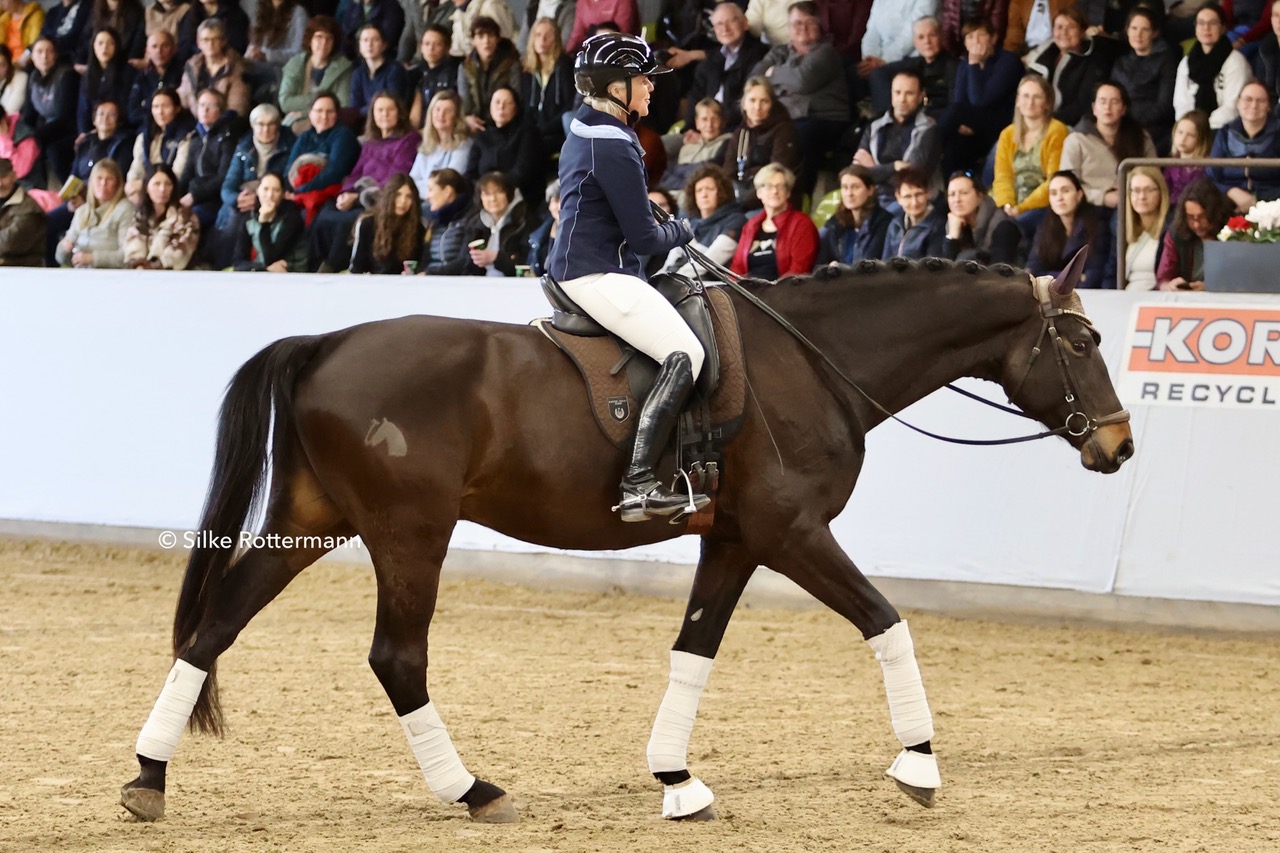
Uta Gräf’s SD can boast successes up to S***, but rider and owner decided together after a few competitions that SD should only compete at S** level. “I realized that I had to push him quite hard in piaffe and passage,” explained Gräf. That contradicts her philosophy. “The horses have to enjoy doing the difficult movements!” From her point of view, there is no reason not to use horses in big sport. Just like the eight-year-old she brought with her to Marbach. His name says it all: Herzenswunsch.
The horses have to enjoy doing the difficult lessons.
The Helium son has such a god-given talent for piaffe and passage that it already looks like child’s play. Whether it’s single changes or pirouettes – Gräf just tested everything and immediately went back into walk and let the reins out as soon as “Herzi” had understood and implemented them. Which was usually the case at the first or second attempt at the latest. And if it did take a moment longer, Gräf remained completely relaxed in the saddle. “With horses that are so fine and committed, it’s important not to push them. As a rider, I wait until they have found the solution I want, then I stop immediately,” says Uta Gräf.
Martin Plewa explained: “This corresponds 100 percent to the learning behavior of horses. The break after a successful lesson is the most important reward of all.” And a horse that has collected its own reward, so to speak, because it has independently recognized what the rider wants from it, will be all the more eager the next time.
Herzi understood what was required of him at lightning speed and didn’t look the least bit stressed during the transition from canter to piaffe. “He enjoys it,” said Gräf. “So why shouldn’t I ride Grand Prix with a horse like that?” A rhetorical question.
Conclusion – it was an afternoon that delighted everyone present. The obvious satisfaction, trust and motivation of the horses demonstrated emphatically that competitive sport with horses is not only possible, but also in the interests of the horses.
Learnings from the Xenophon anniversary seminar
- One of the most frequently asked questions to Gräf and Schneider, which was also asked in Marbach, is: “How do I get my lazy horse to work hard?” There were various tips on this:
- Awaken the desire to go off-road, if possible with several horses to exploit the herd effect
- Only ever set an impulse when driving and immediately reward the horse with a loose leg when it reacts. Never clamp with the leg! This causes the horse to tense its abdominal muscles, tightening its back and making it even more reluctant to move forward.
- When transitioning to a higher gait or a higher basic tempo, provide a driving impulse in combination with weight support.
- Do not sit too heavily so as not to disturb the short muscles of the spine
2. assembly is balance in a confined space
3. practice the beginning and end of lessons – no 60 meters of shoulder-in, rather only 12 meters and then start again.
4. ride a lesson only until it is as good as the horse can perform it according to its level of training, then stop immediately.
5. parades from the higher to the lower gait are to be ridden with a young and not yet loosened horse.
6. wanting to drift into the lower gear during the transition from the higher to the lower gear.
7. restless hand? Ride with rein bridge!
8. does my horse walk in balance? Check it and ride with one hand!