Fee schedule for veterinarians (GOT) - even more expensive after evaluation?
When the vet becomes a luxury – GOT soon even more expensive?
 from Jan Tönjes
 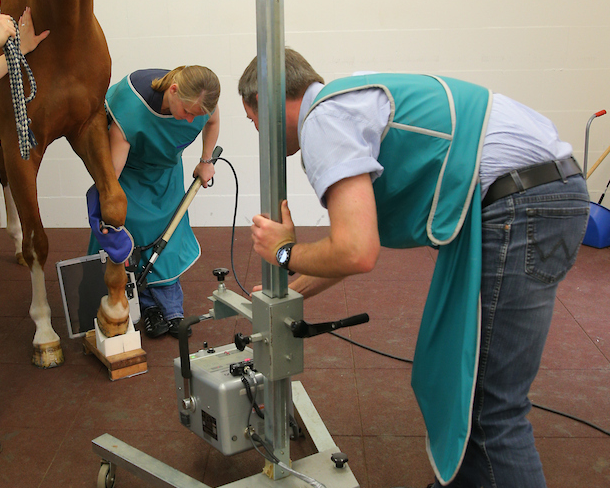 X-rays are one of the few services that have become cheaper with the new version of the scale of fees for veterinarians (GOT). Photo: sportfotos-lafrentz.de
 The background in our FEATURE.
Too expensive, killer of horse breeding (an extra article on EQUI PAGES will be published soon) – the debate about the GOT and its sometimes devastating consequences for horse owners and, above all, horse breeders shows no signs of abating. Worse still, it has driven a wedge between the veterinary profession and its clients. Everyone who keeps horses wants them to be well looked after. Everyone knows that this doesn’t come for free. Nevertheless, the sharp rise in the cost of almost every veterinary service has caught many off guard.
What is the GOT?
The scale of fees for veterinarians is a nationwide legal regulation. It specifies bindingly which veterinary services may be billed at which fee range. Veterinarians can charge within a fee corridor – from a single to a quadruple rate. In addition, the reform introduced or adjusted new items, an emergency service fee and a home visit fee.
The GOT can be read in full detail here (prices of the individual services behind the paragraphs)
While politicians and the veterinary profession describe the reform as overdue modernization, many horse owners experience the effects as a massive financial burden.
At the same time, the new version of the GOT has brought some problems of veterinary medicine to the table that have not yet been widely discussed in public. The “old-style” vet – 24/7 availability, weekend shifts, work as self-exploitation – is a dying breed. In the podcast “Tell me about the horse“, Dr. Kai Kreling discusses the situation of his profession on behalf of the German Veterinary Association. And it looks anything but rosy, according to the vet from Rhineland-Palatinate.

Veterinarians: dissatisfaction, alcoholism, suicide
Kreling’s arguments are simple: the new GOT ensures higher pay. Money alone does not make people happy, but it can be helpful. “The aim is to have reasonable cost coverage and above all, that was the actual basic aim of the GOT, to pay employees a reasonable wage. We have to honestly admit that this has been bad in veterinary medicine for years.”
“(…) over the years there has always been this high level of dissatisfaction among veterinarians with divorce, alcoholism, suicides (…)”
Kreling, who has built up a clinic himself, is familiar with the structural and mental changes in veterinary medicine from his everyday life. For example, the compatibility of family and career plays a much greater role today than it did 20 years ago. He welcomes the new key data of the GOT. “This development is positive because, as we know, there has always been a high level of dissatisfaction among veterinarians over the years, with divorce, alcoholism, suicides and so on. It’s all documented. And this is certainly a way of saying that we can increase the level of satisfaction and improve the attractiveness of veterinary medicine again.”
In fact, the risk of suicide among veterinarians is five times higher than in the general population. The reasons, say insiders, are complex. The fact that anesthetics and other medications are more or less freely available to vets in practices and clinics certainly plays a role, in addition to the psychological – dead and dying animals – and physical stress.
Has the German Veterinary Association reacted too late to the GOT?
Whether the use of alcohol or, even worse, suicide rates can be reduced through higher payment for veterinary services will not be part of the evaluation of the GOT. This review of the amendment is now pending. The new GOT, which has been in force since November 22, 2022, was the first comprehensive revision of the prices for veterinary services, says the German Veterinary Association. As official as the term “Federal Chamber of Veterinarians” may sound, there is no government agency behind it, but nothing more than a registered association that carries out lobbying work. In contrast to this are the state veterinary chambers, which are corporations under public law and perform sovereign tasks based on the self-administration of the profession.
Past flat-rate increases were not sufficient for vets
It’s true that costs haven’t been cut completely for 20 years. But there have always been adjustments. However, veterinarian Dr. Kai Kreling argues that these two flat-rate increases have not been enough. “We are still well behind what other professional sectors have brought in in terms of increases.” Kreling categorically rejects the notion that greed is spreading among German vets, as is often said in German stables. “Today’s vets don’t attach so much importance to more money, they want to have free time, so we have a 38-hour week here. This means that our vets work four days a week, 38 hours a day, and then have weekend duty every four or five weeks, depending on the situation.”
Veterinary medicine 2026 is cost-intensive
The demands of his younger colleagues pose problems for the entrepreneurial soul of the clinic operator in the veterinary body: “Where I want to go: this 38-hour week costs money. Because where they normally had one, they now have to have two.” Dr. Kreling becomes CEO Kreling and explains: “We have significantly increased personnel costs. If I do it right, I actually have to have three teams at the weekend, a surgeon, an anesthetist and at least one assistant. However, when they work at the weekend, they have to have time off. In other words, I would have to turn my 35 people into at least 54.”
Vets will earn 8.5 percent more in 2025 than in the previous year
TVD Finanz GmbH & Co KG, which operates the career platform job.vet for veterinarians, among others, published a salary report for 2025 in January 2026. According to the report, salaries for employed veterinarians rose by 8.5 percent from 2024 to 2025 to an average of 4,650 euros. In 2022 it was still 3,800 euros. An impressive 2,336 employed veterinarians took part in the survey, but it is not representative. According to the survey, equine practitioners earn an average of 4,290 euros nationwide. Those who work in the poultry and ornamental bird sector earn 5,120 euros. The GOT is therefore having an effect. Vet Kreling is also aware of this. However, the conclusion he draws from this does not sound very positive for horse owners:
“Yes, we’ve become more expensive, but we’re actually still too cheap!”
The clinic manager hopes that the evaluation of the GOT will come to this conclusion. This would not be the end of the cost spiral for pet owners.
Only Germany knows the GOT
A private entrepreneur on the one hand, a state-imposed scale of fees on the other – that is a German specialty. Incidentally, Germany owes the GOT to the National Socialists, as FN President Prof. Martin Richenhagen rightly points out in the podcast episode of “Tell me about the horse”. No other country in the EU has anything like this. Countries that have had similar constructs have long since moved away from them.
The background to the GOT has less to do with horses and much more to do with livestock: Security of supply in a sector that also includes the production of food should be ensured at all times. This is what the legislator demands and has therefore opted for a scale of fees. When the new GOT came into force, it was already clear that this ordinance passed by the Federal Council would be evaluated, i.e. assessed after a certain period of time. This is scheduled to take place in 2026. The website of the responsible ministry states: “The Federal Ministry of Agriculture, Food and Home Affairs (BMLEH) has therefore already initiated this evaluation in mid-2025, with results expected by the end of 2026”.
Ministry wants to become faster
Silvia Breher is Parliamentary State Secretary at the Federal Ministry of Food and Agriculture. She is the Federal Government’s Animal Welfare Commissioner. Two applications for the evaluation were received by the end of 2025. “For me, it’s not just about looking at the price increases over the last three years, but also at the effect or lack of effect of the last GOT amendment,” says Breher, who comes from Cloppenburg and whose children ride horses. “For me, it is crucial that we look at how much time is actually required for the individual services and not just assumed.” In the procedure prior to the revision of the GOT, the time required was estimated via an online survey.
Her appeal: “Evaluation. Let’s take an open look at the result. Where does it come from? Which points are justified? Which ones are not? How do we then arrive at an appropriate approach? And: Where can we prevent the distortions that we see as a result?”
According to estimates by the Federal Animal Welfare Commissioner, it will take until the first quarter of 2026 before the key dates of the evaluation are finalized. Silvia Breher emphasizes how comprehensively the topic must be considered, as it is not only the approximately 1.3 million horses in Germany that are affected. “The GOT doesn’t just affect horses. There are 34 million pets in 20 million households in Germany. 47 percent, almost half of all households, have a pet.” And that creates hardship. “It is also the pet owners, the small animal owners, who are having problems with the amendment and the current bills, including in animal welfare (i.e. animal shelters etc.). There, too, we are hearing about significantly rising costs that are hitting animal welfare organizations, many of which are voluntary and financially under-resourced. And in this respect, it is a very, very broad topic.”
Association of German Pet Owners is combative
The fact that politicians have now recognized the explosive nature of the issue is also thanks to the activities of the Vereinigung Deutscher Tierhalter e.V. (VDT). When board member Jens Thormählen is given the keyword “GOT”, figures start pouring out. The term “insurance-optimized billing”, which is circulating among veterinarians, drives him up the wall. He has compiled a lot of figures, initially in his own riding club and later on a larger scale, and compared them with the new fee rates. “Lameness examinations have become about 74 percent more expensive, lung examinations just under 50 percent, colic actually about 100 percent, only X-rays have become a little cheaper”.
Lower Saxony’s rendering plant reports significant increase in numbers
Thormählen has familiarized herself with the subject. “A colic operation that was previously calculated at perhaps 7,000 or 8,000 euros – the fact that it now costs between 15,000 and 20,000 euros” raises the question of how these costs can be met. Surgery or not? Thormählen asked the rendering service in Lower Saxony, where he lives and breeds horses, for annual figures. “According to the old GOT, I had around 7,000 collections by the rendering service, but this figure has risen continuously over the last three years. Last year, I think it was 11,000 collections. We’re talking about thousands more collections compared to the previous year.” What he doesn’t say directly, but what he does mean, is that in view of the fear of the costs, horse owners are deciding against surgery wherever possible and opting to let the animal die.
Position of the FN
The German Equestrian Federation (FN) was not too happy in the run-up to the new GOT. A new wind is now blowing in Warendorf. FN President Martin Richenhagen, an entrepreneur through and through, sees the explosive nature of this. Nowadays, according to Richenhagen, there is a lot of talk about reducing bureaucracy. “I am in favor of the free market economy (…) in this context, this would be a good example of where bureaucracy could be reduced and where it could then be converted into perhaps price recommendations instead of price regulations”. Richenhagen goes one step further in the process. His credo: sick horses are helped thanks to common sense: “The money for the evaluation could be saved if we were allowed to regulate this with common sense”.
Conclusion – further price increases cannot be ruled out at all
The evaluation will take the year 2026. Even if the Federal Animal Welfare Commissioner Silvia Breher has switched on the turbo, the coordination processes are complex. Even an accelerated procedure takes time. It may be that “good things take time”. The question is how “good” is defined in this context. From a vet’s point of view, only a further increase in the prices for individual services defined in the GOT would be “good”. For horse owners, who are beginning to wonder how they are supposed to pay for the costs associated with their hobby, “good” would look more like what FN President Richenhagen would like to see: that the wheel would be turned back.