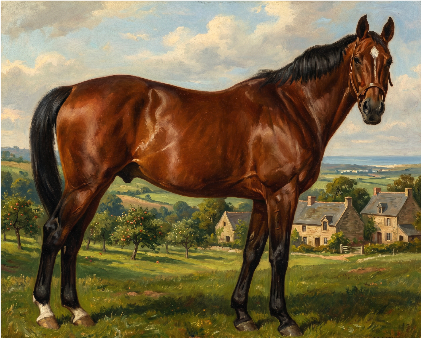
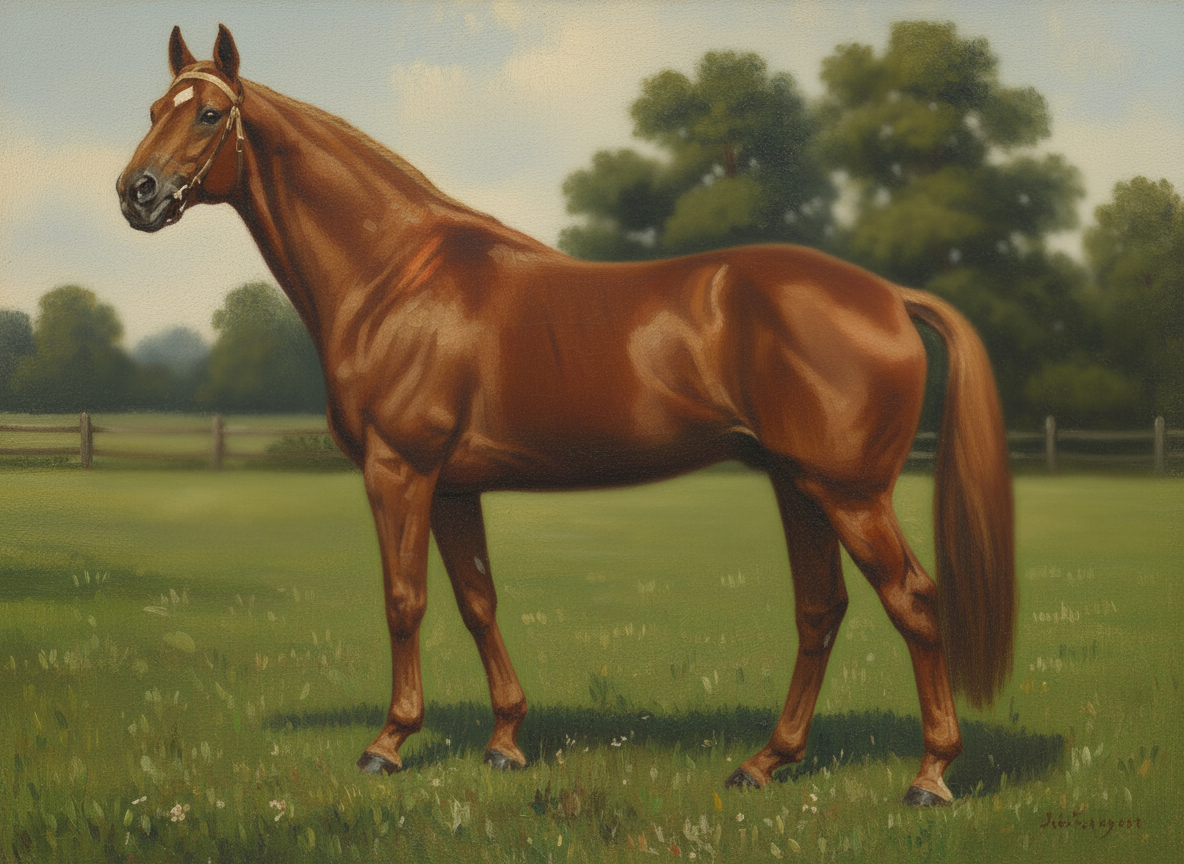
Cor de la Bryère – almost castrated in France, changed the world in Holstein
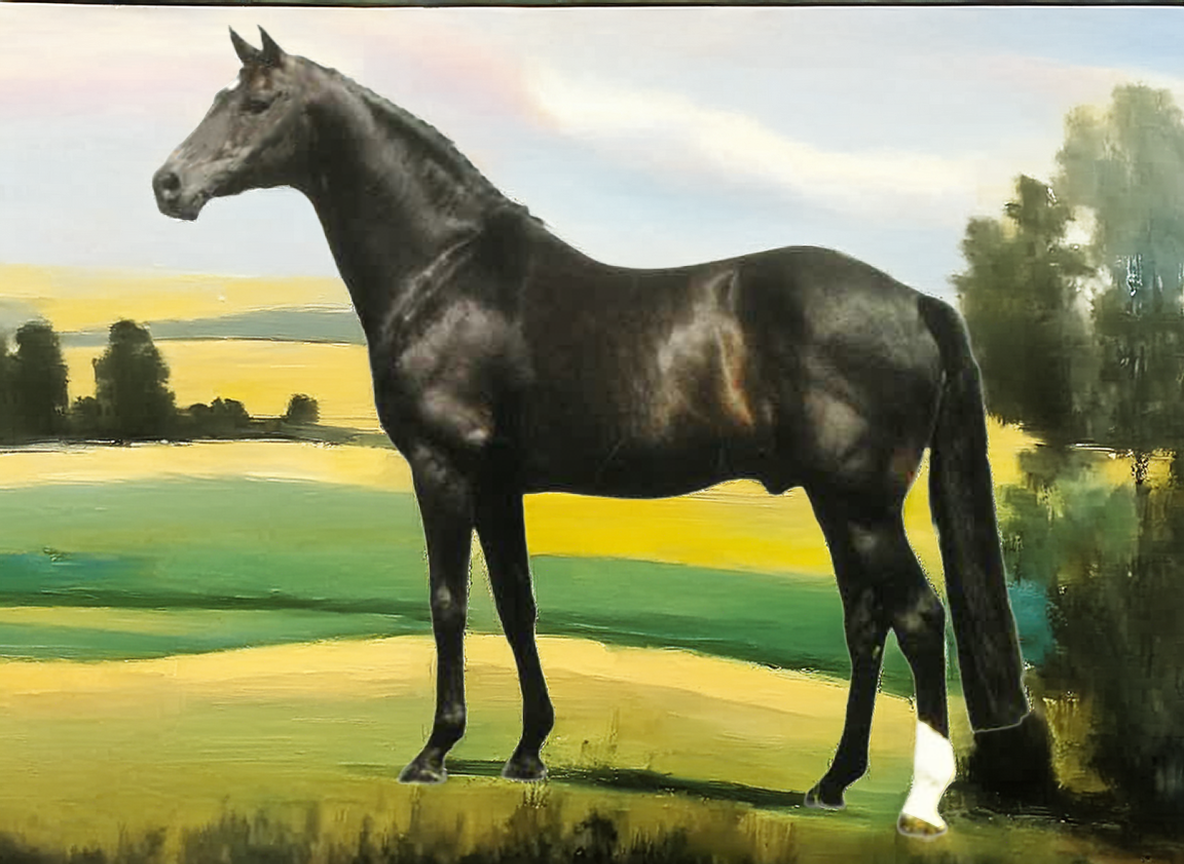
Cor de la Bryère (1968-2000), the legend of breeding in Holstein.
- Name: Cor de la Bryère
- Geschlecht: Männlich
- Jahrgang: 1968
- Rasse: Selle Français
- Vater: Ranzau xx
- Muttervater: Lurioso
- Züchter: Therèse Essayan, FRA Yvre le Polin
It seems that a great stallion’s career always begins with a near-disaster. And like the fairy godmother in a fairy tale, the right person with the right instinct comes around the corner at the right moment. It is unbelievable what would have happened if Cor de la Bryère had been gelded in his native France. Instead, he changed the world from Holstein.
Thoroughbred as the source of success
Cor de la Bryère was born in 1968 far away from Holstein, his dam Quenotte had the Furioso xx son Lurioso as his sire. Furioso xx, who had a strong influence on different breeding areas via Furioso II and his full brother Mexico (great-grandfather of Ferro), was on everyone’s lips as the sire of the 1964 Olympic champion, Lutteur B, and the 1968 world champion, Pomone B. Both horses were ridden by Pierre Jonquères d’Oriola (FRA).
There are legends surrounding Cor de la Bryère’s sire, the thoroughbred Rantzau xx. The chestnut, one of the best racehorses of his time, and literally a picture of a horse if you look at photos until old age, was purchased for the French national studs. From 1951, he stood at the Saint-Lô stud in Normandy. It was long said that the stallion never covered more than three mares per season, partly because his offspring were considered difficult. In fact, the thoroughbred’s children were somewhat more sensitive than other horses, but never really difficult. And records kept by the stud administration show that there were years in which Rantzau xx covered more than 40 mares, which was actually the limit per year at the time. Rantzau xx goes back to Dark Ronald xx via Son in Law xx.
Show jumpers appreciated the qualities of the thoroughbred’s children. They were soon competing in international competitions and, even after his death in 1971, their sire held top positions in the sire statistics of the French warmblood breeding association, Selle Français.
How Cor de la Bryère was almost castrated
Xavier Ribard was the first private stallion owner in France. He discovered the bay weanling Cor de la Bryère at breeder Therèse Essayan and bought him on the spot. But after he had raised him, he soon became disillusioned: the licensing committee of the Haras du Pin, as French horse journalist Pascal Renauldon wrote in an article for Z magazine in 1998, found the young stallion to be “too sporty”. The recommendation: castrate him, “he will certainly become a useful gelding”.
Alwin Schockemöhle, one of the world’s leading show jumpers at the time and a fan of Furioso xx, gave the Holsteiners the idea of looking for genes for their show jumper breeding in Normandy in the early 1970s. Come, see, buy – the delegation, which included Maas J. Hell, then managing director of the Holsteiner Verband, saw Cor de la Bryère and purchased him. It is said that the stallion, who was to become a supersire and legend in Holstein, cost the equivalent of around 9,200 euros.
Initial skepticism instead of enthusiasm
Cor de la Bryère? People in Holstein were skeptical: a stallion that the French, already one of the world’s leading jumper breeds at the time, had rejected was supposed to be good enough for Holstein? To counteract the reservations, Cor de la Bryère took a small detour. Maas J. Hell offered to keep the stallion on his own account until he had passed the stallion performance test. In Siethwende, a stallion station with a long tradition in the Elbmarschen near Elmshorn, the headquarters of the Holsteiner Verband, “Corde”, as he was quickly naturalized, covered 70 mares in his first “year of probation”.
Under saddle, Cor de la Bryère convinced all skeptics and his first offspring showed exactly what had been hoped for: jumping talent and a significantly improved technique. The Holstein mares already had sufficient power and ability back then. The image of the free-jumping Cor de la Bryère with an extremely angled front leg became a symbol of the modern Holsteiner of the 1970s and 1980s.
It soon became apparent that Cor de la Bryère and a number of mares had achieved what is known in horse breeding as a “Passer mating”. The result was not one-hit wonders, but entire dynasties. Even if usually only one of several licensed full brothers was ultimately able to assert himself in breeding over generations, dynasties such as the “Calettos”, the “Calypsos”, the “Calandos” and other line founders have had a significant influence on sport horse breeding. And they have been doing so for more than 50 years.
The most important branches of the Cor de la Bryère lineage
It would go beyond the scope of this article to present the most important sires in detail. For this reason, the major stallion lines that can be traced back to the Frenchman are presented in individual portraits.
- Calypso, the first dynasty – Olympic champion Chipmunk and so much more
- Caletto I and II – without them no Chacco-Blue, no Ermitage Kalone, no Classic Touch, no United Touch
- Corrado – the white giant and grandfather of Cornet Obolensky
- Casall, Holstein’s pride and joy in the 2020s
The first years of Cor de la Bryère were characterized by show jumpers and offspring who excelled in eventing. Herbert Blöcker began his international career in the bush with Contrast, born in 1973. Cordeka, sister of the Caletto brothers – the name gives it away, all out of Deka by Consul-Matador – also competed internationally in the most difficult tests under Blöcker.
In show jumping, the offspring flooded the show grounds, both nationally and internationally. Soon the direct descendants of the Frenchman would be competing in show jumping competitions against grandsons and first great-grandsons “made by Cor de la Bryère”. Even though the majority of Cor de la Bryère’s offspring carried the Holsteiner brand, there were always stallions from other breeding areas who carried on his genes accordingly. One example is the colorful chestnut stallion Cordalmé, who worked in Oldenburg, was placed in Aachen under Gilbert Böckmann and sired many world-class horses.
Goldika, bred from a Lagos dam, was already highly successful under Toni Haßmann and then moved to the US-American McLain Ward. She is one of the most successful horses Cor de la Bryère has sired.
Dressage legend: Corlandus
Despite all the superiority in the jumping sector, one horse must not be forgotten at this point: Corlandus, a direct Cor de la Bryère son out of a Landgraf dam. He was the most successful dressage horse produced by “Corde”. His quality of movement set new standards. The enthusiasm he aroused under the saddle of the petite Margit Otto-Crepin (FRA) can almost be compared to the Totilas craze of the 2010s. The pair won the silver medal at the 1988 Olympic Games in Seoul and the World Cup Final in 1989.
C sometimes becomes A
Not only horses with the initial letter C carry the genetics of Cor de Bryère. The KWPN stallion Arezzo was born in 2005. That was an A year in the Netherlands. All horses born in the tulip country in this year begin with A, according to the naming regulations of the Dutch warmblood breeding association KWPN. Arezzo, himself internationally successful, has Chin Chin as his sire. The two-time Olympic participant, who came sixth in the individual classification in Seoul in 1988 under the Mexican Jaime Azcarraga, also has Constant as his sire, who came from the first crop of Cor de la Bryère. Arezzo also produced the 2024 Bundeschampion Birkhof’s Arezzo Man.
The late years
In 1985, Cor de la Bryère was to have a stimulating effect at Zangersheide Stud in Belgium. From 1986 to 1988 he then stood at the Holsteiner Verband headquarters in Elmshorn.
In 1989, he moved to North Friesland for the last eleven years of his life. Cor de la Bryère spent his last years on the Sollwittfeld ward. Sons, grandchildren and great-grandchildren from all over Europe came to Elmshorn to congratulate the legend on his big birthday celebration, “30 years of Cor de la Bryère”.
“Corde” died of heart failure in Sollwittfeld on April 27, 2000, at the biblical age of 32. The unique aura from which the Holstein delegation in Normandy in 1971 had been unable to escape surrounded him until the very last moment.