Interview with Raphael Netz in Neumünster
“The only thing that has no place in the saddle are emotions – except joy”
 from Dominique Wehrmann
 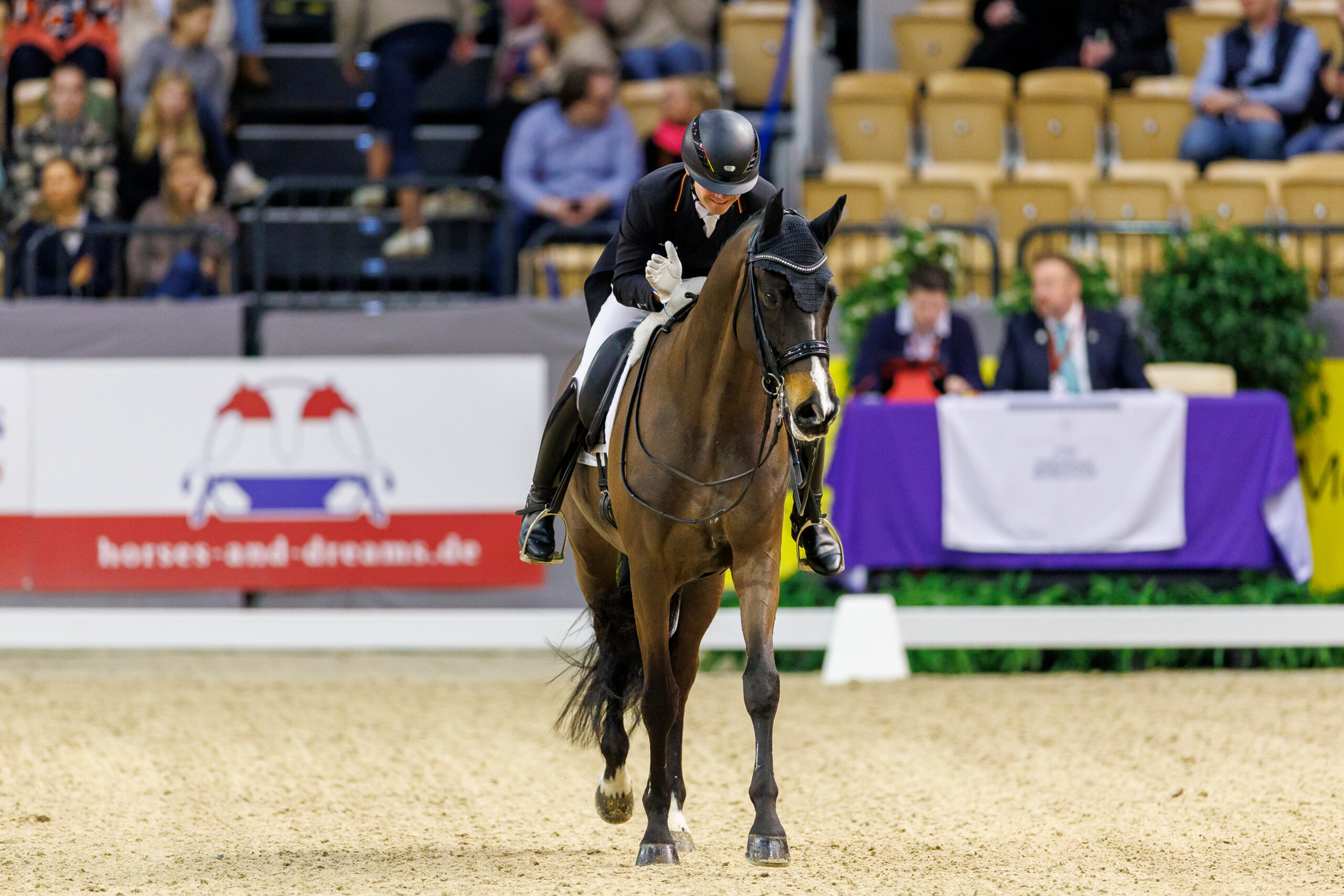 Raphael Netz and Great Escape Camelot in Neumünster. Photo: Sportfotos-lafrentz.de
 We’re here at the third-to-last World Cup stage in Neumünster and you’ve arrived as the leader of the rankings. Will you be competing in Texas?
Definitely! I don’t think I can be ridden out of the final. I’m definitely not going to stay at one, but we’re in for sure and with two horses – which of course makes me very, very proud. This was the first season with two horses and to ride over 80 percent with both horses and actually lead the World Cup list for almost the whole season is – I think – a statement and something I didn’t expect at all at the beginning of the season. But the fact that it turned out like this was a really cool feeling. Every stage where you were and where you weren’t, you looked afterwards and asked yourself, “Where are we? Where are we?” and then of course you were happy, “Ah, still at one!” That’s a really cool feeling, I have to say!
And which horse are you taking to the final?
I’ll leave that open for a bit longer. We’re now in Neumünster with Camelot because it fits in well with the rhythm. The last time he was in Stuttgart was four months ago and Camelot still prefers to be at the show rather than at home, so I didn’t want to deprive him of that. My next stage will be in ‘s-Hertogenbosch, where I will compete with Dieudonné and then I will decide together with Monica Theodorescu.
When you say Camelot prefers to be at the tournament, what do you base that on?
Camelot is a gift because this horse has everything you could wish for in terms of character. He always gives his best, he wants to perform and he is incredibly clever. You can see this, for example, when the truck is driven up and stands in the courtyard two or three days before departure for the show – Camelot can’t take his eyes off the truck. Or this too: He is clipped again about a week before the tournament. As soon as he’s clipped, he knows it’s time for the test and he’s off to the show. His whole behavior is different then. He is even more motivated. He is even more precise on his own initiative. He really thinks for himself, which is absolutely fascinating. And he loves being at the show. He is simply happy there. He enjoys the attention he gets from Nathalie, his groom, and me. Apart from standing in the paddock, there is nothing better for him than when the bell rings and we are allowed to ride in. When he hears the bell – I can’t get to X fast enough. He’s really like, “Let’s go!” That really is a great quality.
And how would you characterize Dieudonné?
Very different! Dieu is still a little wallflower. He’s slowly growing into his role. Sometimes he has moments when he doesn’t even realize how great he is because he’s a bit shy. He doesn’t have that much Grand Prix experience yet. He rode his first national Grand Prix exactly one and a half years ago. And now entering the World Cup at the end of his first season was quick for him. It worked well, but he still lacks experience and routine. At the same time, he has every opportunity. I think Dieu is a very special horse because he has three fantastic gaits and now also knows how to use his body in key situations such as pirouettes and piaffe. Of course, just as we have strengths, we also have weaknesses, but with him you just have to get there a bit more at the show.
How old was Dieu when he came to you?
He was eight years old, but not yet trained accordingly. It was difficult to ride a flying change and riding through the poll was difficult. We started from scratch, so very late, and you can still see some of that today. By the time he came to me, he had ridden maybe two novice dressage horses and one elementary dressage horse. He was off twice. Horses that grow up with competitions are naturally more experienced than a horse that only starts at the age of eight.
And when you look beyond the World Cup to the season, what are your plans?
Of course you have to say world championships in your own country – I don’t think any German Grand Prix rider doesn’t think about that. However, my mindset is always quite good if I really only think about the next step and, above all, the moment I’m in. I just take care of my horses, the management, that they’re doing well and the next ride that’s coming up. Then this ride counts and I’m not really thinking any further ahead. But the sighting route to Texas is on the agenda. We’ll do that and then we’ll see how it goes.
The mindset decides
How do you deal with pressure?
Pressure doesn’t actually exist. Pressure is something personal. Pressure is what you create for yourself through thoughts, through a certain expectation of yourself – or an expectation of a third party that you feel or think you feel. In the end, it’s a mental game. If I’m able to not let this pressure exist – even if it’s just the 30 minutes in the warm-up arena and in the test, then I can also ride with focus. But if I let my head win, give in to the pressure and get nervous and scared, then I also ride badly. Of course, that’s easier said than done. But I already learned that in the U25 Tour. Winning individual medals with three different horses also shapes you, of course. It’s not as if we only rode normal tournaments before and then all of a sudden we started competing in the World Cup. That built on each other.
What was the most important learning in your career?
For example, when Camelot wasn’t fit last year, that was drastic. That taught me a lot about management and training – that it needs to be even more defined, even more detailed, but even shorter and more concise.
In general, as I mentioned, I think it’s the mental aspect, dealing with pressure. Whenever I knew that I was now on a horse that I would soon be riding in a European Championship or a World Cup, the pressure started – when you know that you are now working towards a championship or a World Cup. It was important to learn not to let yourself be guided by that, but to be in control of your thoughts and emotions.
But that is generally important when riding. Regardless of the horse, whether three or 13 years old, whether L or Grand Prix, the only thing that has no place in the saddle is emotions – except joy. You can’t be emotional in the saddle, not in any way, unless you’re happy when something has worked out. You have to remain completely stubborn, even if things don’t work out and you think: “Why isn’t the young horse jumping the change now?” If you ask yourself this question, you’ve already lost. Instead, you have to take a short step and think, how can I do it? Because if something doesn’t work, as a trainer you haven’t yet found the right approach so that the horse understands you. Period. Then I have to think about which way I have to go so that the horse understands me. What I’m getting at: I have to be able to control myself. Because if you can’t control yourself, how can you control 600 kilograms underneath you? Although, control sounds so hard. How can you enter into an emotion-driven dialog with a living being that doesn’t understand you through words? We enter into a dialog via our seat and our aids. If you are emotional or stressed, the seat becomes blurred, communication suffers and the riding suffers.
The new independence
You’ve been self-employed since May 2024. How has your life, how has your everyday life changed since then?
Vehemently – for the better, I would say. I’m incredibly happy being self-employed, I love it. We are a relatively small team, but at the same time a large team for few horses. We are five people for 16 horses, which is of course a very high headcount. But that’s the USP of our stable: that we really want to treat every horse as if it were number one and not just Camelot or Dieu, and we want to keep them as close to their natural state as possible.
To come back to the question about everyday life – good question. It was a lot of work before, it’s a lot of work now (laughs). The office work has been added because I do everything myself and because it was also important for me to have an overview. We are a limited company and it was important to me that I had everything under control. The fact that I sit in the office a lot is new and also here – I have my things with me and sit in the truck and work. Apart from that, everyday life in the stables hasn’t changed. I have a very good and very experienced team at my side, who I already worked with in Aubenhausen. They came with me back then and that was really nice! Of course, I can trust them blindly.
“Keeping it as close to natural as possible” – what does that mean in concrete terms?
That is of course a sentence that can be interpreted in many ways. For us, it means a lot of exercise, exercise, good feeding and individual management. You need the manpower to get the horses out four times a day.
But there is no other rider apart from you and Selina?
No, we ride the 16 horses in pairs. I usually ride twelve and Selina four. And Selina looks after our customers. We have more horses to ride than people who get lessons. But that’s part of it. We want to pass on our knowledge, not only to the horses, but also to the riders. I like doing it too, but I prefer to be in the saddle and I think you have to prioritize that. But as I said, I also want to pass on my knowledge and that’s why I also give courses – very few, five a year for four years. This has proved to be a good way of spreading what I have learned, what I can do and how I handle and want to handle my horses, so that this philosophy is at best taken up by many others.
Horses of the future
Which are the horses that come after Camelot and Dieu?
I’m in the process of building up what I call a “pipeline” of horses. At the moment I have a very, very good eight-year-old called Glamourdoc. I came fourth with him in the final of the Bundeschampionat last year. I think he’s a very exciting horse. He already does a very nice piaffe passage and jumps six or seven single changes. I will continue to train him in peace and quiet. Then I have two very good six-year-olds of my own. We have just bought a very, very good five-year-old young horse together with sponsors. And then some other even younger ones. It’s building up. But I think Glamourdoc is the next one.
That’s a Glamourdale, isn’t it?
Yes, Glamourdale times Millennium.
Is there a pedigree that you prefer? Or one that you don’t go for at all?
You can’t ride on paper. It’s the horse. Of course, when you get new horses, you can already tell what kind of horse they are before you even know it. I’ve ridden I don’t know how many hundreds of horses now, simply because I was employed by the Werndl family and before that I rode eight or nine horses a day. That builds up quite a bit. And once you’ve ridden four or five horses by a stallion and then another one comes along, you realize that.
If you want to sit in the saddle like Netz …
Jonny Hilberath once said “Raphi in the saddle is like a command center” because you have such a good seat from which you give such precise aids. Do you have any tips for re-riding?
(The question has not yet been asked to the end when it comes out of the gun) Riding without stirrups!!! I ride one horse a day without stirrups. I’ve let it slide a bit recently because I got injured. I had a torn muscle fiber – caused by riding without stirrups, by the way. The horse bucked and I closed my knees to avoid falling off. I didn’t, but it did crack once. Luckily it wasn’t that bad, I didn’t have to take a break from riding. It was just a bit painful for a week. But I still say: riding without stirrups is the best thing you can do!
About Raphael Netz
Raphael Netz has been self-employed for almost two years. Together with his partner, Selina Söder, who was also successful in the U25 tour, he has set up his own business on the Weiglschwaig estate in Moosburg an der Isar.
Even as a small child, Raphael Netz was crazy about horses. When he was nine, his non-horsey parents relented – Netz got his own horse, a Haflinger called Aki. The catch was that Aki was only three years old and had not yet been broken in. But that wasn’t a problem for the two of them. They grew up together. When Netz was 13 and Aki was seven, they competed together in their first Prix St. Georges. Netz had a trainer who was able to help him up to elementary class. He learned the rest by watching the Whitsun tournament in his home town of Wiesbaden and watching videos. An unconventional career in other words.
When Netz was 17 years old, Jessica von Bredow-Werndl saw a video of the teenager on social media and asked him if he could imagine becoming a rider at Aubenhausen. Netz was able to, and he worked there for a good eight years. It was here that he learned a lot of the skills he needed to train horses up to Grand Prix level. During this time, he collected U25 European Championship medals with three different horses and became European Champion with two of them: Lacoste, Elastico and most recently Ferdinand BB, who he was allowed to present for a season as a pregnancy replacement for Jessica von Bredow-Werndl. Netz has six European Championship gold medals to his name.
Texas will now be his second World Cup appearance after Riyadh 2024, where he finished fifth in the final with Camelot.